COMPLIANCE GUIDE
| Key Takeaways |
| GDPR applies to any employer processing an EU-based employee's personal data, no matter where the company itself is headquartered. Being an APAC company creates no exemption. |
| The most common compliance gap for a first EU hire isn't a headline fine. It's not having a valid legal mechanism to move that employee's data back to APAC headquarters at all. |
| After December 27, 2022, organizations could no longer rely on the previous SCCs for lawful transfers. Adopting the 2021 SCCs is mandatory to comply with GDPR for transferring personal data to countries outside the EEA. |
| Fines can reach EUR 20 million or 4% of global annual turnover, whichever is higher, and Germany layers its own stricter DPO and works-council rules on top of the GDPR baseline, so "GDPR compliant" isn't one uniform bar across the EU. |
| Hiring through an EU-based Employer of Record shifts direct in-country employer obligations onto the EOR's own EU entity, which meaningfully reduces your company's compliance burden. |
GDPR can apply to a non-EU company the moment it processes the personal data of an EU-based employee. Under Article 3(1), GDPR applies where processing is carried out in the context of the activities of an "establishment" in the EU, regardless of where the processing itself takes place. An establishment doesn't require a registered local office: EDPB guidance and CJEU case law treat it as any real, effective activity carried out through stable arrangements, which a single employee working from Germany or Estonia can satisfy.
Moving that employee's data back to APAC headquarters requires its own legal transfer mechanism, typically Standard Contractual Clauses (SCCs), unless the destination country holds an EU adequacy decision or another Article 46 safeguard applies. Getting either the processing or the transfer piece wrong can carry fines of up to EUR 20 million or 4% of global annual turnover, whichever is higher.
If you're an Ops, Finance, or HR lead about to make your first EU hire, GDPR is probably the single most unfamiliar item on your compliance checklist, more so than termination-notice periods or works-council norms, because it applies immediately and the fine numbers are hard to ignore. This guide walks through what GDPR actually requires of you as an employer, where the real first-day risk hides, and how the mechanics of hiring across the APAC-to-EU corridor actually work.
Does GDPR Actually Apply to Us? Yes, and Here's Why

It's a common assumption that GDPR is a problem for EU-headquartered companies, or for anyone selling into the EU consumer market. Neither is quite right for an employer.
Under GDPR's territorial scope (Article 3), the regulation applies to the processing of personal data of individuals located in the EU, in the context of an establishment's activities, including an employment relationship with an EU-based worker. Once you employ someone who lives and works in Germany, Estonia, or anywhere else in the EU, you're processing their personal data as their employer: bank details for payroll, tax ID, address, performance records. GDPR governs all of it, whether your company has an EU legal entity or not.
The myth to retire: "we're not an EU company" doesn't create an exemption. What matters is where your employee is, not where your headquarters sits. That reframes GDPR from a someday-problem into a from-day-one problem. Your obligations as an employer start the moment you sign the offer letter, not after your first audit or dispute.
Separately, Article 3(2) can bring a non-EU company with no EU establishment into scope if it offers goods or services to, or monitors the behavior of, people in the EU, though that's generally a different test from ordinary HR data processing. Because this is a fact-specific assessment rather than an automatic trigger, it's worth confirming with EU privacy counsel for the specific hiring arrangement.
What GDPR Actually Requires of You as an Employer
Once GDPR applies, three obligations do the most work in an employment context:
A lawful basis for processing. You need a legal justification under Article 6 for every category of data you collect, and the right basis depends on the purpose. Paying the employee is usually grounded in contractual necessity (Article 6(1)(b)); withholding and reporting taxes or social security is usually grounded in a legal obligation instead (Article 6(1)(c)); and emergency contact details are better justified by legitimate interests (Article 6(1)(f)), or vital interests in a genuine emergency (Article 6(1)(d)), since collecting them isn't required to perform the employment contract itself.
Health information tied to sick leave is a special category of data under Article 9, so it needs an Article 6 basis and a separate Article 9(2) condition, commonly Article 9(2)(b), plus whatever safeguards Member State law adds. Where this kind of processing is likely to pose a high risk to employees, such as large-scale processing of health data, a DPIA under Article 35 is also required beforehand.
Data minimization. Collect only what your payroll and HR functions genuinely need. A common misstep is defaulting to a domestic APAC intake form and asking an EU hire for information, like extensive family details or informal background information, that a German or Estonian employer wouldn't typically request.
Employee rights. EU employees have the right to access the personal data you hold on them, correct inaccuracies, and in some cases request erasure. Erasure has real limits in an employment context. Statutory retention rules for payroll and tax records mean you can't simply delete everything on request, but you do need a process for handling these requests.
None of this is exotic. It's closer to what a careful HR function would do anyway. The part that trips up first-time APAC-to-EU employers isn't processing the data lawfully in the EU, it's what happens next, when that data needs to travel.
The Part Everyone Misses: Moving the Data Back to APAC

Processing being lawful and transferring being lawful are two separate questions. You can have a perfectly valid lawful basis under Article 6 to process your EU employee's payroll data, and still be in breach of GDPR the moment you move that data to your APAC headquarters without a valid transfer mechanism in place. One doesn't cover the other.
Whether you need a transfer mechanism at all depends on where your APAC entity is located. The European Commission maintains a list of countries it has formally recognized as providing an adequate level of data protection, an "adequacy decision." If your APAC headquarters is in a country with an adequacy decision, personal data can flow there under largely the same conditions as within the EU. If it isn't, you need a separate legal tool under Article 46 to make the transfer lawful.
| APAC Country/Territory |
EU Adequacy Status |
Transfer Mechanism Needed |
| Japan |
Full adequacy decision |
None. Data can flow under the adequacy framework |
| South Korea |
Full adequacy decision |
None. Data can flow under the adequacy framework |
| Taiwan |
No adequacy decision |
Standard Contractual Clauses or another Article 46 mechanism |
| Singapore |
No adequacy decision |
Standard Contractual Clauses or another Article 46 mechanism |
| China |
No adequacy decision |
Standard Contractual Clauses or another Article 46 mechanism |
| Most other APAC jurisdictions |
No adequacy decision |
Standard Contractual Clauses or another Article 46 mechanism |
Adequacy status reflects the European Commission's list as of this article's publication date. The Commission periodically reviews and can add to or withdraw from this list, so we'd recommend confirming current status before relying on it for a specific transfer.

For the majority of APAC headquarters like Taiwan, Singapore, China, and most others in the region, that means Standard Contractual Clauses, or SCCs: a set of European Commission-approved contract terms that bind both parties to EU-equivalent data protection standards.
One landmine worth flagging directly: only the 2021 version of the SCCs (European Commission Implementing Decision 2021/914) is currently valid. The older 2001, 2004, and 2010-era clause sets were invalidated as of December 27, 2022, and any contract or guidance still referencing them is out of date.
This is the compliance gap we'd point to first, ahead of the headline fine figures: a company can be entirely diligent about how it processes an EU employee's data day-to-day and still have no valid mechanism in place to send that data home for payroll or HR purposes. It's a gap that exists from day one of employment, not a hypothetical future violation.
Employee Monitoring: Where APAC and EU Norms Diverge Hardest
Time-tracking and productivity-monitoring tools that raise no eyebrows in many APAC workplaces can create real exposure once applied to an EU employee. GDPR treats systematic monitoring of employee behavior as a category of processing that requires particular care: a stricter lawful basis, clear transparency with the employee, and often a data protection impact assessment before you switch it on.
The clearest illustration of what happens when this goes wrong is the Hamburg Commissioner for Data Protection and Freedom of Information's 2020 enforcement action against H&M's Nuremberg service center. Managers there had been informally collecting and storing detailed personal information about employees, including health conditions, family circumstances, and religious beliefs, gathered through casual "welcome back" conversations after leave and floor-level chats, in a way that was accessible to as many as 50 managers across the company. The resulting fine was about EUR 35.3 million, one of the largest GDPR fines issued against an employer to date, specifically for employment-context data handling rather than a consumer-data breach.
Germany adds a second layer that has nothing to do with GDPR directly: under the
Works Constitution Act (Betriebsverfassungsgesetz), Section 87(1) No. 6, a works council (Betriebsrat), where one exists, has a co-determination right over introducing or using any technical device designed to monitor employee behavior or performance. If your EU hire's workplace has a works council, you may need its sign-off before rolling out the same monitoring or productivity software you use across your APAC team, a separate approval step that GDPR compliance alone doesn't satisfy.
Do We Need a Data Protection Officer?

The short answer is: it depends on which rulebook you're checking against, because GDPR sets one bar and Germany sets a stricter one.
Under GDPR itself (Article 37), a Data Protection Officer is mandatory only for public authorities, or for organizations whose core activities involve large-scale, regular, and systematic monitoring of individuals, or large-scale processing of special category data. It's an activity-based test; headcount alone doesn't trigger it.
Under the Federal Data Protection Act (BDSG), Section 38, a DPO is mandatory once a company constantly employs at least 20 people who are, as a rule, regularly engaged in the automated processing of personal data. That 20-person count isn't the company's total headcount; it is limited to staff whose work involves this kind of processing, and the same provision imposes a DPO requirement regardless of headcount if the company carries out processing subject to a data protection impact assessment under GDPR Article 35, or commercially processes personal data for transfer, anonymized transfer, or market or opinion research purposes. That's a headcount-based trigger layered on top of GDPR's activity-based one, and it's a good illustration of a broader point: "GDPR compliant" isn't a single uniform bar across every EU country. France and other member states have their own additional national wrinkles.
| Requirement |
GDPR Baseline |
Germany's Stricter/Additional Rule |
| DPO appointment trigger |
Activity-based: large-scale systematic monitoring or large-scale special-category processing (Article 37) |
Headcount-based: at least 20 people regularly engaged in automated personal data processing (BDSG Section 38) |
| Monitoring software rollout |
Requires a lawful basis and, often, a data protection impact assessment |
Also requires works council co-determination sign-off where a works council exists (Works Constitution Act, Section 87(1) No. 6) |
| International data transfer |
SCCs or another Article 46 mechanism required absent an adequacy decision |
Same GDPR-level requirement, no separate German transfer rule, but German authorities actively enforce it |
For a company making a single first hire in Germany, this table is the practical question to answer early: even if you're nowhere near GDPR's activity-based DPO trigger, a small headcount in Germany specifically can cross the national threshold faster than you'd expect once your team there grows.
What Getting It Wrong Actually Costs
GDPR fines are tiered by the type of infringement, and the international-transfer failures we've been describing sit in the higher tier, which is the same tier as violating the core data-processing principles themselves.
| Infringement Tier |
Maximum Fine |
Example |
| Lower tier (Article 83(4)) |
Up to EUR 10 million or 2% of total worldwide annual turnover, whichever is higher |
Failures in record-keeping, data protection by design, or processor obligations |
| Higher tier (Article 83(5)–(6)) |
Up to EUR 20 million or 4% of total worldwide annual turnover, whichever is higher |
Violating core processing principles, employee data rights, or unlawful international transfers (Articles 44–49). H&M Nuremberg case: EUR 35,258,708 (2020), issued by the Hamburg Commissioner for Data Protection and Freedom of Information for unlawful employee-data collection and storage |
The H&M case is a useful anchor precisely because it's employment-specific rather than an abstract e-commerce or marketing example: it shows a real regulator applying real fines to how a company handled its own staff's personal data, not a customer database. It's also a reminder that these figures aren't ceilings that only apply to giant multinationals. The "4% of global turnover" alternative means the exposure scales with your company's overall size, not just the size of your EU operation.
The Simpler Path: Hiring Through an EU-Based EOR

Everything above is manageable, but it's also a genuine amount of new compliance surface for a company making its first EU hire. You need a lawful basis to document, a transfer mechanism to put in place, a DPO threshold to track, and possibly a works council to coordinate with, all before your new employee's first payroll run.
This is where using an Employer of Record with its own EU legal entities changes the picture. We operate our own entities in Germany, France, Estonia, and the UK, which means that for a client hiring through our EOR, it's our EU entity, not your APAC company, that carries the direct, in-country employer-side GDPR obligations: issuing the compliant contract, running compliant payroll, and holding the primary data controller responsibilities tied to local employment records.
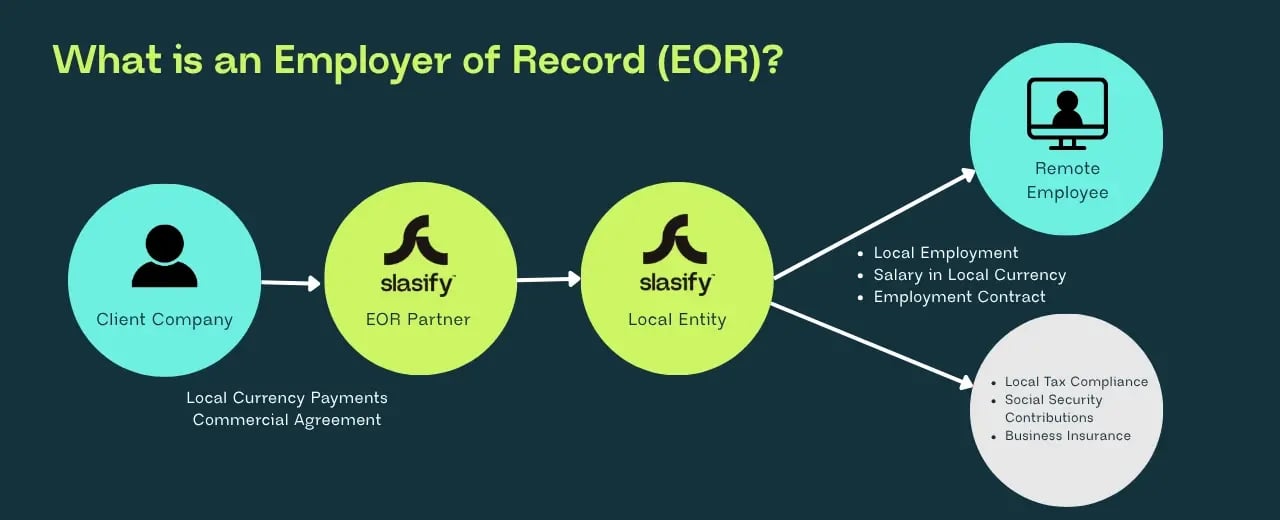
We'd rather be precise here than oversell it: this is a genuine structural simplification, not a claim that it removes your GDPR obligations entirely. Depending on what data you continue to hold directly, for example, when running performance reviews from APAC, your company may still be a joint controller for those specific purposes. What changes is that the heaviest, most technical layer of in-country compliance, the contract, the payroll data handling, the local statutory obligations, sits with an entity that already has the EU infrastructure and legal presence to carry it, rather than with a company doing this for the first time.
Frequently Asked Questions
Q1. Does GDPR apply to my company if we're not based in the EU?
Yes. GDPR applies based on where the employee is located, not where your company is headquartered. If you employ someone who lives and works in an EU country, you're processing their personal data as their employer, and GDPR governs that processing from day one, regardless of whether your company has any EU legal presence.
Q2. Can we send our EU employee's payroll data back to our headquarters in Asia?
Only with a valid transfer mechanism in place. If your APAC headquarters is in Japan or South Korea, an EU adequacy decision covers the transfer. Otherwise, for Taiwan, Singapore, and China, you need Standard Contractual Clauses (the 2021 version) or another Article 46 transfer tool before the data can legally move.
Q3. What is a Standard Contractual Clause, and do we need one?
A Standard Contractual Clause (SCC) is a European Commission-approved contract that binds both parties to EU-equivalent data protection standards for an international transfer. You need one if you're sending an EU employee's personal data to an APAC country without an EU adequacy decision, which covers most of the region.
Q4. Which Asian countries have an EU adequacy decision?
Currently, only Japan and South Korea hold full EU adequacy decisions in Asia. Taiwan, Singapore, China, and most other APAC jurisdictions do not, meaning data transfers to those countries require Standard Contractual Clauses or another Article 46 mechanism. Adequacy status is reviewed periodically, so it's worth confirming before relying on it.
Q5. Do we need to appoint a Data Protection Officer to hire one person in Germany?
Not automatically for one hire, since GDPR's own DPO trigger is activity-based rather than headcount-based. But Germany's national law requires a DPO once a company constantly employs at least 20 people regularly engaged in automated personal data processing, a threshold worth tracking as your German headcount grows, since it's stricter than the GDPR baseline.
Q6. What happens if we don't comply with GDPR as an employer?
Penalties scale by violation type: up to EUR 10 million or 2% of global turnover for the lower tier, and up to EUR 20 million or 4% of global turnover, whichever is higher, for the worst violations, including unlawful transfers. The roughly EUR 35.3 million fine against H&M in Germany shows regulators apply these to employment data specifically.
Q7. Does using an Employer of Record solve our GDPR compliance obligations?
It substantially reduces them but doesn't remove them entirely. An EU-based EOR's own entity carries the direct in-country employer obligations for the employment relationship, a real structural simplification. Your company may still be a joint controller for data it continues to hold directly, so an EOR removes the heaviest layer of compliance work, not every obligation.
Ready to Make Your First EU Hire With Confidence?
GDPR compliance for a first EU hire is a program, not a checkbox you tick once. It touches your lawful basis, your data transfer mechanism, your monitoring tools, and possibly your DPO threshold, and it starts from day one of employment. Depending on the data your company continues to hold and the purposes for which it uses that data, for example, conducting performance reviews from APAC, it may remain a separate or joint controller for specific processing activities.
Don't Build This From Scratch for One Hire
Talk to our team about what hiring your first EU employee compliantly actually looks like.
Talk to Our Team