US PAYER TAX GUIDE
Last updated: November 2026
This article is general guidance, not tax or legal advice. US tax rules and how the IRS applies them can change, so confirm details with the IRS or a qualified US tax professional before you act.
| Key Takeaways |
| — Establish the recipient's US tax status before you choose a form. An overseas address alone does not determine that status. |
| — Documented foreign contractors generally don't get a 1099. US citizens working abroad may. |
| — Record where the work was physically performed, including any days in the US. |
| — W-9 and W-8 forms document the recipient's tax status. Forms 1099-NEC and 1042-S report payments when required. |
| — Reconcile the contract, tax form, work locations, invoice, and payment details before you approve the payment. |

Your first overseas contractor has sent an invoice, but finance needs to confirm which tax documents belong in the payment file. Do international contractors get a 1099? For a US business considering a 1099 for foreign contractors, the short answer is generally no when valid documentation establishes foreign status. US persons working abroad may still require Form 1099-NEC reporting. Form 1099-NEC is an information return the payer files to report certain payments for services by nonemployees. Other withholding or reporting duties may still apply.
For a US company paying foreign contractors, the starting point is to confirm who receives the payment and where the services were performed. Then assess the documentation, reporting, and withholding requirements for that payment. Collecting these details during onboarding gives HR, operations, and finance a shared record when the invoice from your contractor arrives.
1. 1099 for Foreign Contractors: Start with Tax Status
The Internal Revenue Service (IRS) explains in its guidance on withholding and reporting obligations that foreign persons who provide appropriate foreign-status documentation are generally exempt from Form 1099 reporting. Therefore, not all international contractors receive a 1099. A US person working overseas, however, may still be subject to US information-reporting rules.
So what constitutes an "international contractor"? The term generally describes how your business works with someone across borders. It does not identify an IRS tax category by itself. Before deciding whether your contractor needs a 1099, establish whether the payee is an individual, an entity, or an intermediary receiving money for someone else.
What counts as a US person?
A payee's US tax status helps determine which documentation and reporting rules apply. For individuals, check citizenship and tax residency; for entities, check where they were organized and their tax classification.
| Payee |
US person? |
What to check |
| US citizen |
Yes, even when living and working abroad |
Collect a W-9. A foreign address doesn't change the answer. |
| Noncitizen individual |
US resident aliens, yes; nonresident aliens, no |
Start with the green card test and substantial presence test, then check any applicable exceptions or elections. Refer unclear cases to a tax advisor rather than inferring residency from a passport, visa label, or address. |
| Entity |
Yes for domestic corporations and partnerships, domestic trusts, and estates other than foreign estates; no for foreign entities. For a disregarded entity, generally use the owner's status. |
Confirm where the entity was organized and how it is classified for US tax purposes. For a disregarded single-member LLC, review the owner's status and the applicable form instructions. |
When does a payment need a 1099?
If the payee belongs in your US reporting process, check four things before you decide whether a 1099 applies:
—Payment category: Form 1099-NEC covers reportable nonemployee compensation.
—Annual amount paid to the same payee during the calendar year.
—Recipient and payment exceptions that may apply.
—Payment method, since card and third-party network payments follow different rules.
Start with the IRS page on when an information return is required. For payments made in 2026, the general 1099-NEC reporting threshold is $2,000 per payee; the general threshold for 2025 payments was $600. The threshold may be adjusted for inflation starting in 2027. Record the payment date and calendar year separately from the invoice date so you apply the correct year's rules.
2. Where Does the Contractor Perform the Services?
Your next question is where the work actually happened. For personal service income, the IRS generally determines the source by the place where the services are performed. The payer's location, payment destination, and place where the contract was signed do not generally control that determination. See the IRS guidance on personal service income sourcing for more details.
This matters when your US company pays someone who works entirely abroad or travels to the United States during a project. As part of your invoice review, confirm:
—Which countries the contractor worked in during the service period.
—Which services were performed in the United States, and on which dates.
—How the fee is divided between locations when the work crossed borders.
—Whether the invoice describes the work in enough detail to support that split.
Use the four scenarios below to find the one closest to your situation. They are hypothetical examples of US payer questions, and they don't determine the contractor's tax obligations in Spain, India, Taiwan, or the UK.
| Scenario |
Separate questions to verify |
Your next review step |
| US citizen working from Spain |
Recipient documentation and potential reporting treatment despite an overseas work location |
Review W-9 documentation and the applicable US information-reporting rules |
| Foreign individual performing all services in India |
Foreign-status evidence, service-location records, and applicable reporting treatment |
Confirm foreign-source treatment and retain the evidence supporting the decision |
| Foreign individual based in Taiwan, who also performs project work in the US |
Work-location allocation, documentation, withholding, and reporting review |
Review the US-source portion for possible 30% withholding and Form 1042-S reporting, and assess any applicable exemption with a tax reviewer. |
| UK entity invoicing for services performed overseas |
Entity status, ownership or intermediary issues, and the appropriate documentation route |
Confirm the relevant payee and documentation before applying a reporting treatment |
3. Which Tax Forms Should a US Business Request?
Tax forms for international contractors serve different purposes. Recipient documentation records the payee's tax status. An information return reports a payment under the rules that apply to it. A valid W-8BEN can document a foreign individual's status; it does not settle every reporting question. Whether you must file Form 1099-NEC, Form 1042-S, or neither depends on the payee and the payment.
Use this table to distinguish recipient certifications from payer information returns.
| Document |
What it generally addresses |
Things to check |
| Form W-9 |
A US person's taxpayer identification number (TIN) and applicable certifications |
Confirm the proper recipient and required information. |
| Form W-8BEN |
A foreign individual's status and applicable claims |
Check eligibility, completeness, and whether the income requires another form. |
| Form W-8BEN-E |
A foreign entity's status and applicable claims |
Check entity classification, beneficial ownership, and exceptions. |
| Form 1099-NEC |
Reportable nonemployee compensation |
Assess the payment-year rules, recipient exceptions, and payment method. |
| Form 1042-S |
Certain income paid to foreign persons |
Assess sourcing, the reporting category, and applicable exceptions. |
Use the linked IRS instructions throughout this section to determine applicability. The table can be used as a starting point for your review process, since the right form still depends on the facts of each transaction. Below, we answer the questions that come up most often.
Form W-8BEN vs. Form W-9 for contractors
The choice between Form W-9 and Form W-8BEN depends on the recipient's tax status. Form W-9 is for US persons, including US citizens living abroad, while Form W-8BEN is for foreign individuals certifying their non-US status. If a contractor is unsure which form applies, advise them to consult a qualified tax advisor before signing.
—For a US person: review the W-9 against the payee details in your agreement and accounting record. If a business name differs from the tax name, resolve the difference using the form instructions. Do not change a submitted certification just to make it match the invoice.
—For a foreign individual, a Form W-8BEN may establish foreign status when appropriate. Keep it in the payee's secure documentation file for payment review; do not send it to the IRS.
Note: A TIN alone does not establish US tax status. Likewise, an overseas bank account does not determine whether you request a W-9 or a W-8 form.
When Form W-8BEN is not the appropriate form
Form W-8BEN is not the appropriate form in the following situations. Refer these cases to your tax reviewer:
—A foreign entity or intermediary receives the payment. Depending on its role and classification, Form W-8BEN-E, Form W-8IMY, or another form may be needed.
—A nonresident alien individual is paid for independent personal services performed in the United States. Form W-8BEN is not appropriate for that pay. The IRS points these payees to Form 8233 or Form W-4 instead.
—The income is effectively connected with a US trade or business. Form W-8ECI may apply. It does not apply to a nonresident alien individual's pay for personal services performed in the United States. Use Form 8233 or Form W-4 for that pay.
When can 1042-S reporting or withholding apply?
Withholding means deducting tax from a payment and remitting it as required. For US-source payments to foreign persons, examine the applicable withholding and information-reporting rules together. A payment can require reporting even when no tax is withheld.
The 1042-S instructions explain that some income remains reportable even when a treaty or statutory exemption means no tax is withheld. Where required, Form 1042 addresses the related annual withholding return. Payers should confirm the full set of duties before treating "no 1099" as the final tax decision.
How do payment methods and missing documents affect reporting?
Payments made by credit card or through qualifying third-party network transactions generally fall under Form 1099-K reporting rules rather than Form 1099-NEC. Whether the settlement entity must issue a 1099-K depends on the applicable rules and exceptions. The IRS FAQs for third-party filers explain how to avoid duplicate reporting. Ask finance to confirm the transaction type and who is responsible for reporting it.
Using a payment platform does not automatically resolve your obligations. A bank transfer through a platform may be treated differently from a transaction subject to payment-settlement reporting.
If documentation is missing, have your tax reviewer determine the applicable treatment before payment.
4. Paying Foreign Contractors: What Should You Collect First?
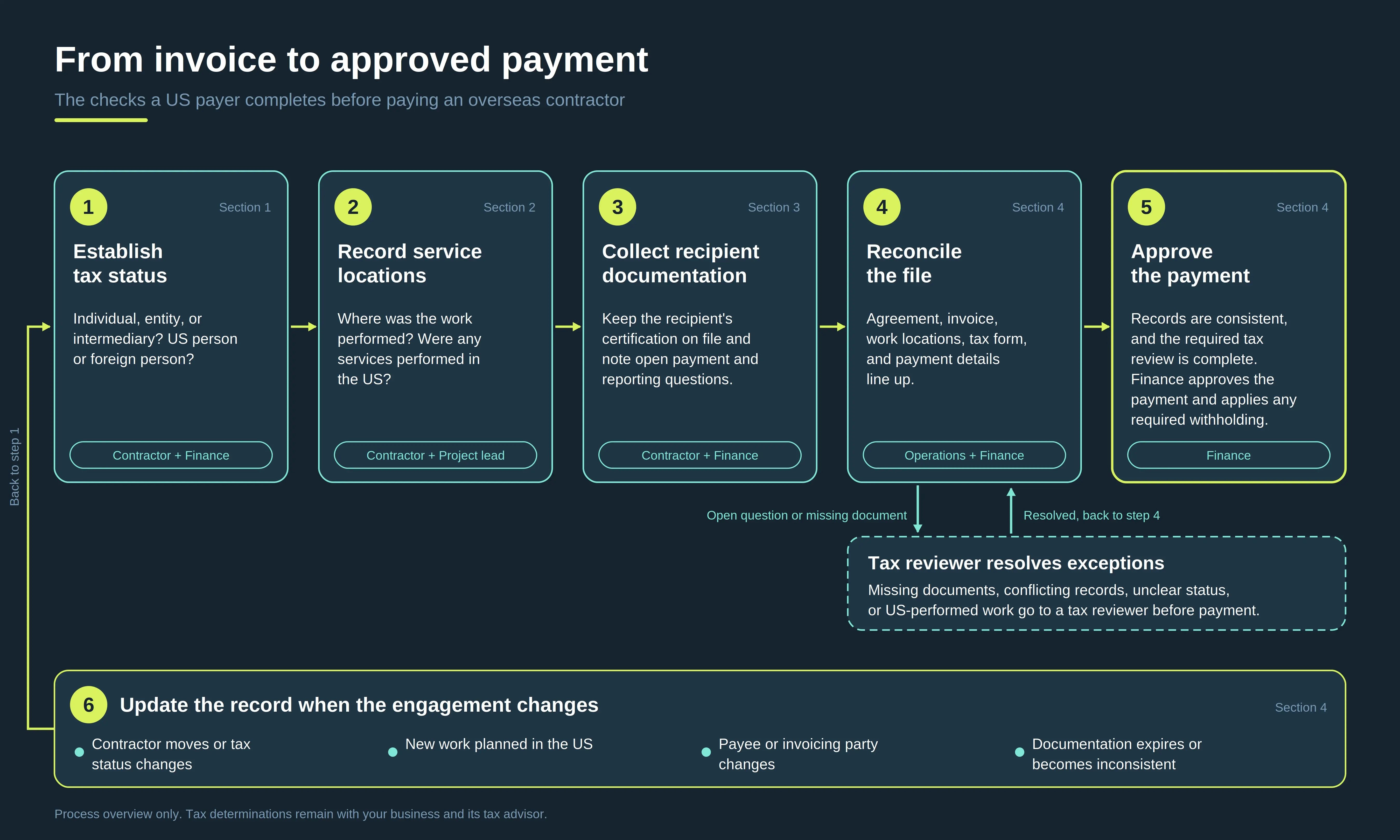
Conflicting records can leave tax questions unresolved when you prepare year-end returns. Before you pay an overseas contractor, connect the recipient, the work, and the payment in one consistent file.
Use this checklist before you approve payment. Some items mirror what IRS forms collect, and others are controls your company sets for onboarding and payment approval:
| Record |
What to capture |
Suggested owner |
| Recipient identity |
Legal name, address, individual or entity status, and relevant ownership information |
Contractor and onboarding team |
| Tax documentation |
Applicable certification, required identifiers, signatures where required, and review status |
Contractor and finance |
| Work locations |
Countries, dates, activities, and any US-performed services |
Contractor and project lead |
| Agreement and invoice |
Contracting party, service scope, invoice period, and agreed fees |
Operations and accounts payable |
| Payment details |
Currency, method, account holder, amount, and transaction reference |
Finance |
| Review decision |
Approved treatment, supporting sources, unresolved questions, and follow-up owner |
Finance and tax reviewer |
Tip #1: Reconcile the file before approving the invoice
Check four things before you approve the invoice:
—Match the parties named in the agreement and the invoice, and confirm the role of anyone else receiving the payment.
—Tie the invoice to its service period and work locations, with a short description of the services and dates.
—List reimbursements, licensing payments, and other charges separately, since each may need its own tax assessment.
—Confirm the currency, fees, and recipient instructions, and compare international contractor payment methods before you send the payment.
Tip #2: Assign an owner to unresolved questions
HR or operations can coordinate collection, while finance owns the payment decision and obtains specialist input where needed. Ask the contractor for missing facts through one designated contact, so the contractor gets one consistent set of requests.
Keep the review evidence in your approved secure system, limit unnecessary copies, and keep identification numbers out of project discussions.
Tip #3: Update the record when the engagement changes
An onboarding file can become outdated while the contractor continues sending invoices. Ask contractors to report changes in recipient details, business structure, work location, or the nature of the services through a designated contact.
Under the IRS requester instructions, you can rely on a Form W-8 only while it is valid and you have no reason to know it is incorrect or unreliable.
Plan a review when these events occur, and note the date the new facts became relevant:
—The contractor reports a move or new information affecting tax status.
—A project includes newly planned services in the United States.
—The invoice or payment recipient changes from the agreed party.
—Documentation expires, becomes inconsistent, or needs correction. A Form W-8BEN generally remains valid through December 31 of the third calendar year after signing unless a change in circumstances makes it incorrect; exceptions can apply.
Tip #4: Review worker classification separately
Tax forms do not settle whether the working arrangement should be employment. The IRS considers the facts of the relationship, including behavioral control, financial control, and the type of relationship, in its independent contractor or employee guidance. For the red flags and penalty exposure behind that review, see our guide to misclassification red flags and penalty risks.
If the engagement changes materially, arrange the relevant classification review, including local requirements where the person works. Our guide to converting a contractor to an employee can help frame the operational transition if employment becomes the appropriate arrangement.
5. What Happens If the Documents Are Missing or Late?
Incomplete paperwork can leave your business unable to support its reporting or withholding treatment. Review these three situations before payment:
—Foreign payee without valid documentation: US-source service payments to foreign contractors generally start at 30% withholding unless a documented exemption or reduced rate applies. Services performed entirely outside the US generally produce foreign-source income outside this withholding regime. Missing or unreliable documentation still requires the IRS presumption rules; have your tax reviewer determine the applicable withholding before payment.
—US person without a TIN: If a US person, including a US citizen working abroad, doesn't give you a taxpayer identification number, backup withholding of 24% may apply to reportable payments.
—Late or incorrect 1099-NEC: The general filing and recipient-statement deadline is January 31 after the payment year, or the next business day when that date falls on a weekend or legal holiday. For 2026 payments, the ordinary deadline is February 1, 2027. Late or incorrect returns can trigger penalties; check the IRS instructions for the applicable amounts.
Also plan for how you file. If you file 10 or more information returns in a year, you must file them electronically.
6. How Can Our Global Contractor Service Support Your Payment Workflow?
Once you have identified an independent contractor, our Global Contractor service can support onboarding, contracts, and cross-border payments. Your business and its tax advisor remain responsible for determining the applicable US tax treatment.
—The Global Contractor service onboards your contractor and drafts a contract tailored to local regulations, so your agreement and service scope are in place before the first invoice.
—We support contractor payments in available local currencies, with ongoing help from our service team.
—If the arrangement should become employment, our Employer of Record (EOR) service can employ the worker in supported markets where you have no local entity. If your business already has a local employing entity, Global Payroll can support employee payroll.
We operate in 150+ countries through 600+ local partners, process payments in 130+ currencies, hold ISO 27001 certification, and have been acknowledged by industry leaders including KPMG, so HR and finance can work with one provider as your international team grows.
Get Your Contractor Payment File Ready
7. FAQs about International Contractor Tax Documents
Q1. Do you issue a 1099 to a foreign contractor?
Generally, no, when the contractor is a foreign person with valid foreign-status documentation. A US person, including a US citizen working abroad, may need a 1099-NEC once reportable payments reach the 2026 threshold of $2,000. Confirm the actual payee and the evidence behind their status, and send other withholding or reporting questions to a tax reviewer.
Q2. What happens if a US contractor lives abroad?
A US citizen living abroad remains a US person, so US information-reporting rules can apply. The contractor documents that status on a Form W-9, which is the form a US person gives you to certify a taxpayer identification number. Your business then assesses the payment category, reporting rules, and exceptions, and keeps the work location on record.
Q3. Should I request a Form W-8BEN or a Form W-9 from my contractor?
It depends on the payee's tax status. Generally, request Form W-9 from US persons, Form W-8BEN from foreign individuals, and Form W-8BEN-E from foreign entities. The IRS requester instructions explain the exceptions. If status is unclear, an intermediary receives the payment, or services are performed in the US, ask a tax reviewer which documentation applies.
Q4. What changes if some of the work is performed in the US?
US-performed services require a separate sourcing, withholding, and reporting review. Start with the IRS rules on where the services were performed. Record the dates, activities, and compensation needed to evaluate the US portion. Have a tax reviewer confirm the allocation and whether a treaty or other provision offers an exemption or reduced withholding rate.
Q5. Can other reporting obligations apply when a 1099 is not required?
Yes, depending on the recipient, income source, and payment circumstances. Certain payments to foreign persons can involve Form 1042-S reporting and related withholding obligations. Reporting can also apply when no tax is withheld under an exemption. Review those questions independently, since "no 1099" answers only one part of the payment.
Q6. How can Slasify help me pay and manage overseas contractors?
Our Global Contractor service supports onboarding, contracts, and payments for independent contractors. If employment becomes appropriate, EOR may fit where you lack a local entity; our Global Payroll supports payroll where you already have one.
Sources: IRS Instructions for Forms 1099-MISC and 1099-NEC; IRS Instructions for the Requester of Form W-9; IRS Instructions for Form W-8BEN; IRS Instructions for the Requester of Forms W-8; IRS Instructions for Form 1042-S; IRS Publication 515; IRS Source of Income: Personal Service Income; IRS Backup Withholding.