|
Key Takeaways
|
| Emerging markets offer strong talent pools, lower hiring costs, and fast-growing business opportunities. |
| The right hiring platform depends on whether a company needs EOR, payroll support, or a full entity setup. |
| Compliance, payroll accuracy, country coverage, and security should be the core evaluation criteria for selecting the ideal platform. |
| Different providers fit different business stages, from early testing to large-scale expansion. And Slasify helps companies hire and pay talent compliantly across emerging markets without unnecessary complexity. |
1. Why Are Global Companies Hiring in Emerging Markets in 2026?
In 2026, emerging markets are becoming a more important part of global hiring strategy. For many international companies, regions such as Southeast Asia, India, Latin America, and parts of Africa offer access to skilled talent, better cost efficiency, and more room for expansion than many mature markets.
However, when doubling down on hiring across these markets, you also need the right HR and payroll infrastructure to help you run local payroll, hire legally, and meet compliance requirements across markets.
That’s why identifying the best EOR platforms in 2026 and evaluating the best payroll platforms for global hiring has become a top priority for companies expanding into these high-growth regions. The right solution can help businesses enter new markets more efficiently, while keeping compliance and operations under control.
2. Why Emerging Markets Matter in 2026

With rapidly growing digital economies, increasing investment in hiring, and more funding flowing into AI and data center infrastructure, emerging markets such as Malaysia, Vietnam, and Indonesia are increasingly being seen as part of a broader strategic expansion plan for global companies looking to hire APAC tech talent and find new growth opportunities.
There are several factors driving that shift:
- Growing talent pipelines: Many emerging markets now offer growing pools of engineers, AI/ML specialists, and multilingual professionals who can support product, operations, and customer-facing functions.
- Better cost efficiency: Hiring and operating costs are often lower than in the US, the UK, or Western Europe, which gives companies more room to scale teams while keeping employment costs manageable.
- Faster market expansion: Companies can test market demand, build local capability, or support regional customers before committing to a legal entity and a full in-country operating structure.
- Remote teams require HR infrastructure: As more businesses look to hire developers in Asia remotely, the need for reliable HR and payroll infrastructure becomes harder to ignore, especially when managing distributed teams across multiple time zones.
3. What Companies Need When Hiring in Emerging Markets

“Global expansion initiatives by emerging small and midsized firms continue escalating, driven by the continued trend in globalization and the need to access top talent in high-demand industries compliantly.”
- Jeanine Crane-Thompson, Principal Analyst, NelsonHall
Once a company decides to hire in emerging markets, the challenge usually shifts from talent sourcing to execution. Employers need a reliable way to hire legally, localize contracts, run payroll accurately, and manage tax and statutory obligations across different countries. Without the right structure in place, even a promising hiring plan can become difficult to manage as expansion grows. At a minimum, companies usually need the following:
- Legal employment support: A clear structure for employing workers in-country, especially when the company does not yet have a local entity.
- Accurate local payroll: Salary payments, payslips, tax deductions, and employer contributions need to be processed correctly based on local rules and timelines.
- Tax and statutory compliance: Employers need support with required filings, statutory benefits, tax obligations, and employer responsibilities that can vary significantly across markets.
- Worker classification guidance: When hiring overseas, companies need to understand whether a role should be structured as employment or independent contractor engagement in order to reduce misclassification risk.
- Localized contracts and documentation: Employment terms, onboarding documents, and compliance workflows need to reflect local labor requirements rather than a one-size-fits-all global template.
- Secure data handling and scalable coverage: HR and payroll operations need to protect employee data while supporting hiring across multiple markets, since each country may have its own rules on how data should be handled and protected.
4. Evaluation Framework: Comparing EOR and Global Hiring Platforms in Emerging Markets
When evaluating the right platform for hiring in emerging markets, employers should focus on whether the platform fits their actual hiring model, supports the way their teams are structured, and can meet data and employment compliance requirements. Here is a table of the top areas to consider when evaluating a platform:
|
Evaluation area
|
Key capabilities to look for
|
Why it’s important
|
|
Compliance
|
Local labor law knowledge, localized contracts, worker classification support, statutory tax and benefits handling
|
Reduces legal exposure and helps prevent avoidable employment issues
|
|
Payroll
|
Multi-country payroll capabilities, local currency salary payments, automated payslips, tax filing, and reporting
|
Keeps payroll operations reliable as hiring expands across markets
|
|
Country coverage
|
Coverage in major emerging markets, ability to support multiple currencies, and employment models across countries
|
Makes expansion easier without relying on disconnected local solutions
|
|
Security
|
Data protection standards, secure document handling, approval workflows, and internal controls
|
Protects sensitive employee data and lowers operational risk
|
|
Visa or mobility support
|
Relocation or cross-border mobility support where relevant
|
Helps companies move talent across subsidiaries more easily
|
5. EOR vs Payroll Provider vs Entity Setup

Companies hiring in emerging markets do not all need the same setup. Some need a fast way to hire employees without opening a local entity, while others already have entities in place and mainly need payroll support. In practice, the right model depends on how quickly the company wants to enter a market, how much control it needs, and how much complexity it is ready to manage.
Employer of Record (EOR)
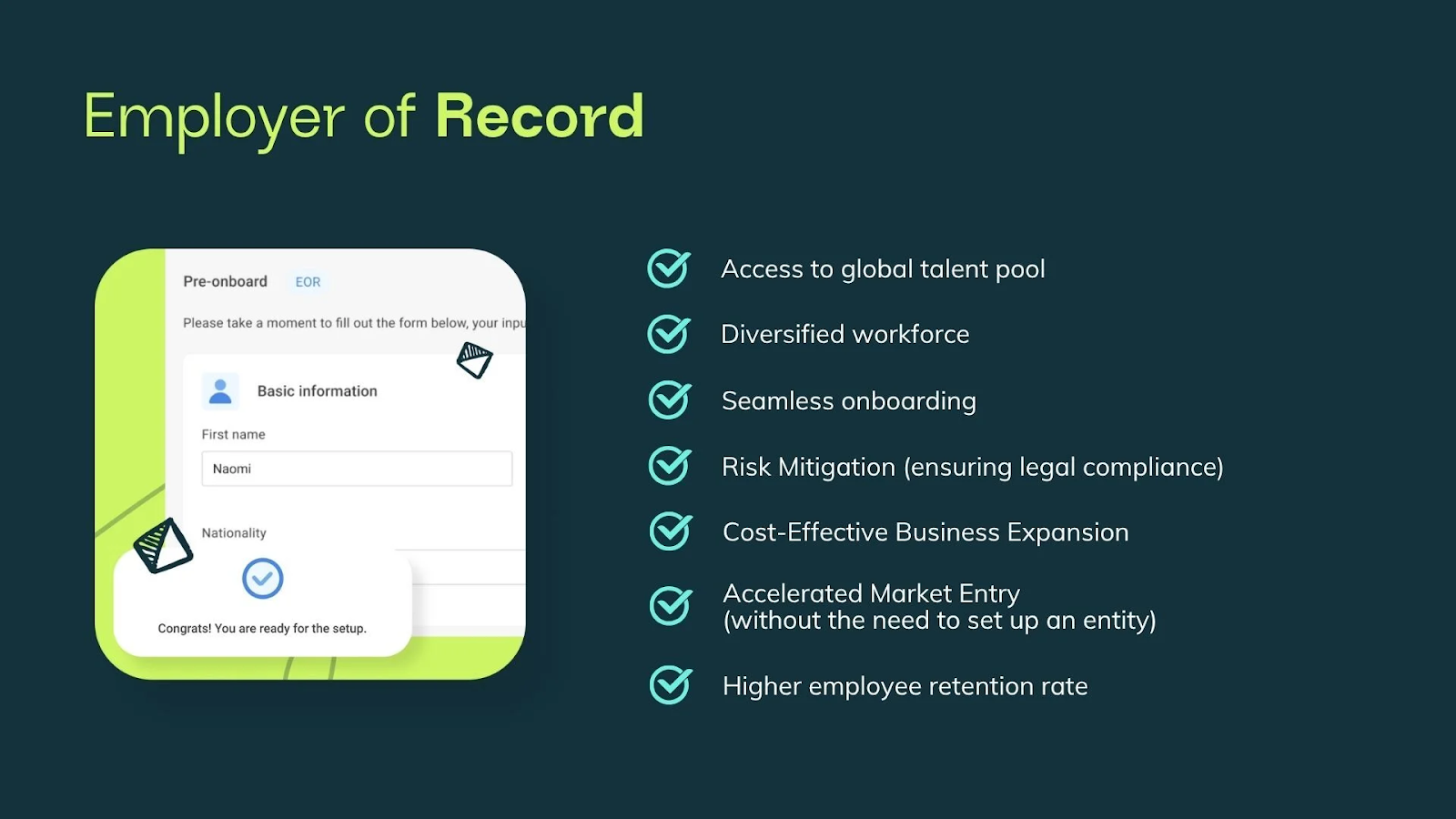
An Employer of Record hires employees on a company’s behalf in countries where the company doesn’t yet have a legal entity. This is usually the most practical way to hire developers without setting up a local entity while maintaining speed, compliance, and a lower initial cost.
An EOR is best for:
- Companies entering a new market quickly
- Early-stage expansion with a small initial team
- Employers that want to reduce the burden of managing local employment compliance, onboarding, and payroll directly
Payroll Provider
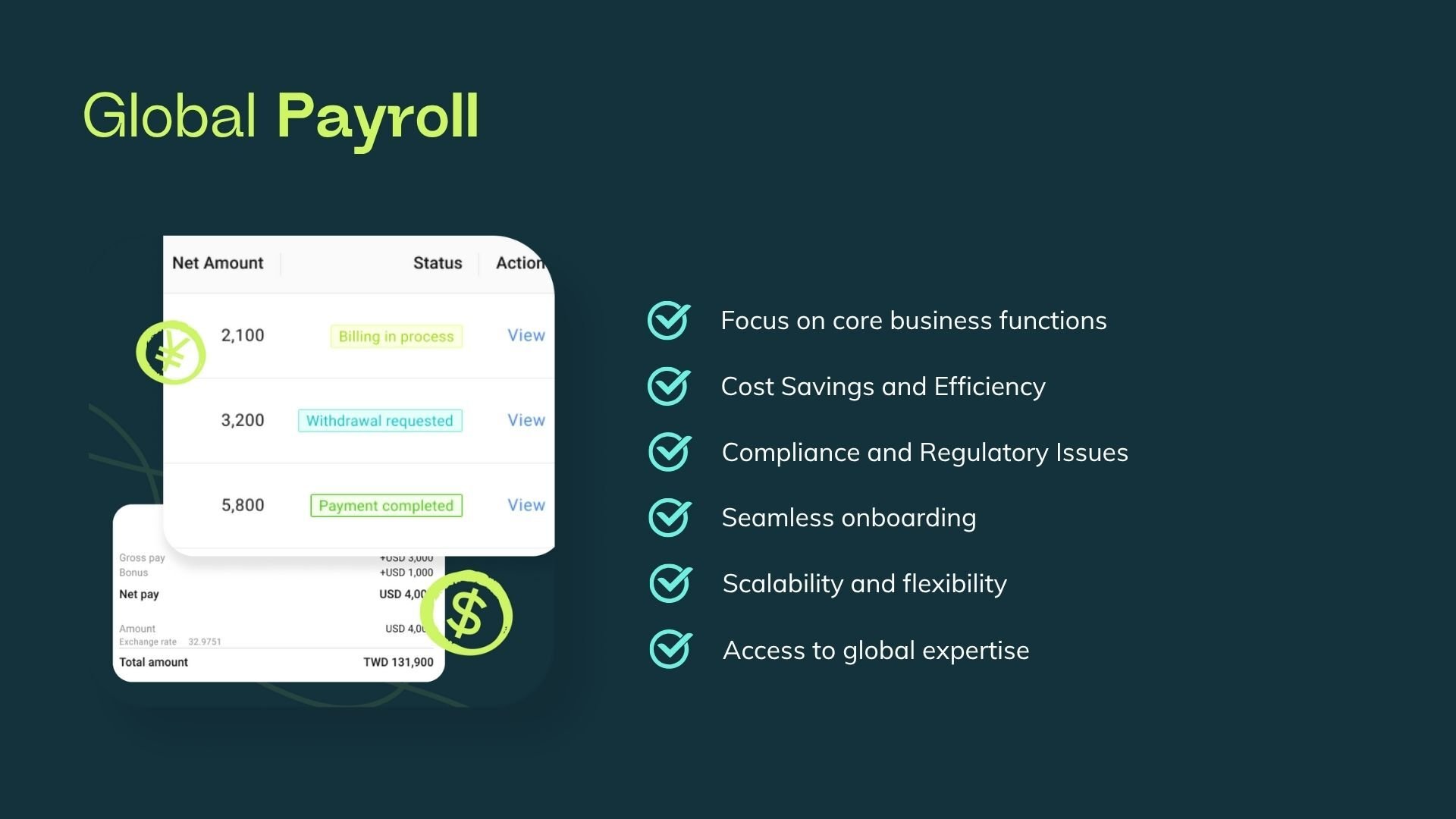
A payroll provider manages payroll execution for workers already employed through the company’s own local entity. This usually includes salary processing, deductions, tax reporting, and other payroll administration tasks. It is generally a better fit for companies that want to retain direct employment control while outsourcing payroll operations.
A payroll provider is best for:
- Companies with established local operations
- Businesses that want to retain direct employment control
- Larger teams in a single country that need to optimize payroll processing
Entity Setup
Entity setup gives the company full in-country control, but it also creates the greatest operational responsibility. Once a business establishes its own legal presence, it becomes directly responsible for local HR, payroll, tax, and legal obligations.
Entity setup is best for:
- Long-term market commitment, especially where local tax or regulatory requirements make an entity more practical
- Hiring at a volume where setting up a legal entity justifies the time and resources involved
- Companies that want more direct control over sensitive business functions such as intellectual property, data security, and strategic talent management
6. What the Best Platforms Should Offer in 2026

In 2026, a reliable platform needs to support compliant hiring, operational consistency, and expansion across different emerging markets without adding unnecessary complexity. The most versatile platforms usually excel in these areas:
- Fast & compliant setup: They support onboarding speed without sacrificing local compliance or employee experience.
- Reliable payroll: They provide transparent payroll workflows, clear approvals, automated calculations, tax deductions, and reporting.
- Flexibility across markets and worker types: They can support hiring in emerging markets, handle both employees and contractors if needed, and scale across multiple countries with proper compliance and currency support.
- Strong local execution support: They combine local compliance and financial expertise with practical implementation support, so HR and finance teams don’t need to manage every issue on their own.
7. Structured Provider Profiles: Best Fit and Strengths

Each service provider is useful if it fits a company’s business needs and strategic growth plan, whether the goal is rapid expansion or managing multi-country teams with a diverse workforce. Below, we look at how different types of HR and payroll platforms compare with Slasify:
|
Provider type
|
Best for
|
Strengths
|
Trade-offs
|
|
Slasify
|
Companies hiring across APAC and emerging markets that need a suite of EOR, payroll & contractor services
|
Flexible support across multiple hiring models, practical coverage for emerging-market expansion, and a strong fit for companies hiring without local entities
|
May not be the best fit for enterprises that need deep integration with existing finance, HR, and IT infrastructure
|
|
Large global EOR platforms
|
Companies are hiring across many regions at once and prioritizing standardization
|
Broad international coverage, established processes, and strong fit for multinational expansion
|
May feel less tailored for companies focused specifically on emerging markets
|
|
Regional payroll specialists
|
Companies with local entities that mainly need consistent payroll execution in specific countries
|
Deep country-level payroll expertise and a strong fit for companies with a mid-to-large in-house team
|
Limited support for no-entity hiring
|
|
Local HR or compliance providers
|
Companies entering one specific market and needing highly localized support
|
Strong in-country knowledge and support for niche compliance requirements
|
Harder to scale across multiple countries
|
8. Decision Guide by Company Size and Expansion Stage
One of the better ways to assess which platform is best for your business is by looking at your company size and expansion stage, which will determine the balance between specialized services and flexibility:

Early-stage startups: EOR for speed and flexibility
Early-stage startups usually need speed, flexibility, and a way to enter new markets without taking on too much fixed cost early on. In most cases, an EOR platform is the most practical starting point, with contractor support used when the hiring model and local requirements allow it.
This setup is often the best fit because it helps startups:
- Avoid setting up an entity before demand is proven
- Reduce legal and administrative overhead during early expansion
- Move faster when testing a market or building a small initial team
Scaling companies: EOR with broad payroll support
Scaling companies usually face a different problem, as they are now hiring at a faster rate for different functions. This means they need a setup that supports repeatable hiring across several markets without creating fragmented payroll and compliance workflows.
This kind of setup helps scaling companies:
- Expand across multiple countries with more consistency
- Simplify compliance as headcount grows
- Create a more repeatable process for onboarding and payroll operations
Enterprises: Entity-based payroll with EOR for new markets
Large enterprises often need the most flexible structure of all. They may already run payroll through their own entities in established markets, while still exploring new countries where they are not ready to commit to a full setup. In those cases, the most effective model is often a hybrid one, which helps enterprises:
- Maintain direct control in mature markets with deep in-market expertise
- Stay flexible in new markets until real business demand is proven
- Balance standardization and agility across a more complex global operation
9. How Slasify Supports Hiring in APAC and Other Emerging Markets

In 2026, building infrastructure in emerging markets is a strategic choice that can help global companies seize the next growth opportunities. However, the real advantage lies in partnering with the international payroll providers in 2026 that can effectively consolidate and streamline your hiring process.
In this article, we’ve covered the essential criteria for successful expansion, including compliance, payroll, country coverage, data security, and scalability. Choosing the right platform also depends on your current business needs and expansion goals, whether that means testing a new market, building a regional workforce across countries, or committing to long-term growth.
Ready to scale your tech workforce across emerging markets? Book a consultation with Slasify's global expansion experts today to discover how our trusted EOR and payroll solutions can accelerate your growth.
10. FAQ: How to Choose the Best EOR and Payroll Platforms in Emerging Markets in 2026

What is the best EOR for emerging markets?
The best platform depends on your hiring model, entity status, and compliance needs. A company testing a new market may need something different from a business hiring across several emerging markets at once.
What is the difference between an EOR and a payroll provider?
An EOR can hire employees legally on your behalf without a local entity, while a payroll provider usually focuses on managing complex payroll requirements for employees hired by your own entity.
Do I need a local entity to hire employees in emerging markets?
No. You can use an EOR to hire employees and manage employment and payroll compliance in emerging markets without setting up a legal entity first. Companies can also transition to entity-based hiring later.
What should I look for in a global payroll platform?
You should look for compliance support, multi-currency payroll, country coverage, and scalability. A strong global payroll platform should handle local payroll requirements without adding complexity as headcount grows.
How can I hire talent in Asia without setting up an entity?
Using an EOR is often the fastest and most compliant option. This is especially useful when a company wants to enter a new market, hire quickly, or test demand before committing to entity setup.
How does Slasify help with hiring in emerging markets?
Slasify acts as a trusted bridge to emerging markets. By combining Local Regulatory Monitoring with Automated Statutory Contributions, our platform allows you to hire and pay teams across APAC, LatAm, and Africa with zero local entity setup while rigorously mitigating compliance risks.