COUNTRY FACT SHEET
| Key Takeaways | |
| China Golden Week is not one single holiday. There are three legally different kinds of days stacked into ten days, and the price gap between the cheapest and the most expensive is threefold. | |
| Only October 1 to 3 are statutory holidays. Work on those days requires cash payment at a minimum of 300% of the normal wage, and compensatory time off is not a lawful substitute. | |
| October 4 to 7 are rest days, not statutory holidays. That distinction matters for budgeting: an employer must arrange compensatory rest first, and pays at least 200% only when compensatory rest cannot be provided. | |
| In 2026, September 20 and October 10 are the working days designated to offset the extended break. No weekend premium applies to either day, and missing one without approval is treated as an ordinary unexcused absence. | |
| China has had 13 statutory holiday days since January 1, 2025. The long breaks around them are assembled each November by a State Council General Office notice, not fixed on a permanent calendar. | |
In This Guide
China Golden Week is the extended break built around National Day on October 1, and the dates change every year. Each November, the State Council General Office publishes a notice that converts specific weekends into working days to build the break. Only October 1 to 3 are statutory holidays: work on those three days requires cash payment at a minimum of 300% of the normal wage, and compensatory time off is not a lawful substitute. The rest of the window follows different rules.

This guide covers how those dates are set, what it costs to have someone work on any given day of the window, and what to confirm with your team, your payroll provider, and your clients before the week starts.
1. What Is China's Golden Week?
China's Golden Week (黃金周, huangjinzhou) is a colloquial term, referring to the extended break that forms around National Day each October. In 2026, the Golden Week runs from October 1 to October 7.
In 2025, during the eight-day National Day and Mid-Autumn break, the Ministry of Culture and Tourism recorded 888 million domestic trips and RMB 809 billion in domestic tourism spending. The scale and impact of the Golden Week break make shift planning much harder if you don't plan ahead. For a foreign employer, this means that your counterparts, suppliers, and employees will be unavailable during this time.
2. The Operating Rules Behind China's Golden Week
There are three moving parts of China's Golden Week that HR teams need to be mindful of:
China's statutory holidays
Since January 1, 2025, China has had 13 statutory holidays per year, raised from 11 by a State Council decree No. 795. The updated schedule added Lunar New Year's Eve to Spring Festival and May 2 to Labor Day.
The November annual notice
Each November, the State Council General Office publishes a notice setting the following year's arrangements, converting specific weekends into working days so that the statutory days can be extended into a continuous break. The 2026 arrangements were published on November 4, 2025.
The holiday and workday swap
There are two rules that govern how this swap, known as 調休 (tiaoxiu), works:
- —First, when a statutory holiday falls on a Saturday or Sunday, it must be made up with a rest day on a working day.
- —Second, a provision added in the 2024 amendment states that, other than in exceptional cases, employees should generally not work more than six consecutive days around a holiday.
In 2026, the Mid-Autumn Festival falls on Friday, September 25, landing neatly against the weekend: September 25 to 27 is already a three-day break with no make-up day required.
However, National Day is different, in that October 1 is a Thursday, and October 3 is a Saturday, which triggers the make-up rule. To reach a continuous week through Wednesday, October 7, two weekend days get converted into working days: Sunday, September 20 and Saturday, October 10.
| Holiday Break | Statutory Days | Typical Days Off | How the Gap Is Filled |
|---|---|---|---|
| Spring Festival | 4 (New Year's Eve and the first three days of the lunar year) | 8 to 9 | Adjacent weekends, plus Saturdays converted into working days |
| National Day (Golden Week) | 3 (October 1 to 3) | 7 to 8 | Adjacent weekend, plus converted weekend days; 8 in years when Mid-Autumn merges into it |
For the full 2026 calendar covering all seven national breaks, see our China 2026 holiday payroll calendar guide.
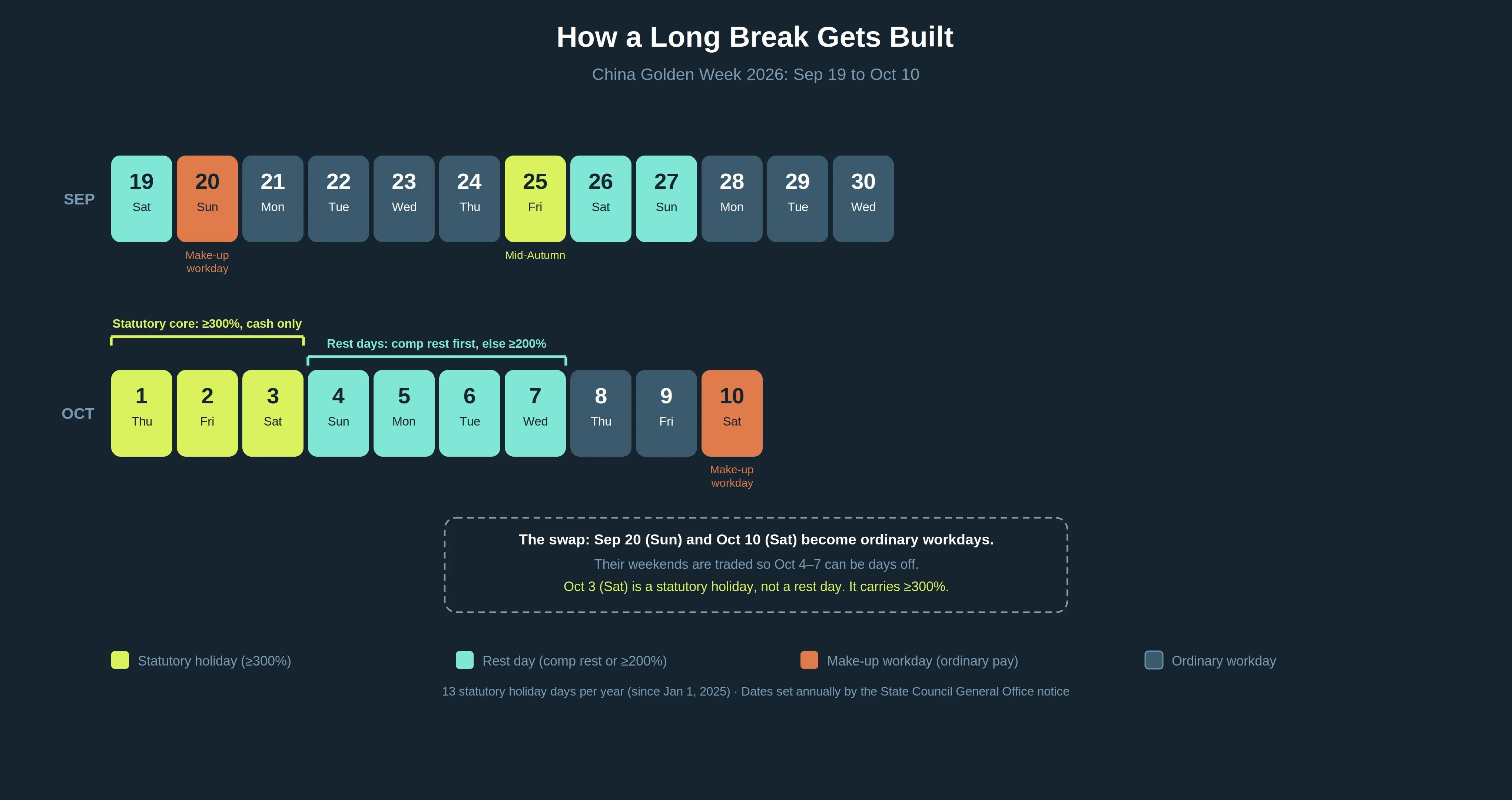
Figure 1: The 2026 Golden Week window runs from September 19 to October 10; the two make-up workdays (September 20 and October 10) are traded in to create the seven-day break.
2025's plan won't work. When Mid-Autumn merges into the October break, the shape of the week changes in ways that affect budget and cutoffs, not just the number of days off. Here are the differences between 2026 and 2025:
| What Changes | 2025 (Merged) | 2026 (Separate) |
|---|---|---|
| Length of the October break | 8 days | 7 days |
| The number of statutory days during the break | 4 | 3 |
| Make-up workdays | 2 | 2 |
| Mid-Autumn Festival | Inside the break | Separate, September 25 to 27 |
| Payroll planning for HR | One long window | Two windows in three weeks |
3. China Golden Week in 2026, Day by Day
Below is a day-by-day breakdown covering the full Golden Week window, from the weekend before the first make-up day through the final make-up day on October 10, to help HR teams plan payroll and shift rotations:
| Dates | Day Type | Pay Rules | Compensatory Rest |
|---|---|---|---|
| Sep 19 (Sat) | Weekend rest day | ≥ 200% | Yes, first |
| Sep 20 (Sun) | Make-up workday | Ordinary pay | Not applicable |
| Sep 21 to 24 | Working days | Ordinary pay | Not applicable |
| Sep 25 (Fri) | Statutory holiday | ≥ 300% | No |
| Sep 26 to 27 | Weekend rest days | ≥ 200% | Yes, first |
| Sep 28 to 30 | Working days | Ordinary pay | Not applicable |
| Oct 1 to 3 | Statutory holidays | ≥ 300% | No |
| Oct 4 to 7 | Rest days | ≥ 200% | Yes, first |
| Oct 8 to 9 | Working days | Ordinary pay | Not applicable |
| Oct 10 (Sat) | Make-up workday | Ordinary pay | Not applicable |
Dates from the State Council General Office notice published on November 4, 2025. Pay treatments follow Articles 41 and 44 of China's Labor Law. October 4 is the ordinary Sunday; October 5 to 7 are the days created by the swap.
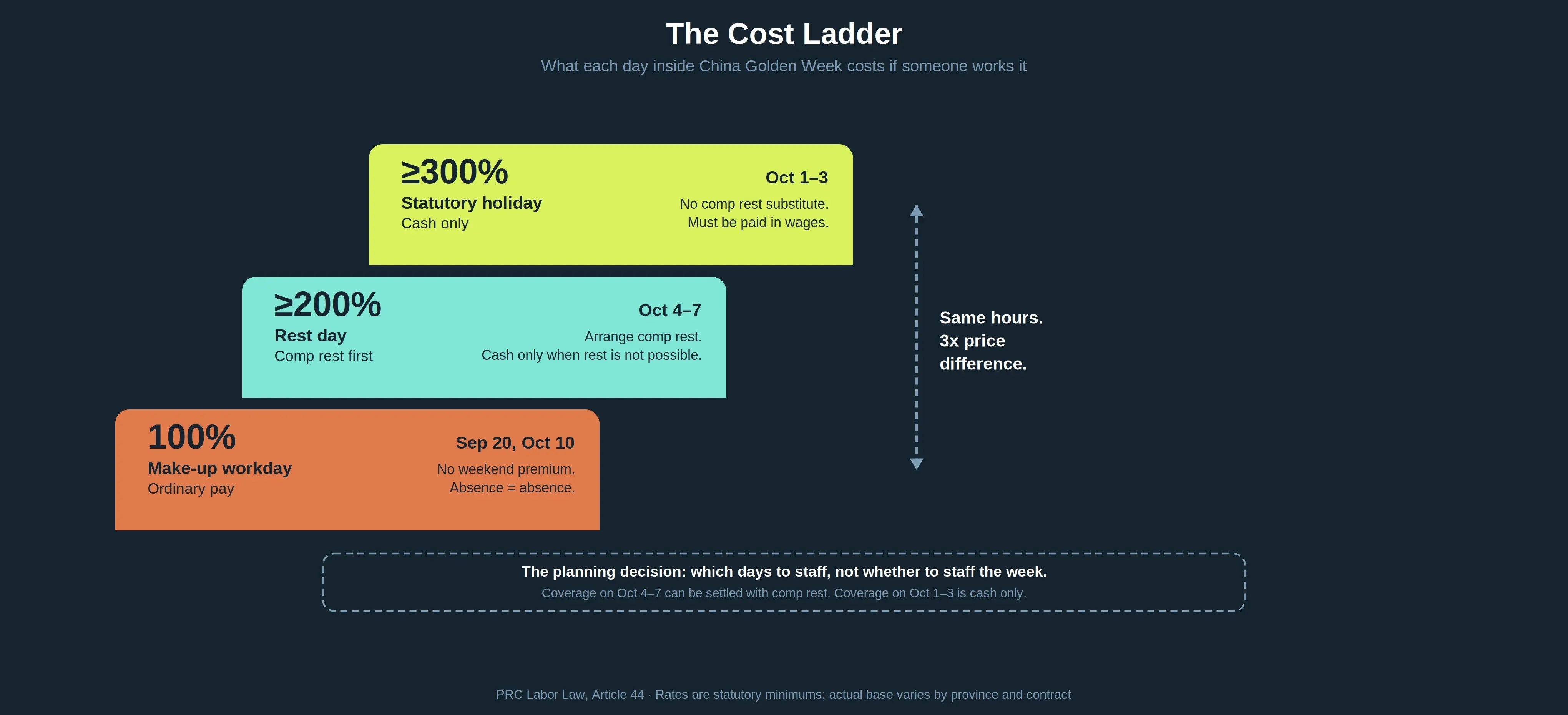
Figure 2: the same coverage hours cost up to three times more on statutory days (October 1 to 3) than on rest days (October 4 to 7), and make-up workdays require no premium at all.
China's pay rules: working on statutory holidays vs. rest days
Under Article 44 of the labor law, work on a statutory holiday is paid at least 300% of the normal wage, and compensatory time off is not a lawful substitute. However, work on a rest day is handled differently: the employer arranges compensatory rest first, and pays at least 200% only where compensatory rest cannot be arranged.
So during China's National Day Golden Week, working on October 1 to 3 must be compensated with overtime pay, whereas time off can be used on October 4 to 7. The shift decision matters most for budget planning, in that if coverage can wait until October 4, moving it off the statutory core saves the premium without reducing hours worked.
Four caveats apply when staffing during long breaks:
- —The compensatory rest has to be genuinely granted
- —How promptly the compensatory rest must be taken varies by province
- —Prior consultation is required when asking employees to work on holidays. The hours may be extended by up to one hour/day in general, or up to three hours/day in special circumstances, subject to a monthly cap of 36 hours
- —During Golden Week, October 3 falls on a Saturday, but as a statutory holiday it carries the 300% rate instead of the 200% rest-day rate
China's wage calculation formula
According to the Ministry of Human Resources and Social Security (MOHRSS), the standard conversion divides the monthly wage by 21.75 days for monthly-salaried employees. However, the wage base can differ by province and by contract, so a standard example should not be treated as universal across your China headcount.

4. The Pre-Holiday Planning Checklist
Most Golden Week planning problems come down to sequencing: the right action, taken a week too late. The checklist below runs backward from October 1, covering what to lock at each stage before the break:
| Time Frame | What to Lock | Why It Matters |
|---|---|---|
| Each November | Next year's public holiday calendar from the State Council General Office notice | Nothing is official before the notice is published |
| Six weeks out | Coverage roster and premium approvals | Choosing which dates are covered can affect your bottom line, and it needs sign-off before managers start negotiating with staff |
| Four weeks out | Payroll cutoff, bank and provider pause windows | Approvals and transfers that normally take two days can take a week when a holiday sits in the middle |
| Three weeks out | Client and delivery commitments | Warning customers before the week costs less and reduces conflicts |
| Two weeks out | Written notice of the adjusted schedule | Employees need to know the make-up days are ordinary working days before they book travel tickets and accommodation |
| During the week | Minimum staffing and a clear escalation path for unexpected situations | A named person with actual decision-making authority can alleviate delays and resolve issues quickly |
| The day after Golden Week | Return-to-work priority list and absence handling | The first two days back carry the backlog, and an absence on the make-up day is treated like any other absence |
There are two rows to highlight:
- —Four weeks out: payroll cutoff is where most first-year mistakes land, because approval chains that clear comfortably in a normal month collide with a closed bank
- —Two weeks out: not having a clear written notice ahead of time can easily create employee conflict and labor law violations, resulting in hectic scheduling, unnecessary overtime costs, and insufficient staffing during the break

Not sure whether your October roster prices the week correctly?
Talk to our China payroll team to review your coverage plan and cutoff dates against the current year's notice before the deadlines close.
Talk to Our China Payroll Team5. Distributed Teams and the October Holiday Overlap
If you have distributed teams of employees in China and your business requires staffing during the Golden Week, here are four things you need to plan for ahead of time:
- —Payroll timing: banks and local providers will be closed. If your October cycle runs anywhere near the first week, move the cutoff into late September and confirm the exact pause window. This applies whether you run Global Payroll centrally or work through a local provider.
- —Asking employees to work: Article 41 of the Labor Law requires prior consultation and caps on extended hours. A clear premium arrangement set in advance works better than assuming availability. Not every day in the window carries the same pay obligation (see Section 3), so plan your rotation accordingly.
- —Response-time expectations: this requires you to set and manage expectations for customers and regional offices (in China or other countries). Send clear notice to external partners on your response availability and expected turnaround times. The same applies internally if you have international teams that involve collaboration with the China team.
- —The October collision: in 2026, the pile-up starts in September. Mid-Autumn takes out September 25 to 27, then a normal week, then Golden Week. Several other markets in the region have October holidays of their own, so an APAC team can lose overlapping coverage in more than one country at once during October. Our APAC holiday payroll guide provides the regional calendar for a full picture of October holidays across the region.
6. The Manufacturer's Half of the Shutdown
If you buy from or run a manufacturing plant in mainland China (or operate within the supply chain), you also need to plan for your workforce on top of the usual booking, port congestion, container availability from the freight side, and Golden Week factory shutdown.
- —The pre-holiday crunch has a legal ceiling: pulling shipments forward means extending hours in the final two weeks of September, but it's also limited by Article 41 of the Labor Law. Extension of working hours is generally capped at one hour per day; where circumstances require more, the limit is three hours per day and 36 hours per month, and the extension requires consultation with the trade union and the workers.
- —The real stoppage is longer than the official one: even though there are seven statutory dates, plants and factories frequently extend the break for maintenance, and staff who travel long distances often add annual leave at either end. Ask your supplier for their actual schedule before finalizing your own schedule.
- —Expect capacity to return slowly: output rarely returns to full rate on the first day back, and October 10 being a working Saturday does not fully offset the lost output. Build the ramp into your delivery commitments rather than discovering it in the first week of October.
7. How We Run Payroll Through China's Golden Week

When the State Council General Office notice is published in November, we lock the following year's cutoff dates for our China payroll cycle immediately, rather than waiting for the quarter in which each break falls. Day types get classified according to the official announcement, so statutory days, rest days, and make-up workdays are already in place before any calculation. That means you can build your rotation and overtime policy before the October planning crunch starts.
Employers we work with in China get a named account manager who handles the coverage and overtime premium questions directly, which matters most in the two weeks before the break when the questions are specific and time-bound.
We run payroll and hiring in over 150 countries and 130+ currencies for more than 900 companies, and China is one of the markets where the annual calendar drives more payroll exceptions than the tax rules do. Our payroll infrastructure is also ISO 27001 certified, so your employees' data is handled to international security standards throughout the cycle.
If you are hiring in China for the first time, our China employment guide covers the contribution and contract basics, and our overview of hiring in China explains why more global companies are hiring in China.
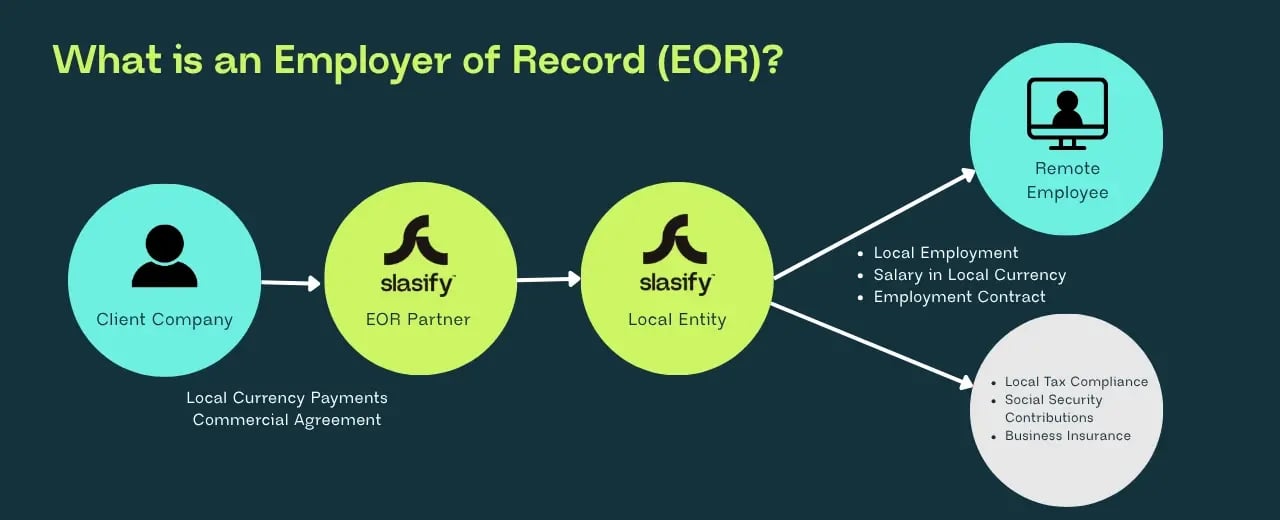
If you need to hire in China without setting up a local entity, our Employer of Record (EOR) service covers everything once your offer is accepted, from contract drafting, onboarding, payroll, and benefits to offboarding.

8. China Golden Week FAQ

Q1. What is the Golden Week holiday in China?
The China Golden Week is a seven-day break from October 1 to October 7, built around National Day. Note that only October 1 to 3 are statutory. The remaining days come from weekend swaps set by the State Council General Office each November of the previous year. This is one of China's long breaks where businesses close, and employees take additional time off to return home or travel.
Q2. Do Chinese employees work during Golden Week?
Most do not, though you can ask employees to work and pay the statutory premium. Under Article 41 of the Labor Law, extending working hours requires prior consultation and must stay within daily and monthly limits. What you pay depends on the date: October 1 to 3 carry the 300% statutory rate; October 4 to 7 allow either compensatory rest in lieu or payment at 200%.
Q3. Does China shut down completely for Golden Week?
No. Banks, government offices, and most companies close, but transport, hospitality, retail, and healthcare run at full capacity. Factories often extend the break beyond the official dates. For planning purposes, assume administrative processing, supplier responses, and payments pause for at least a full week.
Q4. Is China's Golden Week the same as Japan's?
No. They are different holidays, in different countries, and in different months. Japan's Golden Week runs from April 29 to May 6 in 2026. China's Golden Week is the October break around National Day, governed by Chinese labor law and by the State Council General Office notice issued each November of the previous year. This guide covers China's Golden Week only.
Q5. What do we pay employees who work during Golden Week?
For work on October 1 to 3, the statutory holiday rate applies at not less than 300 percent of the normal wage, and time off cannot be substituted for it. For October 4 to 7, since they are rest days, you can arrange compensatory rest or pay not less than 200 percent.
Q6. Are the make-up workdays before and after Golden Week paid extra?
No. September 20 and October 10 are ordinary working days at ordinary pay, even though both fall on a weekend in 2026. No weekend premium applies, and an absence on either day is treated as an ordinary absence. Overtime rules apply only if hours run past the normal daily limit.
Lock Everything Down Before September Ends
China Golden Week rewards employers who treat it as a scheduling problem with a known answer rather than an annual surprise. The dates were published a year ago, the pay rules are stable, and the expensive mistakes are mostly preventable if everything is done right ahead of time.
Staffing Through Golden Week for the First Time?
Our China payroll team can walk through the schedule with you before the September window closes.
Talk to Our China Payroll Team