|
3 Key Takeaways
|
- Beyond the Calendar: Managing a distributed APAC workforce requires navigating not only complex holiday schedules but also hidden financial impacts, such as mandatory bonuses (e.g., THR, 13th-Month Pay) and statutory overtime rules.
|
- Local Compliance is Critical: Overlooking country-specific traditions and regulations—like Vietnam's Tet Bonus expectations or Indonesia's Cuti Bersama (mass leave)—can lead to unbudgeted payroll leakage and severe compliance risks.
|
- Centralize to Scale: Forward-thinking companies leverage Employer of Record (EOR) and Global Payroll solutions like Slasify to automate leave tracking, eliminate manual calculation errors, and ensure 100% cross-border compliance.
|
Introduction: The Challenge of Regional Leave Management

As more U.S. companies expand into Southeast Asia to access high-growth markets, skilled talent pools, and cost-efficient operations, the region has become a strategic hub for global teams. But expansion brings operational complexity, especially when it comes to navigating each country’s unique APAC holiday calendar and labor rules.
Managing distributed teams across Southeast Asia can become a logistical puzzle. When Vietnam shuts down for Tet Vietnam, the Philippines may be fully operational; when Indonesia observes Lebaran and extends leave through cuti bersama lebaran, Singapore teams continue business as usual. For HR managers, project leads, and expansion teams,understanding not only the dates but also the hidden financial impact of bonuses, overtime premiums, and statutory pay rules is essential.
This guide consolidates the 2026 holiday landscape for the top five APAC markets: Singapore, Vietnam, Malaysia, the Philippines, and Indonesia, highlighting both operational shutdowns and the compliance-linked costs that directly affect payroll, budgeting, and workforce planning.
The "At-a-Glance" Matrix: 2026 Snapshot
|
Country
|
Key "Long Break"
(Productivity Dip)
|
Mandatory Holiday Bonus?
|
|
Singapore
|
National Day & Long Weekends
|
No, but overtime rules apply
|
|
Vietnam
|
Tet (Lunar New Year, Jan–Feb)
|
Tet Bonus expected (13th-month pay)
|
|
Malaysia
|
Hari Raya, Chinese New Year, Deepavali
|
Replacement leave rules apply
|
|
Philippines
|
Christmas & Holy Week
|
13th Month Pay mandatory
|
|
Indonesia
|
Lebaran & Cuti Bersama Lebaran
|
THR (1 month salary) mandatory
|
2026 APAC Payroll & Holiday Heatmap
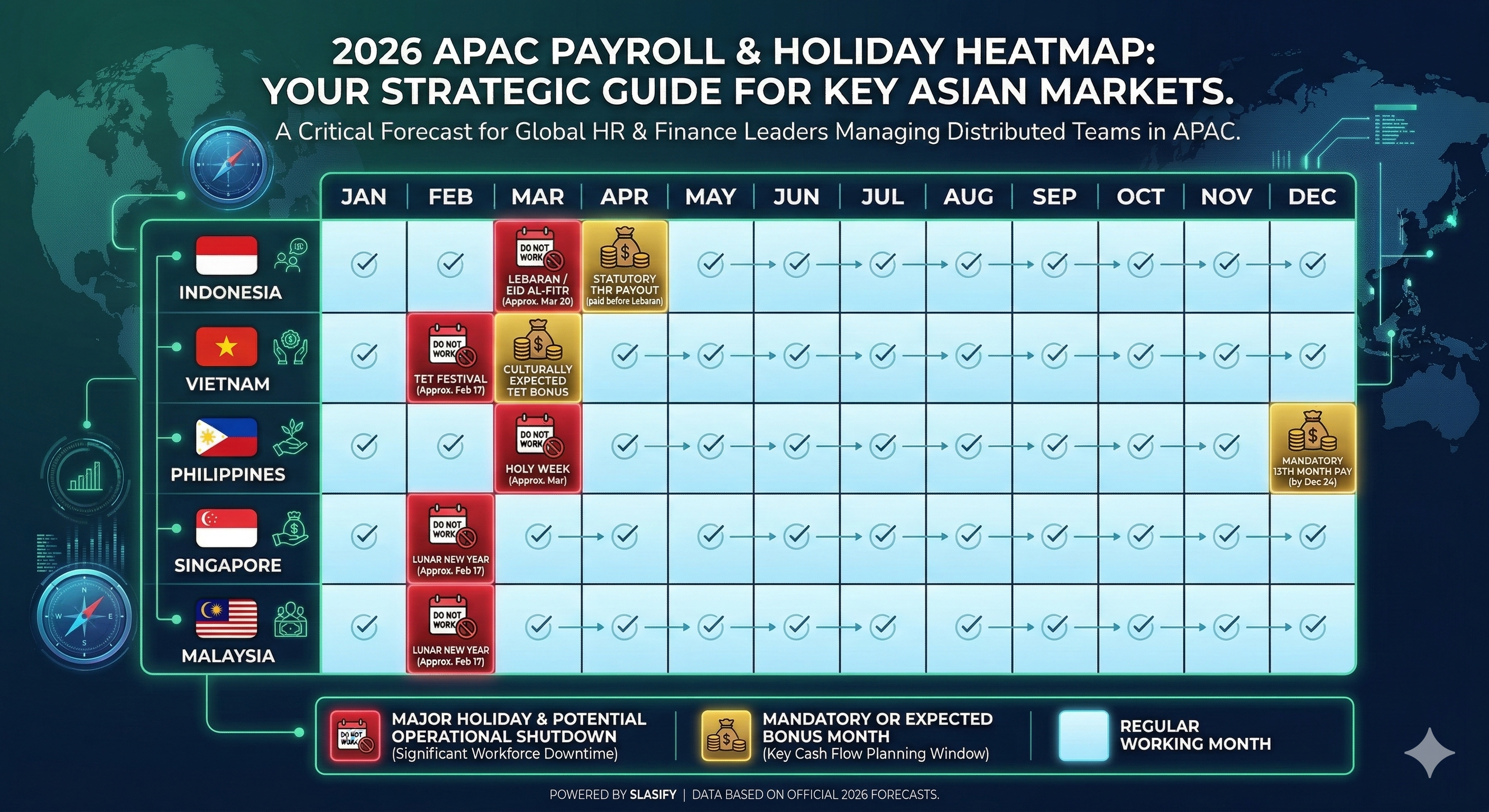
💡 Key Terms for APAC Employers:
- THR (Tunjangan Hari Raya) - Indonesia: A mandatory statutory bonus equivalent to one month's salary, paid legally at least 7 days before the religious holiday (usually Lebaran).
- 13th Month Pay - Philippines: A mandatory bonus equivalent to one-twelfth of an employee's basic salary, which must be paid by December 24 each year for end-of-year compliance.
- Tet Bonus - Vietnam: A culturally expected annual bonus paid before the Tet Festival, critical for employee retention though not statutory.
Vietnam: The Tet Holiday Marathon

Vietnam’s 2026 workforce calendar is dominated by Tet Vietnam, the country’s most significant national holiday. As outlined in our detailed Vietnam employer guide, Tết (Lunar New Year) typically results in a 7–9 day nationwide shutdown, with many businesses closing even longer in practice. Although labor law mandates public holiday pay at 300% for employees who work during official holidays, the larger financial consideration is the culturally expected Tet Bonus, often equivalent to a 13th-month salary.
While not explicitly codified as mandatory, the Tet Bonus functions as a retention tool across industries. For companies managing distributed teams, failing to budget for this payment can significantly impact morale and turnover. HR leaders should forecast Q1 payroll spikes carefully and align Tet Vietnam planning with performance review cycles and cash flow strategy.
Explore Vietnam’s Public Holiday Guide 2026
Indonesia: Lebaran & The THR Mandate

Indonesia’s workforce calendar revolves around Lebaran (Eid al-Fitr), accompanied by the government-declared Cuti Bersama Lebaran (collective leave days). These additional days extend the public holiday period and may be deducted from annual leave, depending on employer policy. This creates both operational downtime and leave tracking complexity for HR teams managing remote teams in the region.
More critically, Indonesia mandates THR (Tunjangan Hari Raya), a religious holiday allowance that must be paid at least 7 days before Lebaran. Employees with 12 months of service are entitled to one full month’s salary. This is not discretionary, it is strictly enforced under Indonesian labor regulations. For expansion leads and finance departments, Q2 budgeting must account for THR alongside regular payroll, making Indonesia one of the most financially sensitive APAC holiday markets.
Learn more about Indonesia’s Employment Guide
Malaysia: The Multi-Cultural Compliance Landscape

Malaysia’s 2026 calendar reflects its multicultural framework, with Muslim, Chinese, Indian, and secular holidays recognized at both federal and state levels. This creates complexity not only in the number of holidays but also in legal interpretation. If a public holiday falls on a rest day (typically Sunday), employers must provide a replacement holiday or compensate employees accordingly. State-specific holidays, such as Sultan birthdays, further complicate workforce planning for companies managing distributed teams across multiple Malaysian states.
Public holiday work in Malaysia requires premium pay or replacement leave, depending on employment terms and circumstances. For companies relying on a regional payroll provider, failing to account for state-level variations can lead to payroll discrepancies. Proactive tracking is essential for compliance and cost control.
Explore Malaysia’s Public Holiday Guide 2026
Philippines: Regular vs. Special Holidays & the 13th Month Obligation

The Philippines has one of the most nuanced public holiday structures in Southeast Asia. The key compliance distinction is between “Regular Holidays” (where employees receive 100% of the employee’s daily wage even if the holiday is unworked., and 200% if worked) and “Special Non-Working Days” (generally no work, no pay unless company policy provides otherwise). This differentiation makes payroll calculations more complex than in neighboring markets.
Additionally, the Philippines 13th month pay is mandatory under law and must be paid no later than December 24. Unlike Vietnam’s Tet Bonus, this is strictly codified and applies to nearly all rank-and-file employees. HR teams managing distributed teams should treat December as a high-liquidity month, while also planning for Holy Week in April, another major productivity slowdown.
Read and learn more about the Philippines Public Holiday Guide
Singapore: Structured Efficiency with Strict Enforcement

Singapore’s public holiday calendar is comparatively streamlined, but compliance expectations are stringent. The Ministry of Manpower enforces detailed regulations governing overtime, work on rest days, and compensation for public holiday work. Employers must distinguish between rest-day pay calculations and public holiday compensation rules. This is a nuance that often creates compliance risk for companies new to the market.
Unlike its neighbors, Singapore does not mandate a 13th Month Pay or holiday allowance. However, many employers provide Annual Wage Supplements (AWS) contractually. For companies expanding into Southeast Asia and working with EOR providers or a global payroll partner, Singapore is operationally efficient but only if payroll calculations are handled precisely and within statutory overtime caps.
Explore Singapore’s Public Holiday Guide 2026
Regional Compliance: The "Bonus Season" Trap
Q1 and Q2 are typically the most financially demanding periods: Vietnam’s Tet Bonus and residual 13th Month Pay in the Philippines hit early in the year, while Indonesia’s THR falls in March/April. In 2026, the Lunar New Year overlaps in Singapore, Vietnam, and Malaysia, creating a regional productivity dip. Expansion leads should plan budgets and project timelines accordingly.
For companies managing distributed teams across Southeast Asia, the biggest budgeting mistake companies make is assuming holiday-related labor costs are evenly distributed throughout the year. In reality, Q1 and Q2 concentrate the highest payroll risk across the region, particularly when managing an APAC holiday calendar across multiple countries simultaneously.
Q1: Vietnam & Philippines – Immediate Cash Pressure
The year begins with Tet Vietnam, which often falls in late January or early February. (For 2026, the year’s major regional disruption centers around Tet Vietnam, which falls in mid-February (with the Lunar New Year landing on February 17, 2026).)
Beyond statutory public holiday pay (300% for employees who work during official holidays), employers must prepare for the culturally expected Tet Bonus. While technically discretionary, in practice it functions as a market standard equivalent to a 13th-month salary.
At the same time, companies operating in the Philippines may still be settling or reconciling the Philippines 13th month pay obligations if payroll cycles are staggered, performance-based, or partially deferred.
Financial Impact in Q1:
- Lump-sum bonus payouts
- Reduced productivity during the Tet shutdown
- Overtime premiums for skeleton crews
- Cash flow strain immediately after the fiscal year close
Q2: Indonesia – The THR Mandate Before Lebaran
In Q2, the financial pressure shifts to Indonesia. Lebaran (Eid al-Fitr) triggers the mandatory THR (Tunjangan Hari Raya) payment, which must be paid at least 7 days before the religious holiday. Employees with 12 months of service are entitled to one full month’s salary.
Unlike Vietnam’s Tet Bonus, THR is legally enforced and non-negotiable. Late payment can result in penalties and reputational damage.
Compounding the issue, the government may declare cuti bersama lebaran, extending the shutdown period. While these collective leave days may be deducted from annual leave depending on company policy and employment agreements.
Financial Impact in Q2:
- One-month salary equivalent THR payouts
- Operational downtime due to cuti bersama Lebaran
- Overtime premiums if operations must continue
- Payroll spike during an otherwise “normal” business quarter
For companies using a global payroll structure, Indonesia often becomes the single largest Q2 payroll variance driver.
Tips to Avoid the Q1–Q2 trap:
- Front-load payroll forecasting in annual budgeting cycles.
- Model lump-sum bonus scenarios for Tet and THR.
- Align project milestones away from regional shutdown clusters.
- Ensure your payroll provider or EOR providers can automatically calculate statutory premiums, holiday pay multipliers, and bonus obligations.
- Consolidate APAC holiday tracking into one centralized dashboard to avoid manual miscalculations.
When managing remote teams across Southeast Asia, holiday compliance is not just a scheduling issue — it is a liquidity and risk management issue.
How Slasify Centralizes Your APAC Leave Management

Managing an APAC holiday calendar across Singapore, Vietnam, Malaysia, the Philippines, and Indonesia isn’t just about tracking dates. It’s about synchronizing payroll, bonuses, overtime rules, and compliance deadlines across five different labor systems. Slasify centralizes this complexity into a single operational layer so HR and Finance teams can focus on strategy instead of manual tracking.
One Dashboard: Real-Time Regional Visibility
Instead of toggling between five government websites and separate spreadsheets, Slasify consolidates all 2026 public holidays, including Tet Vietnam, Cuti Bersama Lebaran, Holy Week, and Malaysia’s state-level holidays into one unified dashboard.
This gives regional HR managers:
- A synchronized view of shutdown overlaps
- Advance alerts for major productivity dips
- Clear visibility into upcoming bonus-heavy quarters (Q1 & Q2)
- Better planning for managing distributed teams across time zones
For project managers, this means no more surprise capacity drops. For expansion leads, it means predictable workforce forecasting.
Automated Compliance: Built-In Local Logic
Holiday compliance in Southeast Asia isn’t uniform. Each country applies different pay multipliers, eligibility rules, and bonus mandates. Slasify embeds these rules directly into the system. For example:
- Indonesia: Automatically calculates mandatory THR payments based on tenure and ensures payouts occur 7 days before Lebaran. It also accounts for extended cuti bersama lebaran schedules.
- Philippines: Differentiates between Regular Holidays (double pay if worked) and Special Non-Working Days (typically no-work, no-pay), while factoring in the Philippines 13th month pay obligations.
- Malaysia: Applies replacement leave logic when holidays fall on rest days and flags state-specific holiday variations.
- Vietnam: Tracks Tet-related payroll spikes and statutory 300% holiday pay for employees working during official holidays.
- Singapore: Ensures overtime caps and public holiday pay calculations comply with MOM regulations.
This reduces compliance risk and removes manual interpretation errors, which are a common issue when managing remote teams across multiple legal systems.

Payroll Integration: Designed for Global Payroll Operations
Public holidays directly impact compensation. Slasify integrates holiday logic into your global payroll workflows so calculations reflect statutory multipliers, mandatory bonuses, and leave deductions automatically.
Whether you work with in-house payroll teams, a local payroll provider, or international EOR providers, Slasify ensures:
- Bonus season forecasting (Tet Bonus, THR, 13th Month Pay)
- Automated pay adjustments for public holiday work
- Accurate leave accrual tracking
- Reduced reconciliation errors at month-end
Instead of manually reconfiguring payroll rules market by market, your finance team operates from one harmonized system.
With centralized APAC leave intelligence, companies can:
- Plan hiring cycles around major shutdowns
- Align product launches outside of Tet and Lebaran clusters
- Model Q1 and Q2 payroll spikes in advance
- Improve employee trust through accurate and timely holiday compensation
In a region where holidays are tightly linked to mandatory bonuses and cultural expectations, managing distributed teams without a unified system creates risk. Slasify transforms fragmented APAC holiday compliance into a single, predictable, and scalable process so your workforce remains compliant, engaged, and productive year-round.
FAQ: How to Manage APAC Holidays Smoothly in 2026?

Q1: What is THR in Indonesia, and when is it mandatory?
Malaysia and the Philippines typically have the longest and most diverse holiday calendars. Malaysia balances federal and state-level holidays across Muslim, Chinese, Indian, and Western traditions, which can result in multiple replacement leave days. The Philippines’ holiday season stretches from September to December, with additional closures for Holy Week in April, making it critical for project managers to plan capacity and timelines carefully.
Q2: Is the "13th Month Pay" mandatory in all Asian countries?
No, it’s not universal. The Philippines legally requires a 13th Month Pay for all employees, usually paid in December. In Vietnam, a “Tet Bonus” or end-of-year bonus is culturally expected and functions like law—even if it’s not codified—failing to pay it can result in high turnover. Singapore, Malaysia, and Indonesia do not universally require a 13th Month Pay, but Indonesia mandates a separate THR (Tunjangan Hari Raya) allowance tied to religious holidays like Lebaran. HR teams managing distributed teams must track these differences to avoid compliance risks.
Q3: How should I manage project timelines during the 2026 Lunar New Year (Tet)?
In 2026, the Lunar New Year falls on February 17. This will cause simultaneous, multi-day downtime across Vietnam, Singapore, and Malaysia throughout mid-February. Project managers must schedule critical deliverables for early February or early March, build in 7-10 days of buffer time, and communicate closely with their EOR providers to ensure skeleton crews are compensated with the correct holiday multipliers.
Q4: Can Slasify help if my team works on public holidays?
Yes, Slasify automatically differentiates between Regular Holidays (payable even if unworked) and Special Non-Working Days (often no-pay) across countries like the Philippines. For Indonesia, it calculates THR payments correctly, and in Malaysia, it handles replacement leave or overtime if a holiday falls on a weekend. By integrating global payroll rules into one dashboard, Slasify ensures HR and finance teams remain compliant while accurately compensating employees who work during holidays, saving time and reducing errors.