| Top Key Takeaways |
- Use Slasify’s payroll and visa prep checklist for global expansion. Focus on staying up to date with local laws, standardizing your hiring documents, and conducting regular reviews.
|
- Pay extra attention to the host-country's rules and don’t just apply U.S.-centric baseline to avoid mishandling payroll and compliance obligations.
|
- Common compliance traps are often due to not knowing local rules well and can be avoided by tracking and automating key dates throughout the year.
|
- Slasify’s International HR solutions and global payroll services can simplify and automate key payroll, visa, and compliance outsourcing management for U.S. companies hiring abroad and expanding overseas.
|
1. Introduction
Entering a new market should bring opportunities, not overwhelm you with legal and administrative complexity. For U.S. companies hiring abroad and looking to expand overseas, getting payroll and work visas right for your new hires and current employees is crucial to building a high-performing global workforce.. This article offers an International payroll checklist, work visa guide for 2026, compliance traps to avoid, and how to move into a market quickly by working with an Employer of Record (EOR) in the USA or overseas markets.
2. International Payroll Checklist for 2026

Running a global expansion from the U.S. requires you to stay compliant and updated on local laws regarding HR compliance across the board. We have prepared a checklist of essentials to help you streamline and simplify payroll:
1) Expansion model: local entity vs. Employer of Record (EOR)
Before hiring, decide whether you want to set up a local entity or use an Employer of Record (EOR). Hiring in an overseas market requires managing onboarding, payroll, and tax compliance in an unfamiliar environment.
An entity gives you control but requires registrations, banking, and filings. On the other hand, an EOR lets you hire legally without an entity and typically goes live in weeks.
2) Register for foreign tax IDs and social contributions
If you decide to set up your own local entity, you should secure employer tax IDs and enroll for social contributions as a priority, since markets like Singapore and Hong Kong have different rules and requirements for employers on social contributions and taxes. We also suggest assigning an owner and creating a checklist and timeline to track your progress.
3) Align Payroll Calendar with Banking Holidays & FX Cut-Offs
Managing payroll in different markets can create headaches since countries like Hong Kong and the U.K. have their unique public holidays, payout dates, payroll calculations, and bank holidays. Employers should align payroll calendars with each country’s public holidays, banking cut-offs, and FX timelines to prevent late or incomplete payments..
Use International HR solutions to track and mark each country's calendar with pay cycles, cut-off dates, and bank holidays. If you’re running multiple markets, it’s helpful to have a shared master calendar between HR, Finance, and third-party partners.
4) Implement Multi-Currency Global Payroll Systems
In order to stay accurate and compliant, we recommend using global payroll and International HR solutions that support local gross-to-net, itemized payslips, and multi-country approvals, while reporting consolidated costs in U.S. dollars for HQ.
5) Maintain Compliance with the U.S. IRS Reporting Rules
Know who you are paying and where the work is performed, especially when you have a mix of full-time employees and contractors working in and outside of the U.S. For example, you should collect W-9 from U.S. citizens and W-8BEN/BEN-E from non-U.S. workers. There are also 1042-S/1042 forms to file if you are paying foreign recipients.
Generally speaking, foreign employees on host-country payroll are reported locally, but U.S. rules may still apply to equity, bonuses, or U.S. income. When using an Employer of Record (EOR) in the USA or in a host-country, the legal employer then becomes the EOR partner, which simplifies many of the obligations and reporting for you.
“When participants were asked to rank global payroll challenges in order of importance, 57% of respondents identified ensuring local compliance as their biggest challenge.”
Cynthia Crise Acosta, PayrollOrg
3. Work Visa Guide & Checklist for 2026

Managing work visa applications and renewals is essential to workforce stability. If you hire foreign employees in markets with large international workforces (e.g., Singapore), use this 2026 work visa checklist before issuing offer letters.
1) Determine Visa Categories for Your Employees
Choose among an intra-company transfer, a local hire via EOR, or a remote contractor. Each route affects eligibility, sponsorship, and payroll; maintain records so expiry dates, quotas, and total costs are tracked.
2) Review Work Visa Rules and Timelines
Regularly review each country’s rules regarding duration and renewal, especially in a market like Singapore, where the International workforce is prevalent and there is a foreign worker quota. Applying for visa processing introduces longer lead times, so hiring timelines must account for these delays. The best way is to track the latest work visa rules and a shared timeline for you to track progress from the start to post-onboarding.
3) Align Contracts with U.S. and Host-Country Laws
Ensure the employment agreement meets both legal standards, including probation/termination and notice, working time/overtime, and payment details. We generally recommend using bilingual contracts to avoid misunderstanding.
4) Ensure Proper Benefit Enrollment
Ensure you and your employees are enrolled in statutory benefits and contributions like insurance and pension. However, many companies look at in-market practices to offer additional benefits to stay competitive.
5) Track Visa Expiry Dates
We recommend creating a shared work visa tracker with owners and reminders at 120/90/60 days before expiry. Make sure you record renewals, rejected applications, and any changes in role or location that may require re-filling and additional lead time.
4. Common Compliance Challenges When Expanding Overseas
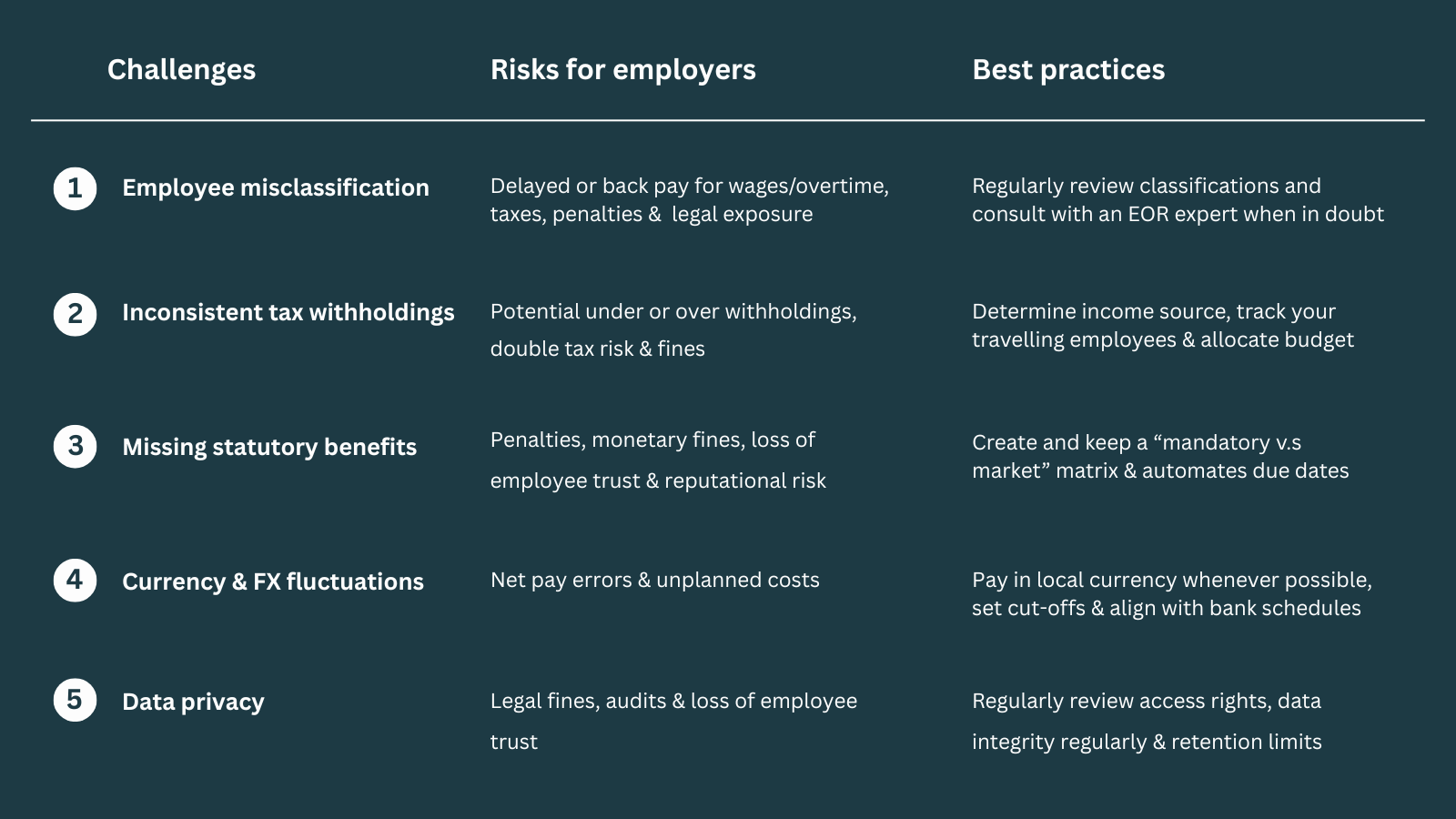
Managing a multi-country workforce is complex. We recommend planning ahead for the challenges below.
1) Employee vs. Contractor Misclassification
Confusing contracts for service with contracts of service can lead to payroll errors, missed benefits, and legal exposure.. Employers should regularly track and review workers’ involvement and use indicators like hours worked, contract scope, and the level of control you have over the workers.
2) Inconsistent Tax Withholding Across Jurisdictions
Cross-border work triggers different payroll rules. For example, the OECD “183-day rule” only exempts host-country tax when all conditions are met. Social security may also be impacted unless a totalization agreement applies when employees work both in the U.S. and in a foreign country. Incorrect tax handling can trigger penalties, double taxation, and retroactive corrections.
3) Overlooking Local Statutory Benefits
Using “U.S. social benefit standards” as a baseline for all International markets can easily lead to inaccurate cost control, delay in payment, and simple miscalculations. For example, Singapore has statutory CPF and SDL contributions that require contributions from both the employer and the employee, Hong Kong’s MPF is determined by income brackets, and the UK's NIC scheme requires increased contributions by employers starting in 2025. Misunderstanding your obligations as an employer will cause legal and financial risks.
While some statutory benefits are required by local laws, simply offering the bare minimum can impact your ability to attract and retain talent.
4) Currency and FX Rate Fluctuations
If you are paying in multiple currencies, you might risk delaying pay day or not paying in full due to currency fluctuations. Continuous mishandling of cross-border and multi-currency payments can also increase hidden costs. We recommend using local currency for payroll, scheduled exchange conversions, and leaving a 3-5% buffer to avoid underpayment.
5) Data Privacy Under GDPR or Local Laws
Moving employee data across borders requires a lawful transfer mechanism like Standard Contractual Clauses (SCCs) in addition to core GDPR principles. Non-compliance can also draw bans or fines up to €20M or 4% of global turnover. Make sure you work with a trusted global payroll partner or utilize compliant International HR solutions to cover all your bases.
5. Risk Mitigation & Best Practices

Before you enter a new market, align on the fundamentals that keep payroll clean and compliant. We are providing five best practices below to help you mitigate risks.
- Do due diligence before entry: Confirm your hiring model, required tax IDs and social contributions, pay-cycle rules, and employee classification. Create a country checklist and compliance calendar to track progress.
- Secure data protection: Treat payroll as sensitive Personally Identifiable Information (PII) and set up security measures like access rights and encryption. Use a trusted partner for storing and transferring sensitive data.
- Regularly review contracts: Create localized employment and contractor terms based on host-country laws and do quarterly or yearly reviews. We also recommend consulting with an HR solution partner that has experience in global payroll and multi-market expansion.
- Schedule annual audit: Run annual compliance audits across payroll, tax, and benefits before a new fiscal year starts. Update your workforce status sheet and upcoming key dates for any payment, visa renewals, and employee re-classification.
- Work with an HR partner: Work with a trusted EOR and global payroll provider like Slasify to streamline and simplify International hiring, onboarding, contracts, document filing, and compliance checks. Leverage our International payroll checklist and work visa guide for 2026 to stay compliant.
6. How Slasify Helps U.S. Companies Expand Overseas

Overseas expansion presents opportunities but also comes with complexity in managing talent, payroll, taxes, and compliance. Many companies choose to work with an Employer of Record (EOR) partner like Slasify that offers International HR solutions and global payroll services. With Slasify, you gain the following advantages:
- Global Employer of Record (EOR): Hire legally in 150+ countries without setting up a local entity. Slasify acts as the legal employer to handle everything from hiring, onboarding, payroll, benefits, and compliance checks, so you can focus on developing your talent and growing the market.
- Global Payroll Management: With support for 130+ currencies, Slasify handles local payroll and automates public holiday pay, leave-in-lieu, and overtime calculations, and aligns the totals with benefits, insurance, and tax with complete audit records.
- Visa Support: As the legal employer in your market, Slasify tracks your employee status and manages visa applications and renewals to ensure your local team can operate without talent shortages or turnover disruptions.
- Compliance Automation: Slasify tracks and automates payroll, taxes, and HR compliance in accordance with local laws to help you stay compliant consistently. With dedicated local expert support, you are always getting the latest updates and advisory for any regulatory change that could impact your HR decisions.
7. Conclusion
Expanding globally requires constant attention to your payroll, visa, and compliance planning from day one to the end of the year. Not knowing the rules for each market can easily lead to careless handling of payroll, statutory enrollment, employee benefits, and more.
By working with a trusted Employer of Record (EOR) and global payroll partner like Slasify, you can consolidate hiring, onboarding, payroll, and compliance into a seamless experience for your HR team and new hires alike. With support for over 150 countries and 130 currencies worldwide, Slasify makes it easy for you to expand into regions like Southeast Asia, where HR requirements vary by country and can become hard to follow. Talk to our global expansion experts today to learn how you can start 2026 in confidence.
8. FAQs for U.S. Companies Hiring Abroad and Expanding Overseas

Q1: What’s the easiest way for U.S. companies to hire abroad legally?
Use an Employer of Record (EOR) so you can hire in another country without setting up a local entity, while the EOR handles employment, payroll, taxes, and compliance, and you manage day-to-day work.
Q2: How do EOR services simplify global payroll?
An Employer of Record (EOR) manages local payroll for you, including withholding, tax remittance, calculations, and required report filing. If there's a need for multi-currency payroll, an EOR can help track cut-off and payout dates to minimize unnecessary costs from fluctuating exchange rates and payment delays. Everything can be centralized in one place for your HR team.
Q3: What are the common work visa categories for overseas teams?
In most countries, common work visa categories generally cover professionals, entrepreneurs/investors, domestic helpers, and trainees/students. Employers are responsible for sponsoring, applying, and renewing for the employees. Each country also has its own unique requirements. For example, Singapore offers Employment Pass for professionals and S Pass for skilled workers, whereas Hong Kong has special permits for Mainland workers.
Q4: How can Slasify assist in global workforce compliance?
Slasify provides trusted Employer of Record (EOR) and global payroll solutions to hire legally in 150+ countries and handle local contracts, multi-market payroll, and tax filing. You will also have access to a dedicated account manager to advise on compliance and HR decisions. Talk to our global HR expert today to learn how you can simplify hiring and onboarding for your new market.