|
Key Takeaways
|
- Cross-border offboarding has seven universal steps, notice confirmation, final-pay calculation, statutory deregistration, benefits termination, asset recovery, documentation, and regulatory filings but the legal floor under each step varies sharply by country.
|
- Notice periods range from 1 day in Singapore (under 26 weeks of service) to 30 days in the Philippines for authorized-cause termination, with the UK at 1 week per year of service up to a 12-week maximum.
|
- Final-pay deadlines are the most common trap: same-day in California for involuntary terminations, 7 days in Hong Kong, 30 days in the Philippines. Missing these triggers compounding penalties.
|
- Country-specific documentation (Singapore CPF records, Philippines Certificate of Employment + BIR 2316, Hong Kong Form IR56F, UK P45, Germany Arbeitszeugnis) is enforceable and missing any one can delay the employee's access to statutory benefits or new employment.
|
Most companies have an onboarding process. Fewer have a documented employee offboarding checklist. And almost none have one that accounts for international employment law.
An employee in Singapore is entitled to encashment of unused annual leave on termination. An employee in the Philippines may be entitled to separation pay, depending on the termination reason. An employee in Germany needs a formal Arbeitszeugnis (an employment reference letter with specific structural requirements). Neglecting these requirements significantly increases the risk of legal claims and statutory penalties.
Offboarding is where most cross-border employment disputes originate, because it is the moment when statutory obligations that were easy to overlook during the employment relationship become enforceable demands. Notice periods that were never documented. Severance calculations that were never run. Final-pay deadlines that were never tracked.
What follows is the full 2026 employee offboarding checklist for cross-border exits: the seven-step process, the country-by-country variation in notice, severance, and final-pay timing, and how an Employer of Record handles the offboarding compliance for employers hiring through our infrastructure.
What this employee offboarding covers

A global offboarding process should include:
- Confirming the notice period and final working day
- Calculating final pay, including unused leave, prorated bonuses, and severance where applicable
- Updating statutory contribution, tax, and benefits records
- Recovering company assets and revoking system access
- Issuing required documents, such as tax forms, certificates of employment, and reference letters
- Filing country-specific regulatory notifications where required
Requirements vary sharply by country. An Employer of Record helps manage the process according to the employee’s local employment law.
The cross-border offboarding checklist

The seven global offboarding process steps below apply in every country. What varies is the legal floor under each step.
Step 1: Confirm notice period and final working day
The notice period is set by whichever is longer: the employment contract or the statutory minimum. In most APAC and European markets, the statutory minimum is binding and cannot be contracted below.
Common statutory minimums:
- Singapore: 1 day for under 26 weeks of service, scaling to 4 weeks for 5+ years.
- Philippines: 30 days for authorized-cause termination by the employer.
- Hong Kong: 1 month or payment in lieu after the probation period.
- UK: 1 week per year of service, up to a 12-week maximum.
- US: no federal mandate; some states require specific final-pay timing that effectively sets a de facto notice timeline.
Once the notice period is confirmed, the final working day and the employment end date are set. These two dates are not always the same: a resignation on 1 May with a 4-week notice gives an employment end date of 29 May, but the employee may be placed on garden leave or transitioned earlier.
Step 2: Calculate final pay
Final pay includes more than the last month's salary. A correct calculation covers:
- Base salary through the employment end date.
- Pro-rated bonus or 13th-month pay.
- Encashment of accrued but unused annual leave (mandatory in most APAC markets).
- Any contractually owed commission or variable pay.
- Severance or redundancy pay, where applicable under local law.
- Any expense reimbursements owed to the employee.
- Deductions for notice shortfalls, asset non-return, or overpaid advances (where local law permits).
The calculation is jurisdiction-specific. In Singapore, annual leave encashment is at the employee's last-drawn basic salary rate. In the Philippines, 13th-month pay is pro-rated based on months worked in the calendar year. In Germany, notice-period pay is part of the formal settlement, and errors here are frequent grounds for wrongful-termination claims.
Step 3: Deregister from statutory programs
The employee must stop, update, or close statutory contribution, tax, and social insurance records where local rules require it. Each program has its own deregistration process and deadline.
- Singapore: CPF contributions stop after the final payable wages; employers should ensure CPF contributions are correctly submitted for the final pay cycle and update CPF employer records where required.
- Philippines: SSS, PhilHealth, and Pag-IBIG each require separate reporting of the employment termination.
- Hong Kong: MPF trustee notification and final-contribution calculation.
- UK: HMRC real-time-information (RTI) reporting includes the leaving date; P45 issued to the employee.
- US: state unemployment-insurance notification; final payroll reflects the termination in federal and state reporting.
Missing a deregistration can create phantom ongoing contributions and payroll-reporting mismatches that are harder to fix retroactively than to handle at the time.
Step 4: Terminate benefits enrollment
Health insurance, retirement plans, life insurance, equipment stipends, and any other employer-provided benefits need to be formally ended. In some countries, benefit continuation is mandatory for a period after employment (US COBRA for group health insurance, for example). The employee's notice of benefit-continuation rights is itself a regulated document in several jurisdictions.
Step 5: Recover company assets and revoke system access
The operational side of offboarding is familiar:
- Laptop, phone, and any other physical equipment returned.
- Access badges collected.
- Email, Slack, VPN, SSO, and cloud-service access revoked as of the final working day.
- MFA devices and shared credentials rotated.
For remote employees, asset recovery involves shipping logistics. A clear asset-return process, with pre-paid shipping labels and a confirmation workflow, is the difference between a smooth offboarding and a small-claims case. For critical-access roles, system-access revocation should be staged: read-only during the transition period, fully revoked on the final working day.
Step 6: Issue required documentation
Most countries require specific documents at the end of employment. Missing any of these can delay the employee's ability to collect statutory benefits or take up new employment.
- Singapore: Statement of pay for the final cycle; CPF contribution records.
- Philippines: Certificate of Employment (mandatory within three days of request), BIR Form 2316 for tax records.
- Hong Kong: Form IR56F (notification of cessation of employment) to the Inland Revenue Department within one month.
- UK: P45 (three parts), which records pay and tax for the year to date.
- US: final paycheck per state timing rules; W-2 at the end of the tax year.
- Germany: Arbeitszeugnis with structured formatting requirements.
Step 7: File regulatory notifications
Many countries require the employer to notify government agencies of the termination independently of the employee-facing documents.
- Singapore: CPF Board notification via the employer portal.
- Philippines: DOLE notification for authorized-cause terminations; BIR annual alphalist reconciliation.
- UK: HMRC RTI final submission; pension regulator notification for auto-enrollment members.
- US: state unemployment-insurance reporting; federal and state final payroll returns.
Skipping these filings does not usually trigger immediate penalties, but they surface during audits or when the worker applies for unemployment or statutory benefits and discovers the record is incomplete.
Country-specific offboarding requirements
The step-by-step applies universally. Here is what the specific legal requirements look like country by country:
Offboarding requirements by country
|
Country
|
Notice period
|
Severance requirement
|
Final pay deadline
|
Key required documents
|
|
Singapore
|
1 day to 4 weeks (service-length-based)
|
None under 2 years; by contract thereafter
|
Last day of employment or next working day
|
CPF records; leave encashment statement
|
|
Philippines
|
30 days (authorized cause)
|
1 month per year of service (authorized cause)
|
Final pay within 30 days of separation (DOLE guidance)
|
Certificate of Employment; BIR Form 2316
|
|
Hong Kong
|
1 month or payment in lieu
|
Long-service or severance payment formula (5+ years)
|
Within 7 days of termination
|
Form IR56F
|
|
United Kingdom
|
1 week per year of service (max 12 weeks)
|
Statutory redundancy pay (2+ years' service)
|
Last regular pay day
|
P45
|
|
United States
|
At-will in most states; state-specific final-pay rules
|
No federal mandate
|
State-specific (same day in CA for involuntary termination)
|
W-2 at year end; state final-pay compliance
|
|
Japan
|
30 days or payment in lieu
|
Typically by contract; retirement-allowance customs
|
Within 7 days of request
|
Certificate of employment
|
|
Taiwan
|
10 to 30 days (service-length-based)
|
Pension payment; severance per Labor Standards Act
|
Within 30 days
|
Separation documentation
|
The California final-pay rule is a specific trap worth flagging. An employee involuntarily terminated in California must receive their final pay on the same day as the termination. Missing this deadline triggers waiting-time penalties that compound daily, and California's enforcement record on this is aggressive.
Running offboarding in-house, or through an EOR
The seven steps above do not change. What changes is who carries them, and who is liable if a step is missed. There are three ways to hold the relationship, and offboarding looks different in each.
Direct employment through your own entity. You run all seven steps yourself, in the local language, against local deadlines. This is the right model once a country holds enough headcount to justify local human resources and legal support. Where you own the entity but not the payroll capacity, our Global Payroll service runs final-pay calculation and statutory deregistration inside your entity, while the employment liability stays with you.
Employment through an Employer of Record. We are the legal employer, so steps 1, 2, 3, 6, and 7 are ours. You make the termination decision and communicate it, and we execute notice, final pay, deregistration, documentation, and regulatory filing to the local deadline. This is the faster route for the first handful of people in a country, and the safer one in jurisdictions with strong dismissal protection. Pricing starts at USD 250 per employee per month.
Global Contractor engagements. Ending a genuine contractor engagement is a contract termination rather than an employment termination, so most of this checklist does not apply. That is only true while the engagement is genuinely independent. If the contractor has been working set hours under your direction, a tribunal or tax authority may find the engagement was employment all along, and the offboarding you owe becomes the employee one. That means notice, back-dated statutory contributions, and severance in the countries that provide for it, which is not all of them. Reclassification is commonly tested at exactly this moment. Pricing starts at USD 50 per contractor per month.
The practical test is how many people you expect to hold in the country over the next two years and how protective its dismissal law is. We are happy to work through that with you before you commit to a structure.
How EOR manages global offboarding process
When the employment relationship runs through an Employer of Record, the EOR is the legal employer and the one carrying the compliance obligation at termination. The engaging company makes the termination decision and communicates it. The EOR executes the offboarding process according to local law.
For the engaging company, this removes the country-specific legal risk from the decision. The decision to end an engagement can be based on performance, business need, or role redundancy. The mechanics (notice period, severance calculation, final-pay timing, statutory deregistration, documentation) are handled by the EOR in the employment country.
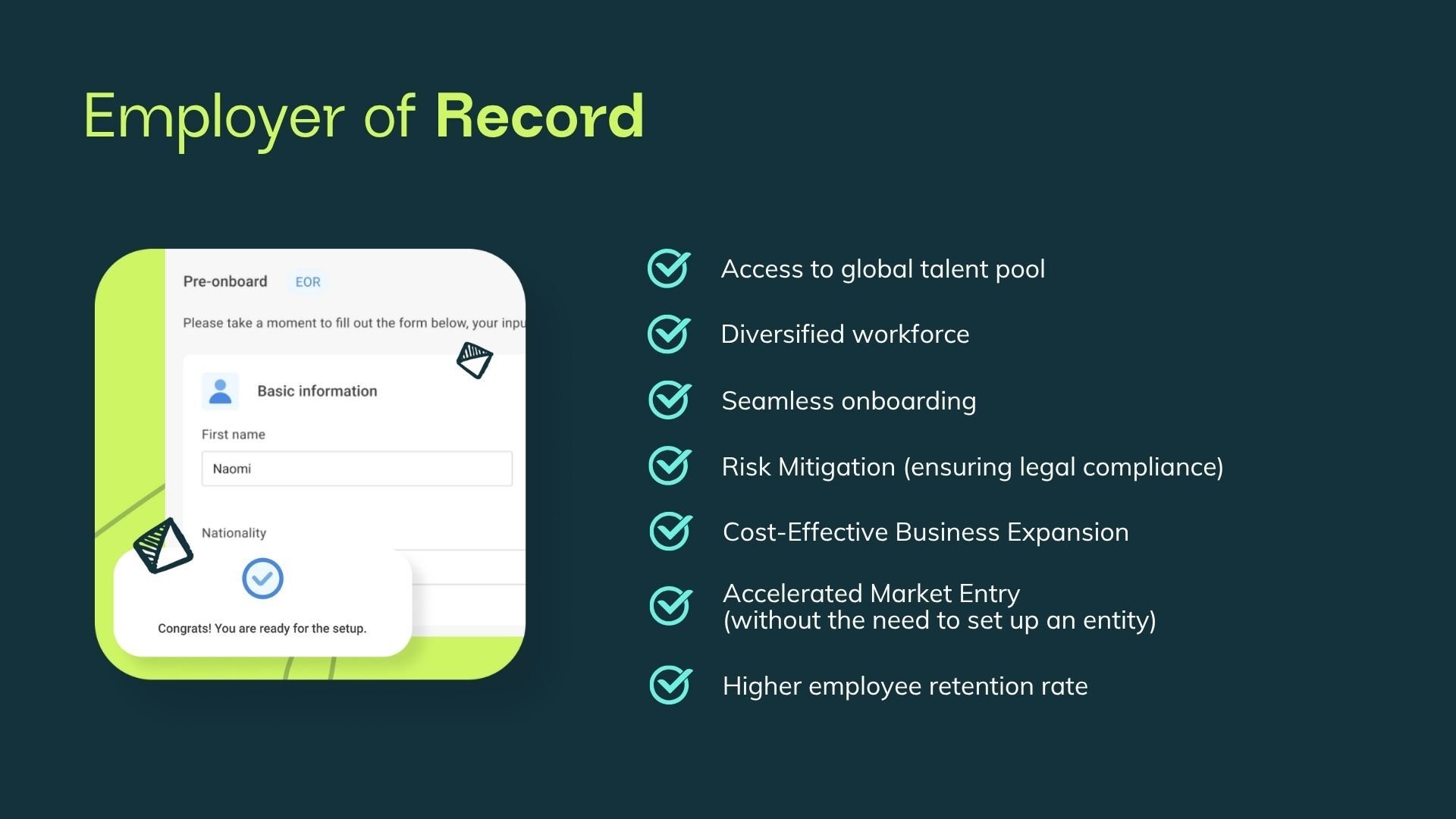
Our EOR handles the full offboarding workflow across 150+ countries with 600+ local compliance partners. For companies making termination decisions in markets with strong employee protections (Germany, France, Brazil, the Philippines), this is where the EOR structure earns most of its value.
Don't let a single offboarding error trigger a multi-country audit. Contact Slasify today to eliminate your global compliance risks and streamline your 2026 exit strategy with our EOR infrastructure.
Frequently asked questions

What should be included in an employee offboarding checklist?
An international employee offboarding checklist must include notice period verification, final pay calculation (severance, bonuses, leave), statutory deregistration (CPF/SSS/MPF), asset recovery, and the issuance of local-law termination documents. Following this structured approach ensures compliance across 150+ jurisdictions.
Is severance pay mandatory when terminating an employee?
Severance is mandatory in many countries and optional in others. The Philippines requires separation pay of 1 month per year of service for authorized-cause termination. The UK has a statutory redundancy-pay formula for employees with two or more years of service. Hong Kong has long-service and severance-payment formulas for 5+ year tenures. Singapore has no statutory severance for tenures under two years. The US has no federal mandate but state-specific rules and WARN Act obligations for mass layoffs.
How does offboarding work with an Employer of Record?
The engaging company makes the termination decision and communicates it through its EOR. The EOR then executes the full offboarding process: notice-period management, final-pay calculation, statutory deregistration, benefits termination, documentation, and regulatory filings. The engaging company avoids having to understand the country-specific mechanics. The EOR's local compliance infrastructure handles the process to the local legal standard.
What is the deadline for final pay in international terminations?
Final-pay deadlines vary. California requires same-day final pay for involuntary termination. The Philippines' DOLE guidance is within 30 days. Hong Kong's Employment Ordinance is within 7 days. Singapore's rule is final pay on the last day of employment or the next working day. UK final pay is the regular next pay day. Missing the deadline in jurisdictions with strong enforcement (California, the Philippines, Germany) creates compounding penalties and claim exposure.
What happens to statutory benefit contributions after termination?
Contributions stop after the final pay cycle in which the employee was employed. The employer must formally deregister the employee from each statutory program (CPF, SSS, PhilHealth, Pag-IBIG, MPF, NIC, FICA). Missing a deregistration can cause phantom ongoing contribution records that are harder to fix after the fact than to handle at the time of termination.
Does Slasify handle offboarding documentation?
Yes. Our EOR issues all required local-law documentation: certificates of employment, tax forms (Form 2316 in the Philippines, P45 in the UK, W-2 in the US), pension and social-insurance records, and any country-specific reference letters or separation notices. This is part of the full offboarding workflow we handle end to end.
Next steps
Offboarding is where the cost of weak compliance infrastructure becomes visible. For companies hiring directly into multiple countries without strong local HR and legal support, the offboarding process is where most of the real claims and regulatory friction surface.
Our EOR handles offboarding across 150+ countries. For companies that have experienced offboarding issues in specific markets, or that are planning termination decisions in jurisdictions with strong employee protections, request a demo and we can walk through the specific scenario, including which of the three models above fits the country you are hiring in.