EMPLOYER OF RECORD IN CHINA
Last updated: November 2026
| Key Takeaways |
| An Employer of Record (EOR) uses a local employing entity to handle agreed employment administration while your team manages the work. The arrangement must fit the role and location. |
| Verify the actual employing entity and applicable legal requirements before approving a China hire; an EOR service label or a provider's license alone does not establish suitability. |
| Your managers still need to provide accurate payroll inputs, document working time, and coordinate changes in duties, compensation, and location. |
| Ending a commercial assignment does not automatically end the employee's labor contract or remove obligations during a provider change. |
| Assess employee data transfers and corporate tax exposure separately, and retain evidence of the employment work your provider performs. |

By the time you agree on a salary with a candidate in China, you may already be discussing a start date and onboarding. Those plans also depend on a few less visible decisions: who employs the person, where contributions are paid, and how the arrangement can end.
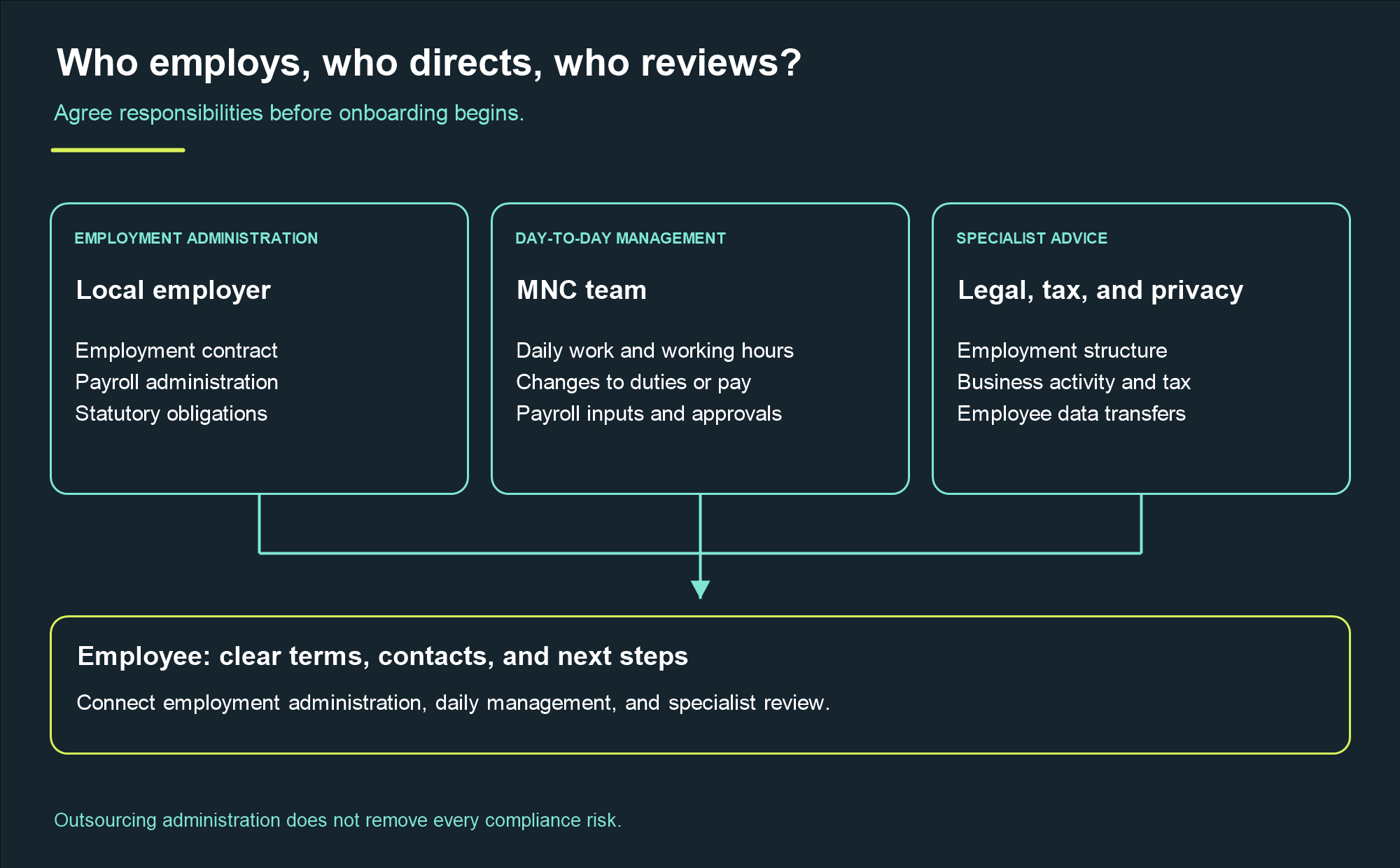
For a multinational corporation (MNC), an Employer of Record in China can provide a local employing entity and administer contracts, payroll, and statutory contributions. Your team still directs the work and supplies the information needed to keep those records accurate. The legal structure must also fit the role and receiving arrangement.
The practical controls are to align employment terms with actual work, reconcile payroll and contribution records, and plan changes before managers communicate them. This guide covers mainland China; Hong Kong, Macao, and Taiwan have separate employment frameworks.
1. Employer of Record in China: Check the Employment Arrangement Before You Hire
Before approving a hire, identify the legal employer and the legal basis of the proposed arrangement.
Begin a China EOR assessment with the actual employing entity, the organization receiving the employee's work, the city where the employee will work, and the duties involved. Ask who signs the employment contract and how the contractual relationships correspond to daily management. A proposal that names only an international service brand leaves these questions unanswered.
Distinguish labor dispatch from other arrangements
Under China's Labor Contract Law, labor dispatch is subject to licensing and specific employment obligations. Where dispatch applies, role eligibility matters alongside the provider's license. Dispatched workers also have equal-pay rights under the law.
The Interim Provisions on Labor Dispatch generally restrict dispatch to temporary, auxiliary, or substitute roles: a role lasting no more than six months, a non-core support role, or temporary cover for an absent employee. Dispatched workers generally cannot exceed 10% of the receiving employer's workforce, counting both direct and dispatched employees.
Under Article 25 of the Interim Provisions on Labor Dispatch, foreign enterprise resident representative offices and representative offices of foreign financial institutions are exempt from the role restrictions and 10% ratio, but other dispatch requirements still apply. An overseas headquarters without a registered mainland representative office does not qualify automatically. The provisions also address arrangements called outsourcing that operate as dispatch.
Use your business situation to frame the assessment:
| Your situation |
Route to assess |
Deciding question |
| Overseas headquarters without a suitable mainland employing entity |
Proposed EOR structure and actual employing chain |
What is the legal basis for this role and receiving arrangement? |
| An appropriate China entity already exists |
Direct employment, potentially with Global Payroll support |
Can that entity employ the worker for the actual activities and location? |
| A temporary, auxiliary, or substitute staffing need |
Dispatch where applicable requirements are met |
Do role, ratio, licensing, and any relevant exception fit? |
| A defined outsourced business service |
Genuine service outsourcing |
Does operational practice match a service arrangement rather than dispatch? |
Table note: These are assessment routes, not findings that a proposed arrangement is lawful.
Get a role-specific explanation
Ask the provider to identify the employing entity and explain how the arrangement fits the role, location, and day-to-day management, including any local partner. For an overseas client without a suitable mainland entity, obtain a China employment-law assessment of that structure before signing.
2. Control Contract, Payroll, and Day-to-Day Employment Risks
Once the arrangement is suitable, keep the written terms, actual work, and payroll records aligned. The provider needs timely information from your team to administer changes; your managers need a clear route for reporting them.
Employment terms and manager conduct
Check the employee's duties, work location, compensation, probation terms, and renewal dates before the start. Under the Labor Contract Law, a written contract must be signed within one month if none is signed when employment begins. The terms and local policies should match what managers tell the employee.
—Working time: The standard working-hours rules provide for an eight-hour day and 40-hour week. Record recurring late meetings and agree how applicable overtime is approved and paid; an overseas reporting line creates no exemption.
—Changes: Route pay, duty, location, and schedule changes through HR before implementation. For bonuses, name the person submitting the amount, the person checking its treatment, and the payroll cutoff.
—Manager instructions: Cover leave, workplace safety, and confidentiality in the operating guidance, and record any required changes to employment terms.
For communication practices, see our guide to managing remote teams in China.
Payroll, social insurance, and the housing fund
Reconcile salary, individual income tax (IIT), social insurance, and the housing provident fund separately. Each needs a different check:
| Item |
What to verify |
| Salary |
Approved pay, bonuses, and allowances match the payroll calculation and payment record. |
| Individual income tax (IIT) |
Under Article 9 of the Individual Income Tax Law, the income recipient is the taxpayer and the payer is the withholding agent. Name who handles withholding and filing. |
| Social insurance |
The Social Insurance Law requires employee registration within 30 days of starting work and timely, full contributions. The 2025 judicial clarification, effective September 1, 2025, confirms that an agreement to waive social insurance contributions is invalid. |
| Housing provident fund |
Under the housing provident fund rules, check required registration, the applicable contribution base and rate, and payment records. Keep these records separate from social insurance. |
For cross-region labor dispatch, Articles 18–19 of the dispatch provisions require social insurance in the receiving unit's location. If work and contribution locations differ, ask how the setup meets the applicable rules.
An invoice or salary transfer alone does not establish that all payments and filings were made. Match the payroll report to approved changes and the relevant payment and statutory records.
3. Plan for Assignment Endings, Termination, and Transfers
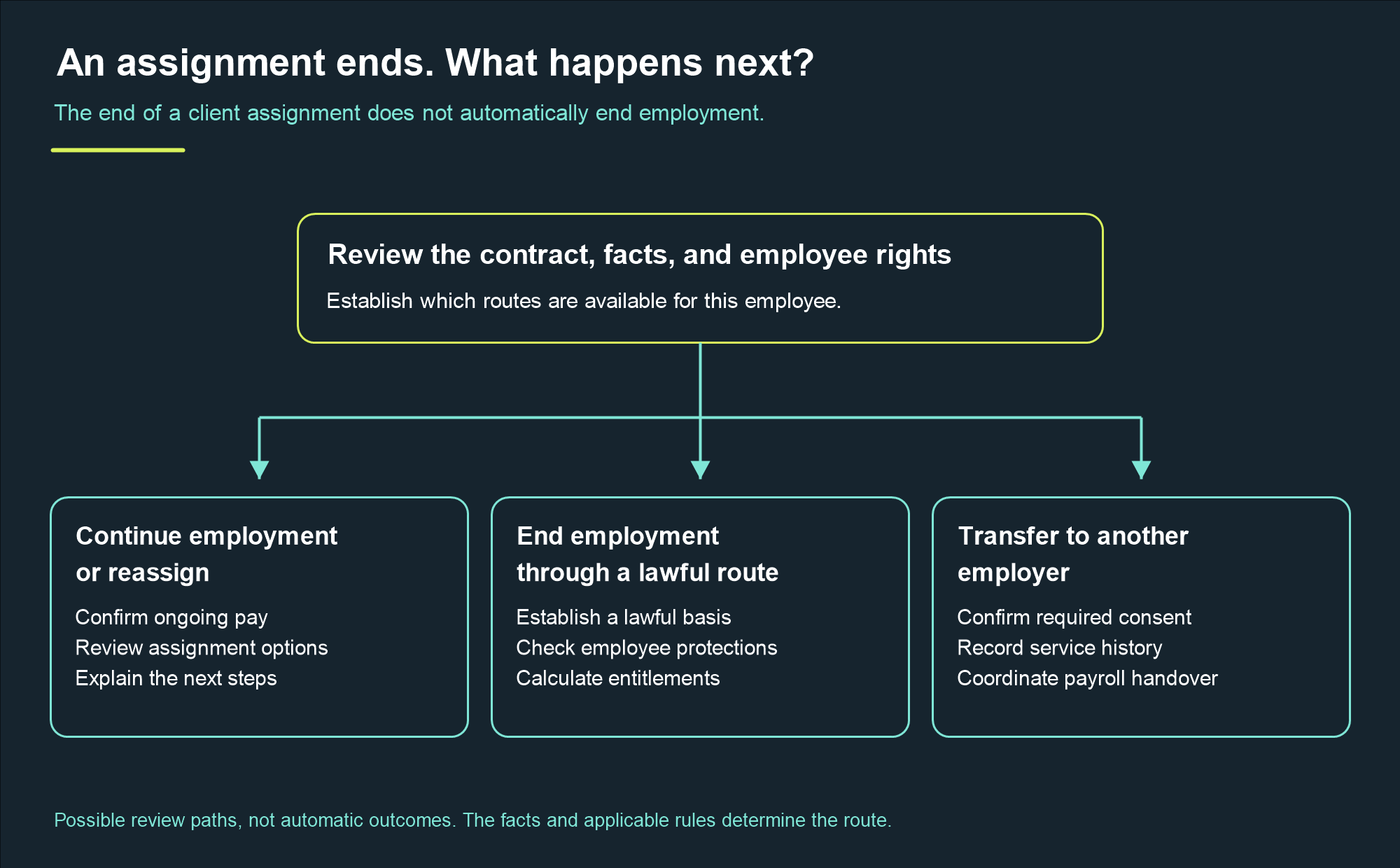
Ending your need for a role is a business decision. Ending the service agreement, returning a dispatched worker, and terminating employment are different actions with different consequences.
Before a manager communicates an exit decision, ask the provider for the applicable route, supporting facts, employee protections, process, potential compensation, and allocation of costs. Budget for those obligations rather than assuming the service fee includes them.
Separate assignment return from employment termination
Returning a dispatched worker and ending their labor contract are separate actions under the dispatch provisions. The employer may still owe pay between assignments, so ending the client service agreement does not settle all employment obligations.
Before communicating an exit, ask HR and the provider to establish the facts and process, the legal team to assess the route, and finance to approve the cost allocation. The Labor Contract Law makes three points relevant to that decision:
—Employee protections: Some dismissals are restricted, and contracts can be extended during protected periods such as pregnancy, maternity leave, and nursing.
—Severance: Where due, the calculation generally starts at one month's pay per year of service, subject to partial-year rules and caps for higher earners.
—Unlawful dismissal: Remedies can include reinstatement or compensation at twice the statutory severance standard.
Protect continuity during a change of employer
If you move the worker to another provider or your own entity, document the transfer route before setting the effective date. Confirm any required employee consent, treatment of service history, accrued leave and benefits, final payments, contribution changes, and record handover.
Article 10(3) of the 2025 judicial interpretation treats certain changes of contracting employer as two consecutive fixed-term contracts for open-ended contract purposes. This applies when, for reasons not attributable to the worker, they remain in the same workplace and role under the employer's continued management, and the contract expires.
Also close practical gaps: equipment return, system access, confidentiality documents, and intellectual property (IP) arrangements. Check that the relevant parties and rights are covered instead of assuming the EOR's signature transfers all rights in the employee's work product to your company. If a noncompete is proposed, assess its applicability and scope separately.
Give the employee a consistent explanation of their employer, terms, payroll contact, and next steps. Conflicting messages from headquarters and the provider can turn an orderly handover into a dispute over what was agreed.
4. Address Data Transfers and Business Risks Beyond Employment Administration
Employment administration does not determine whether your employee data flows or business activities meet separate legal requirements. Assign those questions to the teams that control them.
Employee data and overseas headquarters access
Before adding an employee to your global HR system, map the fields headquarters needs, their purpose, and who can access them. Include overseas remote access, vendors, storage, retention, and deletion.
Under Article 5(2) of the 2024 provisions, necessary HR transfers under lawfully formulated labor rules and lawfully concluded collective contracts can be exempt from a data export security assessment, a personal information export standard contract, and personal information protection certification. Important data is excluded; applicable notice, consent, impact assessment, and security duties remain.
The CAC's October 2025 FAQ explains that ID, passport, and bank details must still meet the necessity test. Document why each field is needed and have privacy counsel assess the actual transfer before relying on the exemption.
Corporate tax and activity boundaries
An EOR contract does not settle China corporate-tax exposure. Domestic rules and any applicable tax treaty's permanent-establishment (PE) provisions depend on what the company actually does. For example, Article 5 of the corporate-tax implementation rules covers certain agents that regularly sign contracts on a nonresident enterprise's behalf.
Give your tax team the employee's duties, contracting authority, work location, and reporting relationships, and revisit the review when those facts change. Sector permissions and foreign-worker authorization need separate checks; a payroll arrangement cannot replace permission for the activity or person.
Preparing to hire in China? Share the role, work location, reporting line, and whether you have a local entity. Discuss your EOR requirements with us to understand the proposed employment and payroll support before setting a start date.
5. Vet the Provider and Keep an Evidence Trail
A useful provider review establishes who does the work, what they can document, and how your team will handle an exception. Keep the resulting evidence accessible after the procurement process is complete.
Verify the employing chain and commercial terms
Ask for a clear explanation of the following:
—Employing structure: The actual employer's legal name and registration, relevant licenses and validity, work locations, and any partner or subcontractor chain.
—Employment process: Sample documents, the role-specific rationale for the proposed arrangement, payroll components, contribution handling, and termination support.
—Commercial exposure: Setup and service fees, foreign-exchange charges, deposits, exit funding, and the limits and conditions of any indemnity.
—Operational continuity: Record access, complaint handling, data-processing terms, escalation contacts, and plans for disruption or provider replacement.
An indemnity is a contractual protection, not proof that statutory responsibility has disappeared. Its wording, enforceability, and the provider's ability to meet it all matter.
For a broader procurement framework, see our guide to choosing an EOR for local labor law compliance.
Agree on ownership after signing
Use an operating matrix to connect provider work with your approval process:
| Trigger |
Provider action to agree |
Your internal owner |
Evidence to retain |
| Before confirming a start date |
Explain the structure and prepare employment documents |
HR/legal approve; procurement verifies provider |
Employing chain, relevant licenses, terms, approval |
| Each payroll cycle |
Prepare calculations and supply agreed payment and filing records |
HR checks changes; finance approves and reconciles |
Approved inputs, payroll report, remittance evidence |
| A city, role, pay, or hours change |
Update affected employment documents and payroll records; flag any registration changes. |
Manager informs HR; specialists check implications |
Change request, advice, updated records |
| Employment ending or employer transfer |
Propose process, documents, and cost treatment |
HR/legal approve before communication |
Agreed route, employee documents, entitlements |
| Provider, license, or data-flow change |
Notify and supply updated evidence |
Procurement/privacy/legal reassess |
Change notice, revised terms, follow-up decision |
Table note: This is a recommended governance model. Agree the actual responsibilities in your contract; it is not a universal statutory allocation.
For an unresolved payroll item, record the missing evidence, owner, response deadline, and approval decision. "HR is awaiting September contribution records; the provider's response is due Friday" is more useful than "compliance pending." For an example of how these issues can surface together, see our China labor-inspection case study.
Pause approval if the provider will not identify the employer or explain contribution locations, and have HR or legal review the response. An employee waiver cannot replace statutory social insurance contributions.
6. How We Support Your China Employment Workflow
Once you have selected a candidate, our Employer of Record services support the employment administration behind the hire:
—Contracts and onboarding: We prepare contracts for review and coordinate onboarding requirements, so your team has one agreed set of terms and next steps.
—Payroll and statutory administration: We coordinate payroll using your approved inputs and document the agreed administrative responsibilities, helping HR and finance reconcile changes with the resulting records.
—A dedicated account manager: You have a named contact to coordinate late bonus changes, location moves, and payroll questions, with clear routes for the decisions your team needs to approve.
Before onboarding in China, agree on the actual employing entity, role, location, service scope, and records you will receive. Separate legal, tax, and privacy questions still need the appropriate specialists.
For teams operating beyond China, we support EOR services across 150+ countries through 600+ local partners and Global Payroll payments in 130+ currencies. If you already have an appropriate China employing entity, Global Payroll may fit better; your entity remains the legal employer.
An EOR arrangement works best when the contract, actual work, and payroll records stay aligned. Keep your managers involved in changes and require evidence of the employment administration you outsource.
Request a Slasify demo to discuss who would employ your China-based team, which employment and payroll tasks we would handle, and how your team would approve changes and review records.
7. Frequently Asked Questions About EOR in China
Q1. Can an overseas MNC use an EOR in China without its own mainland entity?
It depends on the proposed employment and receiving arrangement; an EOR service label is not enough. Before hiring without your own mainland entity, identify the actual employer and receiving party, confirm role and location requirements, and obtain a role-specific assessment of the proposed structure. Do not assume dispatch rules apply identically to an overseas headquarters and a registered representative office.
Q2. Can an MNC use an EOR if it already has a Chinese subsidiary?
Having a Chinese subsidiary does not, by itself, decide whether an EOR arrangement is appropriate. Identify which entity will employ or receive the worker and assess the role and working arrangement. Direct employment through a suitable entity may fit better. If the need is payroll administration, assess Global Payroll separately. Document the reason for the chosen structure before approving the start.
Q3. What is the difference between an EOR service fee and total employment cost in China?
The service fee is only one part of the employment budget. Compare salary, applicable employer contributions, agreed benefits, setup charges, foreign-exchange costs, and potential exit obligations. A deposit may also affect cash flow without necessarily becoming a final expense. Ask which amounts are refundable, when they are reconciled, and what costs fall outside the quoted fee. For a broader cost breakdown, see our guide to EOR pricing and fees. Use location-specific assumptions for statutory items.
Q4. Can an EOR arrange a work permit for a foreign national in China?
Not automatically. An EOR service agreement does not guarantee work-permit approval; feasibility depends on the proposed employer, role, location, and worker's eligibility. Work permits and work-type residence permits are separate requirements. Under the National Immigration Administration's residence-permit guide, Z-visa holders must submit a work permit and an employer certification letter when applying for a work-type residence permit. Confirm both routes before work begins.
Q5. What should an MNC do when the provider cannot show contribution records?
Request a reconciliation identifying the employee, contribution type, period, and missing evidence. Clarify which records can lawfully be shared, assign HR and finance to follow up, and keep the discrepancy open until it is resolved. An invoice alone does not prove payment. Obtain advice before changing payment or employment arrangements.
Q6. Does replacing the EOR provider erase the employee's service history?
Do not assume that replacing a provider resets the employee's service history or accrued rights. Establish whether the legal employer changes and how the transition will be implemented. Confirm continuity, accrued entitlements, consent where required, and the supporting records. Avoid presenting resignation as an automatic administrative step. Resolve the treatment before the effective date so the employee and both providers receive consistent instructions.
Sources
Labor Contract Law of the People's Republic of China
Interim Provisions on Labor Dispatch (Ministry of Human Resources and Social Security, State Council Gazette)
State Council Provisions on Working Hours
Individual Income Tax Law, Article 9
Social Insurance Law of the People's Republic of China
Supreme People's Court: Interpretation (II) on Labor Disputes (2025)
Supreme People's Court: Mandatory Social Insurance Payment Obligation
Regulations on the Administration of the Housing Provident Fund
CAC: Provisions on Promoting and Regulating Cross-Border Data Flows (2024)
CAC: Policy Q&A on Data Export Security Management (October 2025)
State Taxation Administration: Enterprise Income Tax Implementation Regulations
NIA: Service Guide on Issuance of Residence Permit for Foreigners