TAIWAN HIRING GUIDE
| Key Takeaways |
| — A foreign company without a Taiwan entity generally can't enroll an employee in Labor Insurance, NHI, or Labor Pension on its own. |
| — You have three compliant routes: set up a local entity, hire through an Employer of Record (EOR), or engage a genuine independent contractor. |
| — Employers in Taiwan pay 70% of Labor Insurance premiums, 60% of the NHI premium for the employee, and at least 6% of monthly wages into the employee's pension account. |
| — Taiwan judges employee status by the actual working relationship, not the contract title, so long-term "contractors" can create back-premium and penalty exposure. |
| — An EOR can usually onboard a Taiwan employee in about two weeks, compared with weeks or months to register a subsidiary. |
Last reviewed: November 2026
This article is general guidance, not legal advice. Taiwan's rules and how authorities apply them can change, so confirm details with the Ministry of Labor (MOL) or a qualified Taiwan employment-law professional before you act.
You've found a strong engineer in Taipei. They're ready to start, and the obvious plan is to add them to your US or EU payroll and send a monthly wire. In Taiwan, that plan usually doesn't hold up.
If you want to hire remote workers in Taiwan, you need more than a way to move money. Taiwan's Labor Insurance, National Health Insurance (NHI), and Labor Pension schemes generally run through a locally registered employer. This guide explains the three legal ways to hire in Taiwan, what you owe an employee there, and the risks to check before you send an offer.
Can a Foreign Company Hire Remote Workers in Taiwan Without a Local Entity?
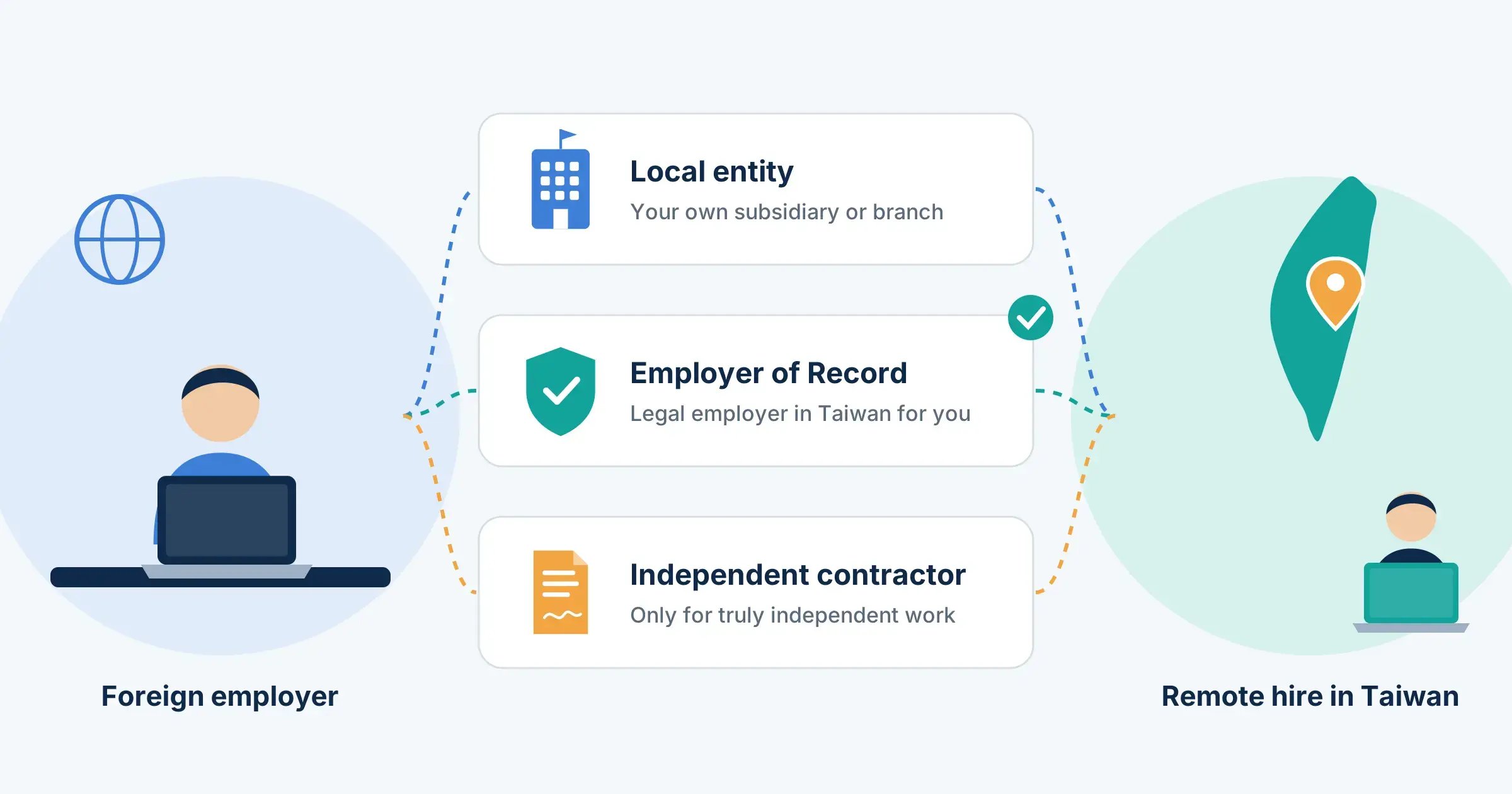
Yes, but not by employing them directly. A foreign company without a Taiwan entity can hire through an Employer of Record, which becomes the legal employer in Taiwan, or engage someone as an independent contractor if the working relationship really is independent. What it generally can't do is put a Taiwan resident on an overseas payroll and treat them as an employee.
According to the Bureau of Labor Insurance, Taiwan's insurance and pension schemes are built around an employer registered in Taiwan, which files enrollment and contributions under its local registration. A foreign company paying from abroad generally has nothing to enroll its worker under, which can leave the worker uninsured and the company exposed. Note that a unit without a company or business registration can file a tax withholding registration instead, and a foreign company's representative office may enroll voluntarily. Employment Insurance and occupational accident insurance also run through the employer.
Why Foreign Employers Are Hiring in Taiwan
Taiwan has a deep bench of engineering, semiconductor, hardware, and software talent, and its UTC+8 time zone gives US and European teams overnight or early-morning coverage across Asia. Salaries are also competitive for the skill level; see our guide to the average salary in Taiwan in 2026 for current role benchmarks.
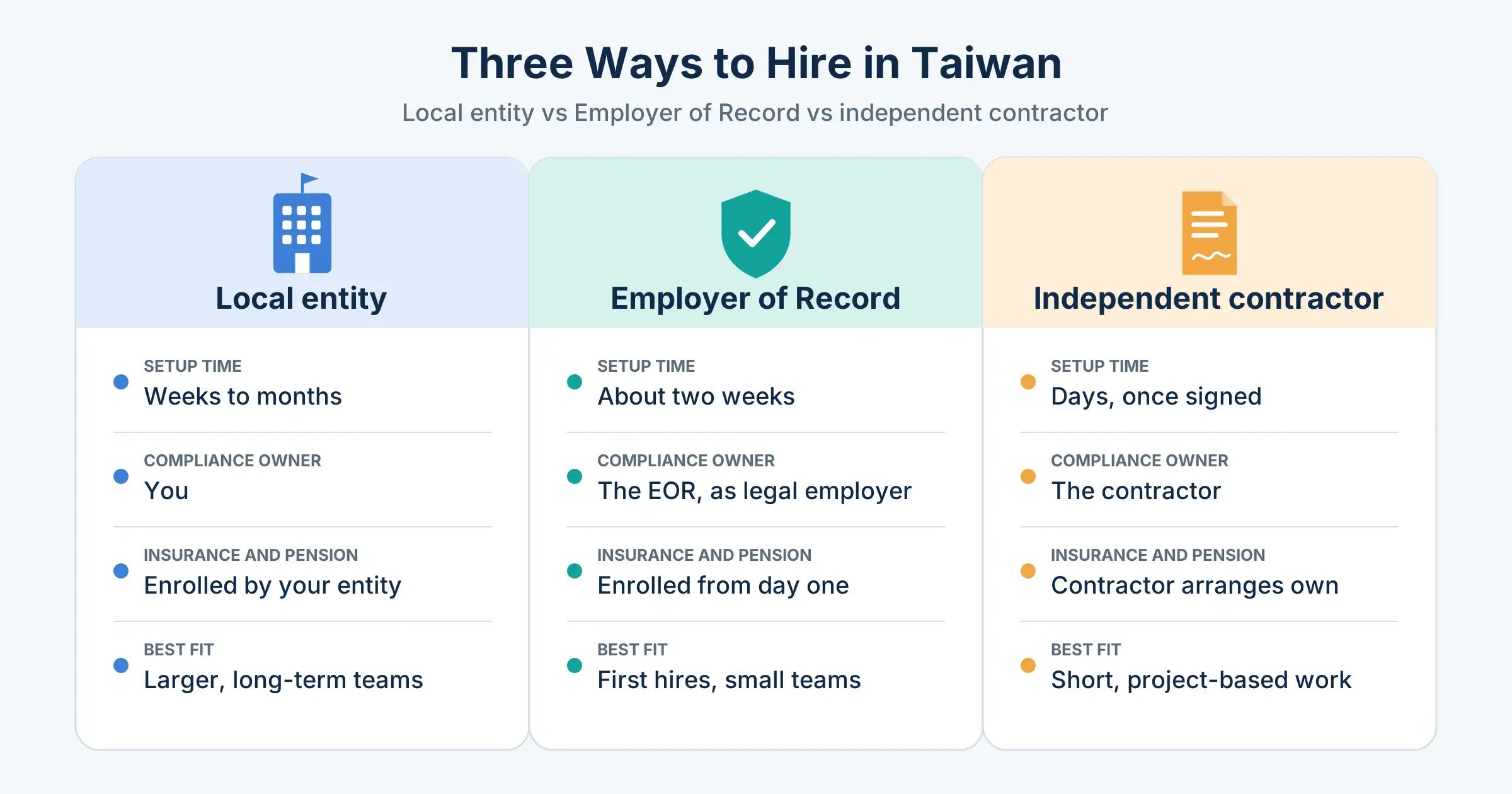
Three Legal Ways to Hire in Taiwan: Entity, Employer of Record, or Contractor
Each route fits a different stage of expansion. The right choice depends on how many people you plan to hire, how long you'll stay, and how much control you need over the role.
| Factor |
Local entity (subsidiary or branch) |
Employer of Record (EOR) |
Independent contractor |
| Setup time |
Several weeks or more, from foreign investment approval through company registration |
About two weeks to onboard |
Days, once a contract is signed |
| Main cost drivers |
Registration, capital, accounting, local payroll and HR staff |
Monthly service fee plus salary and statutory contributions |
Agreed fee; no statutory employer contributions |
| Who owns compliance |
You |
The EOR, as legal employer; you direct the daily work |
The contractor, provided the relationship is truly independent |
| Statutory insurance and pension |
Yes, enrolled by your entity |
Yes, enrolled by the EOR from day one |
No; the contractor arranges their own cover |
| Best fit |
Larger, long-term teams in Taiwan |
First hires, small teams, market testing |
Short, project-based, independent work |
What does an Employer of Record do in Taiwan?
Definition: An Employer of Record (EOR) is a company with its own Taiwan entity that legally employs your worker. It signs the employment contract, runs payroll, and files the required insurance and pension enrollments.
The EOR issues a contract that complies with the Labor Standards Act, enrolls the employee in Labor Insurance, NHI, and Labor Pension, and handles withholding and filings. You manage the employee's day-to-day work.
One important caveat: Taiwan law has no "Employer of Record" category, and an arrangement where one company employs a worker while another directs their work may be treated as labor dispatch. Under those rules, your company can share liability for unpaid wages and workplace injuries, and you may not interview or select the worker before the EOR signs the employment contract. The worker can also ask to be hired by you directly within 90 days of starting. If you've already picked your candidate, read our guide to Taiwan's labor-dispatch rules and confirm the setup with your EOR before moving forward.
For a first hire, an EOR removes the need to register a company before you know whether Taiwan is a long-term market. If the team grows, you can later move employees to your own entity.
When does hiring a contractor in Taiwan make sense?
A contractor setup works when the person really runs an independent business: they set their own hours, use their own tools, work for other clients, and deliver defined projects. It doesn't fit a full-time engineer who attends your standups, follows your schedule, and works only for you.
If the relationship is independent, Slasify's Global Contractor service handles contracts and compliant payments. If you need a local partner to hold the contractor relationship for you, compare the options in our guide to Contractor of Record vs Global Contractor. For withholding and supplementary premium rules, see paying contractors in Taiwan.
What Do Employers Owe Remote Employees in Taiwan?
Employing someone in Taiwan, directly or through an EOR, brings a fixed set of obligations under the Labor Standards Act and related insurance laws. Remote work doesn't change them.
—Minimum wage. The minimum wage is NT$29,500 (New Taiwan dollars, about US$923) a month and NT$196 (about US$6.15) an hour in 2026, according to the Ministry of Labor. A rise to NT$30,900 and NT$205 from January 1, 2027 has been approved by the Executive Yuan (Cabinet).
—Labor Insurance and Employment Insurance. The ordinary Labor Insurance rate is 11.5% and Employment Insurance is 1% of the insured salary, with the employer paying 70%, according to the Bureau of Labor Insurance. Employers also pay the full occupational accident insurance premium for Taiwanese employees. Labor Insurance is compulsory for employers with five or more employees and voluntary below that (Labor Insurance Act Arts. 6 and 8), while Employment Insurance and occupational accident insurance have no headcount threshold. Taiwan News reports the combined Labor Insurance rate rises 0.5 points to 13% in 2027 (ordinary rate 12%).
—National Health Insurance (NHI). The NHI premium rate is 5.17%, and the employer pays 60% of the premium for each insured employee, according to the National Health Insurance Administration.
—Labor Pension. Employers must contribute at least 6% of the employee's monthly contribution wage to an individual pension account under Article 14 of the Labor Pension Act. The employee can't be asked to fund this.
—Income tax withholding. Employers must withhold income tax from salaries each month and file annual withholding statements, according to the National Taxation Bureau of Taipei.
—Working hours and leave. The standard is eight hours a day and 40 hours a week, with overtime premiums, annual leave that grows with service, and protected sick and family care leave. See our Taiwan employment guide for details.
—Termination. Dismissal is allowed only on grounds set out in law. Employees are entitled to 10 to 30 days' notice, depending on length of service (Labor Standards Act, Article 16). Severance applies when the employer ends the job on statutory grounds. Under the current pension system (the Labor Pension Act scheme), it is half a month's average wage per year of service, capped at six months (Labor Pension Act, Article 12). Employees still under the older Labor Standards Act system receive one month per year of service (Art. 17). Learn more about Terminating an Employee in Taiwan Guide to ensure no laws are broken.
For a full breakdown of what these add to your budget, see employer costs in Taiwan in 2026 and our Taiwan payroll and NHI/Labor Insurance compliance checklist.
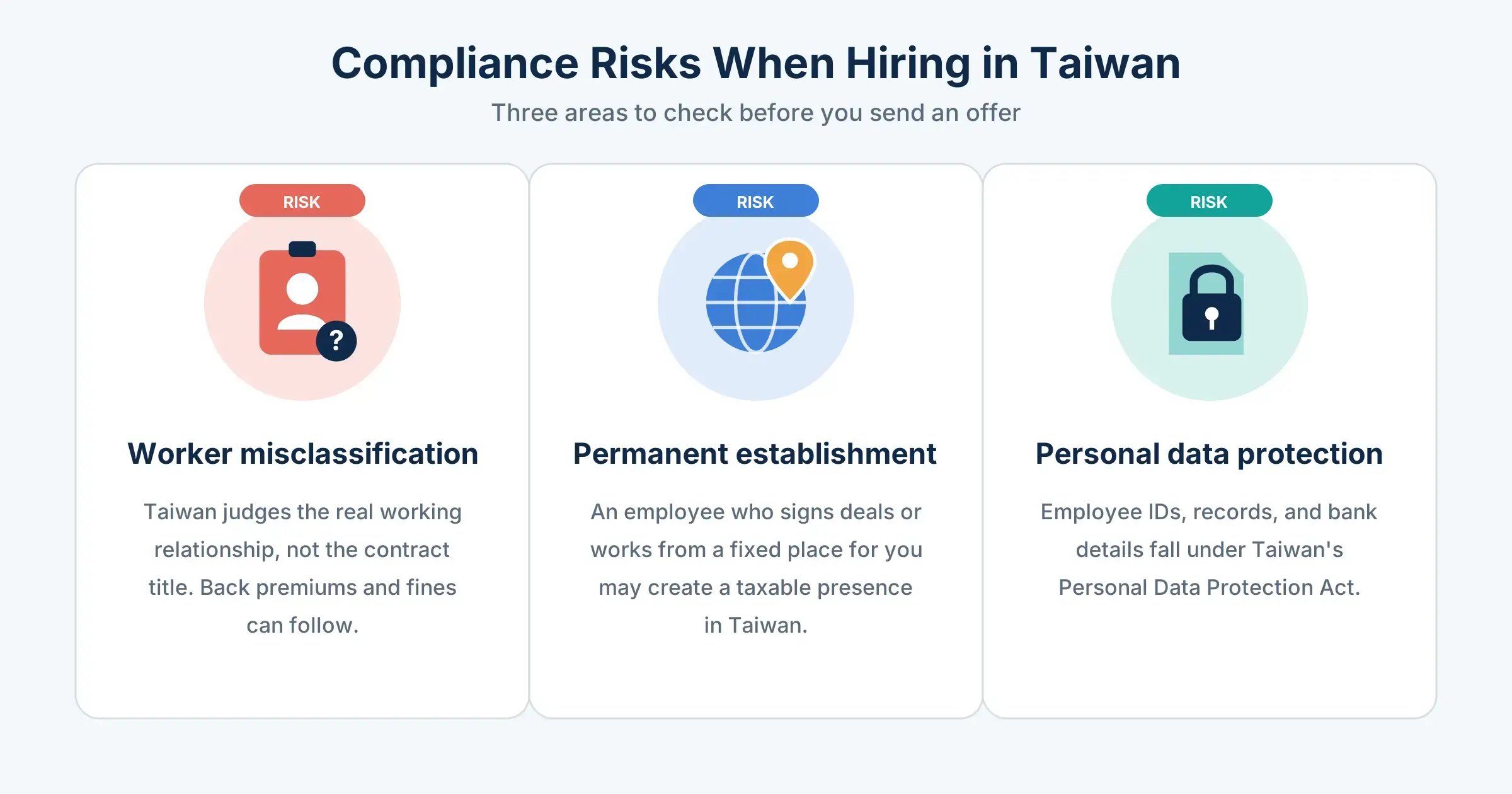
Compliance Risks to Watch: Misclassification, Permanent Establishment Risk, and Data Privacy
Most problems come from three areas. Each is easier to prevent at the offer stage than to fix later.
—Worker misclassification. Taiwan looks at the real relationship, including personal, economic, and organizational subordination, rather than the title on the contract. That is the approach set out in Constitutional Court Interpretation No. 740. If a contractor is found to be an employee, the Bureau of Labor Insurance can fine the employer four times the premiums that should have been paid, counted from the start date, and the employer must also cover any loss to the worker. The exposure does not stop at Labor Insurance: unpaid Labor Pension contributions (a damages claim, plus fines under Labor Pension Act Arts. 31 and 49) and severance can apply too.
—Permanent establishment risk. An employee in Taiwan who negotiates or signs contracts for you, or who works from a fixed place on your behalf, may create a taxable presence for your company. There's no comprehensive income tax treaty between the US and Taiwan, so Taiwan's domestic rules apply to US companies. Check whether Taiwan has a tax agreement with your home country from the MOF treaty list. Our guide to paying remote employees in Asia without triggering permanent establishment risk covers this in more depth.
—Data privacy. Employee records, ID numbers, and bank details fall under Taiwan's Personal Data Protection Act. Check where HR data is stored and whether it leaves Taiwan, because the PDPA sets security and cross-border transfer requirements.
Slasify Scenario: The Contractor Who Became an Employee
Imagine this: A US software startup pays a Taipei-based engineer as a contractor for 18 months. The engineer works only for the startup, joins daily standups, uses a company laptop, and reports to the CTO. On paper, the engineer is a contractor. In practice, the relationship looks like employment.
—The exposure: 18 months without Labor Insurance, NHI, or pension contributions, plus potential penalties if the relationship is reclassified.
—The fix: The startup works with its EOR and Taiwan advisors to confirm how the new structure fits Taiwan's labor-dispatch rules, then moves the engineer to an Employer of Record. A Labor Standards Act contract is issued, insurance and pension start from the new start date, and the startup reviews with an advisor whether anything is owed for the earlier period.
The engineer keeps the same role and manager. The startup now has a structure that follows Taiwan's employment rules, and it can repeat the same approach for its next Taiwan hire.
How Slasify Helps You Hire in Taiwan
Slasify was founded in Taiwan in 2016 and runs its own local entity and office there. Our in-country experts work in Mandarin and English, so Taiwan's rules get explained clearly to your HR, finance, or founding team.
—Employer of Record (EOR): Slasify employs your Taiwan team on a compliant local contract, runs payroll, and enrolls employees in Labor Insurance, NHI, and Labor Pension. A typical onboarding takes about two weeks from signing to the first day, though timing varies by role.
—Global Contractor: For independent professionals, Slasify handles contracts and compliant cross-border payments.
—Hiring a foreign national? If your hire is a foreign national living in Taiwan, see our guide to Taiwan work permits, the ARC, and the Gold Card.
Slasify has been recognized for three consecutive years in Taiwan's national talent sustainability initiative. As one client, the Director of Engineering at Compass, put it: "Slasify has made it easy to scale our engineering team globally – fast, affordably, and responsively."
Your Next Step: Choose the Right Way to Hire in Taiwan
Hiring remote workers in Taiwan is possible without a local entity, as long as the structure matches the role. A full-time, managed employee needs Taiwan insurance, pension, and a compliant contract, which in practice means an Employer of Record or your own entity. A contractor setup only works for truly independent work.
Ready to hire in Taiwan with confidence?
Talk with Slasify's Taiwan team about the right hiring structure before you send your first offer, and make your first Taiwan hire the start of a thriving team, not a compliance cleanup later.
Talk to our Taiwan team
Frequently Asked Questions
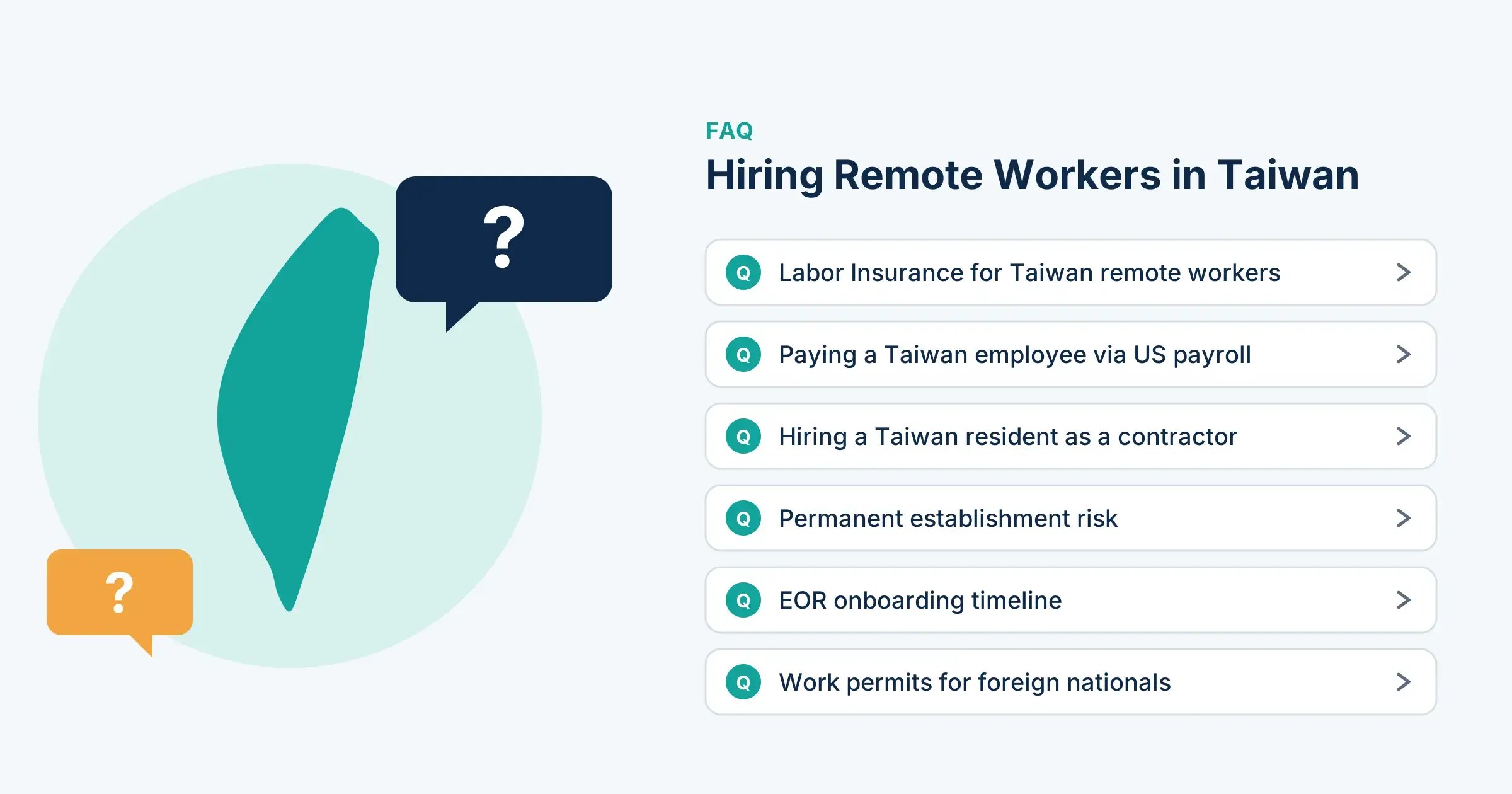
Q1. Do foreign employers have to pay Labor Insurance for Taiwan remote workers?
It depends on the headcount. Labor Insurance is compulsory for employers with five or more workers and voluntary below that, but occupational accident insurance, NHI, the Labor Pension, and, for most Taiwanese employees, Employment Insurance apply from the first hire. If you hire through an Employer of Record, the EOR is the insured employer.
Q2. Can I pay a Taiwan employee through my US payroll?
Generally, no. Your overseas payroll can't enroll a worker in Taiwan's Labor Insurance, NHI, or Labor Pension, or handle Taiwan withholding and filings. Paying from abroad can leave the worker without statutory coverage and expose your company to back premiums and penalties. Use a local entity or an Employer of Record instead.
Q3. Is it legal to hire a Taiwan resident as an independent contractor?
Yes, if the relationship is truly independent. The contractor should control their schedule, use their own tools, and be free to serve other clients. Taiwan assesses the actual working relationship, so a full-time, managed role labeled "contractor" can be reclassified as employment, triggering back premiums and fines.
Q4. Does hiring a remote employee in Taiwan create permanent establishment risk?
It depends on what the employee does. Risk rises if the employee negotiates or signs contracts for your company, or works from a fixed place on its behalf. Routine technical or support work carries less risk. Because the US and Taiwan have no comprehensive tax treaty, US companies should get tax advice for sales or leadership roles.
Q5. How long does it take to onboard an employee in Taiwan through an EOR?
Usually about two weeks. With Slasify, a typical timeline runs from signing the service agreement on day one, through drafting and signing the employment contract, to local registrations within about 14 days. Timing can vary with the role, start date, and whether the employee needs a work permit.
Q6. Do foreign nationals living in Taiwan need a work permit to work remotely for a foreign company?
It depends on their residence status. Gold Card holders, certain permanent residents, and foreign spouses of Taiwan nationals can generally work without an employer-sponsored permit. Others usually need a permit applied for by a qualifying Taiwan employer. Whether an EOR can sponsor one depends on the specific case, so confirm before making an offer.
Sources: Bureau of Labor Insurance, National Health Insurance Administration, Ministry of Labor, Labor Standards Act, Labor Pension Act, Labor Insurance Act, Ministry of Finance tax agreements, and Personal Data Protection Act.