COUNTRY FACT SHEET
| Key Takeaways | |
| Every dismissal must fit one of five Article 11 grounds (notice and severance required) or six Article 12 grounds (immediate dismissal, no severance). | |
| The old system tenure earns 1 month of average wage per year, uncapped. The new system tenure earns 0.5 months per year, capped at 6 months total. | |
| Wages are due on the last working day. Severance must be paid separately, within 30 days of the contract end date. | |
| Foreign professionals without permanent residency joined the new pension system on January 1, 2026. Those already employed who did not opt to stay in the old system by June 30, 2026 moved over automatically, creating mixed-tenure severance calculations for most foreign professionals hired before 2026. | |
| A wrongful dismissal can result in provisional reinstatement with full salary continuing through litigation, which is often more expensive than the severance itself. | |
In This Guide
- Taiwan Has No At-Will Termination: Legal Grounds
- When Termination Is Off the Table
- Notice Periods and the Job-Seeking Leave
- Two Systems and the July 1, 2005 Split
- Taiwan Severance Pay: Three Examples
- Foreign Employees: Which Regime Applies in 2026
- How to Execute a Lawful Termination
- Mass Layoffs: When the Thresholds Trigger
- Penalties for Wrongful or Non-Compliant Termination
- Is Taiwan Severance Pay Taxable?
- Switching EOR Providers Without Triggering Severance
- How We Handle Taiwan Terminations
- FAQs
The cost of terminating an employee in Taiwan depends on two questions. First: does your ground hold? An invalid dismissal doesn't just mean regulatory fines; it can also mean your former employee is legally back on payroll, with wages accruing while the dispute works through the courts. Second: which pension system covers each year of their service? Under the Labor Standards Act (LSA) and the Labor Pension Act (LPA), a single employee can carry two different severance formulas for two different periods of their career.
Taiwan severance pay rules under the LSA and LPA have been stable since 2024. The one change that matters for 2026 is who falls under which system, as the rules for foreign professionals are different now than they were a year ago.
1. Taiwan Has No At-Will Termination: Legal Grounds, and Why Even a Valid Ground Can Fail
There are clear statutory grounds for terminating and dismissing an employee in Taiwan. The Labor Standards Act (LSA), last amended July 31, 2024, provides 5 grounds under Article 11 that require advance notice and severance pay, and 6 grounds under Article 12 that permit immediate dismissal with neither. When severance is owed, the amount follows one of two formulas: 1 month of average wage per year for old system service, uncapped, or 0.5 months per year capped at 6 months for new system service, both payable within 30 days of the contract end date.
Article 11: Termination that requires notice and severance
- 1.The employer suspends business operations or transfers ownership.
- 2.The employer suffers business losses or is compelled to reduce operations.
- 3.Force majeure causes a business suspension exceeding one month.
- 4.The nature of the business changes and no suitable alternative role is available for the employee.
- 5.A particular worker is clearly not able to perform satisfactorily the duties required of the position held.
Among them, ground 5 is the most litigated and the most frequently mishandled by employers in Taiwan. Courts look for three things before a performance dismissal holds up: documented proof of the deficiency, a genuine chance to improve, and evidence that reassignment was considered first. Taiwan's Supreme Court restated this last-resort principle in Case 109-Tai-Shang-1516 (August 2020, in Chinese). The ruling also shows how the test fails: the court sent two bank employees' dismissals back for retrial because they had been measured against sales and licensing targets unrelated to the jobs they actually held.
Article 12: Immediate dismissal without notice and severance
Article 12 grounds apply when a worker meets any of the following:
- 1.Misrepresentation of facts during hiring in a way that materially harmed the employer.
- 2.Violence or gross insult against the employer, a member of the employer's family, or a colleague.
- 3.A final criminal sentence received during employment and is not granted a suspended sentence or permitted to commute the sentence to payment of a fine.
- 4.Serious violation of the labor contract or work rules.
- 5.Deliberate damage to machinery, tools, raw materials, products, or other property of the employer; disclosure of any technical or confidential information of the employer thereby causing damage to the employer.
- 6.Absence from work without good cause for 3 consecutive days or for a total of 6 days in any month.
Comparison at a Glance: Termination (Art. 11) vs. Dismissal (Art. 12)
| Article 11: With-Notice Grounds | Article 12: Summary Dismissal | |
|---|---|---|
| Notice required | Yes | No |
| Severance owed | Yes | No (LSA Art. 18) |
| Number of grounds | 5 | 6 |
| 30-day discovery window | N/A | Applies to grounds 1, 2, 4, 5, 6 only, not ground 3 (criminal sentence) |
| Key documentation risk | Ground 5 (competence): requires PIP, documented deficiency, reassignment consideration | Must demonstrate the triggering act occurred and was timely discovered |
For context on how Taiwan's framework compares to other APAC jurisdictions, see our overview of employee termination laws by country.
2. When Termination Is Off the Table
Article 13 of the LSA prohibits termination during two protected periods:
- —While a female employee is on maternity leave under Article 50 (8 weeks of combined maternity leave before and after childbirth)
- —While an employee is receiving medical treatment for a work-related injury or illness under Article 59
During either period, the employment relationship is legally frozen. The employer cannot serve notice or pay in lieu of it, and cannot treat a coerced resignation as voluntary. The only exceptions are force majeure business closure or a mass redundancy pre-approved by the competent authority.

3. Notice Periods and the Job-Seeking Leave
For Article 11 terminations, the required notice period depends on how long the employee has been continuously employed:
| Continuous Service | Notice Period |
|---|---|
| 3 months or less | No statutory notice required |
| More than 3 months to less than 1 year | 10 days |
| More than 1 year to less than 3 years | 20 days |
| 3 years or more | 30 days |
Note that "more than one year" means one year and one day. An employee who completed exactly one year of service yesterday is already in the 20-day tier. The same precision applies at the three-year boundary. Payment in lieu of notice is permitted; the employer can pay the equivalent wages and release the employee immediately rather than running the notice period.
Job-seeking leave: during the notice period, the employee is entitled to up to 2 paid working days per week to search for new employment under LSA Article 16(2). This is a recurring weekly entitlement, not a total allocation of 2 days.
Authority notification: separately from the notice obligation, the employer must file the employee's departure with the competent authority under the Employment Service Act (ESA) Article 33 at least 10 days before the last working day. For force majeure layoffs, this deadline shifts to within 3 days after the last working day.
Our Taiwan payroll compliance checklist covers the wage settlement obligations that run alongside these notice requirements.
4. Taiwan Severance Pay: Two Systems and the July 1, 2005 Split
Taiwan's severance framework split on July 1, 2005, when the Labor Pension Act (LPA) took effect. Employees who joined the workforce before that date could remain in the old system under the LSA or elect to transfer to the new system during a five-year window (2005–2010). Those who transferred, and everyone hired on or after July 1, 2005, fall under the new system.
- —Old system (LSA Article 17): 1 month of average wage per full year of service, with no ceiling. Partial years are calculated proportionally as a fraction of 12 months; any partial calendar month within that remaining period rounds up to one full calendar month. For example, 12 years and 3 months of old system service gives 12.25 months of severance.
- —New system (LPA Article 12): 0.5 months of average wage per year of service, capped at 6 months total. Partial years under one year are prorated. An employee with 15 years of new system service calculates to 7.5 months but only receives the 6-month cap.
Mixed tenure
Pension system membership determines which formula applies:
- —Hired before July 1, 2005, never transferred: old system is applied. All years calculated under LSA Article 17 with no cap.
- —Hired on or after July 1, 2005: new system is applied. All years of service calculated under LPA Article 12.
- —Hired before July 1, 2005, transferred to the new system during the 2005–2010 window: years before the transfer date use the old-system formula; years after use the new system formula. The pre-transfer seniority is preserved under LPA Article 11 and calculated using the average wage at termination.
Both old- and new-system severance must be paid within 30 days of the contract end date. This is separate from the wage settlement deadline, which falls on the last working day itself.
What average wage means
Under LSA Article 2, average wage is calculated as:
The definition has a practical implication that catches many employers off guard: a customary Lunar New Year bonus paid within the six-month window counts as wages under LSA Article 2 and is included in the average wage calculation. If a long-tenured employee was terminated two months after receiving their year-end bonus, that bonus raises the average wage figure, and every month of severance is calculated against the higher number.
Our 13th and 14th month pay guide covers the structure of these bonuses. If a bonus falls inside the six-month window, it raises every month of severance owed and is worth accounting for before any notice goes out.
5. Taiwan Severance Pay: Three Examples
We calculated the three cases below from the statutory average wage definition, using a simplified monthly equivalent for readability, and cross-checked each total against the Ministry of Labor's online severance pay calculator. You can use the same calculator to run your own employee's numbers; the formulas behind it are set out on the MOL's Severance Pay page.
Severance Calculations
| Employee Profile | Old System Component | New System Component | Total Severance |
|---|---|---|---|
| Case A: Pure new system. Hired January 1, 2018; last day September 30, 2026. Average wage: NT$60,000/month. |
Not applicable | 8.75 years × 0.5 = 4.375 months; 4.375 months × NT$60,000 = NT$262,500 | NT$262,500 |
| Case B: Mixed tenure. Hired January 1, 2002; transferred to the new system July 1, 2005; last day September 30, 2026. Average wage: NT$60,000/month. |
Jan 2002–Jun 2005: 3.5 months × NT$60,000 = NT$210,000 (calculated at average wage at termination) |
Jul 2005–Sep 2026: 21.25 years × 0.5 = 10.625 months (capped at 6 months); 6 months × NT$60,000 = NT$360,000 |
NT$570,000 |
| Case C: Foreign professional, 2026 split. Hired October 1, 2021, no PR status, did not opt to stay in the old system, so moved to the new system on January 1, 2026. Last day August 31, 2026. Average wage: NT$55,000/month. |
Oct 2021–Dec 2025: 4.25 months × NT$55,000 = NT$233,750 |
Jan–Aug 2026: 8/12 (8 months pro-rated) × 0.5 × NT$55,000 = NT$18,333 |
~NT$252,000 |
6. Foreign Employees: Which Regime Applies in 2026
For foreign employees, severance liability is decided on two questions: which pension system they are enrolled in and when that enrollment started.
Taiwan labor laws for foreigners on termination impose no reduced protections compared to Taiwan nationals; the same LSA grounds, notice requirements, and payment deadlines apply. Here are the three different regimes for foreign employees:
- —No PR status, hired on or after January 1, 2026: new system only (LPA Article 12, 0.5 months per year, capped at 6 months). The amended Act for the Recruitment and Employment of Foreign Professionals, promulgated September 24, 2025 and in force since January 1, 2026, extends the new system to foreign professionals in white-collar roles without requiring permanent residency (Article 24). Migrant workers in blue-collar roles are not covered.
- —No PR status, hired before January 1, 2026: it depends on the choice they made. Employees who declared in writing by June 30, 2026 that they wanted to stay in the old system remain there for their entire tenure, with no cap, and cannot switch later. Everyone else moved to the new system automatically, backdated to January 1, 2026. Their earlier service is preserved under the old system formula (LPA Article 11), and service from 2026 onward uses the new system formula. Employers had to file new system contributions for these employees with the BLI by July 15, 2026.
- —APRC holders and foreign spouses of Taiwanese nationals: covered by the new system since May 17, 2019 and January 17, 2014, respectively. Those already employed on those dates who did not opt to stay in the old system carry old system seniority for their earlier service.
New system enrollment also brings a monthly pension contribution of at least 6% of wages, separate from any severance. Our guide to employer contributions in Taiwan covers how it is calculated.
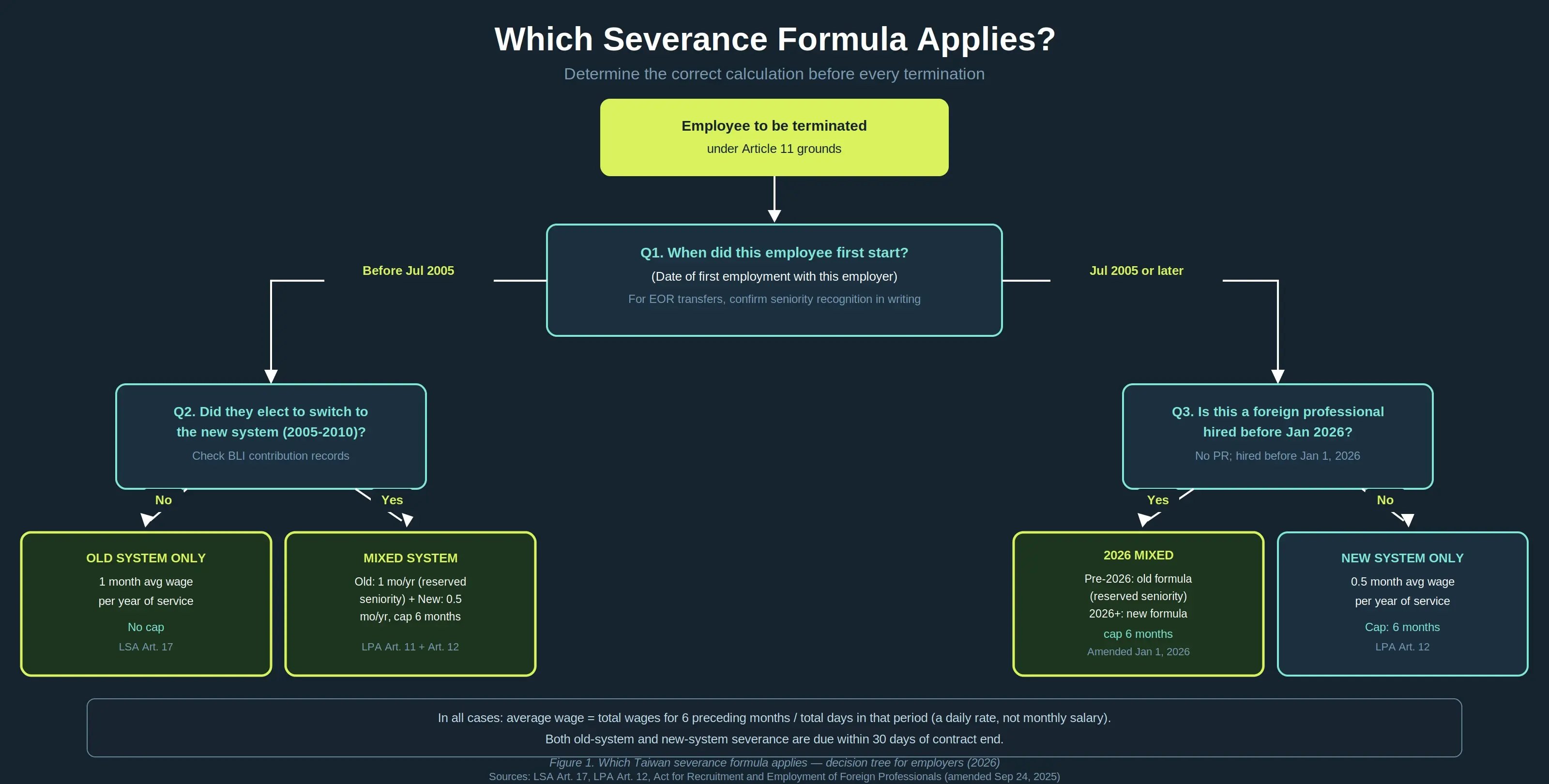
Figure 1: Decision tree - which Taiwan severance formula applies?
7. How to Execute a Lawful Termination
Getting the ground right and calculating severance correctly is only half the equation. Every step below has its own deadline; missing one creates independent legal exposure regardless of whether the underlying termination is valid.
Wages and severance run on different clocks. Wages fall due on the last working day itself; severance follows within 30 days of the contract end date. Conflating these two deadlines (paying both at 30 days) is a common error that puts employers in breach of the wage obligation.
The 8-Step Termination Checklist
| Step | Action | Deadline/Timing | Legal Basis |
|---|---|---|---|
| 1 | Verify statutory ground (Art. 11 or Art. 12) and confirm no protected period applies (Art. 13) | Before any notice or communication | Labor Standards Act (LSA) Art. 11, 12, 13 |
| 2 | Assess MRPA thresholds if the layoff may be large-scale | At least 60 days before the layoff meets the MRPA threshold. To be safe, count back from your first planned dismissal date. | MRPA Art. 2, 4 |
| 3 | Prepare documentation: performance records, business financials, or evidence of triggering event | Concurrent with Step 1 | Supreme Court 109-Tai-Shang-1516 in Chinese (Art. 11 ground 5) |
| 4 | Deliver written notice to the employee | Per notice period: 10/20/30 days depending on tenure (or 0 for Art. 12 dismissal) | LSA Art. 16 |
| 5 | File a layoff report (Art. 11 terminations only) with competent authority | At least 10 days before last working day (3 days after for force majeure) | Employment Service Act (ESA) Art. 33(1) |
| 6 | Honor weekly job-seeking leave entitlement | Up to 2 paid working days per week during notice period | LSA Art. 16(2) |
| 7 | Settle all outstanding wages, including pay for unused annual leave | Immediately when the contract ends (the last working day) | LSA Enforcement Rules Art. 9 |
| 8 | Pay severance; issue a service certificate and, for Article 11 terminations, a certificate of involuntary termination | Severance within 30 days of contract end; certificates on the employee's request (the employee needs the involuntary termination certificate to claim unemployment benefits) | LSA Art. 17 / LPA Art. 12; LSA Art. 19; Employment Insurance Act Art. 25 |
Note: All LSA, LPA, ESA, and MRPA legal bases, including the LSA Enforcement Rules, are sourced from the MOL laws database (laws.mol.gov.tw).
The legal steps above tell you what must happen and by when. Our employee offboarding checklist covers what needs to happen concurrently on the HR operations side: system access revocation, equipment return, final payslip coordination, and reference letter policy.
Retirement Is Not Termination
When an employee reaches 65, the mandatory retirement age under LSA Article 54 (which employer and employee can agree to extend), ending the employment is a retirement, not a termination, and no severance is owed. Old system years are paid as retirement pay under LSA Article 55: two months of average wage per year for the first 15 years, then one month per year, capped at 45 months, typically drawn from the employer's labor pension reserve account. New system years are already funded through the employee's individual account at the BLI, which they can claim from age 60 under LPA Article 24.
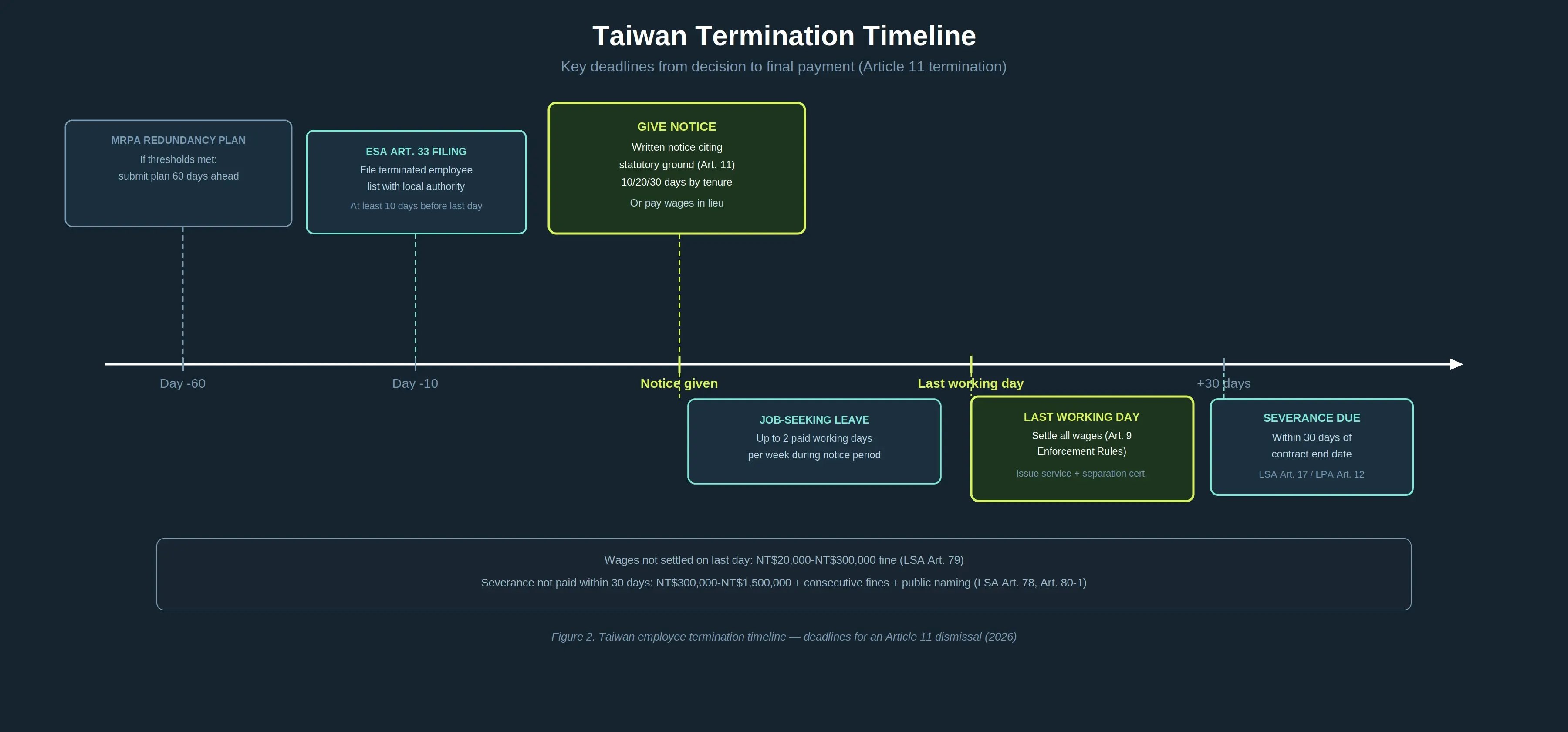
Figure 2: Taiwan employee termination timeline: deadlines for an Article 11 dismissal (2026)
Worried about getting a mixed-tenure calculation or a filing deadline wrong?
As your legal employer in Taiwan, our team verifies the grounds, prepares the documentation, serves notice, files with the authorities, and pays out on the right timelines.
Talk to Our Expert Today8. Mass Layoffs: When the Thresholds Trigger
When a layoff exceeds certain scale thresholds, the Act for Worker Protection of Mass Redundancy (MRPA), last amended July 1, 2015, imposes additional obligations: a written plan, a public announcement, and worker consultation. You must give the plan to the competent authority and the other required parties at least 60 days before the layoff meets the Article 2 threshold. To be safe, count back from your first planned dismissal date.
MRPA Mass Redundancy Thresholds (Article 2)
| Workers at the Same Site | 60-Day Trigger | Single-Day Trigger |
|---|---|---|
| Fewer than 30 workers | More than 10 | – |
| 30 to 199 workers | More than 1/3 of the workforce | More than 20 workers |
| 200 to 499 workers | More than 1/4 of the workforce | More than 50 workers |
| 500 or more workers | More than 1/5 of the workforce | More than 80 workers |
| Whole business, all sites combined | More than 200 workers | More than 100 workers |
The 60-day rule does not apply to natural disasters, accidents, or other sudden events (MRPA Article 4).
Source: MRPA Article 2, Ministry of Labor. Last amended July 1, 2015. Either condition within a tier independently triggers the 60-day plan and notification requirements. Headcounts exclude fixed-term foreign workers hired under ESA Article 46.
Meeting either condition is sufficient. A company that stays below the 60-day percentage threshold can still trigger the MRPA if a single day's announcement exceeds the single-day limit for its tier.
9. Penalties for Wrongful or Non-Compliant Termination
A wrongful termination in Taiwan carries two types of penalties, including administrative fines and civil liability.
Penalty At a Glance
| Violation | Fine Range | Legal Basis |
|---|---|---|
| Failure to pay required severance | NT$300,000–NT$1,500,000 with court order to pay; consecutive fines apply for continued non-payment, plus public naming | LSA Art. 78(1); Art. 80-1 |
| Termination during protected period (maternity leave or occupational injury treatment) | NT$90,000–NT$450,000 | LSA Art. 78(2) |
| Notice period violation (insufficient notice or failure to pay in lieu) | NT$20,000–NT$300,000 | LSA Art. 79(3) |
| Failure to file a layoff report at least 10 days before the employee's last working day (within 3 days after, for force majeure) | NT$30,000–NT$150,000 | ESA Art. 33(1), 68(1) |
| MRPA notification or plan failure in a mass layoff | NT$100,000–NT$500,000 plus daily continuation | MRPA Art. 17 |
10. Is Taiwan Severance Pay Taxable?
Firing an employee in Taiwan does not automatically trigger income tax for the departing employee on the severance amount, but the answer depends on the size of the payout relative to years of service.
Taiwan classifies severance as retirement income under Category 9 of the Income Tax Act (ITA) Article 14. For Tax Year 2026, there are three exemption tiers set by the Ministry of Finance:
- —Fully exempt from income tax: total severance at or below NT$206,000 multiplied by years of service.
- —50% of the amount above NT$206,000 per year of service is taxable: total severance between NT$206,000 and NT$414,000 multiplied by years of service.
- —The full amount exceeding NT$414,000 per year of service is taxable: total severance above NT$414,000 multiplied by years of service.
For installment severance payments, NT$894,000 per year is exempt under the installment formula. In practice, though, most employees with moderate salaries and multi-year tenure fall well within the exempt range. The full thresholds and guidance can be found at the Ministry of Finance e-Tax portal.

11. Switching EOR Providers Without Triggering Severance
Switching Employer of Record (EOR) providers changes the employee's legal employer, and Taiwan law does not carry their seniority across automatically. What happens to severance depends on how the outgoing contract ends and what the incoming provider agrees to in writing before the transition date.
If the outgoing EOR ends the employment on an Article 11 ground and the incoming EOR hires from scratch, it is a termination followed by a new hire: the outgoing provider owes severance for the full tenure, and the seniority clock restarts. If the employee resigns instead, no severance is owed, and their seniority is lost.
With the written commitment in place, the employment is treated as continuous:
- —No severance is triggered on the transition date.
- —The employee's prior seniority counts toward any future severance calculation, annual leave, and notice periods, because the incoming EOR has agreed to it in writing.
- —The incoming EOR takes on the severance liability for those earlier years.
For context on termination rules in the other markets where our clients operate, see our 2026 guide to employee termination laws by country.
12. How We Handle Taiwan Terminations
Taiwan is our home market, where we maintain our own legal entity, a local payroll and compliance team, and direct working knowledge of how the Ministry of Labor applies these statutes in practice. For the wider picture of hiring and paying employees here, see our Taiwan employment guide.
When you need to end an employment relationship in Taiwan, we can handle every step as the legal employer:
- —Running ground verification, documentation, and authority notifications on the right timelines before a single notice goes out.
- —Settling wages on the last working day and paying severance within 30 days of contract end, on separate timelines.
- —For foreign employees under the 2026 pension change, confirming BLI enrollment status and running the mixed-tenure calculation before notice is served.
For three consecutive years, Slasify has been recognized as a participant in Taiwan's national talent sustainability initiative, demonstrating a long-term commitment to ethical hiring practices.
Our Employer of Record and Global Payroll services support compliant hiring across more than 150 countries in over 130 currencies, serving more than 900 companies worldwide, through 600+ local partners and our own entities in key markets. We also hold ISO 27001 certification for information security management.
Frequently Asked Questions: Taiwan Severance Pay & Termination

Q1. Is severance pay mandatory in Taiwan?
Taiwan severance pay is mandatory only for Article 11 terminations. It is not owed on resignation, fixed-term contract expiry, or any Article 12 summary dismissal. Severance is triggered only when the employer initiates termination on one of five statutory grounds: business closure, contraction, force majeure, a business change with no suitable alternative role, or employee incompetence.
Q2. How do you calculate severance pay in Taiwan?
Taiwan severance pay uses two formulas, split on July 1, 2005. The old system tenure earns 1 month of average wage per year without any ceiling. The new system tenure earns 0.5 months per year, capped at 6 months. The average wage is total wages over the preceding 6 months divided by the total days in that period (MOL provides an online calculator for calculation references).
Q3. What severance does an employee hired before July 2005 get?
It depends on whether they transferred to the new system during the 2005-2010 election window. Employees who never transferred are on the old system only. Employees who transferred have a mixed calculation. Both components use the average wage at termination.
Q4. Do foreign employees in Taiwan get severance pay?
Yes. Foreign employees have the same severance rights as Taiwanese nationals. The formula follows pension-system membership. Since January 1, 2026, foreign professionals without permanent residency are covered by the new system, and existing employees who did not opt to stay in the old system by June 30, 2026 moved over automatically. As your Employer of Record, we confirm each employee's BLI enrollment before calculating.
Q5. Is severance pay taxable in Taiwan?
Severance is classified as retirement income, and for most employees the full amount is tax-free. Taiwan's Income Tax Act applies annual exemption thresholds scaled by years of service; an employee with several years of tenure will typically find their payout falls well below the fully exempt ceiling.
Q6. Can we terminate an employee for poor performance?
Yes, but only after following a documented improvement process. A bare assertion of incompetence will not hold in court. Under LSA Article 11, the employer must document the deficiency, provide written notice and a reasonable improvement period, and consider reassignment before dismissal. Courts routinely void these terminations when any step is missing, even when the underlying performance issue was genuine.
Terminate Correctly in Taiwan
We handle Taiwan terminations as the legal employer, from ground verification through final payment, on the right timelines, with the documentation that holds up if it's ever challenged.
Ending an Employment Relationship in Taiwan?
Talk to our team today and learn how we handle Taiwan terminations as the legal employer, from ground verification to final payment.
Talk to Our Team