STATISTICS
| Key Takeaways |
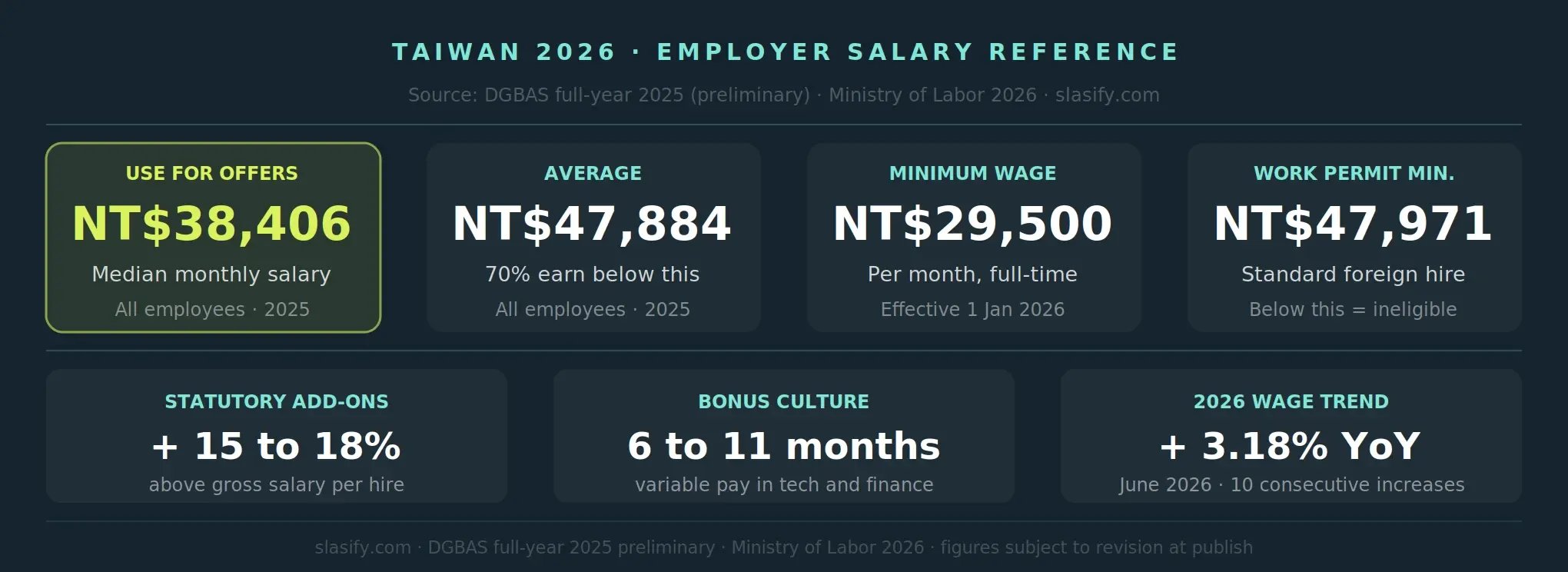
| Taiwan's official 2025 average monthly salary is NT$47,884 (≈US$1,480), but 69.74% of employees earn below that figure. The median, NT$38,406, is the more practical benchmark for most offers. |
| Sector determines salary more than the headline figure, and the bonus structure can invert the monthly ranking entirely. In electronics, profit-sharing adds over 11 months of base pay per year, pushing annual total earnings to NT$1,332,924 as the leading sector. |
| Average total earnings of NT$760,632 exceed 12 times the monthly average because of year-end bonuses and profit-sharing that most Taiwan employers pay as market practice. Many also pay a 14th month. |
| Mandatory contributions (Labor Insurance, National Health Insurance, and Labor Pension) add roughly 15–18% above gross salary, depending on salary level and applicable caps. |
| A standard foreign professional work permit requires a minimum monthly salary of NT$47,971. The Employment Gold Card requires NT$160,000/month under the salary-based route. Want the full cost modeled for a specific hire? Talk to our Taiwan EOR team → |
The average salary in Taiwan is NT$47,884 per month (roughly US$1,487) as of the latest full-year Directorate-General of Budget, Accounting and Statistics (DGBAS) report. According to DGBAS, 69.74% of Taiwan employees earn below the NT$47,884 average salary in 2025.
Employers hiring in Taiwan should also budget 15 to 18% above gross salary for mandatory statutory contributions: Labor Insurance, National Health Insurance (NHI), and Labor Pension. If you don't yet have a Taiwan entity, Slasify's Employer of Record and Global Payroll services can model and run this for you.
1. Average Salary in Taiwan: The Headline Numbers, and Which One to Use
Two DGBAS series circulate in the press, and conflating them inflates every salary comparison when planning your hiring budget:
- —The first covers all employees in Taiwan's industrial and service sectors: all full-time and part-time workers, Taiwanese nationals and foreign workers included.
- —The second covers full-time employees with Taiwan nationality only. The difference between the two is approximately NT$2,700 per month in regular earnings.
Taiwan salary benchmarks (full-year 2025)
| |
Average monthly regular earnings |
Median monthly regular earnings |
Average annual total earnings (incl. bonuses/overtime) |
| All employees (incl. part-time and foreign workers) |
NT$47,884 (≈US$1,487) |
NT$38,406 (≈US$1,193) |
NT$760,632 (≈US$23,622) |
| Full-time employees, Taiwan nationality |
NT$50,643 (≈US$1,573) |
NT$39,890 (≈US$1,239) |
NT$806,448 (≈US$25,045) |
(2025 Industry and services earnings statistics from DGBAS; excludes agriculture and public sector. USD conversions at CBC interbank close NT$32.20 = US$1, 13 Aug 2026)
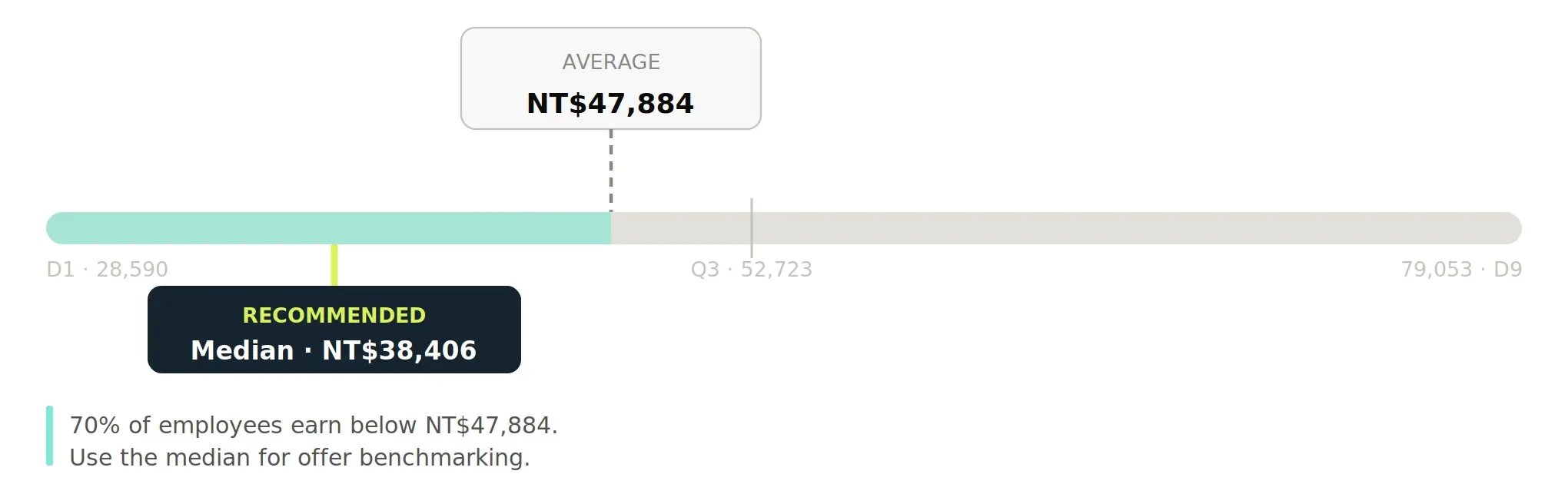
According to DGBAS, 69.74% of employees in 2025 in Taiwan earn below the NT$47,884 average salary. A cluster of high-paying sectors in finance and semiconductors pulls the average up, which is why the median at NT$38,406 is the more reliable benchmark for most offers.
The distribution table below shows where each earnings tier sits in the market:
Salary distribution, all employees, full-year 2025
| Percentile |
Monthly regular earnings |
What it means for offer benchmarking |
| D1 (bottom 10%) |
NT$28,590 |
Minimum wage adjacent; entry-level or high-attrition roles |
| Q1 (25th percentile) |
NT$29,940 |
Just above the minimum wage; competitive only in hospitality and basic retail |
| Median (50th percentile) |
NT$38,406 |
The market midpoint; a solid anchor for most non-specialist mid-level offers |
| Q3 (75th percentile) |
NT$52,723 |
Above market; appropriate for strong candidates or senior-adjacent roles |
| D9 (top 10%) |
NT$79,053 |
High-demand specialist or managerial; includes semiconductor premium |
Note: The NT$28,590 was 2025's minimum wage and has been increased to NT$29,500 starting in 2026. All statistics are from the 2025 DGBAS report (in Chinese).
The median is a starting point. Build the offer outward from there: layer in the sector benchmark, city premium, role seniority, and the statutory contributions that sit on top of gross salary.
2. Salary by Industry
When budgeting for a Taiwan hire, the average salary in Taiwan for your specific sector matters far more than the economy-wide figure. Within sectors, monthly salary tells only part of the story. In Taiwan, the bonus payment structure means that a sector ranking by monthly pay can look quite different from a ranking by annual total cost.
Taiwan salary by industry, all employees, full-year 2025
| Industry (DGBAS category) |
Average monthly regular |
Median monthly |
Average annual total |
YoY (annual) |
| Finance and insurance |
NT$70,997 |
NT$58,105 |
NT$1,320,960 |
+2.57% |
| Publishing, AV and information/communication |
NT$69,595 |
NT$53,458 |
NT$1,037,184 |
+3.11% |
| Electronic parts and components (mfg. sub-sector) |
NT$57,096 |
NT$47,068 |
NT$1,332,924 |
+8.52% |
| Wholesale and retail |
NT$47,483 |
NT$38,229 |
NT$669,756 |
+3.71% |
| Manufacturing (all industries) |
NT$45,850 |
NT$36,824 |
NT$832,476 |
+5.72% |
| Accommodation and food services |
NT$34,961 |
NT$31,590 |
NT$468,360 |
+1.20% |
2025 Industry and services earnings statistics from DGBAS; sorted by average monthly regular earnings
Two sectors define the extremes of this distribution and deserve a closer look:
In electronics, monthly base pay understates annual cost. Its monthly average (NT$57,096) sits about 20% below finance (NT$70,997). But profit-sharing and performance bonuses in the semiconductor supply chain are substantially larger: total annual earnings for electronics workers (NT$1,332,924) exceed those of finance workers, despite the monthly gap. Budget from monthly base salary alone and you would land NT$647,772 short of the actual annual total, nearly half the real cost.
Accommodation and food services sit well below every other sector. The NT$34,961 monthly average is only NT$5,461 above the 2026 minimum wage. For hospitality or F&B hires, market rate benchmarking starts near the statutory floor, not the NT$47,884 economy-wide figure.
For tech and semiconductor hires, where most foreign employer hiring in Taiwan concentrates, the gap between the monthly base and the annual total is the bonus and profit-sharing budget you need to carry alongside base salary. In electronics, it averages over 11 additional months of base pay per year.
3. Salary by Role and City
The salary ranges below use the DGBAS sector benchmarks from the table above as the baseline. For role-level data broken down by specific job title, the Ministry of Labor publishes an annual occupational salary survey (Chinese only); the most recent edition covers July 2025 monthly salaries and 2024 annual income.
Technology and engineering
The DGBAS sector benchmarks for electronics and ICT run from NT$57,096 to NT$69,595 per month across all seniority levels. Ranges by role:
- —Entry level (software developer, Taipei): NT$45,000 to NT$55,000 per month.
- —Mid-level (backend or embedded engineer, IC design house, Hsinchu): NT$80,000 to NT$120,000 per month, above the sector average due to the Hsinchu Science Park premium and the concentration of specialist IC design roles.
- —Senior, high-demand roles (TSMC, MediaTek, Novatek): electrical and electronic engineers averaged NT$1,406,000 in annual income in 2024 per the MOL survey above; profit-sharing at leading semiconductor companies pushes senior totals above this figure.
-
Finance and accounting
The Finance and insurance sector benchmark (NT$70,997 average, NT$58,105 median) covers accountants, financial analysts, compliance officers, and relationship managers. Entry-level roles at smaller firms often start closer to the median. Senior positions in private banking or treasury run well into the D9 range.
Sales and operations
Wholesale and retail (NT$47,483) and the broader manufacturing average (NT$45,850) bracket most sales and operations roles outside of technology. Mid-level B2B sales managers in industrial or technology supply chain companies typically earn NT$50,000 to NT$70,000 per month in base salary, with commissions on top.
City premiums
For engineering roles, Hsinchu pays more than Taipei. Hsinchu consistently commands a premium for engineering positions because of the Hsinchu Science Park, home to TSMC, MediaTek, Novatek, and hundreds of IC design and semiconductor manufacturing suppliers. Engineers in Hsinchu commonly earn 10 to 15% more than counterparts in equivalent Taipei roles, plus more generous profit-sharing tied directly to the semiconductor cycle.
- —Taipei: commercial center for finance, consulting, and consumer tech; salaries track close to the sector benchmarks above.
- —Tainan: emerging semiconductor hub following TSMC's advanced-fab expansion into the Southern Taiwan Science Park; engineering salaries rising but still below Hsinchu.
- —Kaohsiung: non-tech salaries generally run 10 to 15% below Taipei, which matters for regional service or operations hiring.
-
4. What a Salary in Taiwan Actually Costs You
On top of gross salary, every employer in Taiwan must contribute to three mandatory programs, each with its own rate mechanics and salary cap:
| Program |
Employer contribution |
Monthly salary cap |
| Labor Insurance |
8.75% (employer pays 70% of the combined 12.5% rate) |
NT$45,800 (effective Jan 1, 2026; BLI, MOL) |
| National Health Insurance |
≈3.1% (employer pays 60% of the 5.17% rate) |
NT$313,000 (effective Jan 1, 2026; NHIA, MHW) |
| Labor Pension |
6% (legal minimum) |
NT$150,000 (effective Jan 1, 2026; BLI, MOL) |
Figures exclude occupational accident insurance (industry-rated) and the wage arrears fund (~0.025%). Learn more about the full itemization from our employer contributions in Taiwan article.
Worked all-in employer cost examples
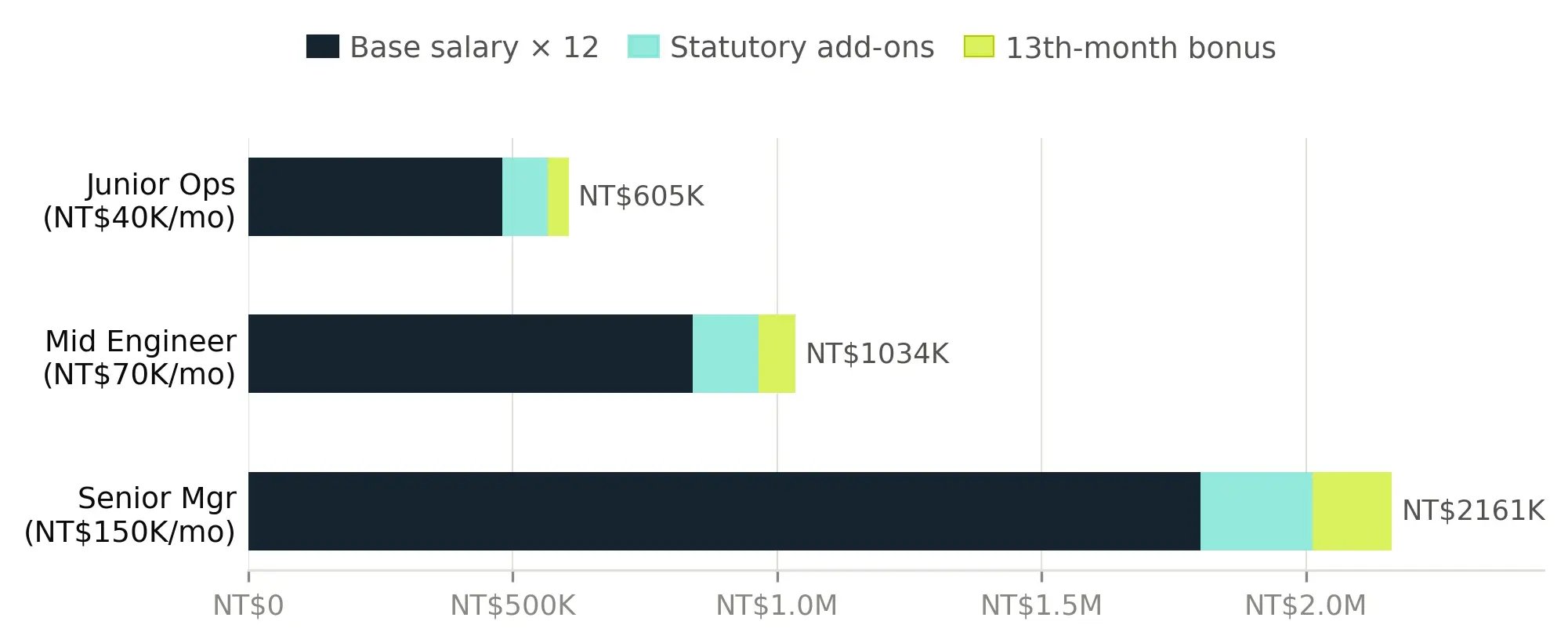
| |
Junior Operations |
Mid-Level Engineer |
Senior Manager |
| Monthly gross salary |
NT$40,000 |
NT$70,000 |
NT$150,000 |
| Labor Insurance |
NT$3,500 |
NT$4,008 |
NT$4,008 |
| National Health Insurance |
NT$1,241 |
NT$2,171 |
NT$4,653 |
| Labor Pension |
NT$2,400 |
NT$4,200 |
NT$9,000 |
| Total statutory add-ons |
NT$7,141 |
NT$10,379 |
NT$17,661 |
| Monthly employer cost |
NT$47,141 |
NT$80,379 |
NT$167,661 |
| Add: one 13th-month bonus |
NT$40,000 |
NT$70,000 |
NT$150,000 |
| Annual employer cost |
NT$605,692 |
NT$1,034,548 |
NT$2,161,932 |
| Annual cost in USD |
≈ US$18,810 |
≈ US$32,129 |
≈ US$67,141 |
Full-time employee; Labor Insurance salary cap NT$45,800; pension contribution cap NT$150,000; one 13th-month bonus assumed, customary, not statutory.
Statutory overhead runs about 18% of gross for junior roles and about 12% for senior ones. The difference comes from the Labor Insurance cap: once salary exceeds NT$45,800, the LI contribution stops increasing, so higher earners cost proportionally less in statutory terms. Budget from the higher end of that range for your junior hires.
5. Beyond Base Salary: Taiwan's Bonus Culture
Taiwan's average annual total earnings in 2025 (NT$760,632 for all employees) exceed 12 times the monthly regular average by NT$186,024. That difference is variable pay, and it shapes every Taiwan hiring budget in ways that base salary alone does not.
Taiwan has no statutory 13th-month requirement under the Labor Standards Act. What exists instead is a layered market practice that varies by industry, company, and role type:
| Bonus type |
How it works |
| Year-end bonus |
Typically paid before Lunar New Year, equivalent to 1 to 2 months of base salary at most private-sector employers. Some offer letters explicitly state "14 months guaranteed," meaning 12 months of base plus two months of year-end bonus. |
| Festival bonuses |
Smaller payments at Dragon Boat and Mid-Autumn Festivals. Standard at traditional Taiwanese companies; less consistent at international firms. |
| Performance bonus |
Quarterly or annual payouts tied to individual, team, or company targets. Common in financial services, technology, and professional services roles. |
| Employee profit-sharing |
Legally distinct from salary; distributed from company profits rather than the payroll budget. At TSMC, MediaTek, and major IC design houses, this is where total compensation diverges most significantly from base salary, varying year to year with the semiconductor cycle. |
| Sales commissions |
Variable and percentage-based, typically structured as a separate contractual component from base salary. |
The numbers are most striking in the sectors where Taiwan competes hardest for talent. Finance and insurance averages NT$1,320,960 in annual total pay against a NT$70,997 monthly base, a gap equal to 6.6 additional months; in electronic components manufacturing, that gap reaches 11.3 months. In both markets, and in IC design more broadly, variable pay is not a supplement to the offer: it is the offer. Employers who leave the bonus structure vague lose candidates to those who make it explicit.
How to state it in an offer letter
Because bonuses in Taiwan are market practice rather than a statutory obligation, you have flexibility in how you structure them. A standard Taiwan-market approach is to state the base monthly salary clearly, then add a separate clause for variable pay.
Sample clause
"An annual discretionary performance bonus, with a market norm of one to two months of base salary, to be determined by the company based on individual and company performance."
If your offer specifies a guaranteed bonus rather than a discretionary one, note that payments above certain thresholds may attract an additional NHI supplementary premium. Verify the current rate with your payroll provider before finalizing the figure.
For markets where year-end bonuses are a statutory obligation rather than market practice, the 13th and 14th month pay guide has the full breakdown by country.
6. Paying Foreign Professionals: The Salary Thresholds
Hiring a foreign national in Taiwan requires meeting a minimum salary threshold before the work permit application is eligible. Two routes apply depending on the candidate's profile.
- —Standard foreign professional work permit: The minimum monthly salary is NT$47,971, set by the Workforce Development Agency (WDA). Verify the current figure with the WDA before extending the offer, as the threshold is reviewed periodically.
- —Employment Gold Card: A self-sponsored open work permit covering twelve designated fields including technology, finance, law, and architecture. Under the salary route, the qualifying threshold is NT$160,000 per month. Candidates who do not meet it may qualify through credentials in their field instead; the Gold Card Office administers both routes.
How the threshold affects permit eligibility
⚠ Compliance note
The NT$47,971 standard threshold sits just NT$87 above the all-employees average of NT$47,884. An offer benchmarked to "market average" is, in practice, a below-threshold offer for a foreign professional under the standard permit category. The work permit application is not just difficult at that point. It is ineligible.
If your offer falls between NT$29,500 (the minimum wage) and NT$47,971, the standard specialized/technical category is unavailable. You would need to qualify the candidate through an alternative route or bring the salary to the threshold before applying.
7. The Pay Floor: Minimum Wage 2026
According to the Ministry of Labor (MOL), from 1 January 2026, Taiwan's statutory minimum wage is:
- —NT$29,500 per month for full-time workers
- —NT$196 per hour for part-time and hourly workers
Taiwan has raised its minimum wage every year since 2016. The 2026 adjustment is the tenth consecutive annual increase, each set through a government formula that ties the review to CPI growth and economic performance.
That pattern is unlikely to change: employers with Taiwan headcount should build an annual minimum wage increase into multi-year budget models, even for roles that currently sit well above the floor. The MOL typically announces the following year's adjustment each September, so the September 2026 announcement is the one to watch for 2027 planning.
For part-time and hourly hires, the NT$196 hourly rate also sets the base for overtime premium calculations under the Labor Standards Act. Our Taiwan payroll compliance checklist covers the overtime premium structure in detail.
8. Where Taiwan Salaries Are Heading
2025 in context
Regular earnings grew 3.09% in 2025, the largest nominal increase in 26 years per the February 2026 CNA report citing DGBAS. After adjusting for inflation (CPI +1.66% in 2025), real regular earnings grew 1.40%, and real total earnings grew 2.21%. Both beat inflation for the year, the highest real growth for regular wages in five years.
Three forces drove the broad pay increase together: the annual minimum wage increase, company-led pay adjustments driven by AI hardware demand, and a tightening supply of engineers across the semiconductor and electronics supply chain.
Wages continuing to grow into 2026
DGBAS's most recent monthly release (August 10, 2026) reports June 2026 average monthly regular earnings at NT$49,343 for all employees, up 3.18% year-on-year and above April's +2.90%, suggesting wages are still climbing. The structural driver is Taiwan's position in the global AI supply chain. The economy grew 8.76% in 2025, with Q1 2026 growth at 14.55%, the fastest quarterly rate since 1987, driven by AI infrastructure exports and semiconductor manufacturing demand that flows directly into engineering salaries.
What to build into your 2027 budget
- —Base salary growth: Budget 3 to 3.5% annual increase for non-tech roles. For engineering, semiconductor, and IC design roles, plan 5 to 8%, consistent with the electronic components sub-sector's +8.52% annual earnings growth in 2025.
- —Variable pay on top of base: Year-end bonuses and profit-sharing are market-standard in Taiwan, not optional extras. In electronics and finance, variable pay has historically added six to eleven additional months of base salary to annual totals. Model both base and variable when budgeting.
- —Hsinchu and semiconductor-cluster roles: Add a 10 to 15% premium over Taipei benchmarks for engineering roles in the Hsinchu Science Park and adjacent clusters.
- —Minimum wage: Watch the MOL's September 2026 announcement for the 2027 minimum wage floor. Taiwan has raised it every year since 2016.
- —Full-year 2026 data: DGBAS publishes full-year earnings results each February; the 2026 release (expected February 2027) is the right baseline for 2027 compensation bands.
For a framework on how geography affects compensation planning across hiring markets, the geography-based salary strategy guide covers the models we use with clients weighing regional hiring decisions.
9. Hiring in Taiwan Without an Entity
In Taiwan, Labor Insurance, NHI, and Labor Pension obligations apply from an employee's first day; misclassifying a full-time hire as a contractor creates retroactive liability under the Labor Standards Act.
We have operated our own local entity in Taiwan since our founding in 2016.
"For three consecutive years, Slasify has been recognized as a participant in Taiwan's national talent sustainability initiative, demonstrating a long-term commitment to ethical hiring practices."
When a client engages us for a Taiwan hire, we handle it through one of three paths:
- —Fast hiring: Through our Employer of Record, we employ the worker on the client's behalf, handle all statutory filings with the Bureau of Labor Insurance and NHIA, and run payroll in NT dollars under a single contract, with no local entity or minimum headcount required.
- —Compliant payroll for your Taiwan entity: For clients who already have a Taiwan entity, our global payroll handles payroll calculation, taxes, statutory contributions (NHI, LI, Labor Pension), and reporting automatically.
- —Contractor payment and agreements: For Taiwan-based contractor engagements, we structure compliant agreements and handle NT dollar payments across borders.
Our coverage runs across 150+ countries through 600+ local partners, in 130+ currencies, serving 900+ companies globally, with ISO 27001 certification.
The Taiwan employment guide covers probation norms, notice periods, termination obligations, and leave entitlements. To see what Employer of Record employment looks like for a specific Taiwan hire, our team can model the full picture with you.
10. Common Questions About Average Salary in Taiwan

Q1. What is a good salary in Taiwan in 2026?
A good salary for a mid-level professional in Taiwan is NT$50,000 to NT$70,000 per month in regular earnings, depending on sector and city. The 2025 DGBAS median for all employees was NT$38,406, so NT$50,000 already places a hire above the market midpoint. For engineering or finance roles, use the sector medians (NT$53,458 for ICT and NT$58,105 for finance) as the more precise benchmark.
Q2. What is the minimum (basic) salary in Taiwan?
Taiwan's minimum wage from 1 January 2026 is NT$29,500 per month and NT$196 per hour. The Ministry of Labor announced this 3.18% increase on 26 September 2025, the tenth consecutive annual increase. The monthly rate applies to full-time employees; the hourly rate sets the base for overtime premium calculations under the Labor Standards Act.
Q3. What is the average salary in Taiwan in USD?
The average salary in Taiwan in 2025 was NT$47,884 (or approximately US$1,480) per month. The median is NT$38,406, with nearly 70% of employees earning below the mean because high earners in semiconductors and finance skew the average upward. For benchmarking, the median is the more reliable anchor.
Q4. How much does it cost to employ someone in Taiwan on top of their salary?
Statutory contributions add approximately 15 to 18% above gross salary, depending on the pay level. The three mandatory programs are Labor Insurance (employer pays 8.75%, insured salary capped at NT$45,800 per month), National Health Insurance (employer share approximately 3.1%), and Labor Pension (employer minimum 6%, capped at NT$150,000 per month). Speak with our Taiwan payroll expert today to model your actual costs.
Q5. What salary must I pay a foreign professional in Taiwan?
A standard foreign professional work permit requires a minimum monthly salary of NT$47,971, set by the Workforce Development Agency. The Employment Gold Card salary route requires NT$160,000 per month. Offering below NT$47,971 makes the standard permit application ineligible, not just uncompetitive. Verify both figures with the WDA before extending an offer, as thresholds are reviewed periodically.