There are four different insured-salary ceilings, not one
All figures here are New Taiwan dollars (TWD, written NT$). Labor Insurance and Employment Insurance cap at NT$45,800, occupational accident insurance at NT$72,800, the Labor Pension at NT$150,000, and National Health Insurance at NT$313,000. Applying one ceiling to all five contributions is the single most common costing error we see.
Employer contributions run to 19.8% of the insured amount where no ceiling binds
That is 8.05% Labor Insurance, 0.70% Employment Insurance, roughly 0.21% occupational accident, 4.84% health insurance, and 6% pension.
The loading falls as salary rises
On a NT$30,000 salary, the employer pays 20.0% on top. On NT$60,000, it is 17.9%. On NT$150,000, it is 13.6%. Any single flat percentage quoted for Taiwan is wrong at one end or the other.
The health insurance employer share is charged on 1.56 people, not one
The administratively set average dependent count of 0.56 applies whether or not your employee has any family in Taiwan, which makes the real employer rate 4.84% rather than the 3.10% most cost tables print.
Two things changed for foreign professionals on 1 January 2026
Labor Pension now applies to foreign professionals and Gold Card holders regardless of permanent residence, and Employment Insurance now reaches those with permanent residence. For a typical foreign hire, the pension line went from zero to 6% this year.
Ask what employer costs in Taiwan come to and the answer usually arrives as one figure, somewhere between 17% and 20% on top of salary. Published totals disagree because a single percentage cannot describe a system with four separate ceilings in it.
Taiwan runs five statutory contributions for an employed person. Each is set by its own act, each has its own rate, and each reads from a salary bracket table. Four different tables are in play, with ceilings at NT$45,800, NT$72,800, NT$150,000, and NT$313,000. A cost model that applies one cap to all of them goes wrong from NT$43,901, where the first ceiling binds.
In 2026, a Taiwanese employer pays19.8% of the insured amountin statutory contributions where no ceiling binds:
8.05% Labor Insurance.
0.70% Employment Insurance.
Around 0.21% occupational accident insurance.
4.84% National Health Insurance.
6% Labor Pension.
Because the Labor Insurance ceiling of NT$45,800 cuts in early, the effective loading on gross salary falls as pay rises, from 20.0% at NT$30,000 to 13.6% at NT$150,000.
1. The Five Contributions, and What Each One Costs You
All five read off a bracket table. A sixth charge, the health insurance supplementary premium, does not.
Contribution
Chinese translation
Total rate
Employer share
Employer effective rate
Labor Insurance, ordinary risk
勞工保險普通事故保險
11.5%
70%
8.05%
Employment Insurance
就業保險
1.00%
70%
0.70%
Occupational accident insurance
勞工職業災害保險
0.12% to 0.96%
100%
0.21% average
National Health Insurance
全民健康保險
5.17%
60% on 1.56 units
4.84%
Labor Pension
勞工退休金
6% minimum
100%
6.00%
Employees contribute to only three of these. Employees pay 20% of the Labor Insurance and Employment Insurance premiums, and 30% of National Health Insurance; the central government covers the remaining 10% of each.12Occupational accident insurance and the pension are entirely yours.
Labor Insurance is collected at 11.5%, whoever the employee is
The statutory ordinary-risk rate rose to 12.5% on 1 January 2025, and one percentage point is taken off it before collection. For employees covered by Employment Insurance, the reduction comes from the Employment Insurance Act, and they pay 11.5% Labor Insurance plus 1% Employment Insurance. For employees outside Employment Insurance, the same one-point reduction is applied under a 2002 Executive Yuan directive, so they also pay 11.5%.3
Most foreign hires sit outside Employment Insurance.Their Labor Insurance rate is still 11.5%.The Bureau's published tables show identical Labor Insurance amounts for both groups at every grade.312What a foreign hire outside Employment Insurance saves is the 1% Employment Insurance line, not a point of Labor Insurance.
The rate has climbed from 6.5% in 2009 to 11.5% now, in half-point steps that came annually from 2011 to 2015 and every two years since.4It did not move on 1 January 2026 and no rate for 2027 has been announced.
Occupational accident insurance is the only rate that varies by employer
Since 1 May 2022, this has been a standalone scheme under its own act, and the premium is entirely the employer's responsibility.5The rate has two parts: an industry-specific accident rate running from 0.05% to 0.89%, plus a flat 0.07% commuting-accident component that every industry pays. The combined range is 0.12% to 0.96%, and the Ministry of Labor puts the national average at 0.21%.6
Five industry classifications carry the minimum 0.05% industry rate, which with the commuting component gives 0.12%:
At the other end, petroleum and natural gas extraction and the sand, stone, and other mining categories carry the 0.89% maximum.6The rate table in force took effect on 1 January 2025 and no newer one has been issued.21
The rate attaches to your entity's registered industry classification rather than to the job the person does, so a developer employed by a manufacturer carries the manufacturer's rate. Every worked example here uses the 0.21% national average.
The pension 6% is a statutory minimum
The Labor Pension Act requires an employer to contribute no less than 6% of the employee's monthly contribution wage into that employee's individual pension account.7The 6% is a floor, and an employer may contribute more. Employees may add up to 6% of their own voluntarily, and that voluntary portion is excluded from taxable income in the year it is contributed.7
Cost models routinely give the pension a 70/30 or 60/40 split by analogy with the other schemes. It does not have one. The employer carries the whole 6%.
2. Four Ceilings, Four Tables, Four Different Answers
Each of the four tables is promulgated separately, by a different order, on its own schedule.
Scheme
Floor
Ceiling
Grades
2026 order
Labor Insurance and Employment Insurance
NT$29,500
NT$45,800
11
勞動保2字第1140091863號, 21 Nov 2025
Occupational accident insurance
NT$29,500
NT$72,800
21
勞動保3字第1140090499號, 17 Nov 2025
Labor Pension
NT$1,500
NT$150,000
62
勞動福3字第1140153598號, 24 Nov 2025
National Health Insurance
NT$29,500
NT$313,000
58
衛部保字第1140153424號, 12 Dec 2025
The National Health Insurance bracket table20and the Labor Pension contribution wage table22are both published in full and are worth keeping open when you set an insured amount.
Three of those floors sit at NT$29,500 because they track the statutory minimum wage, which rose from NT$28,590 on 1 January 2026.8The Labor Insurance table carries sub-minimum grades below that floor for part-time workers and vocational trainees; the occupational accident table has no equivalent.24The pension floor is different in kind, because that table also serves voluntary contributors and professional practice income.
NT$72,800 is not the Labor Insurance ceiling, and this is where most cost models break. It has been a separate scale since occupational accident insurance was carved out into its own act. On a professional salary, only the NT$45,800 ceiling realistically binds, which is why the loading falls as pay rises.
The tables also round up. An employee on NT$60,000 is insured on NT$60,800 for three of the four schemes, because that is the grade their salary falls into.
3. What Changed on 1 January 2026
Four things moved, and two of them only affect foreign hires.
The minimum wage rose to NT$29,500 a month and NT$196 an hour, from NT$28,590 and NT$190. It was the tenth consecutive annual increase, decided in September 2025.8Because three of the four bracket tables peg their floor to it, every table was reissued and the lowest grades shifted. Our summary of the 2026 contribution changes covers the year-on-year movement; this page is the itemized reference behind it.
The Labor Insurance table lost a grade, dropping from 12 to 11. The old NT$28,800 grade sat below the new minimum wage and was deleted, and the Bureau of Labor Insurance adjusted affected employees up to NT$29,500 without requiring employers to file anything.9
The Labor Pension reached foreign professionals. Article 24 of the Act for the Recruitment and Employment of Foreign Professionals extends the pension system to foreign professionals and Gold Card holders engaged in professional work, whether or not they hold permanent residence.10Before this, a foreign employee without permanent residence generated no pension cost at all.
Employment Insurance reached foreign professionals with permanent residence. Article 25 of the same act brings foreign professionals, Gold Card holders, and senior foreign professionals into Employment Insurance once the National Immigration Agency has granted them permanent residence.11Employers of anyone already holding permanent residence on 1 January 2026 were required to file that day.
The pension change is the larger of the two. On a NT$60,000 salary, it adds NT$3,648 a month, or NT$43,776 a year, to the cost of a foreign hire who generated nothing under this heading in 2025.
Understanding which pension system applies matters here, because Taiwan runs two in parallel. The older one sits in the Labor Standards Act and obliges the employer to build a retirement reserve rather than fund an individual account. The newer one is the Labor Pension Act system described above, and it is the one that carries the 6%. The change on 1 January 2026 brought foreign professionals into this newer system.
The transition window between them has now closed. A professional already in post before 1 January 2026 had until 30 June 2026 to elect in writing to stay on the older regime. Employers then had until 15 July 2026 to file with the Bureau, with coverage backdated to 1 January 2026 or to the date permanent residence was granted.22Anyone who did not elect is on the 6%, and an employer who has not filed is already late, with the liability accruing from January 2026.
4. Worked Example: One Employee on NT$60,000 a Month
A local employee, full month, occupational accident at the 0.21% national average, and no bonus paid that month.
Step one, find the bracket in each table.
Scheme
Insured amount
Ceiling bite?
Labor Insurance and Employment Insurance
NT$45,800
Yes. NT$14,200 of the salary sits outside the base
Occupational accident
NT$60,800
No
National Health Insurance
NT$60,800
No
Labor Pension
NT$60,800
No
Step two, calculate each line.
Employer line item
Base
Calculation
Amount
Labor Insurance
45,800
45,800 × 11.5% × 70%
NT$3,687
Employment Insurance
45,800
45,800 × 1% × 70%
NT$321
Occupational accident
60,800
60,800 × 0.21%
NT$128
National Health Insurance
60,800
60,800 × 5.17% × 60% × 1.56
NT$2,942
Labor Pension
60,800
60,800 × 6%
NT$3,648
Total per month
NT$10,726
The Labor Insurance and Employment Insurance figures match the Bureau's own published premium tables cell for cell at that grade, NT$3,687 and NT$321 respectively.12
The result: NT$10,726 a month is 17.9% on top of a salary. Annually, NT$720,000 of a salary carries NT$128,712 of contributions, for a fully loaded cost of NT$848,712. That excludes the supplementary premium in any month a bonus is paid.
Your employee has NT$2,088 withheld over the same month: NT$1,053 Labor Insurance, NT$92 Employment Insurance, and NT$943 for their own health insurance share. They contribute nothing toward occupational accident insurance or the pension.
5. The Same Employee at NT$30,000 and NT$150,000
At NT$30,000, no ceiling binds anywhere and all four tables land on the same insured amount of NT$30,300.
Employer line item
Amount
Labor Insurance
NT$2,439
Employment Insurance
NT$212
Occupational accident
NT$64
National Health Insurance
NT$1,466
Labor Pension
NT$1,818
Total per month
NT$5,999
That is 20.0% on top of a salary, and it is simply the composite rate of 19.8% applied to an insured amount that rounds NT$300 above actual pay.
At NT$150,000, three of the five contributions have stopped growing. Labor Insurance and Employment Insurance are frozen at NT$3,687 and NT$321, capped since NT$43,901. Occupational accident insurance caps at its own ceiling of NT$72,800, not at the Labor Insurance one. Only health insurance and the pension keep scaling.
Employer line item
Base
Calculation
Amount
Labor Insurance
45,800 (capped)
45,800 × 11.5% × 70%
NT$3,687
Employment Insurance
45,800 (capped)
45,800 × 1% × 70%
NT$321
Occupational accident
72,800 (capped)
72,800 × 0.21%
NT$153
National Health Insurance
150,000
150,000 × 5.17% × 60% × 1.56
NT$7,259
Labor Pension
150,000
150,000 × 6%
NT$9,000
Total per month
NT$20,420
Monthly salary
Employer contributions
Loading on salary
NT$30,000
NT$5,999
20.0%
NT$60,000
NT$10,726
17.9%
NT$150,000
NT$20,420
13.6%
Salary grows fivefold across that range. Employer contributions increase by 3.4 times. Budgeting a senior hire off a junior hire's loading therefore overstates your cost by several percentage points.
6. The Contribution That Is Not on the Bracket Table
The National Health Insurance supplementary premium runs at 2.11% in 2026 and works on a different principle entirely.13
As an employer, you owe 2.11% on the gap between the total salary income you paid in a month and the total insured amounts you declared for the same month. There is no floor and no cap on the employer levy.14
Below the health insurance ceiling, an ordinary month produces nothing, because the bracket tables round insured amounts up above actual salary. Our NT$60,000 employee has an insured amount of NT$60,800, so the gap is negative and no levy arises. Above the ceiling, the gap is positive every month, bonus or no bonus.
It bites when a bonus lands. Pay that employee a NT$120,000 bonus in one month and the month's salary total becomes NT$180,000 against an insured amount of NT$60,800, producing a levy of NT$2,515.
This is the line that surprises foreign employers at year-end, because Taiwanese pay practice concentrates bonuses into one or two months and the levy is computed monthly. Public holiday pay lands in the same monthly total, so our Taiwan holiday guide is worth reading alongside this when you budget a full year.
7. What Changes When Your Employee Is Not Taiwanese
Coverage rules differ by scheme, and the 2026 changes moved two of them.
Scheme
ROC national
Foreign professional, no permanent residence
Foreign professional with permanent residence
Labor Insurance
Yes
Yes
Yes
Employment Insurance
Yes
No
Yes, from 1 Jan 2026
Occupational accident
Yes
Yes
Yes
National Health Insurance
Yes
Yes
Yes
Labor Pension
Yes
Yes, from 1 Jan 2026
Yes
Labor Insurance covers foreign employees with no residency condition. The act says so directly, including foreign employees within the definition of workers.15The test is lawful work authorization, not visa class.
Employment Insurance excludes most foreign nationals. Coverage runs to ROC nationals and to foreign nationals married to a household-registered ROC national, plus, since January, professionals holding permanent residence.11A foreign hire on an ordinary work permit is outside it, saving 0.70% on your cost but also leaving them without access to unemployment benefits.
Health insurance starts on day one. A foreign national holding a residence certificate qualifies on any one of three alternative conditions, and being an employee with a definite employer is one of them, so the six-month residence rule that cost guides apply to employees does not reach them.16
The health insurance dependent multiplier applies regardless. The act requires the employer share to be charged on an averaged dependent count rather than an actual one.17The administration sets that average, and it has been 0.56 since 1 January 2024, down from 0.57.19So your 60% share is charged on 1.56 units.
You pay the same NT$2,942 for a single foreign hire with no family in Taiwan as for a local employee with three children. Your employee's own 30% share is charged per actual enrolled dependent, capped at three.
One more threshold worth knowing: Labor Insurance is compulsory for employers with five or more employees, and voluntary below that. Employment Insurance and occupational accident insurance have no headcount threshold and apply from your first hire.1825The composite rates in this article assume the five-employee threshold is met.
If you are working out what a specific foreign hire will cost under the 2026 rules, talk to our team and we will map each of the five contributions against the role and run the numbers.
8. Six Ways Employer Costs in Taiwan Get Miscalculated
One ceiling applied to everything. There are four. Above NT$43,901, the answer depends entirely on which table each contribution reads from.
Health insurance priced at 3.10%. That is 5.17% × 60% with the dependent multiplier left out. The real employer rate is 4.84%.
The pension was given a split. It is 6% employer, in full, with no employee share and no government share.
A flat percentage quoted across all salaries. The loading moves from 20.0% to 13.6% across the range in these examples.
Employment Insurance applied to every foreign hire. Most are outside it.
Pension omitted for all foreign hires. It was never right for those married to a household-registered ROC national, covered since 17 January 2014, or for foreign nationals with permanent residence, covered since 17 May 2019.23Since 1 January 2026, it is also wrong for foreign professionals and Gold Card holders in professional work.10It remains correct only for migrant workers, whom the pension scheme excludes.
How Slasify Handles Taiwan Employer Contributions
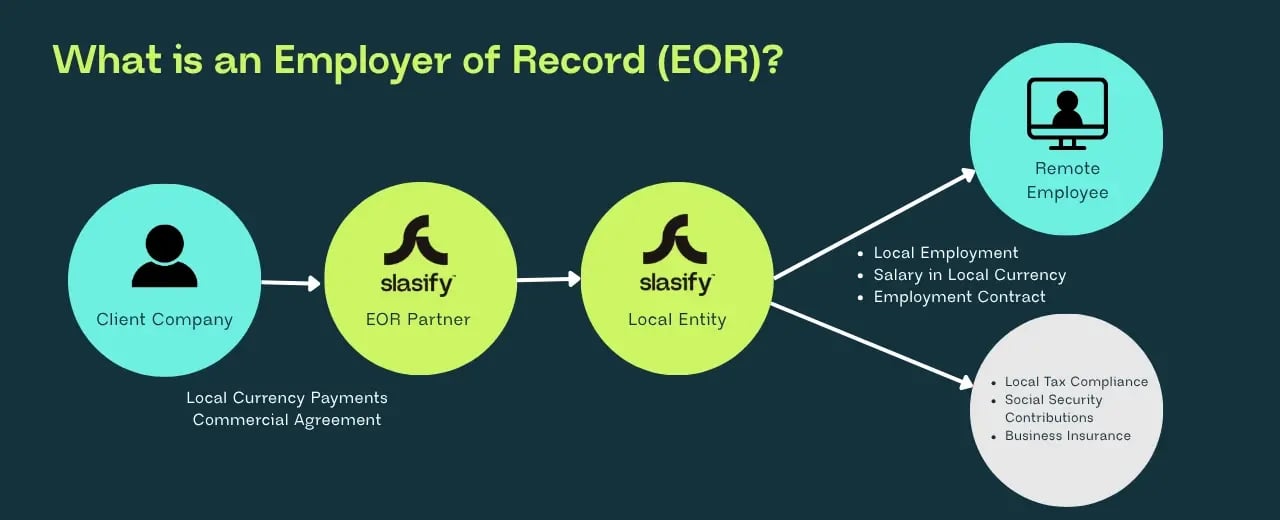
We run payroll in Taiwan through our own local entity, which means our Employer of Record service makes us the legal employer for your Taiwanese hires, and the contributions above are filed under our registration rather than yours. Across our network of 600+ local partners, we cover 150+ countries in 130+ currencies, and we hold ISO 27001 certification.
In practice, that means enrolling each employee with the Bureau of Labor Insurance and the National Health Insurance Administration on their first day, then reporting the right insured amount against four different bracket tables. Those amounts get adjusted when salary changes and again when the tables are reissued each January.
We apply the occupational accident rate for our entity's industry classification, and we calculate the supplementary premium in the months a bonus lands.
Taiwan is one of the markets where we hold our own entity rather than working through a partner, alongside Singapore, Hong Kong, Malaysia, Vietnam, and mainland China. Where you already have a Taiwanese entity and only need the payroll run correctly, our global payroll service handles the filings without becoming the employer.
If you are weighing this against incorporating locally, our guide on choosing an EOR sets out what to check. The Taiwan employment guide covers the statutory position beyond payroll, and the Taiwan payroll checklist is the month-to-month working document.
Frequently Asked Questions
Q1. What percentage does an employer pay on top of salary in Taiwan?
Between roughly 13% and 20%, depending on salary.The composite rate is 19.8% of the insured amount, but the Labor Insurance ceiling of NT$45,800 caps two of the five contributions, so the loading on a gross salary falls as pay rises.
Q2. What is the Labor Insurance rate in Taiwan for 2026?
11.5% for ordinary risk, unchanged from 2025.The employer pays 70%, the employee 20%, and the central government 10%. The statutory rate is 12.5%, and one point is taken off before collection for every insured employee, so 11.5% is what is charged whether or not the person is covered by Employment Insurance.
Q3. Do employers pay the 6% pension for foreign employees?
Since 1 January 2026, yes, for foreign professionals and Gold Card holders in professional work, whether or not they hold permanent residence.Before that date, the obligation only reached foreign nationals with permanent residence or married to a household-registered ROC national.
Q4. Why is the health insurance employer contribution higher than 60% of 5.17%?
Because the employer share is charged on 1.56 units rather than one.The act requires an averaged dependent count rather than an actual one, and the administration currently sets that average at 0.56. That makes the effective employer rate 4.84%.
Q5. Which salary ceiling applies to Taiwanese employer contributions?
There are four different ones that apply.Labor Insurance and Employment Insurance cap at NT$45,800, occupational accident insurance at NT$72,800, the Labor Pension at NT$150,000, and National Health Insurance at NT$313,000.
Q6. What is the minimum wage in Taiwan in 2026?
NT$29,500 a month and NT$196 an hour, effective 1 January 2026, up from NT$28,590 and NT$190.It also sets the floor of three of the four contribution bracket tables.
Q7. Can we employ someone in Taiwan without setting up a company?
Yes, through an Employer of Record.We employ the person through our Taiwan entity and handle the contributions, contracts, and filings. The Taiwan employment guide covers the full statutory picture with more details.
Getting the Numbers Right Before You Hire
If you are pricing a Taiwanese hire, what you need is five line items read off four tables. The total changes with salary, with the work being done, and with whether the person you are hiring is Taiwanese.
We can run that calculation against your roles and tell you what each hire costs fully loaded, including the months where a bonus triggers the supplementary premium. Reach out to us and we will put real numbers against your hiring plan.
Sources
Labor Insurance Act (勞工保險條例), Article 15. Laws and Regulations Database of the Republic of China. law.moj.gov.tw
National Health Insurance Act (全民健康保險法), Article 27. law.moj.gov.tw
Bureau of Labor Insurance, 2026 Labor Insurance ordinary risk premium share table (115年勞工保險普通事故保險費分擔金額表), note 2, recording the one-point reduction for insured persons outside Employment Insurance under Executive Yuan letter 院臺勞字第0910061906號 of 27 December 2002. bli.gov.tw
Bureau of Labor Insurance, Labor Insurance, Employment Insurance, and Occupational Accident Insurance premium calculator (勞保、就保、災保保險費試算), rate history. bli.gov.tw
Ministry of Labor, announcement of the occupational accident insurance industry rate table, 7 November 2024, giving the national average of 0.21%, the 0.05% to 0.89% industry range, the five industry categories at the 0.05% minimum, the mining categories at the 0.89% maximum, and the 0.07% commuting component. mol.gov.tw
Ministry of Labor, minimum wage decision for 2026, announced 26 September 2025 and promulgated by order 勞動條2字第1140148807號 of 21 October 2025. mol.gov.tw
Bureau of Labor Insurance, 2026 insured salary grade adjustments. bli.gov.tw
Act for the Recruitment and Employment of Foreign Professionals (外國專業人才延攬及僱用法), Article 24, in force 1 January 2026, law.moj.gov.tw; and Bureau of Labor Insurance guidance confirming it applies whether or not permanent residence is held, updated 29 December 2025, bli.gov.tw
Act for the Recruitment and Employment of Foreign Professionals, Article 25, in force 1 January 2026; and Bureau of Labor Insurance, Employment Insurance eligible persons. bli.gov.tw
Bureau of Labor Insurance, 2026 Labor Insurance premium share table (115年勞工保險保險費分擔金額表), bli.gov.tw; and 2026 Employment Insurance premium share table (115年就業保險保險費分擔金額表), bli.gov.tw
National Health Insurance Administration, supplementary premium (補充保險費). nhi.gov.tw
National Health Insurance Act, Article 34. law.moj.gov.tw
National Health Insurance Administration, employer and insured premium calculation formula and worked examples, giving the 5.17% rate, the 60/30/10 split, and the average dependent count of 0.56 in force since 1 January 2024. nhi.gov.tw
National Health Insurance Administration, insured payroll bracket table effective 1 January 2026 (投保金額分級表), 58 grades, NT$29,500 to NT$313,000. nhi.gov.tw
Bureau of Labor Insurance, occupational accident insurance industry classification and rate table (勞工職業災害保險適用行業別及費率表), effective 1 January 2025. bli.gov.tw
Bureau of Labor Insurance, Labor Pension monthly contribution wage classification table (勞工退休金月提繳分級表), bli.gov.tw; and notice requiring employers to file for foreign professionals by 15 July 2026, with the 30 June 2026 employee election deadline, bli.gov.tw
Bureau of Labor Insurance, Labor Pension covered persons (勞工退休金適用對象), recording coverage of foreign spouses of household-registered ROC nationals from 17 January 2014 and of foreign permanent residents from 17 May 2019. bli.gov.tw
Bureau of Labor Insurance, comparison of Labor Insurance and occupational accident insurance insured salary rules. bli.gov.tw
Bureau of Labor Insurance, occupational accident insurance eligibility, stating that employees of registered units are compulsorily insured 不論單位僱用人數若干, regardless of how many people the unit employs. bli.gov.tw
Statutory figures reflect published Ministry of Labor, Bureau of Labor Insurance, and National Health Insurance Administration rates, orders, and bracket tables as of September 2026. All four bracket tables are reissued each January and rates change on announced schedules. Confirm the current bracket tables before you run payroll on these numbers.