| 5 Key Takeaways |
|
|
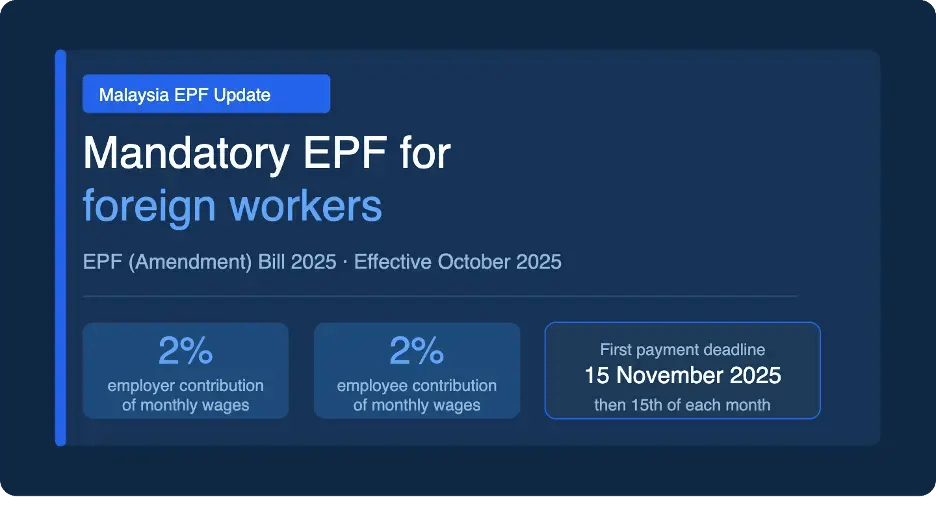
- Both employers and employees must contribute 2% of monthly wages to EPF.
|
|
|
- Domestic workers are exempt; all other non-Malaysian employees holding valid work permits are covered.
|
|
|
Starting from October 2025, Malaysia introduced a Malaysia mandatory EPF contribution from both employers and foreign employees, a policy shift that affects every business operating in Malaysia with non-Malaysian staff on payroll.
For years, EPF participation was voluntary for foreign workers. That has changed. Under the EPF (Amendment) Bill 2025, passed in Malaysia's parliament in March 2025, EPF contributions are now a legal obligation for nearly all non-Malaysian employees. If your Malaysia payroll statutory contributions haven't been updated to reflect this, your business may already be out of compliance.
This article explains what the new rule requires, who it applies to, how it affects your payroll costs, and what steps HR and finance teams need to take now.
What Is EPF in Malaysia?

Before diving into the changes, it helps to understand what EPF is and why it matters for EPF contributions Malaysia employers must manage.
The Employees Provident Fund (EPF), known locally as KWSP (Kumpulan Wang Simpanan Pekerja), is Malaysia's national retirement savings scheme. Both employers and employees make monthly contributions, which are held and managed by the EPF board until employees retire, permanently leave Malaysia, or qualify for specific withdrawals.
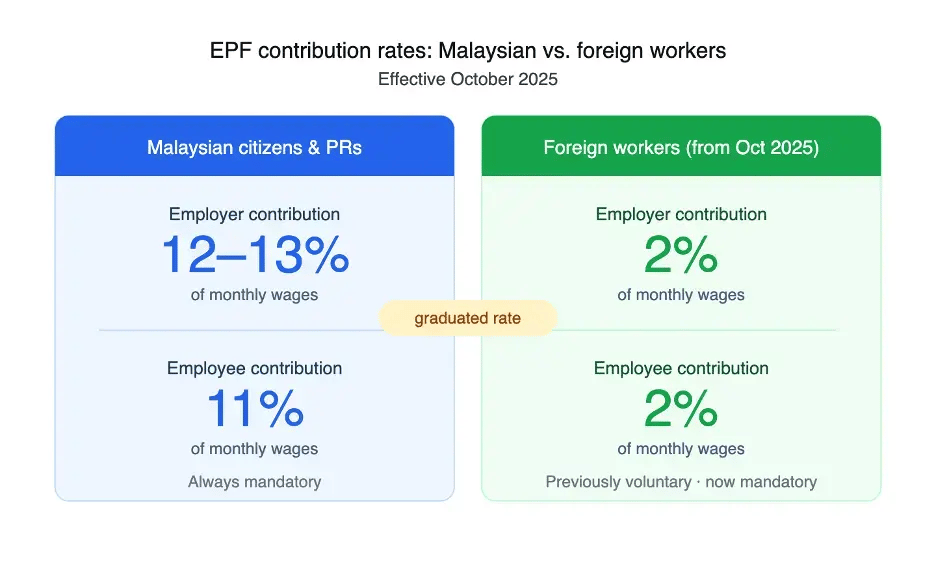
For Malaysian citizens and permanent residents, EPF has always been mandatory. Contribution rates are substantial:
|
Contributor
|
Standard Rate
|
|
Employer
|
12% (wages ≥ RM5,000) / 13% (wages < RM5,000)
|
|
Employee
|
11%
|
EPF sits alongside SOCSO (Social Security Organisation) and EIS (Employment Insurance System) as part of Malaysia's core statutory payroll contributions framework. They are the three contributions that any employer hiring in Malaysia must account for.
Until recently, foreign workers operated under a separate category: EPF participation was optional, not required. That changed with the 2025 amendment.
Malaysia's New 2% EPF Contribution Rule: The Details
Here is what the new policy requires:
|
Item
|
Details
|
|
Effective date
|
October 2025 wages
|
|
First payment deadline
|
15 November 2025
|
|
Ongoing deadline
|
15th of each following month
|
|
Employer contribution
|
2% of monthly wages
|
|
Employee contribution
|
2% of monthly wages
|
|
Legal basis
|
EPF (Amendment) Bill 2025
|
This policy was introduced under the EPF (Amendment) Bill 2025, which was passed in the Dewan Rakyat on 6 March 2025 and later approved by the Dewan Negara. The bill amends the EPF Act 1991, making EPF contributions for foreign workers in Malaysia mandatory for employees who were previously exempt unless they opt in voluntarily.
Note that the Malaysia EPF 2% contribution rate for foreign workers is deliberately set below the standard Malaysian rate of 12–13% (employer) and 11% (employee). This graduated approach reflects the policy intent: extend coverage to foreign workers without immediately applying full local contribution rates.
Who Is Affected by the New Rule?
Covered Employees
The Malaysian mandatory EPF contribution applies to:
- Non-Malaysian employees working in Malaysia
- Workers holding valid employment passes or work permits
- Employees receiving wages in Malaysia across all industries
Exemptions
According to the legislation, domestic servants are excluded from the mandatory requirement. This includes individuals working as maids, cooks, gardeners, cleaners, babysitters, drivers, and similar roles, as defined under Section 3 of the Workmen's Compensation Act 1952.
Other potential exemptions may apply to employees above specific age thresholds or to categories specifically defined under Malaysian labor law. Employers should verify eligibility with EPF directly or through a qualified payroll partner.
Employer Responsibilities
If you employ Malaysian EPF foreign workers, you are now responsible for:
- Registering all eligible foreign employees with EPF (if not already done)
- Calculating the 2% employer contribution per employee per month
- Deducting 2% from employee wages each month
- Submitting monthly contributions by the 15th of the following month
- Maintaining accurate payroll documentation for each foreign worker
Why Malaysia Introduced This Policy
This is not a standalone change. It reflects a broader direction in Malaysia's labor policy, and understanding the intent behind it helps employers anticipate further developments in Malaysia payroll compliance.
Improving social protection for foreign workers. Malaysia's foreign workforce is substantial. Bringing them into the EPF system gives millions of non-Malaysian employees access to retirement savings they previously lacked, providing meaningful financial security for workers who may spend years contributing to Malaysia's economy.
Reducing cost disparities between local and foreign labor. When foreign workers carried lower Malaysia payroll statutory contributions burdens, it created an uneven playing field for Malaysian workers competing for the same roles. The new rule partially closes that gap, making labor costs more comparable regardless of nationality.
Aligning with international employment standards. Neighboring countries and developed markets have long applied retirement contribution requirements across their entire workforces. Malaysia's amendment brings its regulatory framework closer to international norms. This is a consideration that matters particularly for companies managing international payroll in Malaysia across multiple markets.
Strengthening workforce formalization. Mandatory EPF registration creates a more formal paper trail for foreign employment, supporting better labor market regulation and reducing the risks associated with informal work arrangements.

Payroll Implications for Employers
For most businesses, the operational impact of EPF contributions Malaysia employers are now required to make is straightforward to calculate, but not trivial to implement.
Direct Cost Increase
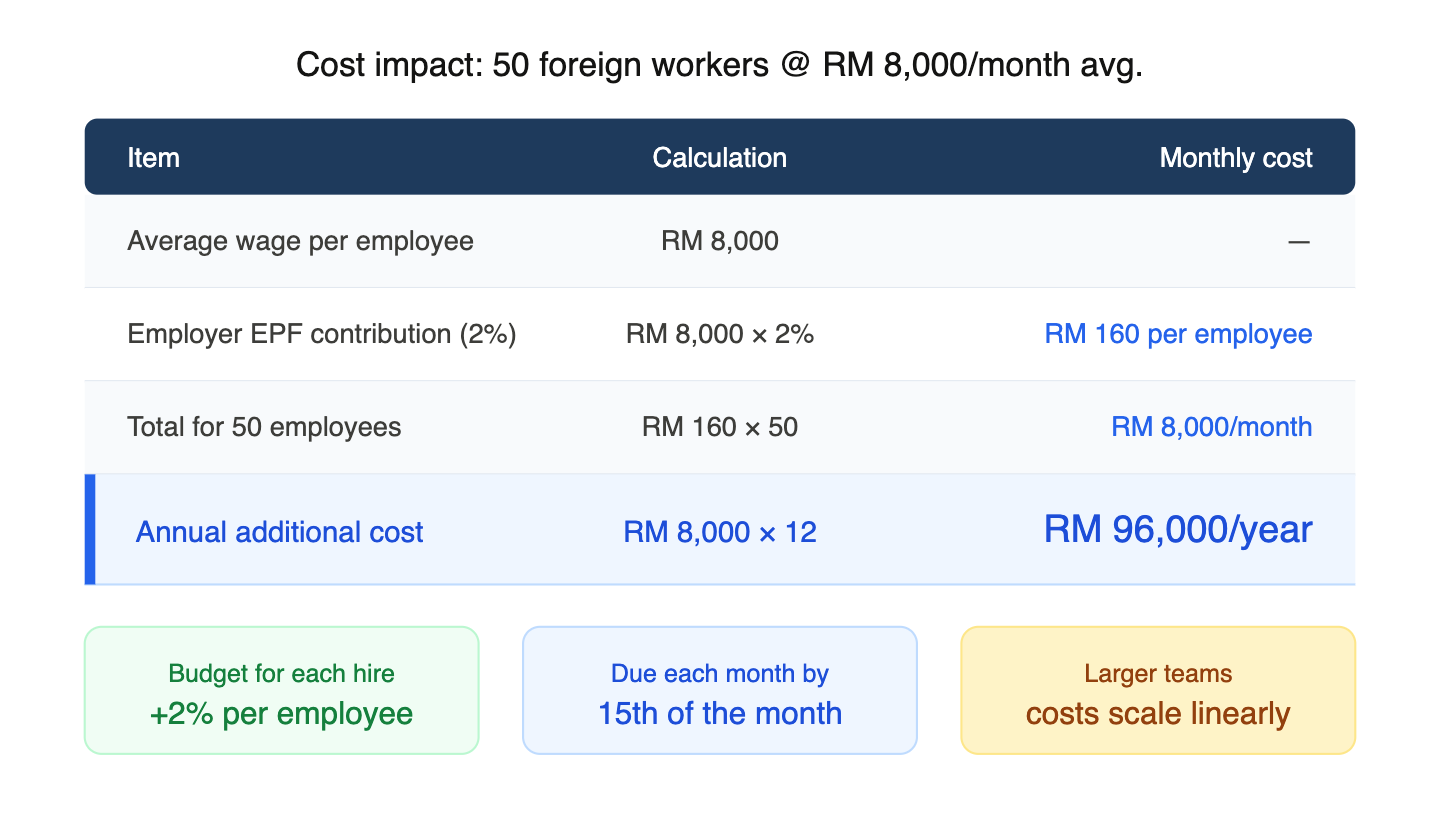
Every foreign employee on your Malaysia payroll now adds an additional Malaysia EPF 2% contribution to your monthly employer costs. For a company with 50 foreign workers earning an average of RM 8,000 per month:
|
Item
|
Calculation
|
Monthly Cost
|
|
Average wage per employee
|
RM 8,000
|
—
|
|
Employer EPF contribution (2%)
|
RM 8,000 × 2%
|
RM 160 per employee
|
|
Total for 50 employees
|
RM 160 × 50
|
RM 8,000/month
|
|
Annual additional cost
|
RM 8,000 × 12
|
RM 96,000/year
|
For companies with larger foreign workforces or higher average salaries, the cost impact will be proportionally greater. Finance teams should revise headcount cost models to account for this before the next budget cycle.
Operational Changes Required
Beyond direct costs, the rule creates several operational requirements that form part of your broader Malaysia employer payroll obligations:
- Payroll system updates: Your payroll software must be configured to calculate and apply the EPF contribution for foreign workers in Malaysia separately from local employee contributions
- EPF registration: Foreign employees not previously registered with EPF must be enrolled
- Monthly filings: A new line of statutory reporting is added to your monthly payroll cycle
- Payslip updates: Employee payslips should reflect the EPF deduction clearly
Compliance Considerations
What Employers Are Responsible For
Compliance responsibility sits with the employer under Malaysian employment law. That means:
- Correct EPF contribution calculations for every eligible foreign employee
- Timely submission of monthly filings (by the 15th of each month)
- Accurate payroll records are maintained for audit purposes
- Proper registration of all foreign employees with EPF
Risks of Non-Compliance
Missing or miscalculating EPF contributions Malaysia employers owe is not a minor administrative error. It carries real legal and financial consequences:
- Financial penalties for late or incorrect contributions
- Audit exposure if statutory records are incomplete or inconsistent
- Back payment obligations if contributions were missed from October 2025 onward
- Reputational risk with employees and regulators
Getting this right from the start is significantly easier than correcting a compliance gap after the fact.

Best Practices for Employers
- Review your current foreign workforce data. Before anything else, generate a complete list of all non-Malaysian employees currently on your Malaysia payroll. Identify who falls under the Malaysia mandatory EPF contribution rule and who may be exempt.
- Confirm EPF registration status for each employee. Any foreign worker not previously registered with EPF should be enrolled immediately. EPF registration for foreign workers was previously optional, so there may be gaps in your records.
- Update payroll systems and contribution calculations. Work with your payroll team or provider to ensure the Malaysia EPF 2% contribution is correctly configured. Both the employer-side deduction and the employee-side deduction. Test calculations against actual salary data before the next payroll run.
- Update employment contracts if needed. Foreign employees should be informed of the new EPF deduction from their wages. Depending on how employment agreements are structured, a formal notification or amendment may be appropriate.
- Establish a monthly compliance calendar. EPF contributions are due by the 15th of each month for the prior month's wages. Build this deadline into your payroll cycle alongside existing SOCSO and EIS filing obligations, treating it as a core part of your Malaysia payroll statutory contributions calendar.
- Document everything. Maintain detailed payroll records showing EPF contributions, registration dates, and employee details. Malaysia's statutory agencies conduct audits, and complete documentation is your best protection.
When to Consider a Malaysia Global Payroll Solution or EOR Support
For companies managing one or two employees in Malaysia, internal payroll updates may be sufficient. But for businesses with broader operations, managing Malaysia employer payroll obligations across a mixed or growing workforce makes a strong case for dedicated support.
Your situation likely calls for a partner if you are:
- Hiring employees in Malaysia without a local legal entity. You need an Employer of Record to compliantly hire and manage statutory contributions on your behalf
- Managing a mixed workforce of Malaysian citizens and foreign workers with different EPF contributions Malaysia employers must calculate separately
- Running international payroll in Malaysia alongside operations in other markets, where each country has its own statutory obligations
- Navigating frequent regulatory updates, Malaysia's labor landscape is actively evolving, and keeping internal teams current on every change requires ongoing investment
A Malaysia global payroll solution or Employer of Record (EOR) partner handles EPF registration, correct contribution calculations, monthly filings, and compliance reporting end-to-end. When regulations change, as they just did with mandatory EPF contribution foreign workers in Malaysia, the compliance burden shifts to the partner rather than your internal team.
Slasify's EOR Malaysia solution manages all Malaysia payroll statutory contributions for your workforce, including the new mandatory EPF for foreign workers. From registration to monthly filings, Slasify ensures your Malaysia payroll compliance stays current as the country's labor laws continue to evolve. Get a demo →
Conclusion
The Malaysia mandatory EPF contribution for foreign workers is now in effect. The EPF (Amendment) Bill 2025 closed a long-standing gap in social protection coverage, and employers should prepare and act promptly.
The Malaysian employer payroll obligations under this rule are clear: register foreign employees with EPF, apply the Malaysia EPF 2% contribution in your payroll calculations, and submit monthly contributions by the 15th of each month. The cost implications are real but manageable with the right payroll infrastructure in place.
For global companies hiring employees in Malaysia, whether through a local entity or an Employer of Record, this change is a direct reminder that Malaysia payroll compliance is not a set-and-forget function. Regulations move, deadlines are strict, and EPF contributions Malaysia employers owe are enforced. Staying ahead of them is part of operating responsibly in the market, and having a reliable Malaysia global payroll solution or EOR partner in place makes that significantly easier.
Frequently Asked Questions

What is Malaysia's new EPF rule for foreign workers?
Starting from October 2025, the Malaysia mandatory EPF contribution requires non-Malaysian employees and their employers to each contribute 2% of monthly wages to EPF. This EPF contribution for foreign workers in Malaysia replaces what was previously a voluntary arrangement.
Starting in October 2025, it is mandatory for both employers and non-Malaysian employees to each contribute 2% of the employee's monthly wages to the EPF.
When does the 2% EPF contribution start?
The mandate takes effect for wages earned in October 2025. Employers must submit the first payment by November 15, 2025.
Who must contribute to EPF in Malaysia under the new rule?
All employers and non-Malaysian employees working in Malaysia with valid work permits or employment passes are covered, with the exception of domestic workers as defined under Malaysian law.
Do employers have to register foreign workers with EPF?
Yes.Employers are required to register all eligible foreign employees with EPF and ensure monthly contributions are submitted on time. Those were not registered must be enrolled before contributions can be processed.
How will the rule affect payroll costs?
EPF contributions in Malaysia employers must now add 2% on top of each foreign employee's monthly wages. For companies with large foreign workforces or high average salaries, this should be factored into workforce planning and Malaysia payroll modeling.
What happens if employers fail to comply?
This can result in financial penalties, back payment obligations, audit exposure, and legal liability under the EPF Act 1991 as amended. Employers are strongly advised to ensure compliance from the October 2025 effective date.
What happens if employers fail to comply?
Non-compliance can result in immediate financial penalties, back payment obligations, and severe audit risks under the EPF Act. (Need help managing this? Contact Slasify's global payroll team.)