Country Fact Sheet
Texas SSC and Hiring Guide
Planning to hire in Texas? Get the full 2026 breakdown of employment law, payroll tax, and statutory contributions — plus how an EOR makes it...
| Key Takeaways |
|---|
| New York has one of the most complex payroll environments in the United States. Employers must manage state income tax withholding, Unemployment Insurance, mandatory Disability Benefits (DBL), Paid Family Leave (PFL), and — for NYC and Yonkers employees — local income taxes, all on top of full federal FICA and FUTA obligations. NYS Tax Dept ↗ |
| The New York minimum wage increased on 1 January 2026: $17.00/hour in New York City, Long Island, and Westchester County; $16.00/hour in the rest of the state. From 2027, increases will be indexed to the Consumer Price Index. NYS DOL ↗ |
| The Unemployment Insurance taxable wage base rose sharply to $17,600 for 2026, up from $12,800 in 2025 — a permanent change tied to 18% of the state average annual wage, adjusted every January. The new employer combined UI rate is 4.1%. NYS DOL ↗ |
| NY Paid Family Leave (PFL) employee contribution increased to 0.432% of gross wages in 2026, capped at $411.91 per employee per year. The maximum weekly PFL benefit increased to $1,228.53. PFL is 100% employee-funded — no employer contribution required. NYS PFL ↗ |
| Statutory Disability Benefits (DBL) coverage is mandatory for all New York employers with one or more employees who have worked 30 days in the state. Employees may contribute up to $0.60/week toward premiums — capped at $31.20/year. The NYSIF DB premium rate decreased 28% to $17.68 per person annually for 2026. NYSIF ↗ |
| Slasify manages the full New York payroll compliance stack — state and local income tax withholding, UI registration, DBL, PFL, and FICA — through our Employer of Record and Global Payroll solutions. View US Employment Guide → |
New York is not the simplest state in which to run payroll. That is not a reason to avoid it — it is a reason to understand it fully before you hire your first employee. For international companies and global HR leaders, New York offers unrivalled access to talent across finance, technology, media, healthcare, and professional services. But that talent access comes with one of the most layered payroll compliance environments in the United States.
Unlike Texas, New York has a state income tax. Unlike California, it also has mandatory Disability Benefits coverage. On top of those, there is Paid Family Leave, Unemployment Insurance on a now-significantly higher wage base, and — for employees living in New York City or Yonkers — local income taxes that must be withheld and remitted separately. This guide walks through every obligation, every 2026 rate, and every registration step a global employer needs to get New York payroll right from day one.

New York State is home to over 9.5 million workers and the largest concentration of financial services, media, technology, and professional services talent in the country. New York City alone accounts for roughly 4.7 million jobs — the single largest urban employment market in the United States. For companies building revenue-generating, client-facing, or specialised knowledge teams, the New York labour pool is frequently non-negotiable.
The payroll complexity is real, but it is manageable when the obligations are understood in advance. The 2026 updates — a higher minimum wage, a significantly higher UI wage base, and increased PFL contributions — make this the right year to audit your New York payroll configuration whether you are already operating in the state or planning to hire your first New York employee.
For international employers: New York requires more compliance infrastructure than most US states — but it is well-documented, consistently enforced, and manageable through a qualified EOR or payroll provider. The key is setting it up correctly from the first payroll run. Retroactive corrections in New York, particularly for UI under-remittances or PFL deduction errors, attract penalties and interest that compound quickly.
New York's minimum wage increased on 1 January 2026 under the phased schedule agreed by Governor Hochul and state lawmakers.1 New York operates a two-tier minimum wage based on geography — a higher rate for downstate employees and a lower rate for the rest of the state. From 2027, future increases will be tied to the Consumer Price Index, meaning annual adjustments without further legislation.
| Location | 2025 rate | 2026 rate | Change |
|---|---|---|---|
| New York City, Long Island, Westchester County | $16.50/hr | $17.00/hr | +$0.50 (+3.0%) |
| Rest of New York State (upstate) | $15.50/hr | $16.00/hr | +$0.50 (+3.2%) |
| Tipped employees — food service (NYC/LI/Westchester) | $13.75/hr cash | $14.00/hr cash | Tip credit applies |
| Tipped employees — all other (NYC/LI/Westchester) | $13.75/hr cash | $14.00/hr cash | Tip credit applies |
Source: New York State Department of Labor — Minimum Wage ↗
Employers with employees across both downstate and upstate New York must apply the correct rate per employee work location. A developer working remotely from Buffalo is on the upstate rate; the same role based in Brooklyn is on the downstate rate. For all-inclusive salary packages, employers must verify that the effective hourly rate — across all hours worked, including overtime and on-call — meets the applicable minimum for each employee's location.
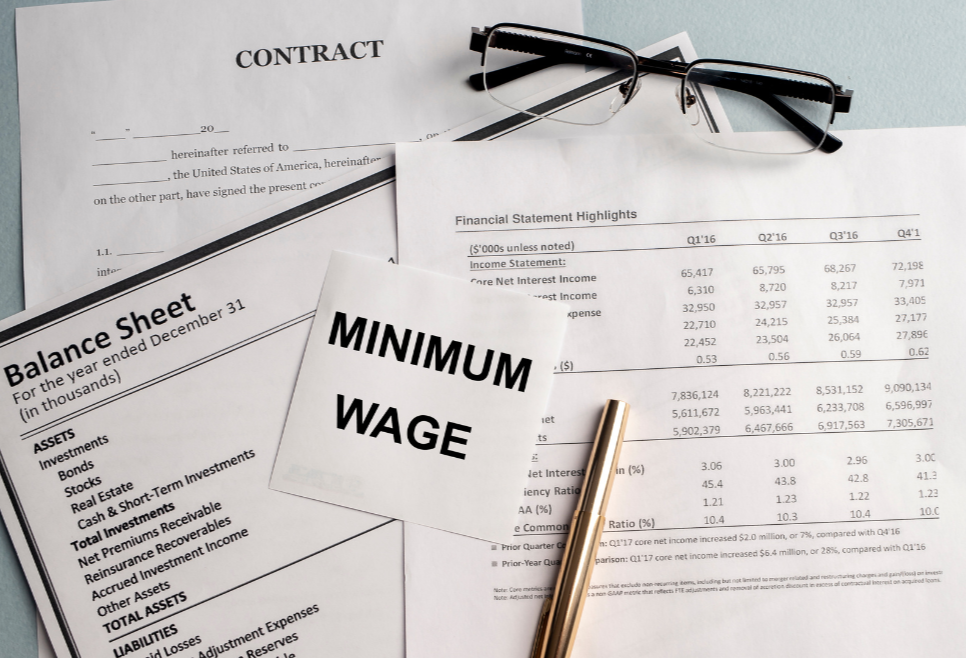
New York follows the federal FLSA overtime standard2: non-exempt employees must be paid at 1.5× their regular rate for all hours worked beyond 40 in a workweek. New York does not have a daily overtime threshold. Certain industries — hospitality, residential care — have additional New York-specific overtime and spread-of-hours rules under the New York Labor Law.3
⚠ Spread-of-hours rule: In the hospitality industry and certain other sectors, New York requires an additional hour of pay at the minimum wage rate for any day in which the spread between the start and end of an employee's shift exceeds 10 hours. This is a New York-specific obligation with no federal equivalent — and a common source of non-compliance for out-of-state employers managing New York hospitality or retail staff remotely.
All New York employers must withhold and match FICA taxes4 for every employee. FICA rates for 2026 are unchanged at 6.2% Social Security and 1.45% Medicare, each paid by employer and employee. The key 2026 change is the Social Security wage base5, which rose from $176,100 to $184,500 — meaning the maximum Social Security tax for both employer and employee is $11,439 each in 2026.
| FICA component | Employee rate | Employer rate | 2026 wage base |
|---|---|---|---|
| Social Security (OASDI) | 6.2% | 6.2% | $184,500 — then stops |
| Medicare (HI) | 1.45% | 1.45% | No limit — all wages |
| Additional Medicare Tax | 0.9% above $200,000 | Not applicable | Employee-only above $200,000 |
The gross FUTA6 rate is 6.0% on the first $7,000 of wages per employee. Employers who pay their state UI tax in full and on time receive a 5.4% credit, reducing the effective rate to 0.6% — a maximum of $42 per employee per year. New York is not currently a FUTA credit reduction state for 2026, following the New York State Budget's commitment to pay off the state's outstanding UI loan and restore Trust Fund solvency. This saves employers approximately $100 per employee compared to what credit reduction status would have cost.7
The biggest payroll cost change for New York employers in 2026 is the Unemployment Insurance taxable wage base. It rose from $12,800 in 2025 to $17,600 in 2026 — a 37.5% increase — and this is now a permanent annual adjustment.7 From 2026 onwards, the wage base adjusts every January 1 to 18% of the state average annual wage, rounded up to the nearest $100. This structural change means the base will continue rising each year as wages grow.
| UI parameter | 2025 | 2026 | Change |
|---|---|---|---|
| Taxable wage base | $12,800 | $17,600 | +$4,800 (+37.5%) |
| New employer normal rate | 3.4% | 3.4% | Unchanged |
| Re-employment Services Fund (RSF) | 0.075% | 0.075% | Unchanged |
| New employer combined rate (incl. RSF) | 4.025–4.1% | 4.1% | Higher cost on higher base |
| Experienced employer range (incl. RSF) | 2.1% – 9.9% | 1.7% – 9.5% | Rates slightly improved |
| Max annual UI cost per employee (new employer) | $524 | $721.60 | +$197.60/employee |
Source: New York State Department of Labor — UI Rate Information ↗
Budget impact for 2026 and beyond: The wage base increase from $12,800 to $17,600 represents an additional $197.60 in annual UI tax per employee for new employers (at the 4.1% combined rate). For a New York team of 20 employees, that is approximately $3,952 more in annual UI cost than in 2025 — before any rate changes from individual claims history. This structural increase will compound each year as the base continues to adjust upward with wage growth. Model this into your New York headcount budget now.

Employers must register with the New York State Department of Labor7 for a UI account before or immediately upon hiring. New employers are assigned the 3.4% normal contribution rate (plus 0.075% RSF = 4.1% combined) until they have five quarters of experience. The NYDOL mails rate notices to employers each February for the coming year.
New York State imposes a graduated income tax with nine brackets, ranging from 3.90% to 10.90%.8 The lower and middle bracket rates were reduced for 2026 under the 2025 state budget. Withholding is governed by Form IT-21049 — New York's own withholding certificate, separate from the federal W-4. Employers must collect a completed IT-2104 from every new hire based in New York. Without a completed IT-2104, withhold at the highest applicable rate.
| NYS income tax band (single filer, 2026) | Rate |
|---|---|
| Up to $17,150 | 3.90% |
| $17,151 – $23,600 | 4.50% |
| $23,601 – $27,900 | 5.25% |
| $27,901 – $161,550 | 5.85% |
| $161,551 – $323,200 | 6.25% |
| $323,201 – $2,155,350 | 6.85% |
| $2,155,351 – $5,000,000 | 9.65% |
| $5,000,001 – $25,000,000 | 10.30% |
| Above $25,000,000 | 10.90% |
Source: NYS Department of Taxation and Finance ↗
Supplemental wages — bonuses, commissions, overtime paid separately — are withheld at a flat 11.70% for New York State tax, plus 4.25% for New York City residents. This flat-rate withholding applies when supplemental wages are paid separately from regular wages and the amount is specified. If supplemental wages are combined with regular wages without specifying the amounts, withhold as if the total were a single payment.
New York City residents — regardless of where they work — pay a separate NYC resident income tax on top of state tax.10 The NYC tax rate ranges from approximately 3.078% to 3.876% depending on income level. Employers must withhold and remit NYC tax for all employees who are NYC residents, using the same payroll filing as state tax. Employees who work in NYC but live outside the city do not owe NYC resident tax.
Yonkers residents pay a 16.75% surcharge on their New York State income tax owed — not 16.75% of their income. If a Yonkers resident owes $3,000 in state income tax, their Yonkers surcharge is $502.50. Non-residents who work in Yonkers (but live elsewhere) face a separate non-resident earnings tax of 0.5% on Yonkers-sourced wages. Employers with Yonkers-based employees must configure payroll for both scenarios and refer to Publication NYS-50-T-Y11 for the withholding tables.
Slasify's US payroll and compliance team handles NYS income tax withholding, NYC and Yonkers local tax, UI registration, DBL, PFL, and FICA for international employers entering the New York market — with a dedicated account manager from day one.
New York's Disability Benefits Law (DBL)12 requires all private employers with one or more employees who have worked in New York for at least 30 days in a calendar year to provide statutory disability benefits coverage. DBL provides temporary wage replacement for employees who are unable to work due to an off-the-job illness, injury, or pregnancy — covering situations that workers' compensation does not.
.webp?width=1920&height=1080&name=Untitled%20design%20(1).webp)
DBL pays 50% of an employee's average weekly wage, up to a maximum of $170 per week for up to 26 weeks. Coverage must be obtained through a private licensed carrier or through the New York State Insurance Fund (NYSIF).13 Effective January 1, 2026, NYSIF lowered its standard DB premium rate from $24.75 to $17.68 per person annually — a 28% decrease — making it one of the lowest available rates in New York State.
| DBL parameter | 2026 figure | Who pays |
|---|---|---|
| Maximum weekly benefit | $170/week | Carrier / NYSIF |
| Maximum duration | 26 weeks | — |
| Benefit calculation | 50% of average weekly wage | — |
| Employee max contribution | $0.60/week ($31.20/year) | Deducted from employee wages |
| NYSIF standard premium (2026) | $17.68 per person/year | Balance of premium above employee contribution: employer |
| Employee eligibility | After 4 weeks of consecutive full-time employment (25 days for part-time) | — |
DBL + PFL are always together: Under New York law, PFL is provided only as a mandatory rider on a DBL policy. You cannot purchase PFL separately from DBL. This means your DBL carrier handles both programmes — and both deductions appear as line items on employee payslips. Ensure your payroll system labels them separately: "NY DBL" and "NY PFL" are distinct deductions with distinct rates and caps.
The NY PFL employee contribution rate increased from 0.388% to 0.432%14 for 2026, as announced by the New York Department of Financial Services. The annual cap increased from $354.53 to $411.91 per employee. The maximum weekly PFL benefit increased to $1,228.53 (67% of the state average weekly wage of $1,833.63).
| PFL parameter | 2025 | 2026 | Change |
|---|---|---|---|
| Employee contribution rate | 0.388% | 0.432% | +0.044pp |
| Annual contribution cap | $354.53 | $411.91 | +$57.38 |
| Max weekly benefit | $1,177.32 | $1,228.53 | +$51.21 |
| Benefit rate | 67% of SAWW | 67% of SAWW | Unchanged |
| Maximum leave duration | 12 weeks | 12 weeks | Unchanged |
| Employer contribution | None | None | 100% employee-funded |
Source: New York State Paid Family Leave — 2026 Rates and Maximums ↗

Once the annual cap is reached, withholding stops. Payroll systems must track each employee's cumulative PFL deductions year-to-date and stop withholding once $411.91 is reached — regardless of when in the calendar year that occurs. Employees who earn above the state average weekly wage ($1,833.63) will hit the cap before year-end; employees earning less than the SAWW will contribute less than $411.91 and their cap is their actual accumulated deductions.
The examples below show the total employer payroll-related cost at two common salary levels in New York City, using 2026 rates. They assume a new employer (4.1% UI rate), full FUTA credit applied, and standard full-time employee classification.
Employer Payroll Cost — 2026 New York City, New Employer (Annual)
| Payroll tax component | Rate / basis | Annual cost at $50,000 salary |
|---|---|---|
| Social Security (OASDI) | 6.2% on first $184,500 | $3,100 |
| Medicare | 1.45% on all wages, no limit | $725 |
| Federal Unemployment (FUTA) | 0.6% effective, first $7,000 | $42 |
| NY Unemployment Insurance (UI) | 4.1% (new employer), first $17,600 | $721.60 |
| State income tax withholding | Graduated 3.90%–10.90% (IT-2104) | Employer-remitted — employee cost |
| Statutory Disability Benefits (DBL) | NYSIF rate $17.68/person/year | ~$17.68 net of $31.20 employee contribution |
| Paid Family Leave (PFL) | 0.432%, capped at $411.91 — 100% employee-funded | $0 employer cost |
| Estimated total employer payroll tax | All of the above combined | ~$4,607/year (~9.2% on top of salary) |

New York vs Texas — the employer cost gap: For a comparable $50,000 employee, New York's employer payroll tax burden is approximately $500 more per year than Texas — primarily from the higher UI wage base ($17,600 vs $9,000) and the mandatory DBL premium. The more material difference is administrative: New York requires state and local income tax withholding accounts, IT-2104 collection from all employees, DBL and PFL insurance policies, and NYC/Yonkers local tax configuration — obligations that simply do not exist in Texas. Budget for both the cost and the compliance infrastructure.
| Action item | Owner | Source | Deadline |
|---|---|---|---|
| Obtain Employer Identification Number (EIN) from the IRS | Finance / HR | IRS ↗ | Before first payroll |
| Register with NYDOL for Unemployment Insurance account | Payroll | NYDOL ↗ | Before first payroll run |
| Register with NYS Tax Department for withholding tax account | Payroll | NYS Tax ↗ | Before first payroll run |
| Obtain DBL + PFL insurance policy (mandatory rider) from a licensed carrier or NYSIF | HR / Finance | NYSIF ↗ | Before first employee's 30th day |
| Collect completed IT-2104 from every new hire (and federal W-4) | HR | NYS Tax ↗ | Before first payroll run |
| Complete I-9 employment eligibility verification | HR | USCIS ↗ | Day 1 / Day 3 |
| Report new hires to NYS New Hire Reporting | HR | NY New Hire ↗ | Within 20 days of hire |
| Apply correct minimum wage: $17.00/hr (NYC/LI/Westchester) or $16.00/hr (upstate) per location | Payroll | NYDOL ↗ | From first payroll |
| Configure UI withholding at 4.1% (new employer) on first $17,600 per employee | Payroll | NYDOL ↗ | From first payroll |
| Withhold PFL at 0.432% after-tax per employee; stop at $411.91 annual cap | Payroll | NY PFL ↗ | From first payroll |
| Withhold DBL at up to $0.60/week per employee (max $31.20/year) | Payroll | NYSIF ↗ | From first payroll |
| Configure NYC resident income tax withholding (3.078%–3.876%) for NYC resident employees | Payroll | NYC Finance ↗ | From first payroll |
| Configure Yonkers surcharge (16.75% on state tax) for Yonkers residents; non-resident Yonkers tax (0.5%) for commuters | Payroll | NYS Tax ↗ | From first payroll |
| File quarterly Form NYS-45 (UI and withholding) and federal Form 941 | Payroll | NYS Tax ↗ | Per quarterly schedule |
| Issue W-2 to all employees and file with SSA and NYS by 31 January annually | Payroll | IRS ↗ | 31 January annually |
Slasify's US payroll and compliance team manages the full New York compliance stack — FICA, FUTA, UI, NYS income tax withholding, NYC and Yonkers local taxes, DBL, PFL, new hire reporting, and federal employment law — for international employers hiring in New York. Our EOR solution covers everything from day one, across 150+ markets, with a dedicated account manager who knows the New York regulatory environment.

Planning to hire in Texas? Get the full 2026 breakdown of employment law, payroll tax, and statutory contributions — plus how an EOR makes it...
Florida SSC changes in 2026: Payroll Taxes, Minimum Wage, and What Every Employer Needs to Know. Click to learn more!
A complete 2026 checklist for Taiwan payroll compliance. Learn employer obligations for NHI, Labor Insurance, payroll processing, and statutory...