SINGAPORE WORK PASSES
| Key Takeaways |
| — In Singapore, a "work visa" is a work pass issued by the Ministry of Manpower. In most cases, the employer applies, not the candidate. |
| — Most foreign professionals need an Employment Pass (EP). Mid-skilled staff usually need an S Pass, which comes with a quota and a monthly levy. |
| — EP candidates must meet an age-based qualifying salary and then score at least 40 points under COMPASS, unless they're exempt. |
| — Qualifying salaries for both the EP and S Pass rise for new applications from January 1, 2027. |
| — A company without a Singapore entity can apply through a genuine local sponsor, or set up its own entity. An Employer of Record (EOR) can employ Singapore citizens and permanent residents (PRs), but it cannot sponsor a work pass for an overseas company's foreign hire. |
Last reviewed: Nov 2026
You've picked your candidate for a Singapore role. Now the question is whether they can legally start, how long approval takes, and who files the paperwork if your company has no office in Singapore.
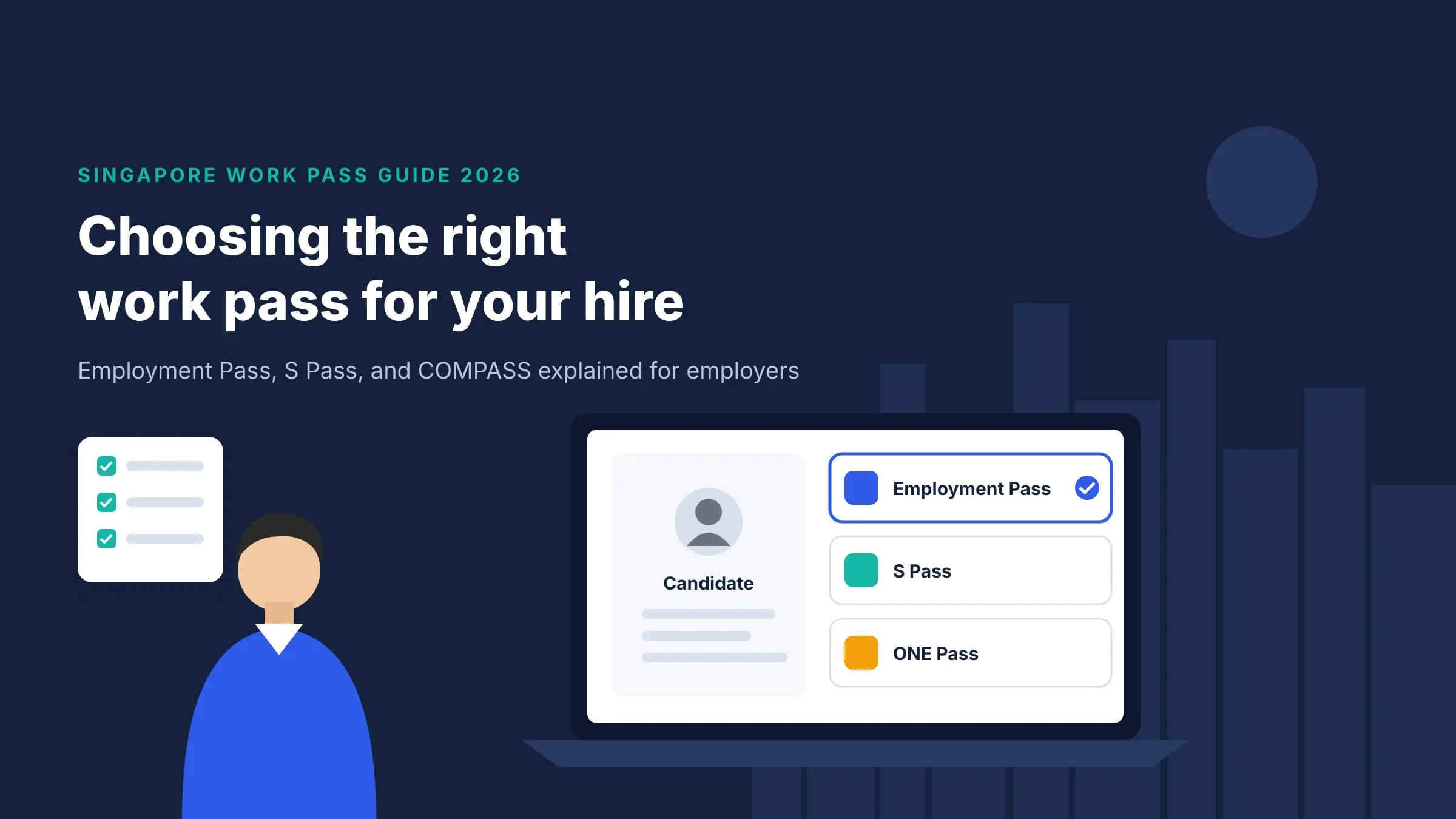
This Singapore work visa guide for 2026 explains how the system works, from choosing the right pass to clearing COMPASS, the points-based framework behind most Employment Pass decisions. It also covers the higher salary thresholds that take effect on January 1, 2027, so the offer you make this quarter still holds up next year.
This article is general guidance, not legal or immigration advice. Requirements change often, so confirm details with the Ministry of Manpower (MOM) before you apply.
1. What Is a Singapore Work Visa in 2026?
Singapore work pass: the permit a foreign national needs to work in Singapore. It’s issued by the Ministry of Manpower (MOM), tied to a specific employer, and applied for by that employer or its appointed employment agent in most cases (ONE Pass is the exception). “Work visa” is the everyday search term; “work pass” is the official one.
If you're the company making the hire, the application is yours to file. According to MOM's Employment Pass key facts, an employer or appointed employment agent submits the application, and overseas companies without a Singapore-registered office must apply through a local sponsor. The candidate gives written consent and completes their part of the form, but the employer owns the process.
That matters because a work pass isn't portable. If the employee changes jobs, the new employer has to apply for a new pass. So the structure you choose at the offer stage shapes every step that follows. For a foreign hire, that means your own Singapore entity or a genuine local sponsor. An EOR can employ Singapore citizens and PRs, but it cannot sponsor a work pass for an overseas company's foreign hire (see Section 6).
2. Which Singapore Work Pass Fits Your Hire?
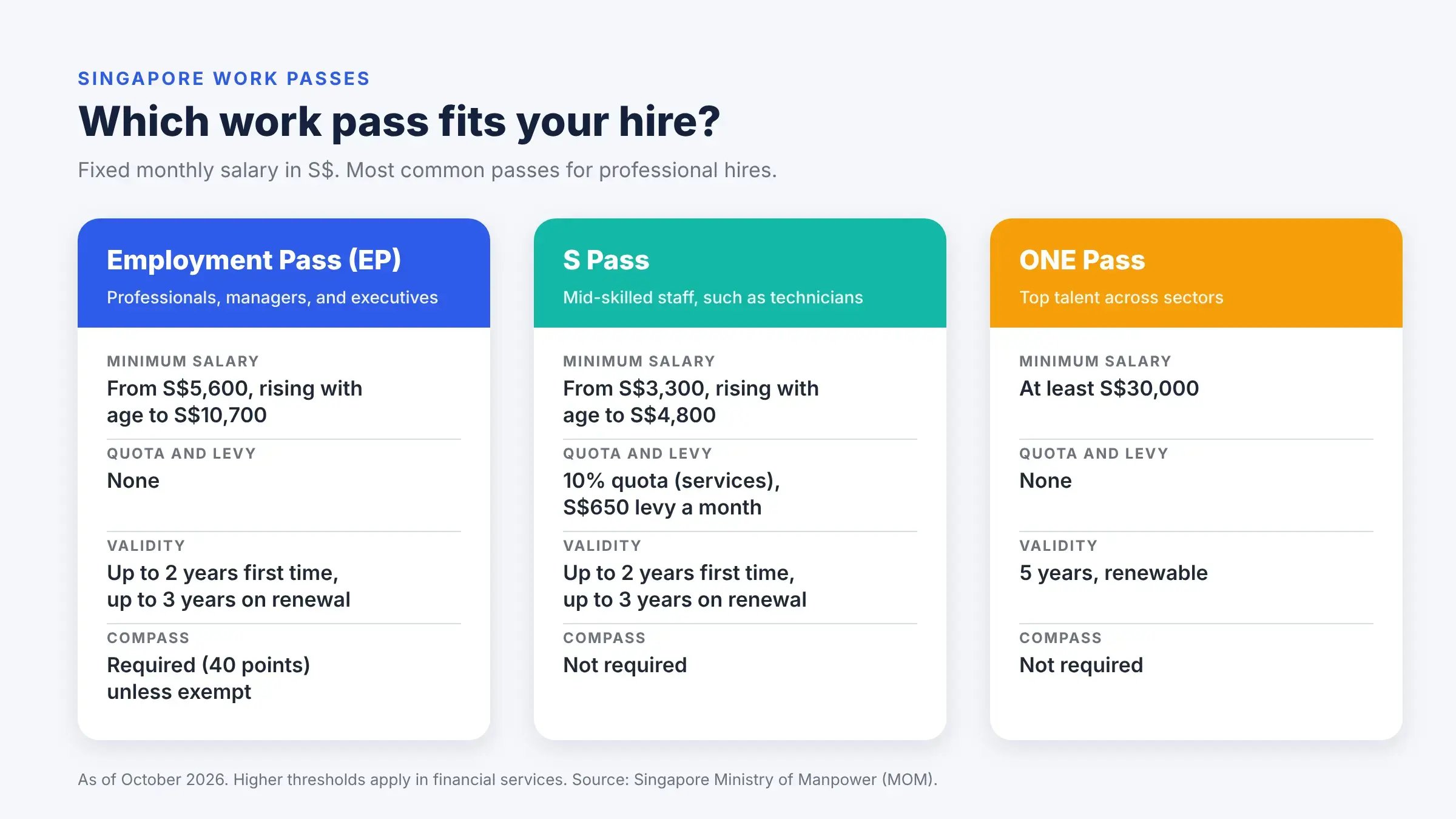
The right pass depends mainly on the role, the salary, and the candidate's profile. The table below covers the passes employers use most for professional hires. Salary figures are fixed monthly salaries in Singapore dollars (S$) and apply as of October 2026.
| Pass |
Who it's for |
Minimum qualifying salary |
Quota and levy |
Validity |
| Employment Pass (EP) |
Professionals, managers, and executives |
From S$5,600, rising with age to S$10,700 (higher in financial services) |
None |
Up to 2 years first time, up to 3 years on renewal |
| S Pass |
Mid-skilled staff, such as technicians |
From S$3,300, rising with age to S$4,800 (higher in financial services) |
Quota of 10% of the workforce in services; levy of S$650 a month |
Up to 2 years first time, up to 3 years on renewal |
| Overseas Networks & Expertise (ONE) Pass |
Top talent across sectors. Candidates can apply directly, and employers or agents can also apply on their behalf. |
Fixed monthly salary of at least S$30,000, or outstanding achievements (no salary test) |
None |
5 years, renewable |
ONE Pass also has an outstanding achievement route for people in sports, arts and culture, or academia and research. It has no salary test, and MOM and other agencies review each case.
Sources: MOM EP eligibility, S Pass eligibility, S Pass quota and levy, and ONE Pass eligibility.
What is the difference between an Employment Pass and an S Pass?
The EP is for higher-paid professional roles and has no quota or levy. The S Pass is for mid-skilled roles and carries both. An S Pass employer must stay within its quota, pay the monthly levy, and buy medical insurance for the employee, according to MOM's S Pass key facts. EP employers can choose whether to provide medical insurance. EP applications also go through COMPASS, which the S Pass doesn't.
What changes on January 1, 2027?
Qualifying salaries rise for new applications submitted from January 1, 2027, and for renewals of passes expiring from January 1, 2028. According to MOM:
—EP: The minimum rises from S$5,600 to S$6,000, and from S$10,700 to S$11,500 for candidates aged 45 and above. In financial services, it rises from S$6,200 to S$6,600.
—S Pass: The minimum rises from S$3,300 to S$3,600, and from S$4,800 to S$5,100 for candidates aged 45 and above. In financial services, it rises from S$3,800 to S$4,000.
MOM has also announced a new ONE Pass AI and Tech track that opens on January 28, 2027, replacing Tech. Pass. If your candidate sits close to the current threshold and you plan to submit in January, plan around the 2027 table instead.
3. How Does the COMPASS Framework Work?
COMPASS is the points-based framework MOM uses to assess Employment Pass applications, apart from a few exempt cases. It runs in two stages, and a candidate has to clear both.
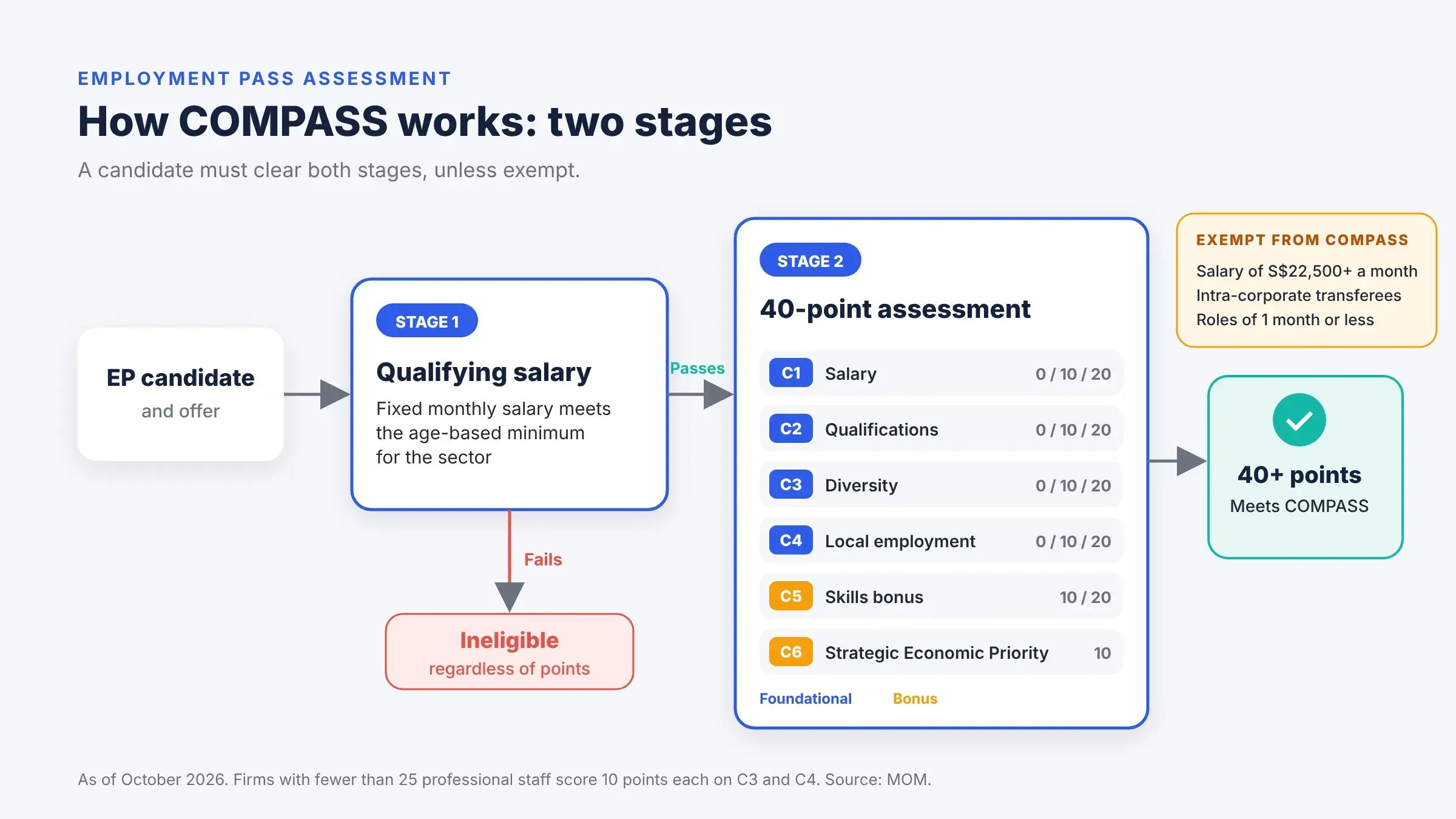
Stage 1: Qualifying salary. The candidate's fixed monthly salary must meet the age-based minimum for their sector. A candidate who fails this stage is ineligible “regardless of the points they would have scored under COMPASS,” according to MOM's EP eligibility page.
Stage 2: The 40-point assessment. The application must earn at least 40 points across four foundational criteria and two bonus criteria:
| Criterion |
What it measures |
Points |
| C1. Salary |
Candidate's salary against local professional salaries in your sector |
0, 10, or 20 |
| C2. Qualifications |
Degree-equivalent qualifications, with top-tier institutions scoring highest |
0, 10, or 20 |
| C3. Diversity |
Share of the candidate's nationality among the sponsoring firm's professionals, managers, executives and technicians (PMETs) |
0, 10, or 20 |
| C4. Support for local employment |
The sponsoring firm's share of local PMETs compared with sector peers |
0, 10, or 20 |
| C5. Skills bonus |
Role is on the Shortage Occupation List |
10 or 20 |
| C6. Strategic Economic Priorities bonus |
Firm takes part in an eligible government program |
10 |
MOM scores C3 and C4 on the sponsoring employer's workforce. If you apply through a local sponsor, that sponsor's PMET headcount drives both criteria, so check it before you make the offer.
Two rules matter most for smaller companies:
—Sponsoring firms with fewer than 25 PMETs score 10 points by default each on C3 and C4.
—Some candidates are exempt from COMPASS altogether: those earning a fixed monthly salary of at least S$22,500, overseas intra-corporate transferees, and those filling a role for one month or less.
MOM also offers a free Self-Assessment Tool on its Employment Pass pages, so employers can check a candidate's likely outcome before applying.
Slasify Scenario: Scoring a First Hire
Say a European software company wants to hire a 32-year-old backend engineer in Singapore. The candidate holds a computer science degree from a top 100 QS-ranked university.
—Stage 1: The offered salary is checked against MOM's age table for a 32-year-old. For age 32, the minimum is S$7,686 now (new applications before January 1, 2027) and S$8,250 from January 1, 2027. It clears the current threshold, but the company confirms it would also clear the 2027 table in case the application slips into January.
—C1 (Salary): The salary sits between the 65th and 90th percentile for the sector: 10 points.
—C2 (Qualifications): Top-tier university degree: 20 points.
—C3 and C4: Fewer than 25 PMETs in the sponsoring organization (the employer named on the application): 10 points each by default.
—Total: 50 points, above the 40-point pass mark, before any bonus.
The figures here are illustrative. Actual percentiles and firm-level scores depend on the sponsoring employer's data at the time of application.
4. How to Apply for an Employment Pass: A Step-by-Step Timeline
The EP process follows a fixed sequence, and getting the order right avoids rework later.
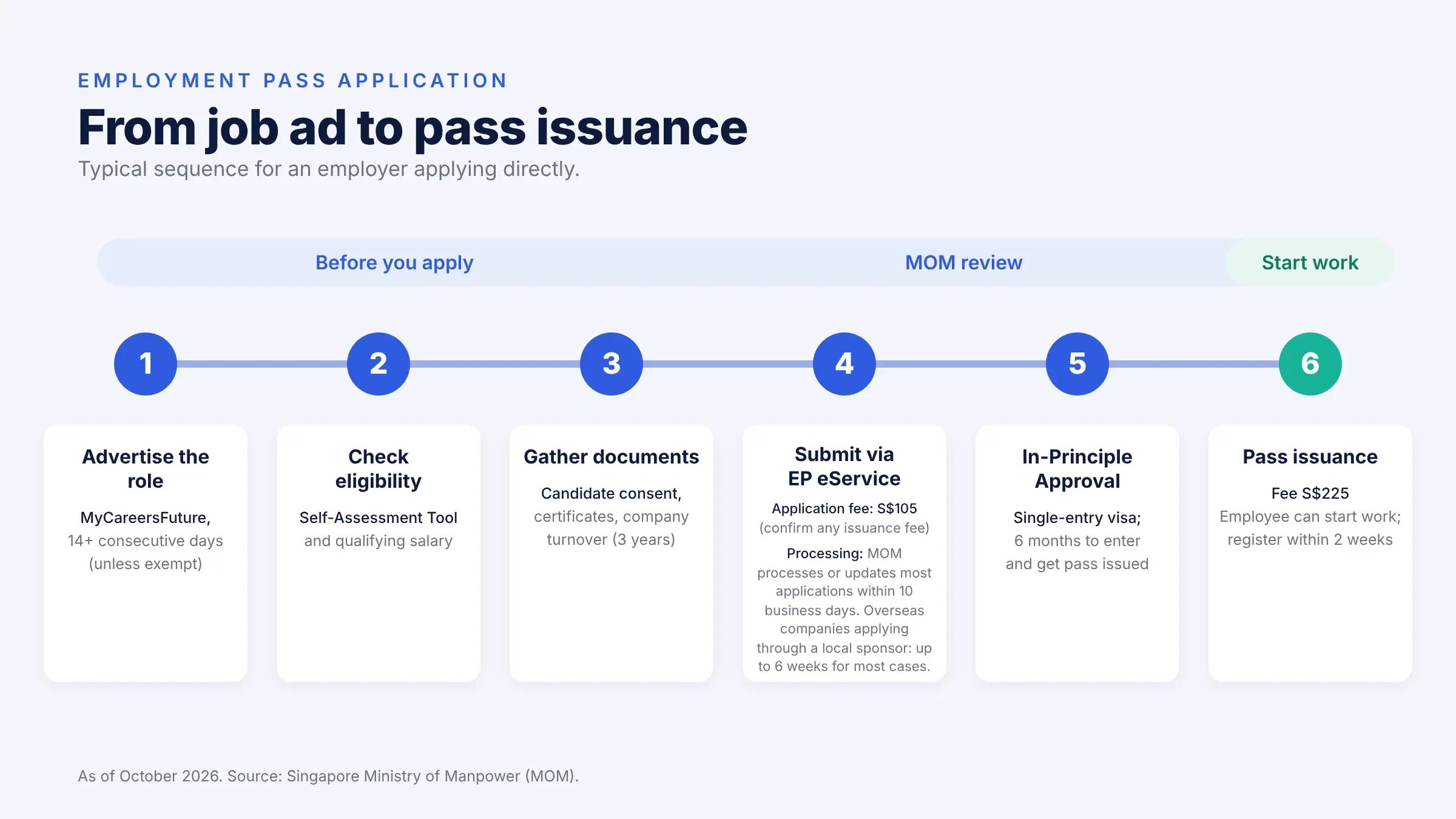
1. Advertise the role, unless you're exempt. Under the Fair Consideration Framework, employers must advertise on MyCareersFuture for at least 14 consecutive days before applying. Exemptions include companies with fewer than 10 employees, roles paying a fixed monthly salary of S$22,500 or more, roles lasting one month or less, and intra-corporate transferees.
2. Check eligibility. Run the candidate through MOM's Self-Assessment Tool and confirm the qualifying salary.
3. Gather documents and consent. You'll need the candidate's written consent, their completed form, supporting documents such as educational certificates, and your company's turnover information for the past three years.
4. Submit through EP eService. The application fee is S$105, according to MOM's apply for a pass page.
5. Receive In-Principle Approval (IPA). The IPA letter works as a single-entry visa and gives the candidate six months to enter Singapore and have the pass issued.
6. Get the pass issued. With the candidate in Singapore, request issuance and pay S$225. The notification letter lets the employee start work while the card is being processed. Fingerprint and photo registration, if required, must be completed within two weeks.
How long does an Employment Pass application take?
MOM says it processes, or gives an update on, most online applications within 10 business days. Applications from overseas companies without a Singapore-registered office, which go through a local sponsor, take up to six weeks for most cases, according to MOM. Add the 14-day advertising period if it applies, plus time for documents and the candidate's arrival, when you set a start date.
5. Employer Obligations After the Pass Is Approved
Approval is the start of the employer's duties, not the end. These duties apply for as long as the employee holds the pass.
—Renewals. EPs and S Passes can be renewed for up to three years at a time. Renewals for passes expiring from January 1, 2028 must meet the 2027 salary tables.
—Job changes. A work pass is tied to one employer. A new employer must apply for a new pass.
—S Pass levy and insurance. S Pass employers pay the S$650 monthly levy and must keep the employee covered by medical insurance that meets MOM's requirements.
—CPF. Foreigners on work passes don't contribute to the Central Provident Fund (CPF). MOM has confirmed that foreigners working in Singapore have not been allowed to contribute since 2003. Contributions start if the employee later becomes a permanent resident.
—Income tax. Employers handle payroll reporting for income tax. A foreigner who stays or works in Singapore for 183 days or more in a calendar year is treated as a tax resident, according to the Inland Revenue Authority of Singapore (IRAS). See our guide to Singapore salary tax for rates and filing.
—Family passes. EP and S Pass holders earning a fixed monthly salary of at least S$6,000 can apply for a Dependant's Pass for a spouse and unmarried children under 21, according to MOM's Dependant's Pass eligibility page.
—Ending employment. When employment ends, the employer must seek tax clearance from IRAS at least one month before the last day, pay for the employee's return flight unless they agree otherwise in writing, and cancel the pass within one week after the last day of notice, according to MOM's cancel a pass page.
One more date to watch: Singapore's Workplace Fairness Act is expected to take effect at the end of 2027. Review your hiring and selection records now so they hold up later.
For the wider picture of employment terms, leave, and payroll, see our Singapore employment guide.
6. Hiring in Singapore Without a Local Entity: Where an Employer of Record Fits
For hiring foreigners who require a work pass (for example, an EP), there are two routes:
—Local Sponsor Route: MOM allows overseas companies without a registered office in Singapore to apply through a genuine local sponsor (such as a local commercial partner). Processing takes up to six weeks for most cases.
—Set up a Local Entity: If there is no genuine local sponsor, the foreign company must incorporate a local entity (e.g., subsidiary or branch office) to directly sponsor and apply for work passes. (Note: MOM explicitly prohibits EORs from acting as proxy employers to sponsor work passes for overseas companies.)
Where an Employer of Record (EOR) fits
An Employer of Record cannot sponsor a work pass for a foreign hire who will work for an overseas company in Singapore, according to MOM. An EOR is the compliant solution for hiring Singapore Citizens and Permanent Residents (PRs) without a local entity. The EOR acts as the legal employer, managing compliant local contracts, CPF contributions, payroll, and tax filings while you oversee their daily operations.
How Slasify helps. Slasify is headquartered in Singapore and is a member of the Singapore Business Federation. Slasify can employ Singapore citizens and PRs through its Singapore entity as an Employer of Record. For foreign hires who need a work pass, we can help you prepare for the process. We'll help you check eligibility, prepare documents, and plan the timeline. Approval decisions rest with MOM, so no provider can guarantee an outcome, but careful preparation reduces avoidable delays and rejections.
If you already have an entity and only need payroll support, Global Payroll covers that. For a closer look at the model, read how EOR services work in Singapore.
7. Your Next Step: Plan Your Singapore Work Visa Before You Make the Offer
The Singapore work visa process in 2026 rewards preparation. Check the right pass for the role, test the candidate against the qualifying salary and COMPASS before you make an offer, and decide early how your company will sponsor the pass. With salary thresholds rising on January 1, 2027, offers made now should be checked against both tables.
Get the sponsor structure right first, and your first Singapore hire starts on schedule instead of waiting on a delayed application.
Ready to hire in Singapore with confidence?
Book a free Singapore hiring consultation with Slasify's in-country team.
Book a free consultation
8. Frequently Asked Questions
Q1. Can a foreign company sponsor an Employment Pass without a Singapore entity?
Yes, but not on its own. MOM requires an overseas company without a Singapore-registered office to apply through a local sponsor, and most applications take up to six weeks. An Employer of Record cannot apply for a work pass for someone based in Singapore who works for an overseas company.
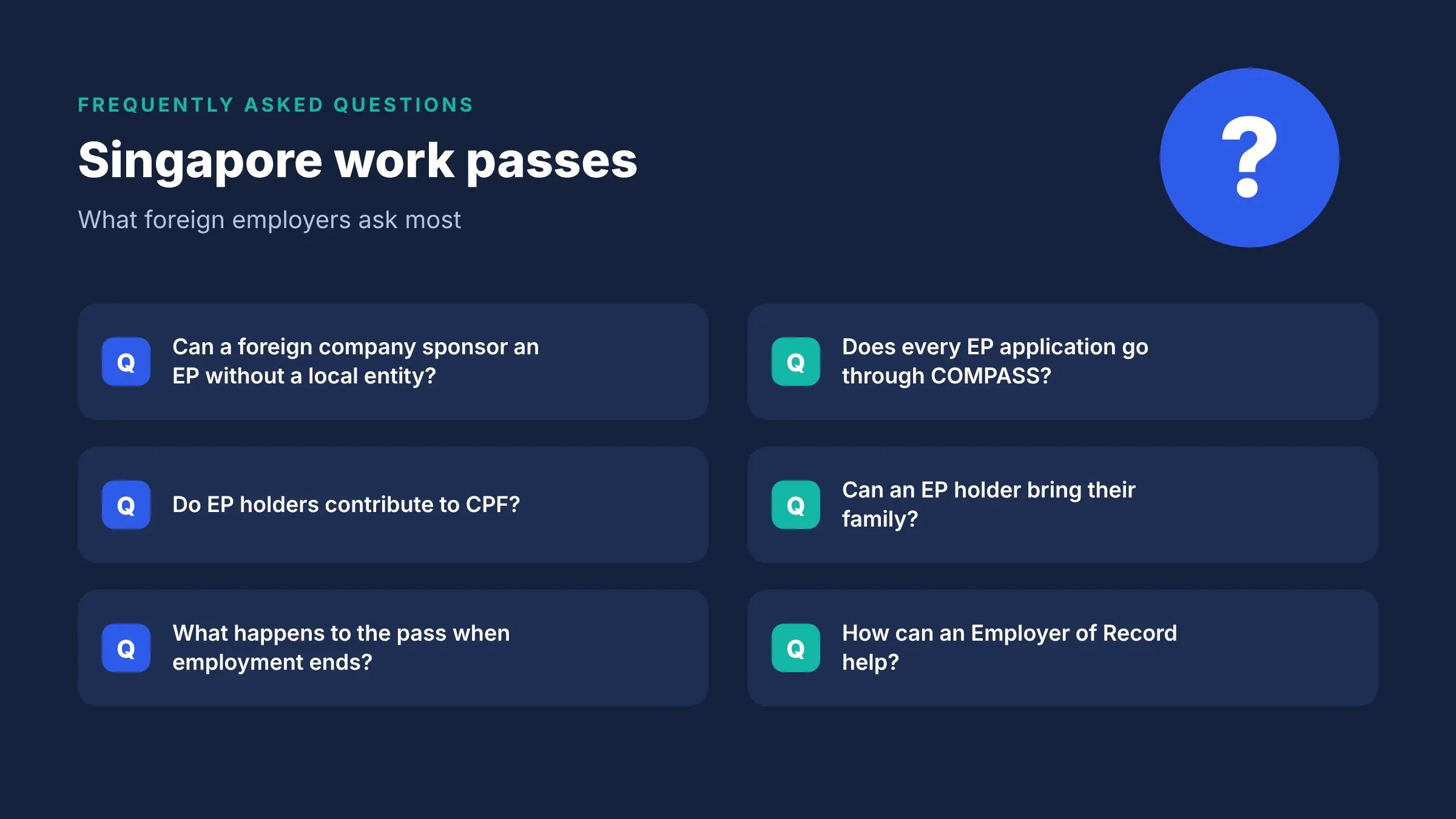
Q2. Does every Employment Pass application go through COMPASS?
No. Candidates earning a fixed monthly salary of at least S$22,500 are exempt, along with overseas intra-corporate transferees and those filling a role for one month or less. Everyone else must meet the qualifying salary and score at least 40 COMPASS points. S Pass applications don't use COMPASS.
Q3. Do Employment Pass holders contribute to CPF?
No. Foreigners working in Singapore on a work pass, including Employment Pass and S Pass holders, don't contribute to the Central Provident Fund, and employers don't pay CPF for them. CPF applies to Singapore citizens and permanent residents. Contributions begin if the employee later becomes a permanent resident.
Q4. Can an Employment Pass holder bring their family to Singapore?
Yes, if they earn enough. EP and S Pass holders earning a fixed monthly salary of at least S$6,000 can apply for a Dependant's Pass for a legally married spouse and unmarried children under 21. Some relatives, such as a common-law partner or unmarried stepchildren under 21, can be brought on a Long-Term Visit Pass instead. The same S$6,000 minimum applies, and parents need S$12,000.
Q5. What happens to the work pass when employment ends?
The employer must cancel it. Cancellation is due within one week after the last day of notice. Before that, the employer must seek IRAS tax clearance at least one month before the last working day and pay for the employee's return flight, unless the employee agrees in writing to cover it.
Q6. How can Slasify help with a Singapore work pass?
Slasify can employ Singapore citizens and PRs through its Singapore entity as an Employer of Record. Our Singapore-based team helps you check eligibility and COMPASS fit, prepare documents, and plan the timeline. For citizen and PR hires, we also run payroll, CPF, and filings as the Employer of Record, so you can hire without setting up a local company first.
Sources: MOM EP eligibility, S Pass eligibility, S Pass levy and quota, Fair Consideration Framework, Dependant's Pass eligibility; CPF Board; IRAS.