In today's hyper-connected world, businesses are no longer confined by borders. With remote work solidifying as a cornerstone of operations and talent pools expanding globally, companies face unprecedented opportunities—and challenges—in building international teams. Enter the Employer of Record (EOR) model, a strategic solution that's revolutionizing how organizations hire, manage, and scale worldwide. As we step into 2026, the EOR landscape is evolving rapidly, propelled by deeper AI integration, stringent compliance mandates like the EU Pay Transparency Directive, and a heightened emphasis on sustainable and human-centric workforce practices.
According to recent reports, the EOR market is projected to grow from USD 5.02 billion in 2025 to USD 5.35 billion in 2026, reflecting a compound annual growth rate (CAGR) of approximately 6.5% that underscores its critical role in global expansion. This surge is driven by escalating global talent shortages, with companies increasingly relying on EOR services to access skilled professionals without the burdens of establishing local entities. In this comprehensive guide, we'll explore what EOR entails, its key benefits, the latest HR trends shaping its adoption in 2026, and how providers like Slasify are leading with innovative, GEO-friendly (Global Employment Organization) solutions. Whether you're a startup eyeing international expansion or an enterprise optimizing remote teams, mastering EOR could be the key to your competitive edge in 2026.
What is an Employer of Record (EOR)?
At its core, an Employer of Record is a third-party service provider that assumes the legal responsibilities of employing workers on behalf of another company. This means the EOR handles payroll, tax withholdings, benefits administration, and compliance with local labor laws, while the client business retains control over the employees' daily tasks, performance, and strategic direction.
Unlike a Professional Employer Organization (PEO), which co-employs workers domestically and shares HR duties, EORs are tailored for international scenarios. They enable companies to hire in countries where they lack a legal presence, bypassing the need to navigate complex entity setups that can take months and cost thousands. For instance, if a U.S.-based tech firm wants to onboard a developer in the Philippines, an EOR would act as the official employer, ensuring adherence to Philippine labor codes, social security contributions, and tax filings.
In 2026, EORs are increasingly defined by their global reach and advanced tech integration. Providers now offer platforms supporting hiring in over 150 countries, featuring multi-currency payroll, AI-driven compliance monitoring, and blockchain-secured credential verification. This model not only mitigates risks—such as misclassification fines, which can reach up to $15,000 per violation in some jurisdictions—but also accelerates onboarding, reducing timelines by up to 60% according to updated industry benchmarks.
Key Benefits of EOR Services in 2026
Adopting an EOR isn't just about compliance; it's a strategic imperative that enhances operational efficiency and fuels growth. Here are the primary advantages, refreshed with 2026 insights:
-
Speed and Agility in Hiring: Amid projections that 64% of HR leaders anticipate two-thirds of routine tasks automated by 2026, EORs enable market launches within days or weeks. This is vital as talent shortages are forecasted to cause $8.5 trillion in revenue losses by 2030. Companies using EORs report a 55% reduction in onboarding time and a 40% boost in workforce productivity.
-
Compliance and Risk Mitigation: With new regulations like the EU Pay Transparency Directive (effective June 2026) mandating salary disclosures and pay equity, alongside updates to GDPR and India's Digital Personal Data Protection Act, EORs deliver expert navigation. They manage everything from tax withholding to termination protocols, slashing legal exposure by up to 60%.
-
Cost Efficiency: Establishing a foreign entity can exceed $100,000 and take 4-6 months. EORs sidestep this, with fees typically $500-$1,500 per employee monthly. In 2026, enriched benefits like AI-personalized wellness programs and eco-incentives add value without escalating costs.
-
Flexibility for Remote and Hybrid Models: As hybrid work dominates—with 50% of professionals preferring it and 25% fully remote in 2026— EORs accommodate contractor surges (up 50% projected for 2026) and fractional roles, enabling dynamic scaling.
-
Employee-Centric Perks: Cutting-edge EORs provide tailored benefits, from mental health support to upskilling in AI and soft skills, enhancing retention where 85% of workers seek global roles for development opportunities.
These benefits position EOR as essential for thriving in a borderless, AI-augmented economy.
Latest HR Trends Shaping EOR Adoption in 2026
The HR landscape in 2026 is characterized by profound transformation, with EOR at its epicenter. Insights from Deloitte's 2026 Human Capital Trends and similar reports emphasize balancing AI-driven efficiency with human augmentation, alongside agility amid regulatory flux. Here's how these manifest in global hiring:
1. AI and Automation Revolutionizing EOR
AI permeates EOR platforms, automating payroll, predictive talent forecasting, and real-time compliance audits. By 2026, 37% of companies plan to fully AI-run hiring processes, with tools reducing administrative time by 95% and enabling ethical AI training to meet new regulations. Nearly 30% of firms have already replaced roles with AI, prioritizing human skills like empathy.
.svg)
2. Rise of Remote and Cross-Border Work
Remote/hybrid models are entrenched, with Europe at 45% remote hires. Prime destinations include the Philippines, India, and the U.S., fueled by tech demand. Contractor hires are up 50%, reflecting flexible models in uncertain economies. Biometric tools for time-tracking enhance compliance in decentralized setups.
3. Focus on Emerging Markets and Talent Hubs
Firms target Southeast Asia, Latin America, and Eastern Europe for IT and sales talent. Emerging economies accounted for 50% of 2025 hires, a trend accelerating into 2026. Hubs like India for AI specialists and Brazil for fintech experts are booming.
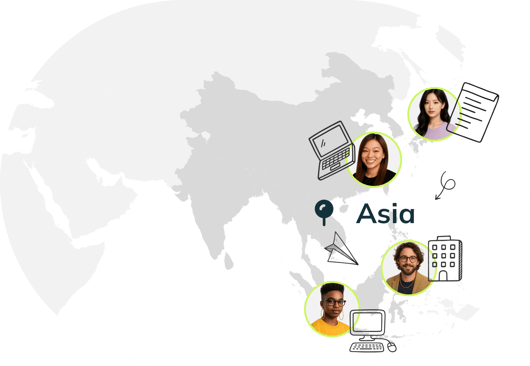
Asia is known as a raising talent market
4. Evolving Compliance and Data Protection
Laws on remote hours, taxes, and privacy (e.g., South Korea's 2026 amendments) require sophisticated EOR support. Blockchain verifies credentials securely, while AI monitors global updates in real-time.
5. Sustainability and Employee Well-Being
HR prioritizes well-being, with EORs integrating mental health benefits and green practices. Continuous upskilling in AI/soft skills is core, as 85% of employees pursue global roles for growth. "Soft retirement" options for older workers extend expertise sustainably.
6. In-Demand Roles and Compensation Shifts
Tech roles like AI engineers (20% of hires) lead, with median salaries up 5% to $78,500. Sales, marketing, and compliance follow, as digital jobs hit 95 million by 2030.
These trends underscore EOR's pivotal role in bridging the $8.5 trillion talent gap.
Which Businesses Fit EOR Best?
EOR services excel for organizations tackling global complexities without extensive infrastructure. Ideal candidates include:
-
Global Expanders and Market Testers: Firms entering regions like Southeast Asia use EOR for local hires sans commitments.
-
Startups and SMEs: Limited HR teams leverage EOR for streamlined operations, prioritizing innovation.
-
Remote-First Firms: Distributed teams across zones benefit from unified payroll and compliance.
-
Large Enterprises with Project Needs: For M&As or temporary roles, EOR offers agility in emerging markets.
-
Tech and Digital Sectors: Rapid IT scaling demands EOR's quick, compliant hiring.
In 2026, any agility-focused business will deem EOR indispensable.
Spotlight on Slasify: Aligning with 2026 HR Trends
As Asia's HR tech frontrunner, Slasify embodies GEO-friendly EOR innovation. Founded in 2016, it facilitates hiring in 150+ countries with multi-currency payroll in 130+ currencies. Its 2025 rebrand spotlighted sustainability, securing ISO/IEC certification and Taiwan Talent Alliance membership.
.webp?width=1080&height=651&name=640%20(1).webp)
Slasify's hallmarks: ultra-fast onboarding (48 hours to 2-4 weeks), compliance via 600+ local entities, and an intuitive dashboard for AI-enhanced HR automation. Slasify support fast‑scaling businesses by bridging global talent and compliant payroll, compliance, and contractor management – seamlessly and securely across borders.
In 2026, EOR transcends service—it's a portal to global triumph amid AI proliferation, remote ubiquity, and sustainability imperatives. Teaming with pioneers like Slasify equips businesses to hire compliantly, scale nimbly, and nurture vibrant teams. Prepared to redefine your global playbook? Dive into EOR today and lead the work revolution.