|
Key Takeaways
|
|
You can standardize most of an employment contract globally (role, IP, confidentiality, code of conduct, comp philosophy), but a defined set of clauses must be localized to each country, or they are unenforceable or illegal.
|
|
The clauses that almost always need localizing: governing law, notice periods, probation limits, termination grounds, statutory benefits and contributions, working hours and overtime, leave and public holidays, severance, and non-compete enforceability.
|
|
The gap between countries is wide. US employment is at-will with no notice; Germany requires documented grounds and statutory notice; the Philippines mandates 13th-month pay and just-cause termination.
|
|
Some countries require the contract in the local language to be valid (for example, France and Indonesia), and some make non-competes unenforceable regardless of what the contract says.
|
|
A standardized global core contract plus a country-specific addendum, executed through a local entity or an Employer of Record, is the most practical structure for multi-country teams.
|
A US company hires its first engineer in Germany. The HR team sends over the standard offer letter, the one they've used for years, built around at-will employment. Months later, they discover that at-will termination doesn't exist in Germany, the probation clause exceeds the statutory six-month cap, and the non-compete is unenforceable as written because the company never agreed to compensate the employee for the restriction.
This is how an international employment agreement goes wrong most often: not through... Understanding how to structure a global employment contract is the ultimate starting point for any global team.
1. Can you use one employment contract for every country?

You can standardize most of it, but there are also many clauses you cannot. Getting those wrong is how companies usually end up in employment tribunals, paying back wages, or discovering mid-acquisition that their workforce in one country was misclassified.
The short answer is that the structural and cultural elements of a global employment contract travel well, but the compliance-dependent elements do not.
Some companies try to solve this with a single global master contract covering every jurisdiction. In practice, the clauses that govern how a person is hired, paid, protected, and terminated vary too much between countries for one document to apply the same way globally.
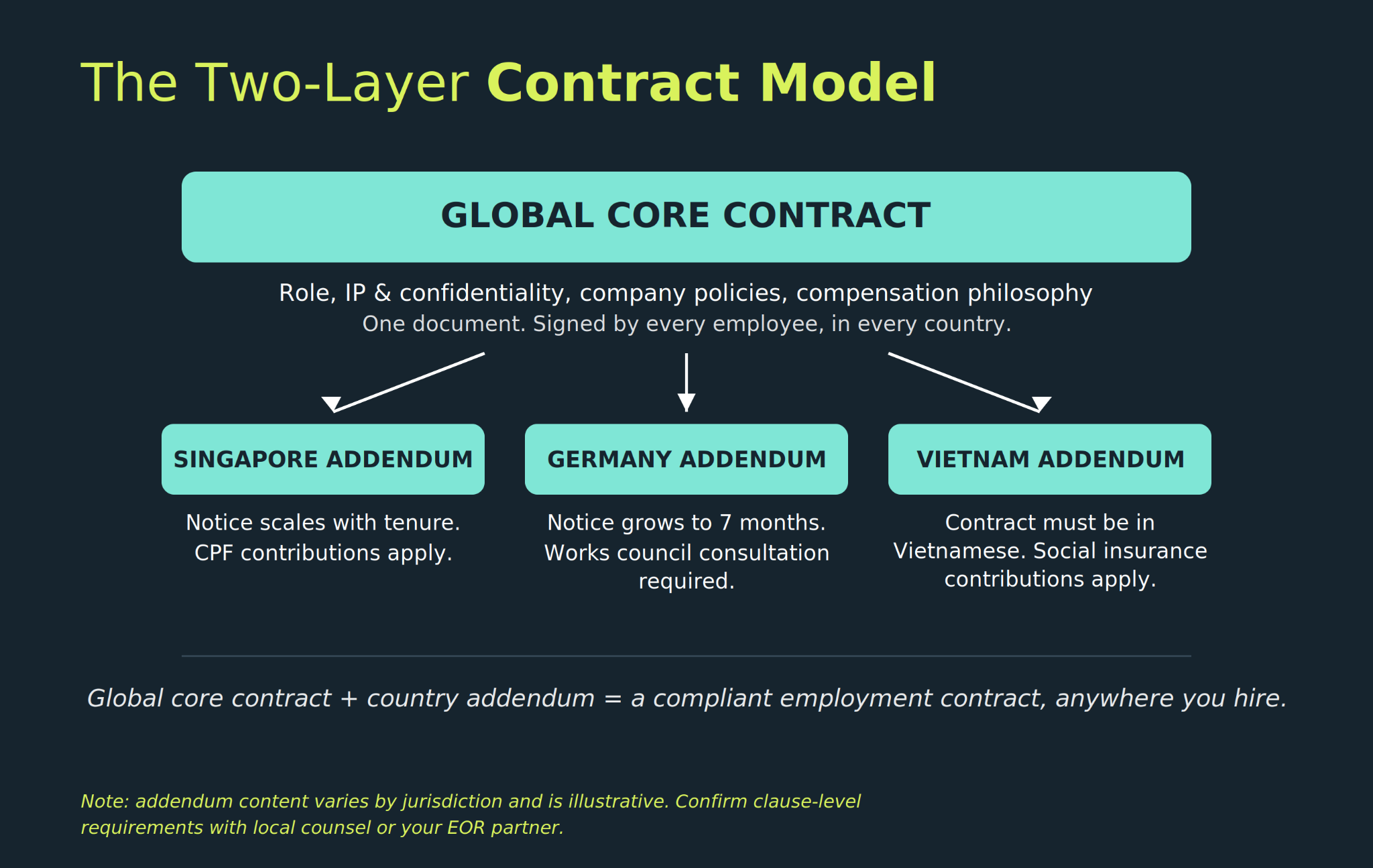
A more effective approach is a two-layer model, which includes a standardized global core contract covering role, values, IP, and company-wide policies, paired with a country-specific addendum that localizes whatever the law requires.
2. What to standardize globally?

Most employment contract clauses cross borders without friction. The three categories below can usually be applied to every employee worldwide.
Role and reporting structure
These clauses describe the shape of the job and not the legal obligations that come with it, so they usually raise no conflict with local employment statutory requirements.
- Job title, role description, and reporting line
- Performance review cadence, bonus framework, and equity eligibility (local vesting and tax treatment localized in the addendum)
Company standards and policies
Internal standards apply to employees regardless of where they are based: a code of conduct or acceptable use policy sits above local law without conflicting with it.
- Company mission, values, and code of conduct
- Anti-harassment and equal-opportunity commitments
- Acceptable use, device, and security policies
IP, confidentiality, and data protection
A global NDA and IP assignment clause is enforceable in most jurisdictions without modification. In several countries, employee IP rights are defined by statute in ways that affect the validity of standard assignment clauses. Germany and Japan are the most commonly cited examples, but France, the UK, and China have similar statutory provisions. In any market where employees create patentable work or proprietary software, verify the IP clause with local counsel before relying on it.
- Confidentiality and non-disclosure terms
- Intellectual property assignment (verify enforceability in Germany and Japan)
- Data protection commitments 1 (global baseline; GDPR-covered employees may require localized addendum terms)
3. What to localize by country?
-May-14-2026-10-06-52-0616-PM.jpg?width=1920&height=1080&name=Blog%20Post%20Banner%20%26%20Images%20(1)-May-14-2026-10-06-52-0616-PM.jpg)
When a localized clause is non-compliant, the local statutory default applies automatically, usually on terms more favorable to the employee in most countries. The three categories below are where the risk is the highest for employers.
Employment basics: how employment starts and ends
Country-by-country regulations diverge significantly in this area. For example, US employees can be terminated at will with no notice; German employees have documented-grounds protection; Philippine employees become regularized at six months; Japanese employees are entitled to 30 days' notice. No single clause covers all four countries.
- Notice periods: statutory minimums can range from one week in Singapore to seven months in Germany after 20 years.
- Probation period limits: exceeding the statutory cap voids the clause entirely.
- Termination grounds and process: At-will termination does not exist in most countries.
- Employee classification rules: misclassifying an employee as a contractor triggers back-pay liabilities and unpaid contributions.
Compensation, benefits, and working conditions

Every jurisdiction sets a statutory floor for pay and benefits, and your global pay band does not override it. For instance, in the Philippines, a 13th-month bonus is a legal obligation and not a discretionary benefit. Copying your home-country benefit structure into a foreign contract without adjustment means you owe the statutory difference, plus any back contributions already accrued.
- Minimum wage compliance: always follow the local statutory rate.
- Statutory benefits and contributions: For example, CPF in Singapore, 13th-month pay in the Philippines, social insurance in Vietnam, and MPF in Hong Kong SAR.
- Working hours, overtime, and rest-day rules vary by country and local labor laws.
- Leave entitlements and public holidays: annual leave minimums, sick leave, and parental leave all vary.
- Severance and end-of-service entitlements: many countries mandate specific formulas.
Legal and governance obligations

These clauses govern the contract itself, such as which courts apply, whether the document is valid in the language in which it was written, and what post-employment restrictions apply. It’s easy to overlook until a dispute reaches a court, and the contract was never localized.
- Governing law and jurisdiction
- Contract language requirements: Vietnam and France require the contract in the local language
- Non-compete and restrictive-covenant enforceability: Some countries refuse enforcement; Germany requires the employer to pay the employee during the restricted period.
- Collective bargaining and works-council obligations: Germany and much of the EU require consultation before significant workforce decisions
4. The standardize vs localize matrix (at a glance)
The table below is the decision framework for reference. We recommend verifying specific clauses with local legal counsel before finalizing any employment contract.
|
Standardize globally (safe to template)
|
Localize by country (must adapt)
|
|
Job title, role description, reporting line
|
Governing law and jurisdiction
|
|
Company mission, code of conduct, ethics policy
|
Notice periods (statutory minimums vary)
|
|
Confidentiality and non-disclosure terms
|
Probation period limits (statutory caps)
|
|
Intellectual property assignment (verify local enforceability)
|
Termination grounds and process
|
|
Data protection commitments (global baseline)
|
Statutory benefits and contributions
|
|
Compensation philosophy and pay-band structure (currency localized)
|
Working hours, overtime, and rest-day rules
|
|
Performance review cadence and bonus or equity framework (eligibility localized)
|
Leave entitlements and public holidays (including 13th-month pay where mandatory)
|
|
Acceptable use, device, and security policies
|
Minimum wage compliance
|
|
Anti-harassment and equal-opportunity commitments
|
Non-compete and restrictive covenant enforceability
|
| |
Severance and end-of-service entitlements
|
| |
Contract language requirements
|
| |
Employee classification rules
|
| |
Collective bargaining or works council obligations
|

5. How far do the localized clauses actually diverge?
It’s actually further than most companies expect. The table below compares seven countries where we regularly help clients build compliant employment contracts, including Singapore, the Philippines, Germany, the United Kingdom, Hong Kong Special Administrative Region (Hong Kong SAR), Vietnam, and Japan.
How localized clauses diverge by country (as of June 2026)
|
Country
|
Statutory notice period
|
Probation cap
|
13th-month pay
|
Non-compete enforceable?
|
Local-language contract required?
|
Primary authority
|
|
Singapore
|
1 day–4 weeks by tenure
|
None statutory
|
Not mandatory
|
Yes, reasonableness test
|
No
|
MOM / Employment Act
|
|
Philippines
|
30 days (authorized-cause termination)
|
6 months maximum
|
Yes, mandatory by Dec 24
|
Limited/case-by-case
|
No
|
DOLE / Labor Code
|
|
Germany
|
4 weeks minimum
|
6 months maximum
|
Not mandatory
|
Yes
|
No (highly recommended)
|
BMAS / BGB §622
|
|
United Kingdom
|
1 week per year of service (min 1 week, max 12 weeks)
|
No statutory cap
|
Not mandatory
|
Limited/case-by-case
|
No
|
GOV.UK / Employment Rights Act
|
|
Hong Kong SAR
|
Not required during the 1st month; minimum 7 days after one month
|
None statutory
|
Not mandatory
|
Limited/case-by-case
|
No
|
Labour Dept / Employment Ordinance Cap. 57
|
|
Vietnam
|
30–45 days by contract type
|
60 days (college or above); 180 days for executives
|
Not mandatory (Tết bonus widely expected)
|
Yes
|
Yes (Vietnamese required; bilingual acceptable)
|
MOLISA / Labour Code 2019
|
|
Japan
|
30 days employer-initiated
|
None statutory
|
Not mandatory (year-end bonus is common)
|
Limited/strict scrutiny
|
No (highly recommended)
|
Ministry of Justice / Labor Standards Act
|
2026 Employment Law Highlights
Singapore

Singapore's Employment Act 2 covers most employees and sets statutory notice defaults that scale from one day to four weeks based on tenure. There is no statutory probation period, but it is typically between 3 and 6 months by local practice and may extend to 12 months for senior roles. Most professional contracts specify one to three months. Non-competes are enforced under a reasonableness test covering scope, geography, and duration.
Philippines

The Philippines does not recognize at-will employment. All terminations require either just cause (misconduct, gross negligence) or authorized cause (retrenchment, business closure), with specific notice and process requirements for each. The 13th-month pay is mandatory for all rank-and-file employees under Presidential Decree 851 3 and must be paid by December 24. Employees who continue working past 6 months of probation are automatically considered regularized under the Labor Code.
Germany

Germany's Kündigungsschutzgesetz (dismissal protection law) requires documented grounds for any dismissal in companies with more than ten employees. Notice periods under BGB §622 start at four weeks and scale to seven months after 20 years of service 4. Non-competes are enforceable only if the employer pays at least 50% of the employee's last salary throughout the restricted period; without that compensation, the clause is void.
United Kingdom

The Employment Rights Act 2025 (Royal Assent December 2025) reduces the qualifying period for unfair dismissal claims from two years to six months, effective January 1, 2027 5. Consequently, probation periods set beyond six months offer little additional employer protection from that date. Statutory notice scales at one week per year of service, capped at 12 weeks.
Hong Kong SAR

Hong Kong Special Administrative Region's Employment Ordinance (Cap. 57) does not require statutory notice within the first month of employment; after one month, the notice period cannot be less than 7 days 6 (or the period specified in the contract). There is no statutory year-end bonus, though double or bonus pay in December is a well-established market norm. Non-competes are enforced where the employer can demonstrate a legitimate proprietary interest, such as trade secrets or confidential client relationships.
Vietnam

Vietnam's Labour Code 2019 7 requires employment contracts to be in Vietnamese. Bilingual contracts (Vietnamese and English) are common and acceptable, but Vietnamese law governs in any dispute. Notice periods vary by contract type: 45 days for indefinite-term, 30 days for fixed-term contracts of 12 to 36 months, and 3 working days for contracts under 12 months. Non-competes are permitted for up to two years but require agreed compensation to the employee throughout the restricted period. As for the 13th-month bonus pay, it is not required, but the Tết (Vietnamese Lunar New Year) bonus is widely practiced locally.
Japan
.png?width=1280&height=720&name=Hubspot%20Blog%20Images%20(3).png)
Japan's Labour Standards Act requires at least 30 days' advance notice 8 before employer-initiated dismissal, but most professional contracts specify 1 to 3 months. Japanese courts examine non-competes closely: scope, geographic reach, duration, and whether the employee received compensation. Without consideration for the restriction, enforcement is difficult.
"Slasify helped us scale in Vietnam, the Philippines, Indonesia, and Malaysia. Their local knowledge and execution saved us time and costs."
Head of Operations, Astro Malaysia Holdings Berhad
Eliminate your global compliance risks today. Unsure which clauses your contracts need to localize for each market? Get a free contract compliance review from Slasify. We will map exactly what to change, country by country.
6. How should you structure employment contracts for a global team?
Once you know what to standardize and what to localize, the structure follows directly. The model we recommend is two layers.
|
Layer
|
What it contains
|
Who owns it
|
|
Global core contract
|
Role description, IP assignment, confidentiality, code of conduct, data protection, compensation philosophy, and company-wide policies
|
Owned centrally (your legal or HR team)
|
|
Country addendum
|
Governing law, notice periods, probation clause, termination grounds, statutory benefits, local minimum wage, leave entitlements, severance, language requirements
|
Owned by the local entity or Employer of Record for that country
|
The global core contract is written once and signed by every employee worldwide and defines the employment relationship in terms that hold across borders. The country addendum attaches to it and governs everything local law requires, drafted to the statutory standards of the employee's jurisdiction and reviewed by a local employment lawyer or your Employer of Record partner.
The structure carries several practical advantages beyond legal correctness:
- Legal review is faster because counsel is reading a short, jurisdiction-focused addendum, not a 40-page master agreement.
- Country expansion is simpler: entering a new market means drafting one addendum, not rewriting the contract from scratch.
- Regulatory updates are contained: when a jurisdiction changes a benefit rate or introduces a mandatory clause, only that country's addendum changes.
- Ownership is clear: your legal or HR team holds the global core; local counsel or your EOR partner owns each addendum and is accountable for keeping it current.
7. How does an Employer of Record keep contracts compliant?
For companies without a local entity in a given country, an Employer of Record is the structure that makes the two-layer model work in practice.
When you hire through an EOR, it becomes the legal employer of your employees in that country. The country addendum is the EOR's responsibility, including:
- Drafting employment contracts that meet local statutory requirements (and localized where necessary)
- Registering employees with the relevant social insurance and tax authorities
- Running payroll in local currency at the correct rates
- Handling statutory benefit contributions
- Updating contracts when the law changes, before the effective date
We operate across 150+ countries through 600+ local partners and keep you updated and compliant with the latest regulatory changes. For example, when Vietnam's Labour Code updated its social insurance provisions and when the UK Employment Rights Act 2025 changed the unfair dismissal threshold, both were reflected in the relevant employment contracts before their effective dates.
We are also ISO 27001 certified for enhanced data security, recognized by KPMG and Talent in Taiwan, and a member of the Singapore Business Federation. Our Global Payroll infrastructure processes payroll across 130+ currencies, and our Global Contractor Management platform covers contractor agreements, giving your finance and HR teams one place to manage employment contracts, payroll, and contractor compliance across every market.
For companies weighing EOR against a PEO structure, our EOR vs PEO guide covers the main differences.

8. FAQ
Can I use the same employment contract for every country?
No, you cannot use the exact same employment contract globally without country-specific modifications. While core structural and operational policies travel well, compliance-dependent clauses like notice periods, termination grounds, statutory benefits, and non-compete enforceability must be localized to each jurisdiction. Get a free compliance review, and we will map what needs to change.
What has to be localized in an international employment contract?
Several clauses must be localized per country, including notice periods, probation limits, termination grounds, statutory benefits, working hours, leave, minimum wage, severance, back-pay liabilities, and non-compete enforceability. Some jurisdictions also require the contract to be in the local language. A missing or non-compliant clause triggers the local statutory default, usually on more employee-protective terms.
What clauses can I standardize across all countries?
Three categories travel safely across every jurisdiction: role and reporting structure (job title, performance framework, equity eligibility), company standards (code of conduct, anti-harassment, security policies), and IP and confidentiality terms (NDA, IP assignment, data protection baseline). These clauses describe the employment relationship or internal policy without conflicting with local law.
Is a non-compete enforceable internationally?
It depends on the country, and the differences are significant. Germany requires employers to pay 50% of the last salary during the restricted period; without that compensation, the clause is void. Japan scrutinizes the scope, geography, duration, and whether the employee received consideration. Some EU jurisdictions restrict non-competes further via collective agreements.
Do I need an employment contract in the local language?
In some countries, yes. Vietnam requires employment contracts in Vietnamese, with bilingual versions acceptable. Germany and Japan have no equivalent mandate, but courts and works councils in both operate in the local language. A contract that the parties cannot easily read is an enforcement risk regardless of its technical validity.
What is the difference between a local and a global employment contract?
They differ in scope and legal structure. A local contract covers one employee under one country's law, with all clauses meeting that jurisdiction's statutory requirements. A global employment contract attempts uniform terms across multiple countries, which in practice requires a two-layer structure: a global core contract for role, IP, and policy, plus a country-specific addendum for each jurisdiction's compliance-sensitive clauses.
What happens if my employment contract does not comply with local law?
The non-compliant clause becomes unenforceable, and the statutory default applies at the employer's cost. In Germany, a below-minimum notice period still means you owe the full statutory amount. In the Philippines, exceeding the six-month probation cap triggers retroactive regularization and full benefits owed. For misclassified contractors, back pay and unpaid contributions are typical outcomes.
For the reclassification compliance process, see our guide on how to convert a contractor to an employee.
How does an Employer of Record handle employment contracts across countries?
An EOR becomes the legal employer in each country, which means the EOR drafts, holds, and updates the local employment contract on your behalf. You don't need a local entity. The EOR manages the country addendum, statutory registrations, and payroll compliance, and updates contracts before law changes take effect.
Hire globally on contracts that hold up in every jurisdiction
Employment agreements that work at home can create significant liability across borders. The right structure is a standardized global core, localized addenda per country, and a partner responsible for keeping each version current as laws change.
Don't let outdated contract templates put your business at risk. Hire globally with confidence using localized, legally compliant employment agreements. Book a free demo with Slasify today and scale your international workforce with ease.
Sources
1. General Data Protection Regulation for GDPR-covered and EU employees. https://gdpr.eu/
2. Ministry of Manpower. Statutory notice periods and non-compete. Singapore Employment Act.
3. Philippines Department of Labor and Employment. Statutory 13th-month pay. Presidential Decree No.851.
4. Bürgerliches Gesetzbuch (BGB). The notice period ranges from 4 weeks to 7 months. § 622 Kündigungsfristen bei Arbeitsverhältnissen
5. The Employment Rights Act. Unfair dismissal claims reduced to 6 months from 2 years, effective January 1, 2027. Business.gov.uk.
6. Chapter 9 of the Employment Ordinance, cap. 57, HK Labour Department. labour.gov.hk/
7. Ministry of Labour, Invalids, and Social Affairs (MOLISA), Vietnam. Labour Code 2019. MOLISA
8. Japan Labour Standards Act, Advanced dismissal notice. At least 30 days if initiated by the employer. Ministry of Justice.