| Top 4 Key Takeaways |
- There are 9-13 public holidays in Germany, depending on the state the employee works in. Align each employee with the correct state holiday calendar in your HRIS.
|
- Employers are required to provide paid time off when a holiday falls on an employee’s scheduled working day, and this is separate from annual leave. Premium pay is not required by law but is usually provided as a 25-50% bonus when working on a public holiday.
|
- Use HR solutions for Europe to track local holidays and staffing and automate payroll calculations using country-specific rules and requirements.
|
- Slasify acts as your Employer of Record in Germany to handle hiring, onboarding, contracts, benefits, payroll, and compliance for you, without setting up a local entity.
|
1. Introduction
Germany is widely regarded as an employee-friendly market with strong protections, strict regulations, and well-defined employee rights. If you are looking to expand or hire in Germany in 2026, understanding the German public holidays landscape can have a major impact on when your teams are available to work and how you plan around the holiday calendar throughout the year.
Because most public holidays in Germany are set at the state level, HR leaders need a clear framework to manage schedules, leave, and payroll correctly. This guide will cover Germany’s 2026 holiday calendar, key employer obligations, planning tips, and how you can navigate the strict labor regulations without adding a full in-house HR team.
2. Germany Public Holidays in 2026

According to the Federal Ministry of the Interior, 9 public holidays in Germany apply nationwide in all 16 states:
|
Date
|
Day
|
Holiday
|
|
1 Jan
|
Thursday
|
New Year’s Day
|
|
3 Apr
|
Friday
|
Good Friday
|
|
6 Apr
|
Monday
|
Easter Monday
|
|
1 May
|
Friday
|
Labour Day
|
|
14 May
|
Thursday
|
Ascension Day
|
|
25 May
|
Monday
|
Whit Monday (Pentecost Monday)
|
|
3 Oct
|
Saturday
|
German Unity Day
|
|
25 Dec
|
Friday
|
Christmas Day
|
|
26 Dec
|
Saturday
|
Second Day of Christmas (Boxing Day)
|
In addition to the nationwide holidays, several states observe additional regional holidays. Key 2026 dates include:
|
Date
|
Day
|
Holiday
|
Applicable States
|
|
6 Jan
|
Tuesday
|
Epiphany
|
Baden-Württemberg, Bavaria, Saxony-Anhalt
|
|
8 Mar
|
Sunday
|
International Women’s Day
|
Berlin, Mecklenburg-Vorpommern
|
|
4 Jun
|
Thursday
|
Corpus Christi
|
Baden-Württemberg, Bavaria, Hesse, NRW, Rhineland-Palatinate, Saarland
|
|
15 Aug
|
Saturday
|
Assumption Day
|
Saarland, Bavaria (partially)
|
|
31 Oct
|
Saturday
|
Reformation Day
|
Brandenburg, Bremen, Hamburg, Mecklenburg-Vorpommern, Lower Saxony, Saxony, Saxony-Anhalt, Schleswig-Holstein, Thuringia
|
|
1 Nov
|
Sunday
|
All Saints’ Day
|
Baden-Württemberg, Bavaria, NRW, Rhineland-Palatinate, Saarland
|
In practice, employees may generally have between 9 and 13 public holidays a year, depending on the state where they usually work. Employers should set up state-specific holiday calendars in their HR and payroll systems.
Note that for distributed and remote teams, the applicable state calendar follows the employee’s regular place of work, not the employer’s registered office. For example, if your entity is based in Munich (Bavaria) but an employee works remotely from Berlin, Berlin’s holiday calendar governs their paid public holidays and working-time restrictions.
3. Workforce Planning Around German Holidays

Public holidays in Germany often cluster between April and June, and again in late December. Because rules are set at the state level and holidays cluster at specific times of the year, workforce planning has to look beyond just a single national holiday calendar. HR teams should consider regions, holiday clusters, payroll timing, and shift coverage when building 2026 workforce plans.
Regional Variations:
Each state can add holidays on top of the 9 nationwide dates, so some employees may have up to 13 public holidays a year. Plan staffing and coverage by state and place of work, especially for remote and distributed teams.
Vacation Clusters:
Long breaks tend to form around Easter, Ascension Day, and Christmas, when employees typically add a few days of annual leave to public holidays and weekends. Note that in Catholic-leaning states, factories or offices may even have a full week off.
Payroll Adjustments:
On public holidays, banks and government offices close, and standard cut-off days may fall on non-working days. It’s best to move payroll approvals and payment dates forward in those weeks to avoid late salary payments or filings.
Shift Work:
In sectors like hospitality and restaurants that operate on Sundays and public holidays, rosters must reflect both legal rest-day rules and typical holiday premiums set in employment agreements (often around 25-50%). Employers need to budget for these premiums and lock in holiday coverage early.
For employers, the 2026 German holiday calendar should function as a capacity map. Regional differences show where you might be short-staffed, while holiday clusters show when leave requests will spike.
4. Employer Obligations in Germany
-1.jpg?width=1920&height=1080&name=%E6%9C%AA%E5%91%BD%E5%90%8D%E8%A8%AD%E8%A8%88%20(1)-1.jpg)
Public holidays in Germany are legally protected rest days with strict scheduling and overtime rules. For example, according to the Working Time Act (Arbeitszeitgesetz, ArbZG), each employee may work up to 8 hours a day or 48 hours a week. Although daily working time can be extended to 10 hours, the average over 6 months must not exceed 8 hours. There are also break requirements. In short, simply following the public holiday calendar isn’t enough. Employers must also ensure schedules comply with working-time rules.
Paid Holidays:
Public holidays are paid days off when they fall on an employee’s scheduled working day. Employees must receive their normal pay, and the day off cannot be deducted from their annual leave entitlement, which is a minimum of 20 working days per year (in a five-day week).
Part-Time & Shift Workers:
Part-time and shift workers are entitled to the same holiday protection on a pro-rata basis. If a public holiday falls on their scheduled workday, they receive paid time off or equivalent compensation, just like full-time employees would.
Overtime & Work on Holidays:
Where Sunday or public-holiday work is legally permitted (for example, in healthcare and hospitality), employees must receive compensatory time off, typically within 8 weeks. Note that premium pay on public holidays is not required by law but can be defined in a Collective Bargaining Agreement (CBA) or individual contract.
State Differences:
Aside from German Unity Day, public holidays are set by each Bundesland or state, so employers must track and apply the correct state holiday list based on the employee’s place of work.
Compliance Risk:
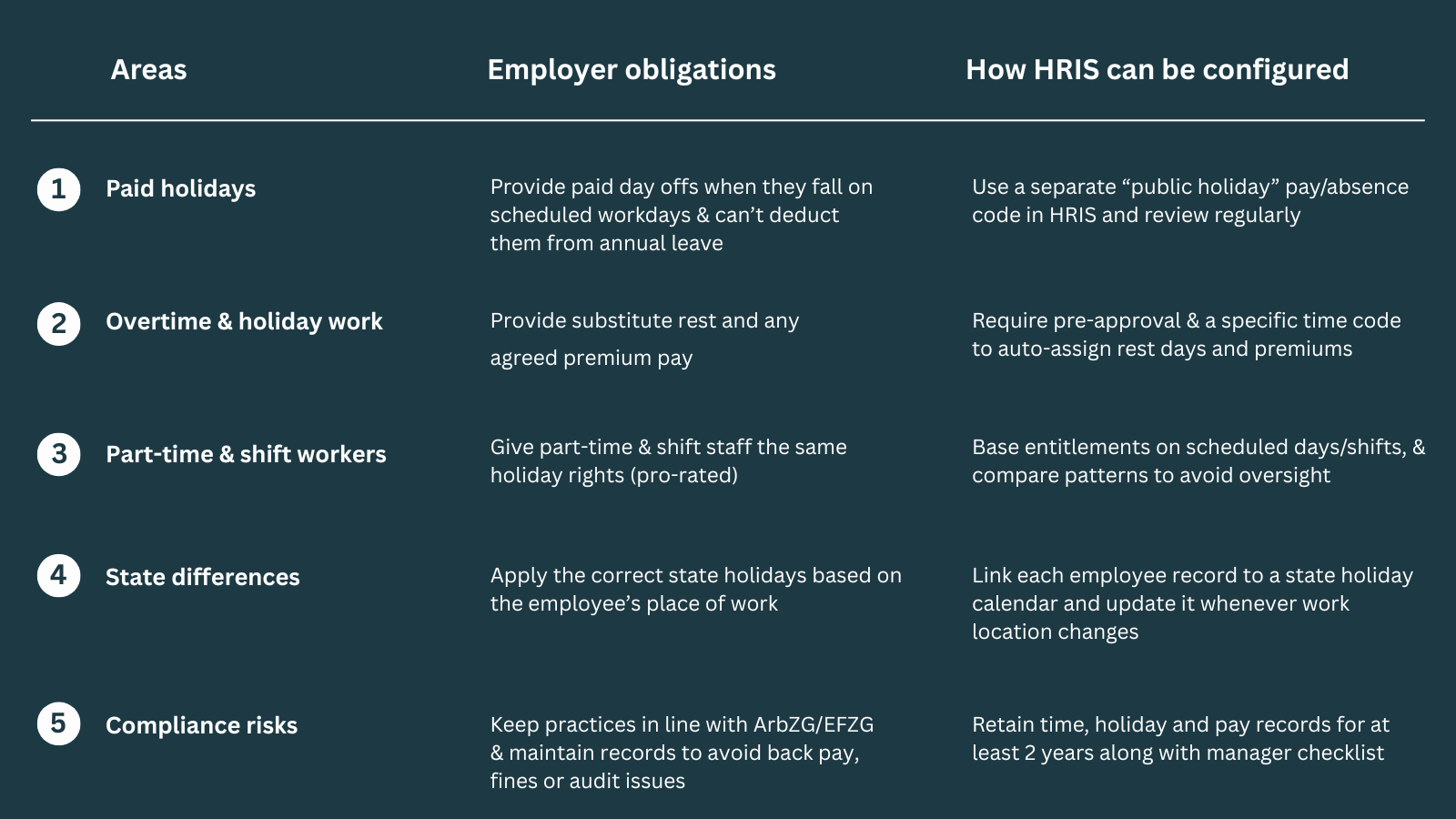
Mismanaging holiday pay and compensatory time off can lead to violations of ArbZG and EFZG, back pay claims, fines and reputational damage to the company brand. Employers must align policies, roster management and payroll with federal and state laws to stay compliant at all times. Utilizing an Employer of Record in Germany can mitigate these risks by ensuring all state-specific laws are followed automatically.
5. Payroll & Compliance Considerations
From a payroll perspective, public holidays are where local law, schedules, and pay rules intersect. Getting them wrong is highly visible to employees and a common trigger for disputes or audits.
Adjust Payroll Timelines:
Banks and many public offices are closed on German public holidays, so payroll approvals and payment runs need to be moved forward when your normal cut-off date falls on or just before a public holiday.
Record Public Holiday Work Hours:
Any hours worked on Sundays or public holidays should be clearly flagged in your time-tracking system so you can demonstrate that working-time limits, substitute rest days and any contractual premiums have been applied correctly and in time.
Consistent Holiday Pay Calculations:
Full-time and part-time employees should have holiday pay calculated using the same rules, based on their usual earnings for that day. Note that contractors are not covered by these employment-law rules, so their work hours and any premium rates should be clearly documented and agreed upon before the engagement starts.
Keep Records for Up to 2 Years:
The Working Time Act (ArbZG) requires that work hour records be retained for a minimum of 2 years. We recommend keeping all relevant records, like payroll, calculations, substitute time off, and holiday work hours, for at least the same number of years, so everything matches during audits.
6. How Slasify Helps Employers in Germany
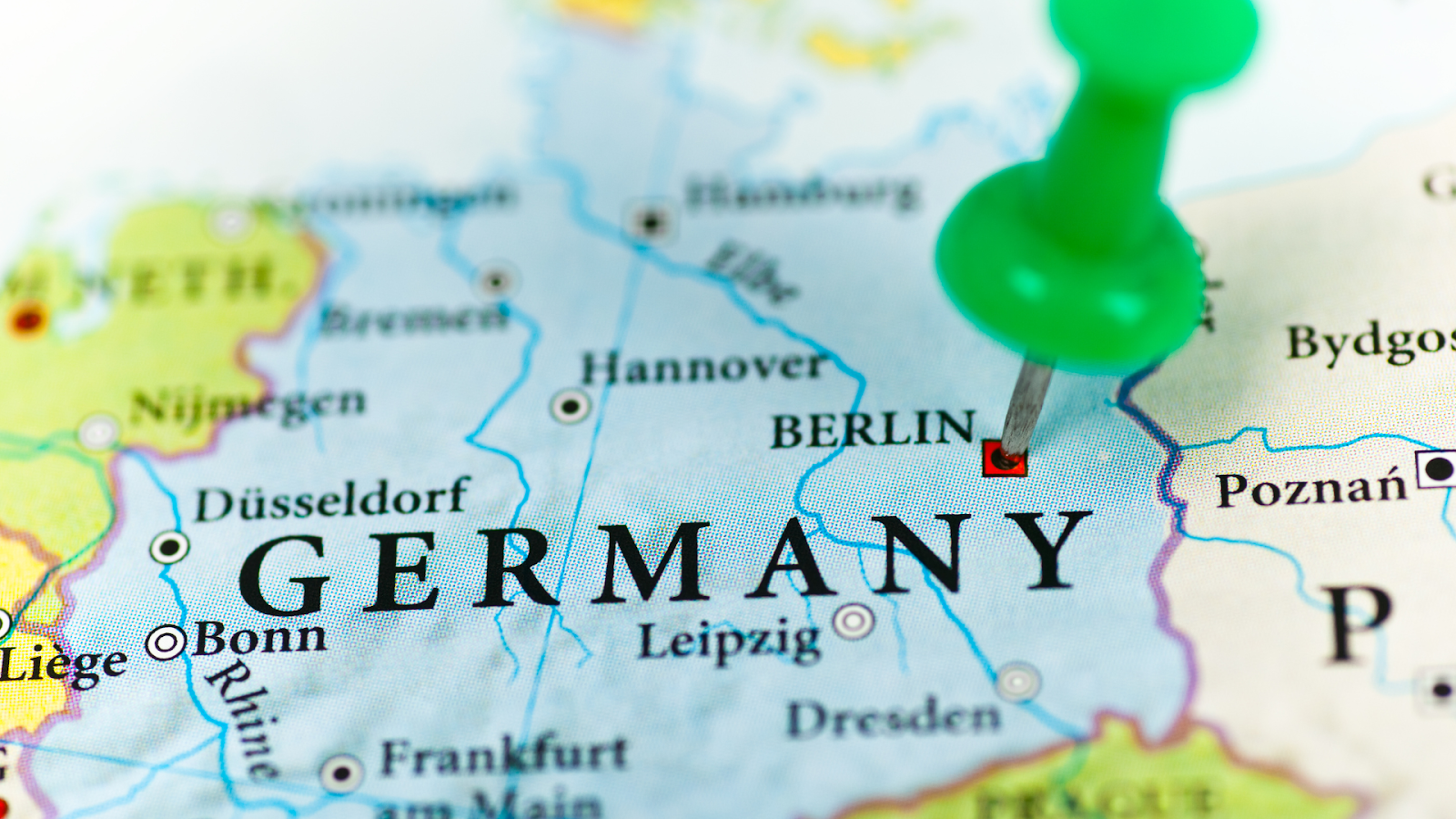
Managing the German holiday calendar, state differences, and payroll rules can be complex without a local team. As your dedicated Employer of Record in Germany, Slasify turns these legal requirements into a predictable operating model.
Here are our key HR solutions for Europe and Germany:
- EOR for Europe: Hire employees in Germany legally without setting up a GmbH. Slasify acts as your Employer of Record, handling contracts, statutory benefits, and registrations on your behalf.
- Payroll for Germany: Slasify’s payroll solution for Germany is configured to provide accurate, on-time pay across multiple states, factoring in public holidays, social contributions and tax rules as an integrated service.
- Localized Expertise: You will have access to our local specialists and a dedicated account manager to help you navigate state-specific holidays, advising on working-time limits, holiday premiums, and leave policies so your operations are aligned with federal and state requirements.
- EU-Wide Scalability: As you expand, you can manage your workforce alongside hires in other European countries using Slasify’s EOR solutions, with country-specific rules built in to provide consistent reporting and workflows.
7. Conclusion
With 9 nationwide and additional state holidays, plus a minimum of 20 days of paid annual leave, how you plan around Germany’s public holidays in 2026 becomes a key success factor in running a well-oiled team.
Strong compliance practices also enhance your employer brand and support long-term growth. Contact Slasify’s experts today to learn how our Employer of Record Germany and HR solutions Europe services can help you scale seamlessly.
8. FAQ: German Public Holidays & Employer Responsibilities
Q1. Are all German public holidays paid?
Yes. If a statutory public holiday falls on an employee’s regular working day, it is a paid day off under the Continued Remuneration Act (EFZG) and should not be deducted from their annual leave entitlement. If an employee works on a public holiday, employers should provide compensatory time off, typically within eight weeks.
Q2. How do public holidays differ across states?
All 16 states share 9 nationwide holidays, but each Bundesland has its own regional holidays, so employees may have between 9 and 13 holidays per year, depending on where they work. Employers should assign the correct regional public holiday calendar to each employee.
Q3. What if an employee works on a holiday?
Holiday work is generally prohibited by law except for certain sectors like hospitality or healthcare. When it happens, the employee keeps their normal pay and must receive compensatory time off, with any extra premium pay defined by the employee contract or collective bargaining agreement (CBA).
Q4. How should employers handle regional variations?
Assign each employee to the state holiday calendar for their place of work (including remote work), and configure HR/payroll so public-holiday entitlements and substitute time off are calculated from that calendar, instead of just following the standard German public holidays.
Q5. Can global companies offer additional floating holidays?
Yes. Many employers add floating or company holidays on top of statutory entitlements, with statutory paid annual leave starting at a minimum of 20 working days. HR leaders should also factor in holiday clusters, staffing management, and payroll to maintain a healthy balance between compliance and productivity.