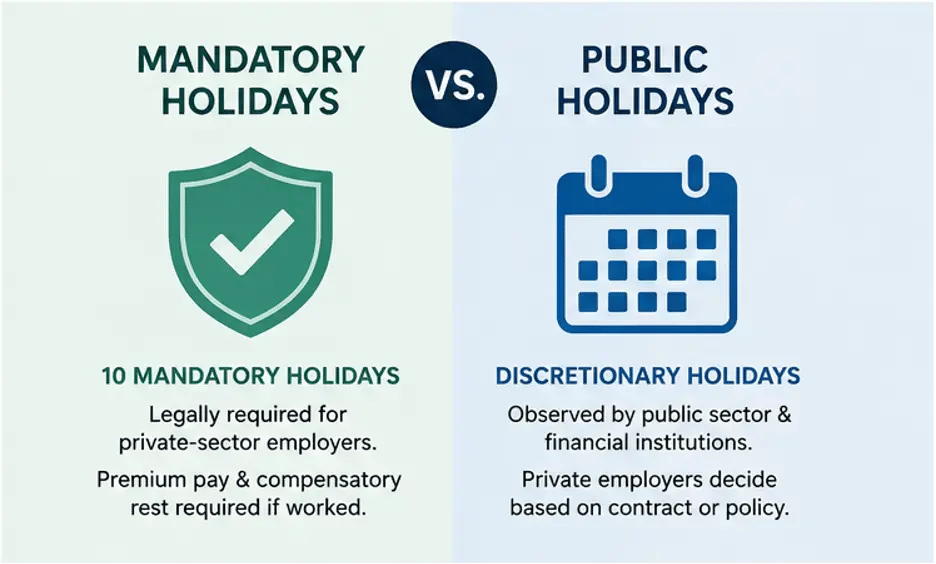
If your global HR team runs Macau public holidays 2026 payroll by treating every date on the calendar the same way, you are either overpaying your workforce or exposing your company to statutory fines. Macau’s Labour Relations Law (Law No. 7/2008) draws a hard line between the 10 Mandatory Holidays, where premium pay and compensatory rest are legally required for private-sector employees, and the remaining Public Holidays, which apply to civil servants but stay discretionary for private employment contracts. Missing that distinction on a single mandatory-holiday marker can trigger fines of up to MOP$25,000 (~USD$3,100) per affected worker.
This guide gives global payroll teams and Heads of People Ops a single, operator-grade reference for 2026: which dates are legally binding, exactly how to calculate premium pay when someone works a mandatory holiday, and what it costs to get it wrong.
Key Takeaways
|
5 Key Takeaways
|
|
Private employers are legally required to grant the 10 Mandatory Holidays under the Macau Labour Relations Law.
|
|
The remaining dates on the standard calendar are Public Holidays that stay discretionary for private corporate agreements.
|
|
Working on a mandatory holiday triggers a rigid legal formula: double compensation, delivered as extra pay, a compensatory rest day, or a combination of both.
|
|
Failing to grant or properly compensate for mandatory holidays can result in statutory fines of MOP$10,000 to MOP$25,000 (~USD$1,232 to $3,100) per employee.
|
|
Using an international Employer of Record (EOR) or localized global payroll provider significantly reduces the misclassification and processing risk.
|
1. Mandatory Holidays vs. Public Holidays: The Crucial Distinction
Macau’s holiday calendar has two legal tiers, and payroll treatment differs sharply between them.
Mandatory Holidays (referred to by Macau’s Labour Affairs Bureau, DSAL, as “obligatory” holidays) are the 10 dates private-sector employers must grant as paid, non-working days. If an employee is required to work on one of these dates, the employer must apply the statutory premium-pay formula covered in Section 3.
Public Holidays cover the additional dates observed by the public sector and financial institutions: Good Friday, Buddha’s Birthday, Tuen Ng Festival, All Souls’ Day, and similar dates. Private employers are not legally obligated to treat these as paid days off; whether staff get the day, and how it is compensated, depends entirely on the individual employment contract or company policy.
This split matters for two reasons. First, most generic “Macau public holiday calendars” online list all ~20 dates without distinguishing legal obligation from custom, which leads global HR teams to either over-grant paid leave or, worse, under-grant it on a date that was actually mandatory. Second, DSAL enforces the mandatory tier through Macau’s Labour Relations Law and Decree-Law No. 60/2000 on Public Holidays, so non-compliance is a labor-law violation, not a policy oversight.
2. Complete Calendar: Mandatory Holidays in Macau 2026
Macau observes 10 Mandatory Holidays in 2026. Three of them (Ching Ming Festival, Chung Yeung Festival, and Macao S.A.R. Establishment Day) fall on a Sunday this year, which is significant if Sunday is also your employees’ scheduled weekly rest day (see Section 3 for the compounding compensation rule this triggers).
Macau 2026 Holiday Compliance Breakdown
|
Date
|
Day
|
Holiday
|
Legal Tier
|
Employer Obligation
|
|
January 1
|
Thursday
|
New Year’s Day
|
Mandatory
|
Paid day off; premium pay if worked
|
|
February 17
|
Tuesday
|
Lunar New Year (Day 1)
|
Mandatory
|
Paid day off; premium pay if worked
|
|
February 18
|
Wednesday
|
Lunar New Year (Day 2)
|
Mandatory
|
Paid day off; premium pay if worked
|
|
February 19
|
Thursday
|
Lunar New Year (Day 3)
|
Mandatory
|
Paid day off; premium pay if worked
|
|
April 3
|
Friday
|
Good Friday
|
Discretionary
|
Contract/policy dependent
|
|
April 4
|
Saturday
|
Easter Eve (Holy Saturday)
|
Discretionary
|
Contract/policy dependent
|
|
April 5
|
Sunday
|
Ching Ming Festival
|
Mandatory
|
Compensatory rest + premium pay if worked (falls on a Sunday)
|
|
May 1
|
Friday
|
Labour Day
|
Mandatory
|
Paid day off; premium pay if worked
|
|
May 24
|
Sunday
|
Buddha’s Birthday
|
Discretionary
|
Contract/policy dependent
|
|
June 19
|
Friday
|
Tuen Ng Festival (Dragon Boat)
|
Discretionary
|
Contract/policy dependent
|
|
September 26
|
Saturday
|
Day after Mid-Autumn Festival
|
Mandatory
|
Paid day off; premium pay if worked
|
|
October 1
|
Thursday
|
National Day
|
Mandatory
|
Paid day off; premium pay if worked
|
|
October 2
|
Friday
|
Day after National Day
|
Discretionary
|
Contract/policy dependent
|
|
October 18
|
Sunday
|
Chung Yeung Festival
|
Mandatory
|
Compensatory rest + premium pay if worked (falls on a Sunday)
|
|
November 2
|
Monday
|
All Souls’ Day
|
Discretionary
|
Contract/policy dependent
|
|
December 8
|
Tuesday
|
Immaculate Conception
|
Discretionary
|
Contract/policy dependent
|
|
December 20
|
Sunday
|
Macao S.A.R. Establishment Day
|
Mandatory
|
Compensatory rest + premium pay if worked (falls on a Sunday)
|
|
December 22
|
Tuesday
|
Winter Solstice
|
Discretionary
|
Contract/policy dependent
|
|
December 24
|
Thursday
|
Christmas Eve
|
Discretionary
|
Contract/policy dependent
|
|
December 25
|
Friday
|
Christmas Day
|
Discretionary
|
Contract/policy dependent
|
|
December 31 (PM)
|
Thursday
|
New Year’s Eve (half-day)
|
Discretionary
|
Contract/policy dependent
|
Source dates: Macao S.A.R. Government Portal, 2026 Public Holidays.
3. The Math: How to Calculate Premium Pay for Mandatory Holidays
Unlike most holiday calendars, Macau’s Labour Relations Law is specific about the mechanics of compensation. Employers owe double compensation for a mandatory holiday worked, delivered through one of two legally equivalent options:
- One compensatory rest day plus one day’s basic remuneration
- Two days’ basic remuneration (no rest day)
The starting point for any of the three is the employee’s daily wage, calculated as monthly salary divided by 30 under standard Macau payroll convention for monthly-paid staff.
Worked example: An employee earning MOP$18,000/month has a daily wage of MOP$18,000 divided by 30 = MOP$600. If that employee is required to work on National Day (October 1), the employer owes an additional MOP$600 on top of the regular monthly salary, or, in lieu of extra pay, a full compensatory rest day of equivalent value.
Premium Pay Calculation Scenarios
|
Scenario
|
Trigger
|
Required Employer Action
|
Example (MOP$18,000/month salary)
|
|
Standard mandatory holiday worked
|
Employee works a full shift on a Mandatory Holiday
|
Pay double compensation via one of the three legal options above
|
Daily wage MOP$600, so the employer owes MOP$600 extra pay, or 1 compensatory rest day
|
|
Mandatory holiday falls on scheduled weekly rest day
|
Employee’s normal weekly rest day coincides with a Mandatory Holiday (e.g., Chung Yeung Festival, October 18, 2026, a Sunday)
|
Grant a separate compensatory rest day within 30 days, in addition to the holiday’s own compensation
|
Employee owed both the MOP$600 holiday premium (or rest day) and a distinct replacement rest day for the lost weekly rest
|
|
Mandatory holiday not worked
|
Employee takes the day off as scheduled
|
No additional pay required beyond normal monthly salary
|
No extra payroll action; the day is already paid
|
Employers using automated payroll software that isn’t localized for Macau frequently miss the second scenario, since global platforms typically process a “holiday worked” trigger but not the compounding “holiday-on-rest-day” trigger. That gap becomes an audit finding, not just a rounding error.
4. Compliance Risks and Penalties for Overseas Employers
Macau’s Labour Relations Law gives DSAL enforcement authority over remuneration violations, including mandatory-holiday pay and rest obligations. For overseas employers managing a distributed workforce that includes professional talent in the Macau SAR, the exposure compounds in three ways:
- Per-employee fines. Violating mandatory-holiday pay or rest obligations can trigger statutory fines ranging from MOP$10,000 to MOP$25,000 (~USD$1,232 to $3,100) per affected employee. A miscalculation applied uniformly across a 15-person Macau team is not a single fine; it is potentially 15.
- Back-pay orders. Beyond the statutory fine, DSAL can require employers to retroactively pay the correct premium, meaning the cost of an error is rarely limited to the penalty alone.
- Localization gaps in global payroll systems. Most multinational payroll platforms are not built to distinguish Macau’s 10 Mandatory Holidays from the broader Public Holiday calendar, or to apply the two-option compensation formula automatically. Relying on a generic APAC calendar template is one of the most common root causes of Macau payroll violations for foreign-headquartered companies.
5. How Slasify Keeps Your Macau Holiday Payroll Compliant

Manually tracking Macau’s mandatory-versus-discretionary split, the double-compensation formula, and the 30-day compensatory rest window across a growing headcount is not a sustainable process for a lean global HR team, and the cost of a single missed marker outweighs years of manual admin savings.
Slasify’s Global Payroll platform applies Macau’s statutory holiday rules, flags rest-day overlaps before they become violations, and keeps your compliance calendar current as DSAL updates its guidance. For companies without a registered Macau entity, Slasify’s Employer of Record service takes on full statutory responsibility for holiday pay, compensatory rest, and DSAL filings, so your team is not the one calculating a Macau premium-pay formula by hand each cycle.
If you also manage talent across Greater China, see Slasify’s related guides on Taiwan public holidays and payroll compliance and Hong Kong payroll, MPF, and leave entitlements for the regional context.
6. FAQ
Q1: Are employers required to pay for all public holidays in Macau?
No. Private employers are legally obligated to compensate employees only for Macau’s 10 Mandatory Holidays under the Labour Relations Law. The remaining public holidays are discretionary and depend on individual employment contracts or company policy. Review your obligations with Slasify’s Employer of Record specialists.
Q2: What happens if an employee’s weekly rest day falls on a mandatory holiday?
The employer must provide a compensatory rest day. When a scheduled weekly rest day overlaps with a mandatory holiday, Macau law requires employers to grant a replacement rest day within 30 days. Slasify’s Global Payroll platform automates these scheduling conflicts to keep your business compliant.
Q3: How many mandatory holidays does Macau observe in 2026, and which dates are they?
Macau observes 10 Mandatory Holidays in 2026: New Year’s Day, the three-day Lunar New Year (February 17 to 19), Ching Ming Festival, Labour Day, the day after Mid-Autumn Festival, National Day, Chung Yeung Festival, and Macao S.A.R. Establishment Day. All other calendar dates are discretionary Public Holidays.
Q4: How is premium pay calculated for employees who work on a Macau mandatory holiday?
Employers must compensate at double compensation: either two days’ basic remuneration, or one compensatory rest day plus one day’s pay. Both options are legally equivalent. Slasify’s Global Payroll team automates these calculations to prevent underpayment.
Q5: What penalties do employers face for non-compliance with Macau’s mandatory holiday rules?
Violating mandatory holiday pay or rest obligations can trigger statutory fines ranging from MOP$10,000 to MOP$25,000 (~USD$1,232 to $3,100) per affected employee, plus potential back-pay orders. Multiplied across a distributed workforce, penalties escalate quickly. Partnering with an Employer of Record like Slasify shifts this compliance exposure onto a provider that manages it locally.
Q6: Is it better to hire in Macau through a local entity or an Employer of Record?
It depends on your timeline. Without an established Macau entity, an EOR is typically faster and lower risk, transferring mandatory holiday pay, compensatory rest tracking, and DSAL compliance to a provider already operating locally. Slasify’s Employer of Record service supports Macau hiring without setting up a subsidiary.
Get Your Macau Public Holidays 2026 Payroll Right