|
Key Takeaways:
|
- Remote employee onboarding involves three layers: legal/compliance, payroll, and operational. Most guides only cover the third.
|
- Statutory enrollment timelines, not paperwork are the primary reason international onboarding runs long.
|
- An Employer of Record (EOR) collapses a 6–16 week entity setup into approximately two weeks by providing pre-existing local infrastructure.
|
- Country requirements vary significantly: Singapore requires CPF enrollment from day one; the Philippines requires three separate statutory enrollments before first payroll; the UK mandates right-to-work checks before the start date.
|
Onboarding remote employees internationally is the compliance-heavy half of global hiring that most guides skip. The offer letter takes an afternoon. The legal, statutory, and payroll setup that follows takes weeks and the gap between those two timelines is where most international hires run into problems.
In the US, onboarding might be a week of paperwork. In Singapore, you need CPF registration, work pass verification, and an employment contract compliant with the Employment Act. In the Philippines, you need SSS, PhilHealth, and Pag-IBIG enrollments completed before the first payroll run. In the UK, you're looking at right-to-work checks, HMRC registration, and pension auto-enrollment before anyone gets paid.
Employees often start working before work authorization, payroll registration, or statutory benefit enrollment is complete., because the offer letter start date and the compliance paperwork completion date rarely line up without an owner managing them in parallel.
This guide explains onboarding remote employees across borders the way the process actually runs: compliance first, payroll second, and operational onboarding third. The final section covers how an Employer of Record collapses the timeline when setting up in a new market.
Onboarding remote employees internationally involves three layers. Compliance onboarding (employment contract, tax registration, statutory enrollment, work authorization), payroll onboarding (bank details, salary structure, currency, pay schedule), and operational onboarding (equipment, system access, team introductions). Most onboarding content covers only the operational layer. For cross-border hires, the compliance layer takes the longest and carries the most risk. An Employer of Record handles the compliance layer in around two weeks.
What remote employee onboarding actually involves

Most onboarding content on the web covers the operational layer: the laptop, the Slack invite, the first-week orientation. That is fine if the employee is being hired by a company with an existing local entity in their country. For any cross-border hire, the full onboarding has three layers, and the first two are where real time and money are spent.
Layer 1: Legal and compliance onboarding
The employment relationship only starts legally when the paperwork is in place and employee onboarding compliance is where most cross-border hiring goes wrong. This layer includes:
- A locally compliant employment contract signed by both parties.
- Employer registration with the local tax authority (if not already done).
- Employee tax registration (if required).
- Statutory benefit enrollments (pension, social insurance, health insurance).
- Work authorization or visa verification for non-resident workers.
- Data-protection compliance (GDPR, PDPA, local equivalents).
Layer 2: Payroll onboarding
Once the legal relationship exists, the payroll plumbing has to be in place before payday:
- Employee bank account details in the local currency.
- Salary structure (base, variable, benefits, allowances).
- Tax withholding setup.
- Payroll cycle (monthly, semi-monthly, weekly).
- Payment rails (bank transfer, payroll provider, cross-border transfer service).
Layer 3: Operational onboarding
Layer 3 is the most familiar and the least risky part of the onboarding process:
- Equipment provisioning and shipping.
- System access and identity management.
- Handbook distribution and policy acknowledgement.
- First-week orientation, team introductions, 1:1s.
- Training on tools, processes, and systems.
Layers 1 and 2 are the focus below, because those are where cross-border onboarding actually takes longer than people expect.
"The most expensive onboarding mistake we see is starting the operational layer before the compliance layer is finished. The new hire is already in Slack, already at their first standup, but their CPF, MPF, social insurance, or other statutory enrollment is not complete yet. Every day of that overlap is retroactive compliance exposure that costs more to fix than to prevent."
- Slasify Account Manager
The remote employee onboarding checklist

A repeatable onboarding process looks the same across every country at this level of abstraction. The country-specific variation goes under each step.
Step 1: Verify work authorization or visa status
Before any other paperwork, confirm the employee has the legal right to work in their country. For citizens and permanent residents, this is typically a document check. For non-residents, this may require an Employment Pass, a dependent-pass endorsement, or a visa application.
In Singapore, an Employment Pass is required for most non-resident white-collar workers. In the UK, right-to-work checks are mandatory and must be completed before the employment start date. In the US, the I-9 form must be completed within three business days of the start date.
Getting this wrong is not a paperwork error. It is a criminal-liability risk in several jurisdictions.
Step 2: Draft a locally compliant employment contract
The contract must be written for the employee's country of residence, not the company's headquarters. For cross-border hires, that means the contract needs to cover:
- Role, reporting line, and start date.
- Compensation in the local currency.
- Statutory notice period.
- Paid-leave entitlements (annual, sick, parental).
- Termination grounds per local law.
- Local-specific mandatory clauses (some jurisdictions require specific wording).
- IP assignment and confidentiality.
- Data-protection clauses where applicable.
A US-template contract used for a Philippines employee may leave key local clauses incomplete, unenforceable, or misaligned with mandatory employment protections. Our contract of service article covers the classification and clause differences in detail.
Step 3: Register with the relevant tax authorities
If the employer does not already have a payroll-capable presence in the employee's country, this is where the timeline blows out.
- Singapore: IRAS registration for the employer, plus tax-file-number confirmation for the employee.
- Philippines: BIR registration for the employer.
- Hong Kong: Inland Revenue Department employer notification.
- UK: PAYE scheme registration with HMRC, plus Pension Regulator duties.
- US: Federal EIN (if new), plus state employer withholding registration for the employee's work location.
Registering from scratch in the Philippines, Japan, or Korea can take three to six months. This is the single most common reason companies use an Employer of Record for first hires in a new market.
Step 4: Enrol in statutory benefit programs
Registration is not the same as enrollment. Each statutory program has its own enrollment step.
- Singapore: CPF contributions begin from the first pay cycle. Missing the first contribution triggers a penalty.
- Philippines: SSS, PhilHealth, and Pag-IBIG enrollments each run through a separate portal.
- Hong Kong: MPF scheme enrollment within 60 days of employment.
- UK: Pension auto-enrollment duty, with an optional three-month postponement that must be formally exercised.
- US: State unemployment insurance, state disability in some states, and any local-mandate enrollments.
Skipping a statutory enrollment is not a neutral cost decision. Retroactive contributions plus penalties plus interest compound quickly.
Step 5: Set up payroll and payment method
Once tax registration and statutory enrollment are done, payroll onboarding is a data-collection step:
- Employee bank account details.
- Currency of pay.
- Pay schedule (monthly is default in most APAC markets; semi-monthly is common in the US).
- Salary structure (base, allowances, benefits).
- Tax-withholding elections where applicable.
For workers paid in a currency different from the company's base currency, this is also where the FX approach gets decided. We support 130+ currencies natively through our Global Payroll.
Step 6: Provide required employment notices
Most countries require specific written notices to the employee at the start of employment:
- Singapore: Key Employment Terms (KETs) must be issued within 14 days of employment.
- Philippines: company rules and SSS/PhilHealth/Pag-IBIG confirmation.
- UK: statutory written statement of employment particulars on day one.
- US: state-specific wage-theft-prevention notices (California, New York, others).
These notices are separate from the employment contract itself and are sometimes overlooked.
Step 7: Ship equipment and provision system access
This is where operational onboarding starts. Laptop shipping, account setup, two-factor authentication, VPN access, single-sign-on provisioning. For remote hires, international shipping timelines (customs, import duty, local delivery) need to factor into the start-date planning.
Step 8: Schedule the first-week orientation
The operational layer of onboarding is the familiar part. Day-one welcome, week-one 1:1 schedule, handbook review, first deliverables. What matters here is that the employee does not start this layer until layers 1 and 2 are complete. Starting work before statutory enrollments are done creates back-dated compliance exposure.
Onboarding international employees: country-specific requirements

The checklist above is universal. Below is what changes country by country.
Singapore
Philippines
- SSS, PhilHealth, and Pag-IBIG enrollments should be initiated before the first payroll run, with statutory reporting deadlines tracked from the hire or assumption date.
- 13th-month pay is mandatory for rank-and-file employees, paid by 24 December.
- Probation period capped at six months.
- BIR registration and tax-identification-number setup required for employer and employee.
- Read more on how to hire and pay employees through our Philippines employment guide.
"When we onboard in the Philippines, we often see a two-week delay on PhilHealth on the employer side even when everything is submitted on time. It is not a gap in the client's paperwork. It is how the system runs. We build that into our timeline so the employee can still start on schedule, and we carry the compliance risk during the pending window." - Slasify Account Manager
Hong Kong
- MPF scheme enrollment within 60 days of employment.
- Employment visa required for non-residents (sponsored by the employer).
- Statutory annual leave of 7 to 14 days depending on service length.
- Inland Revenue Department notification of employment (Form IR56E) within three months of hire.
- Read more about how to hire and pay employees through our Hong Kong employment guide.
United Kingdom
- Right-to-work check mandatory before the start date.
- PAYE scheme registration and real-time information (RTI) reporting to HMRC.
- Pension auto-enrollment with a three-month postponement option.
- For the 2026/27 tax year, employer Class 1 NICs remain 15% above the secondary threshold. (GBP 5,000 from April 2025).
- Statutory written statement of employment particulars on day one.
- Read more on hiring and paying employees through our UK employment guide.
United States
- Federal EIN (if new employer entity).
- State-specific employer withholding registrations for the employee's work location.
- I-9 employment eligibility verification within three business days.
- W-4 tax-withholding form.
- State-mandated notices (wage-theft prevention in CA, NY, and others).
- FICA at 7.65% (6.2% Social Security + 1.45% Medicare) plus state-specific contributions. (For earnings in 2026, the base wage will be $184,500)
How an Employer of Record Accelerates the Cross-Border Employee Onboarding Process
The onboarding checklist above assumes the employer has, or is willing to set up, a local presence in the target country. For companies navigating cross-border employee onboarding for the first time, that assumption rarely holds — especially when onboarding employees in another country means setting up a legal entity from scratch.
Setting up a local entity purely to make one or two international hires is expensive (five figures of setup cost in most markets), slow (three to six months in the Philippines, Japan, or Korea), and locks in a recurring compliance burden (annual filings, local director requirements, corporate tax registrations). The workforce-planning math almost always favors using an Employer of Record for the first hires in a new country.
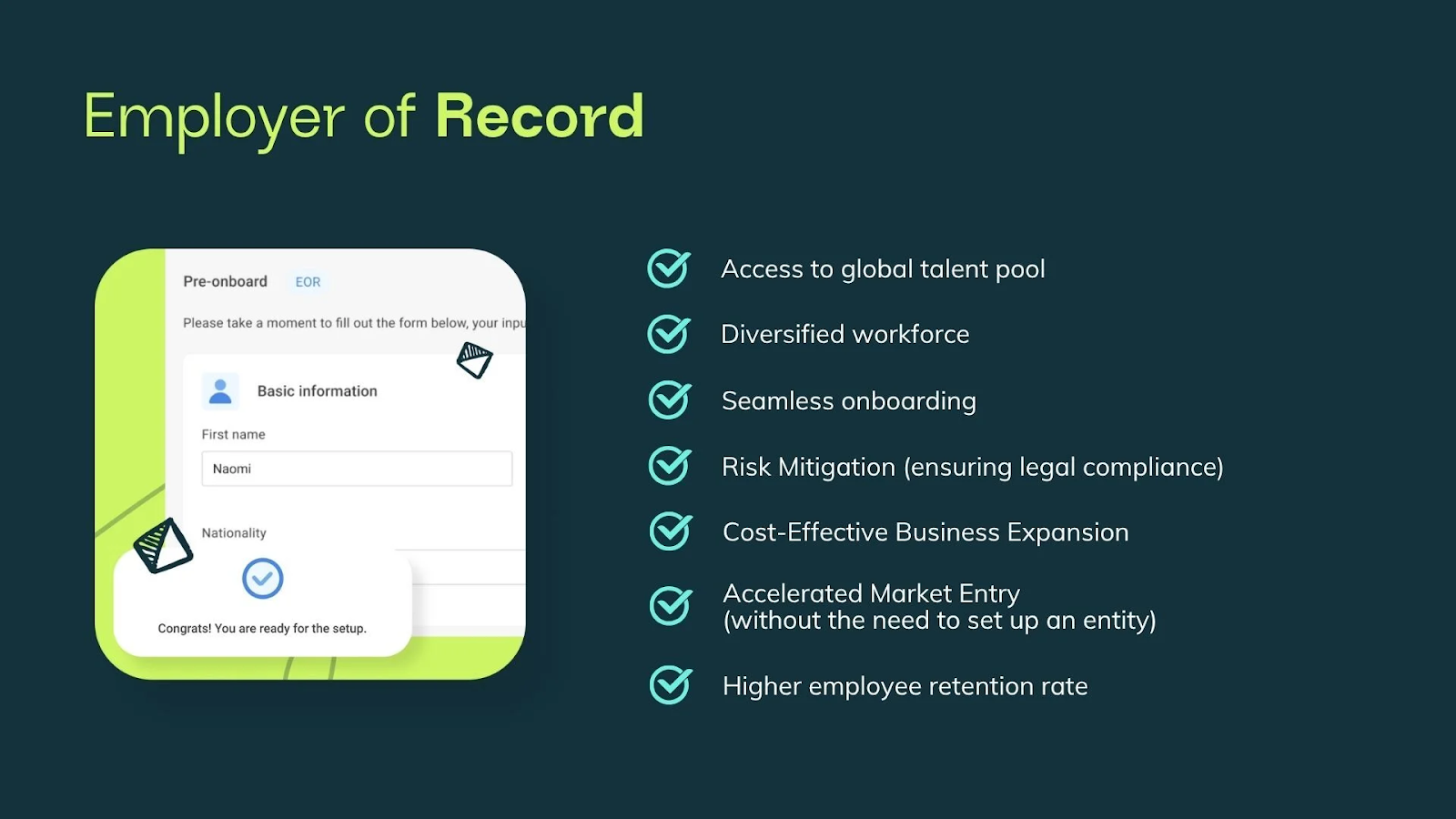
An EOR is the legal employer of record in the country where the worker operates. The EOR has:
- A registered local entity.
- An existing payroll and tax-withholding infrastructure.
- Pre-existing enrollments with statutory benefit programs.
- Knowledge of the country-specific contract clauses, notices, and compliance timelines.
The engaging company provides the offer, the role, and the compensation. The EOR handles contract drafting, statutory enrollments, payroll, and compliance. The worker is legally employed by the EOR while reporting day-to-day to the engaging company.
"Our fastest onboarding through EOR was five business days for a senior engineer into Taiwan. Our longest was three weeks for a regulatory role in the Philippines that needed specific DOLE clearances. The range is wide because the local regulators move at different speeds, not because the process is inconsistent. Our job is to absorb that variance so the client still gets a predictable start date."
- Slasify Account Manager
Our EOR operates across 150+ countries with 600+ local compliance partners. Typical onboarding completes in around two weeks from signed offer to first day, compared to 6 to 16 weeks for direct-entity setup in most markets. For APAC markets specifically, our coverage and local expertise is a meaningful differentiator, because many EOR providers run thin on the ground in Asia.
Request a demo to map a specific onboarding timeline against our market coverage.
Frequently asked questions

How long does it take to onboard a remote employee internationally?
With an existing local entity, onboarding typically takes four to eight weeks, driven by statutory registration and benefit-enrollment timelines. With an Employer of Record, onboarding can complete in around two weeks from signed offer to first day. Country-specific delays in the Philippines, Japan, and Korea can extend timelines by one to two weeks.
What documents are needed to onboard an international employee?
At minimum, the employee usually provides a signed employment contract, right-to-work documents, bank account details, tax identification numbers where applicable, and emergency contact information. The employer provides: a locally compliant employment contract, statutory written notices, and confirmation of statutory benefit enrollment. Country-specific documents vary, with Singapore, the Philippines, and the UK requiring specific additional forms.
Can you onboard an employee in a country where you don't have a legal entity?
Yes, through an Employer of Record. The EOR acts as the legal employer in the target country while the worker reports day-to-day to the engaging company. This is the most common path for companies making their first one to ten hires in a new market, because setting up a local subsidiary is expensive, slow, and over-engineered for single-digit headcount.
What is the difference between onboarding an employee and onboarding a contractor?
Contractor onboarding usually involves fewer employment-law steps, but it still requires classification review, tax documentation, payment setup, data protection, and local contractor compliance checks. The contractor handles their own tax and benefits. Contractor onboarding is typically one to three days. Employee onboarding is typically two to eight weeks because the statutory and compliance layer adds real time. For a deeper comparison of the two models, see our contractor vs employee pay article and the contractor-to-employee conversion guide.
What are the biggest risks in international employee onboarding?
Three risks account for most of the real-world incidents. First, starting work before statutory enrollments are complete, which creates retroactive compliance exposure. Second, sending a contract written for the company's home country rather than the employee's home country, which leaves clauses unenforceable and employer-side obligations unmet. Third, miscalculating the onboarding timeline and missing the agreed start date, which can cost the company the candidate entirely in a tight talent market.
Does Slasify handle the full onboarding process?
Yes. Our EOR handles contract drafting, tax registration, statutory enrollment, payroll setup, and compliance notices. The engaging company provides the offer, the role, and the compensation structure. Our platform also handles contractor onboarding through our Global Contractor services, for engagements where the contractor model is the right choice.
Next steps
Remote-employee onboarding is a solved problem in markets where a company already has an entity. It is a timeline and compliance problem everywhere else. For companies making their first international hires, the question is not "how do we do onboarding" but "how do we do onboarding without spending six months setting up a local entity for a role that needs to start in four weeks."
Our EOR is built for that situation. Request a demo to map your next international hire against local onboarding timelines, payroll requirements, and EOR coverage before you commit to a start date.