SWITCHING EOR PROVIDERS
| Key Takeaways |
|---|
| Before switching EOR providers, confirm whether the legal employer changes so you know which employee documents to prepare. |
| Build the schedule from actual contract terms, payroll cutoffs, and local obligations. |
| Reconcile employee records, accrued amounts, and benefit arrangements before testing payroll. |
| Compare calculations in parallel without authorizing duplicate payments or filings. |
| Assign every payment and filing, then track remaining obligations beyond the first payday. |
In This Article
1. Before Switching EOR Providers, Confirm Your Scope and Exit Terms
2. Confirm the Employment Route and Protect Employee Terms
3. Communicate the EOR Change Before Employees Need to Act
4. Transfer and Validate Payroll and Benefits Records
5. Build the Cutover Calendar and Assign Each Payment
6. Test Payroll and Confirm Readiness Before Cutover
7. Reconcile the First Payroll and Close Outstanding Obligations

When you switch EOR providers, your employees still expect to be paid correctly and on time. If your current Employer of Record (EOR), the organization legally employing your overseas team, is no longer meeting your needs, the handover still has to protect pay, benefits, and employment rights. Your employees need to know what changes, what they must do, and whom to contact.
Begin by confirming who will legally employ each country's team. Then settle employee paperwork, payroll records, benefit dates, funding, and payment responsibilities before committing to the switch. Test the calculations before releasing payments. If a country or employee group is not ready, agree on a way to keep employees paid on time before changing providers.
1. Before Switching EOR Providers, Confirm Your Scope and Exit Terms
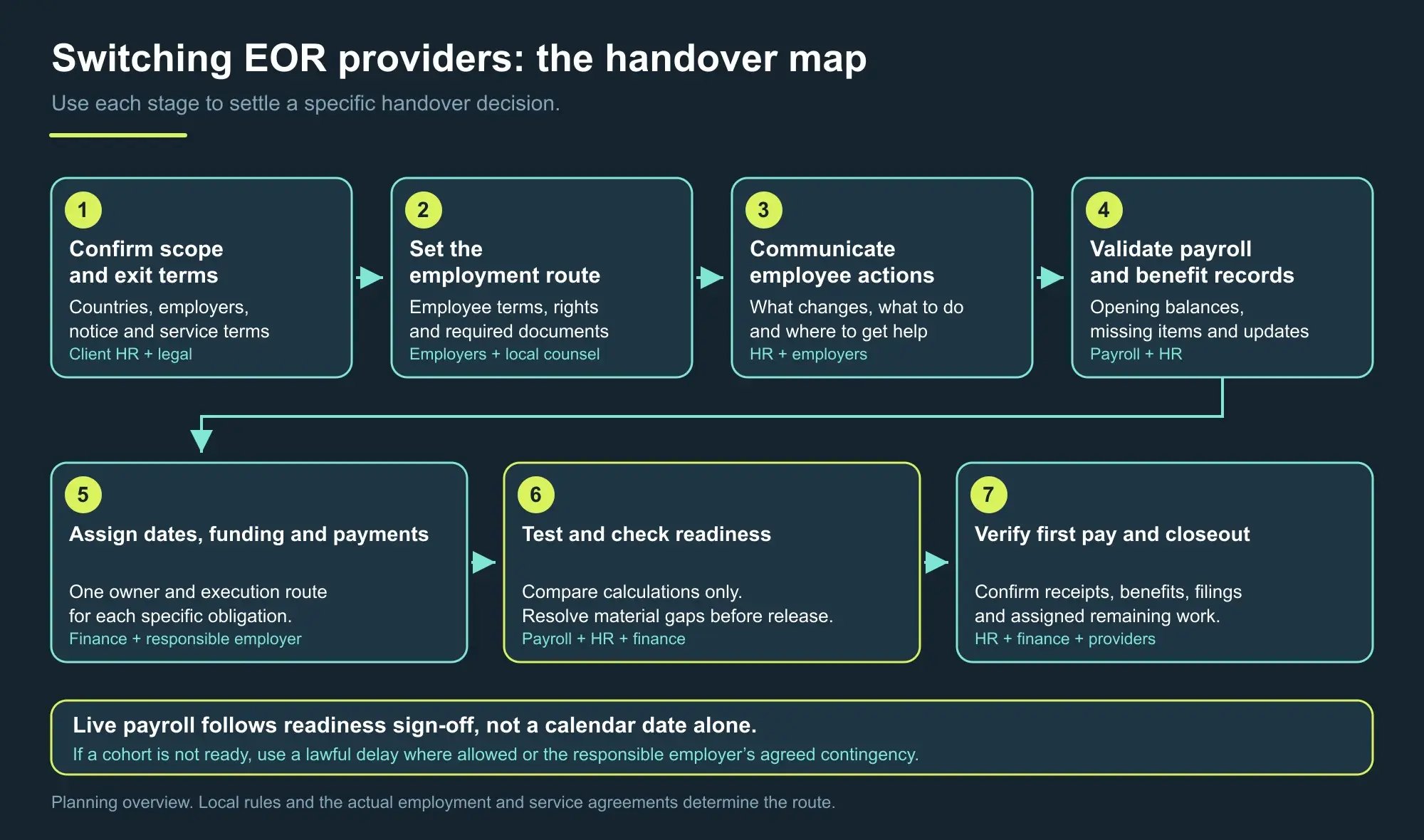
Before committing to a switch, start with the employees and entities involved. Record each worker's country, current legal employer, proposed employer, pay frequency, and benefits. Identify your contracting entity separately, since the company signing the service agreement may differ from the employer named on an employee's contract.
Your next steps depend on the type of change involved:
| Proposed change | First question to ask | Planning consequence |
|---|---|---|
| Service or platform changes; legal employer stays the same | Which employment and payroll arrangements actually change? | Confirm required updates without assuming employment must end. |
| A new EOR becomes the legal employer | Which local employment route applies? | Resolve employee rights and documents before committing to the move. |
| Your own entity becomes the employer | Is the entity ready to employ and run payroll? | Check entity readiness, employee terms, and payroll setup before moving in-house. See our EOR vs. local entity guide for details. |
Next, review three areas of your current EOR agreement that may affect the transition:
—Notice and renewal: Record the deadline, delivery method, acknowledgment, and automatic-renewal terms.
—Exit costs and cash: Identify termination charges and the conditions for returning deposits.
—Data and support: Confirm export access and assistance available after the service ends.
Ending your EOR service agreement does not automatically terminate or transfer your employees' employment. The applicable employment arrangements must be addressed separately.
Lastly, confirm that the incoming EOR provider can support the proposed countries and arrangements before you issue a binding notice, and serve any notice by the deadline your agreement sets. If you need to build an internal business case, our guide to addressing objections to an EOR switch covers the main considerations.
2. Confirm the Employment Route and Protect Employee Terms
Before sending employee paperwork, establish how the change will work under the applicable local rules. Depending on the arrangement, employment may transfer under a statutory mechanism, continue with the same employer, or require another lawful route, including ending one employment relationship and starting another. Before asking employees to resign and sign with a new employer, check whether local transfer rules protect their existing employment terms and continuity.
What to check in employee terms
Compare current and proposed terms in writing and have the record approved for the route that applies:
—Pay: Salary, allowances, commissions, and bonus eligibility.
—Leave and service: Unused leave and the treatment of previous service.
—Employment protections: Probation, notice, and any termination or severance obligations.
—Benefits: Retirement arrangements, medical coverage dates, dependents, exclusions, and waiting periods.
Record pending claims separately and confirm benefit details with the provider or insurer.
How local requirements change the handover
These three examples are illustrative only, but they show why each country needs its own checks:
| Employee location | What the official guidance establishes | What you must resolve for the switch |
|---|---|---|
| United Kingdom | Where the Transfer of Undertakings (Protection of Employment) Regulations (TUPE) apply, employment terms and continuity are protected. | Check whether TUPE applies to this arrangement; changing providers alone does not establish eligibility. |
| Singapore (employee covered by the Employment Act) | Regular salary is due within 7 days after the salary period ends. Final salary is due on the last day if an employee resigns and serves notice; without notice, within 7 days of the last day. If the employer ends the contract, pay on the last day or, if that is not possible, within 3 working days. See MOM's salary payment deadlines. | Identify how employment ends before setting the final-pay date. If IRAS tax clearance is required, withhold all money due from the date you learn of the employee's impending cessation or departure, and follow IRAS release instructions. |
| Hong Kong (regular employee covered by MPF) | For covered regular employees, employers must generally complete MPF enrollment within the first 60 calendar days of employment, subject to applicable deadline extensions. Employer contributions are calculated from the first day of employment. | For monthly paid employees, any applicable employee contribution holiday covers the first 30 days plus the following incomplete wage period. Confirm how the incoming employment is treated before applying a new holiday. See our Hong Kong MPF employer guide for contribution rates and limits. |
Beyond comparing employment terms, employers must also determine how the transition affects existing employee rights and obligations. Recognizing an employee's original start date does not necessarily preserve every statutory entitlement or settle accrued liabilities. The incoming and outgoing employers should therefore clarify which rights continue under local law, which obligations must be allocated between them, and whether individual circumstances (work authorization, protected leave, collective arrangements, or ongoing disputes) require additional attention.
3. Communicate the EOR Change Before Employees Need to Act
Employees should understand what will change before they are asked to sign documents or provide information. Have the HR team coordinate a country-specific message with the incoming and outgoing employers so that the explanation matches the employment documents, payroll calendar, and benefit arrangements.
Give each employee four pieces of information:
—Employer and dates: Name the legal employer and explain the proposed effective date.
—Required actions: Identify documents to review, information to provide, and the actual deadlines.
—Pay and benefits: Explain confirmed pay dates, coverage, and any changes still being resolved.
—Help and escalation: Name the contact for questions and unresolved pay or benefit issues.
We recommend briefing managers before employees receive action requests, so they can help address questions and track outstanding documents. Say what remains unresolved and when employees can expect an update. Don't promise unchanged net pay or insurance coverage until you've confirmed both.
4. Transfer and Validate Payroll and Benefits Records
An incomplete opening record can carry errors into the first payroll after the switch. Agree on what the outgoing provider will export, who will validate it, and how missing items will be resolved before the incoming EOR starts processing pay.
Use this checklist to assign who supplies each record and what must be verified:
| Payroll and employee records | Who provides and verifies the data | What to verify |
|---|---|---|
| Identity, employee IDs, bank details | Outgoing provider; incoming payroll team | Match workers correctly and verify payment instructions. |
| Employment documents, salary, frequency, currency | HR and outgoing provider; incoming EOR | Match signed terms to payroll settings. |
| Allowances, overtime, bonuses, commissions, deductions | HR/payroll owners; incoming payroll team | Include approved changes and unpaid items. |
| Leave, benefits, dependents, contribution identifiers | HR and benefits administrators; incoming EOR | Reconcile balances and effective dates. |
| Relevant year-to-date (YTD) history and adjustments | Outgoing payroll team; incoming payroll team | Confirm treatment under the applicable reporting route. |
The handover doesn't end with the initial export. Both providers and your internal teams need to resolve missing items, verify historical figures, protect sensitive data, and track subsequent changes. Use these four checks to avoid carrying mistakes into the first payroll:
—Resolve missing or incomplete records: Log missing items in an exception list, assign an owner and deadline, and resolve anything affecting the first payroll before payment approval. Keep other outstanding items open until they have been validated.
—Verify historical payroll information: Year-to-date (YTD) figures should not automatically be treated as earnings paid by the incoming employer. Confirm which amounts are needed for reference and which must be included in the new payroll or reporting process.
—Protect employee data during the transfer: Use secure transfer channels, restrict access, and share only the information necessary and permitted for the transition. Review applicable privacy requirements, including how sensitive medical records are handled and how transferred data will be retained.
—Track changes after the initial export: Set a clear export cutoff and maintain a change log. Any subsequent updates, such as salary adjustments or bank account changes, must reach the incoming provider and be validated before they affect payroll.
5. Build the Cutover Calendar and Assign Each Payment
When planning an EOR transition, your first priority is to identify when each employee must be paid and which employer will be responsible for that payment. This helps you set the cutover date: the date the agreed employment or payroll arrangement formally changes. The cutover date may differ from the date you terminate your existing EOR service agreement, so both timelines need to be coordinated to avoid gaps in payroll responsibility.
Once the proposed cutover date is established, the next step is to work backward from each employee's payday. This means allowing enough time for payroll data submission, calculations, internal approval, funding, and bank processing. The calendar should also account for statutory contributions, reporting requirements, and benefit coverage dates, which may follow different schedules. Until these arrangements are confirmed, the cutover date should remain tentative. Moving at a pay-period boundary can simplify reconciliation, but it cannot override a legal or contractual deadline.
Example: Planning for an October 30 payday
Assume the legal employer changes on October 1, employee paperwork and notice requirements are settled beforehand, and the incoming provider has agreed to an October 23 funding cutoff. The team could organize the handover as follows:
| Illustrative date | Milestone | Owner |
|---|---|---|
| September 18 | Validate the opening payroll export and record any missing items. | Client HR + both providers |
| September 25 | Compare test calculations and resolve material differences. | Incoming payroll team + client payroll |
| October 1 | Employment changes to the incoming employer. | Both employers + client HR |
| October 23 | Approve current payroll inputs, including changes since the export, and meet the agreed funding cutoff. | Client finance + incoming payroll team |
| October 30 | Pay employees and confirm receipt. | Incoming EOR |
These dates illustrate the sequence, not a standard transition length. Set the actual dates from the contract, local employment requirements, contribution deadlines, and provider and bank cutoffs.
Counting October 1 as Day 0, these steps fall at Day -13, Day -6, Day 0, Day +22, and Day +29.
The table below shows who is responsible for each payment, when it is due, and what records you need to confirm completion.
Example: Payment responsibilities during an EOR transition
| Payment or Obligation | Covered period | Who Is Responsible | Payment or Filing Deadline | Completion Record |
|---|---|---|---|---|
| Earned wages and final pay | Outgoing employer's period | Outgoing employer for its employment period, unless liability transfers under local law. Record any agreed payment-processing role separately. | Applicable wage/final-pay requirement | Approved calculation; payment confirmation |
| New-period salary | Incoming employer's period | Incoming EOR | Agreed payday and local rules | Payroll approved; funds available |
| Commission, expenses, corrections | Identified earning/expense period | Responsible party under law and written agreement | Contract and applicable rules | Itemized schedule; payment reference |
| Contributions and filings | Each employer's relevant period | Responsible employer | Each applicable deadline | Submission and remittance confirmations |
| Benefit coverage | Old end date; new start date | EOR and insurer/administrator | Agreed coverage dates | Enrollment and coverage confirmation |
| Deposits and service invoices | Relevant service period | Client finance and EOR | Agreement and invoice terms | Funding record; refund status |
Each payment should have a clearly assigned owner, from calculation and approval to funding and execution. This is especially important when responsibilities are split between two providers, as unclear arrangements could result in duplicate payments or employees being left unpaid.
Budget for cash timing as well as fees. Your new provider may require funding before your old provider returns its deposit. If your agreement makes the deposit refundable, treat it as a temporary cash requirement rather than a permanent switching cost, and do not plan around a refund date the agreement does not confirm. Where countries have different readiness dates, assess separate cohorts rather than forcing one global cutover.

Our Employer of Record service combines employment contracts, payroll, and benefits support with dedicated account management.
6. Test Payroll and Confirm Readiness Before Cutover
Before the new EOR processes its first payroll, you need to know whether its calculations are accurate. A parallel payroll run allows both providers' calculations to be compared, helping identify errors before employees are paid. This is a test only and should not trigger duplicate salary payments or statutory filings.
For each employee, the comparison should cover three key areas: pay calculations, deductions and contributions, and payment details, including any relevant year-to-date (YTD) information. Any significant differences should be investigated, corrected, and approved before the first live payroll. An identical net amount is not always the correct result when a valid deduction or benefit arrangement changes.
Example: A missed commission payment
Imagine a US company switching EOR providers for its sales employee in Singapore, whose salary includes monthly commissions. During the transfer, the employee's base salary is recorded correctly, but an approved commission is accidentally left out. Without a parallel payroll comparison, this mistake could go unnoticed and leave the employee underpaid on their first payday with the new EOR.
Check readiness before releasing payroll
Your sign-off should achieve the following:
—The employment route and required documents are settled, with employee steps and consultation completed where required.
—Payroll records are validated, and material calculation differences are explained or corrected.
—Benefits and applicable registrations are ready for the relevant dates.
—Payroll is approved, and funding will be available before the payment cutoff.
—Each payment and filing has an owner, with an executable contingency and escalation contact.
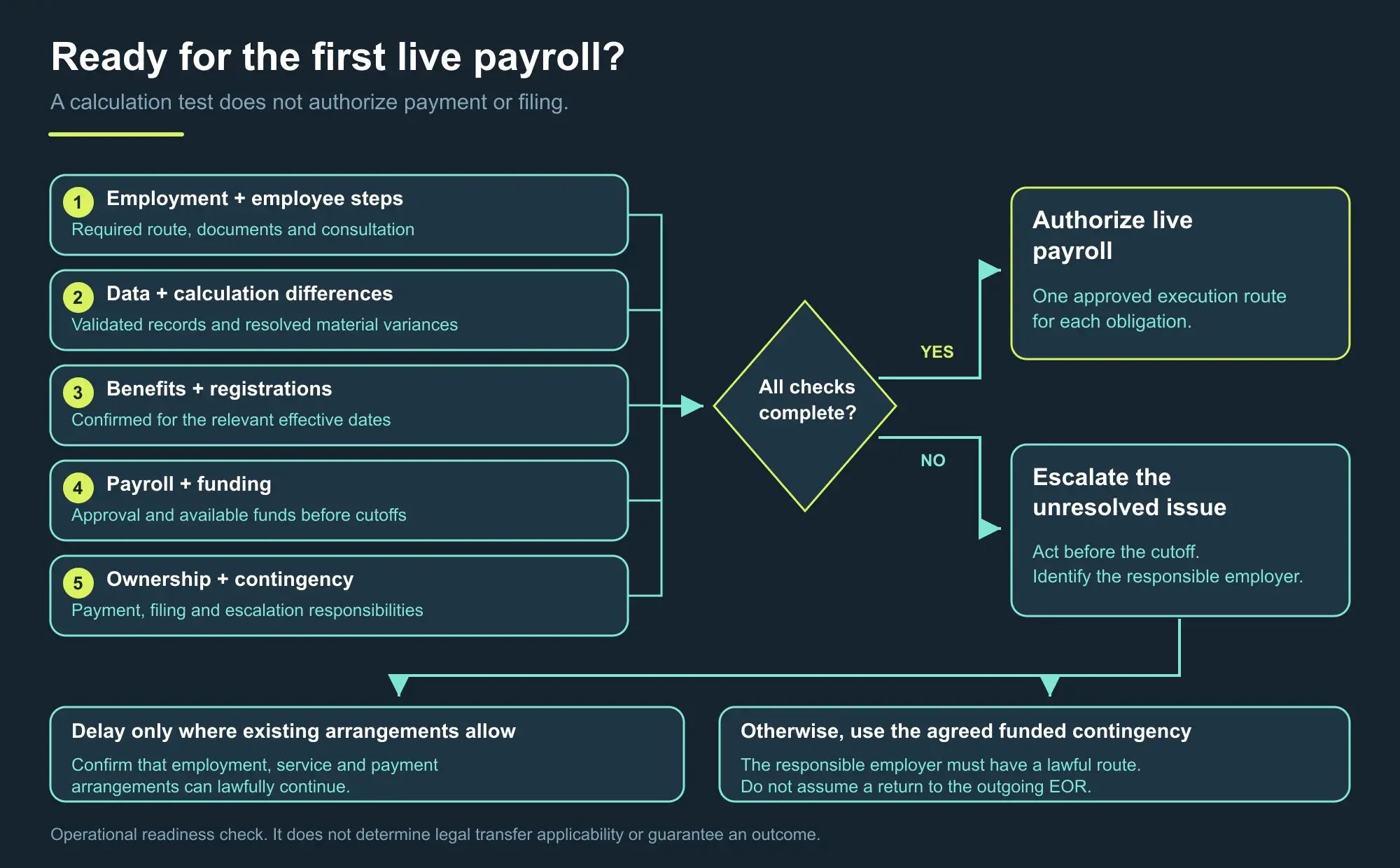
If testing uncovers missing documents, incorrect bank details, or a funding shortfall, resolve these issues before the payment deadline. Postpone the provider switch only if local law and the contracts allow it; employees must still be paid on time. If the legal employer has already changed, the responsible employer needs a funded payment plan rather than assuming the outgoing EOR can step back in.
7. Reconcile the First Payroll and Close Outstanding Obligations
Confirm that employees have been paid and track remaining contributions and filings before closing the EOR handover. Your HR and finance teams should check payslips and benefit coverage, then reconcile approved payroll against actual bank transactions and invoices. A completed status in the provider's system is not proof that an employee has received the money.
Any rejected payments, corrections, or outstanding bonuses should remain on an exception list until resolved. The same applies to statutory contributions and filings, which may have different deadlines and require separate confirmation.
Before closing the handover, make sure that:
—Outstanding wages, adjustments, contributions, and filings are completed or assigned with clear deadlines.
—Deposit refunds, final invoices, and any agreed support have designated owners.
—Required records remain accessible under the agreed retention arrangements.
—Employees know whom to contact about payroll or benefits after the switch.
Some financial and administrative obligations may continue even after the outgoing EOR's service has ended. This doesn't mean both providers need to maintain active employment or run duplicate payrolls. Employees should keep access to your company's day-to-day work systems; manage access to the outgoing EOR's portal separately.
The handover can be considered complete once all remaining obligations have been documented, assigned, and tracked through their respective deadlines.
8. Plan Your EOR Switch Around Readiness, Not a Date
Switching EOR providers works best when employment terms, payroll records, funding, and payment responsibilities are settled for each country. Our Employer of Record service supports employment contracts, payroll, local benefits, and dedicated account management.
Bring your country list, payroll calendar, and open handover questions to a demo to discuss whether Slasify can support your proposed transition.

9. FAQs About Switching EOR Providers
Q1. Can you switch EOR providers in the middle of a pay period?
Yes, if the employment arrangement and local deadlines allow it. First, confirm the effective date and which employer covers each part of the pay period. Any prorated wages, final pay, statutory contributions, and filings must follow the applicable rules, even when the two providers use different payroll schedules.
Q2. How long does switching EOR providers take?
There is no standard timeline for switching EOR providers. Your schedule depends on contract notice, the employment route, employee documentation, benefits enrollment, payroll testing, and funding. Countries may be ready on different dates, so plan each employee group separately.
Q3. Do employees have to resign when you change EOR providers?
No, there is no universal requirement for employees to resign when you change EOR providers. Whether their employment continues or requires a new contract depends on the legal employer and local transfer rules. For example, UK TUPE protections may apply to qualifying transfers, so assess the arrangement before issuing resignation instructions.
Q4. Will employees keep their service history and benefits?
Possibly, but service history and benefits do not always carry over automatically. Local law may protect employment continuity, while recognition of prior service and treatment of accrued leave or liabilities may require separate arrangements. Confirm medical coverage dates, dependents, and waiting periods with the incoming provider and its insurer or benefits administrator before the change takes effect.
Q5. Does parallel payroll mean paying employees twice?
No. Parallel payroll compares the incoming provider's calculations with existing records without paying employees twice or filing twice. Check earnings, deductions, and contributions before approving live payroll. An adjustment for work under the outgoing employer may still be legitimate, but record it separately. See our global payroll failure guide for other common risks.
Q6. What happens if the incoming EOR is not ready by payday?
The responsible employer must have a funded way to pay employees on time. Identify whether the blocker is employee paperwork, payroll calculations, bank details, or funding. If local law and the contracts allow the provider switch to be postponed, agree who will run payroll in the meantime. After the legal employer changes, do not assume the outgoing EOR can resume paying employees.

Sources: GOV.UK (TUPE); Acas (TUPE); Ministry of Manpower Singapore (Paying salary); MPFA (Employee enrollment); MPFA (Employee contributions); Ministry of Manpower Singapore (Employment Act coverage); IRAS (Getting tax clearance).