Key Takeaways
|
- The fastest employer of record providers can start onboarding a new international hire within days; the slowest take six weeks or more, which is long enough to lose the candidate.
|
- Onboarding speed comes down to one structural factor: whether your EOR has a local entity or a ready in-country partner, versus having to set one up from scratch.
|
- Slasify can begin the employment process within 48 hours and, through 600+ local partners across Asia-Pacific, avoid the entity setup delays that slow Western providers in the region.
|
- Building your own local entity takes 8 to 20 weeks and typically costs $20,000 to $150,000 per country; an EOR can onboard the same hire within days for $199 to $699 per employee per month.
|
- Speed alone is not the full picture. Verify compliance depth, benefits coverage, and support quality in your target countries before you sign, not after.
|
1. Why EOR Onboarding Speed Matters

Imagine losing a great hire in an emerging APAC market because your global hiring partner took six weeks to complete registration. By the time the paperwork was ready, the candidate had accepted another offer. This scenario is more common than companies expect, especially when you are in a new market and don’t have a local team to oversee things.
When expanding overseas, choosing from the best EOR companies can help you move a signed candidate toward payroll-ready status in days instead of weeks. An Employer of Record (EOR) is a third-party organization that legally employs workers on your behalf in countries where you lack a local entity, handling all local payroll, taxes, and compliance.
If you have a signed candidate in a country where you have no local entity, your timeline to keep them is measured in days. Building your own local subsidiary is the traditional alternative, and the comparison is stark.
EOR vs. Setting Up Your Own Local Entity
|
Approach
|
Time to hire-ready
|
Typical one-time cost
|
Ongoing cost
|
Best
|
|
EOR
|
Days to 2 weeks
|
No setup fee
|
$199–$699 per employee per month
|
$199–$699 per employee per month
|
|
Build a local entity
|
8-20 weeks (incorporation); 3-6 months (fully operational)
|
In the range of $20,000–$150,000+ per country
|
Ongoing legal, HR, accounting, and admin overhead
|
20+ permanent employees, long-term market commitment
|
Note: The setup costs are indicative ranges; actual costs vary by country, legal structure, and professional fees. EOR pricing from provider sites, verified June 2026.
Need to onboard a signed candidate fast? Talk to a Slasify expert, and we will tell you exactly how quickly we can hire them in your target country, no sales pitch.
So why do some EORs still take two to three weeks when others quote 48 hours? There are several reasons, including country-specific payroll registration requirements, document turnaround between you and the EOR, and payroll cutoff misalignment. We cover each of those later in the article. First, let’s look at how we ranked these EOR companies.
2. How We Ranked These EOR Companies

We evaluated each provider against four criteria:
- Typical onboarding time: Defined as the time from signed contract to employment-active status (payroll registered and contract executed).
- Entity model: Owned entities deliver consistent timelines. Partner networks can be faster or slower depending on partner readiness. We note which model each provider uses.
- Country coverage: Particularly in APAC, where regulatory fragmentation across labor law, social insurance, and payroll filing requirements means Western template solutions break down quickly. An EOR's in-country partner depth determines whether that complexity adds days or weeks to your onboarding timeline.
- Pricing transparency: Starting price per employee per month, as published on each provider's pricing page. Note that this figure is the EOR service fee only. The actual total employment cost also includes the employee's gross salary, employer statutory contributions, and any benefits pass-through costs.
3. The 10 Fastest EOR Companies in 2026
EOR onboarding times, coverage, and support compared
|
Rank
|
Provider
|
Typical onboarding time
|
Entity model
|
Countries supported
|
Starting price (Per employee per month in USD)
|
Best for
|
|
1
|
Slasify
|
Process starts within 48 hrs; employment-active by Day 10–14; fastest in APAC
|
Owned entities + 600+ local partners (APAC-deep)
|
150+
|
Custom (SME-friendly)
|
APAC-focused and cost-conscious global hiring
|
|
2
|
Deel
|
2-5 days
|
130+ Owned entities with partner network
|
150+
|
$599
|
Broad coverage, mature platform
|
|
3
|
Multiplier
|
As fast as 24–72 hrs to onboard
|
150+ owned entities
|
150+
|
$400
|
Cost-conscious APAC hiring
|
|
4
|
Remote
|
2-3 days on average
|
100% owned entities
|
90+
|
$599 (annual)
|
Compliance and IP control in EU/NA
|
|
5
|
Oyster HR
|
As fast as 48 hours
|
Mix (owned in key markets)
|
120+
|
$699
|
Mid-market employee experience
|
|
6
|
Native Teams
|
A few days in most markets (48 hours in some countries)
|
Partner network
|
95+
|
$99
|
Budget-first startups, European market
|
|
7
|
RemoFirst
|
Less than a week
|
Partner network
|
185+
|
$199
|
Low-cost coverage breadth
|
|
8
|
Papaya Global
|
2-4 weeks
|
Partner network
|
180+
|
$499
|
Complex multi-country payroll
|
|
9
|
Globalization Partners (G-P)
|
1-3+ weeks
|
Mix (100+ owned)
|
180+
|
Custom enterprise pricing
|
Enterprise compliance depth
|
|
10
|
Pebl (formerly Velocity Global)
|
Varies by markets
|
Mix (Owned employment licenses)
|
185+
|
Custom enterprise pricing
|
Hard-to-reach and frontier markets
|
Note: Provider coverage, pricing, and onboarding claims were checked against publicly available provider pages as of June 2026. Where a provider does not publish a full employment-active timeline, we describe the claim more conservatively instead of treating it as a guaranteed onboarding window. Pricing reflects published list rates; actual cost includes gross salary, employer statutory contributions, and benefits on top.
1. Slasify
Onboarding time: Setup and contracting can begin within 48 hours; the first compliant payslip is typically within two weeks, currently the fastest in APAC.
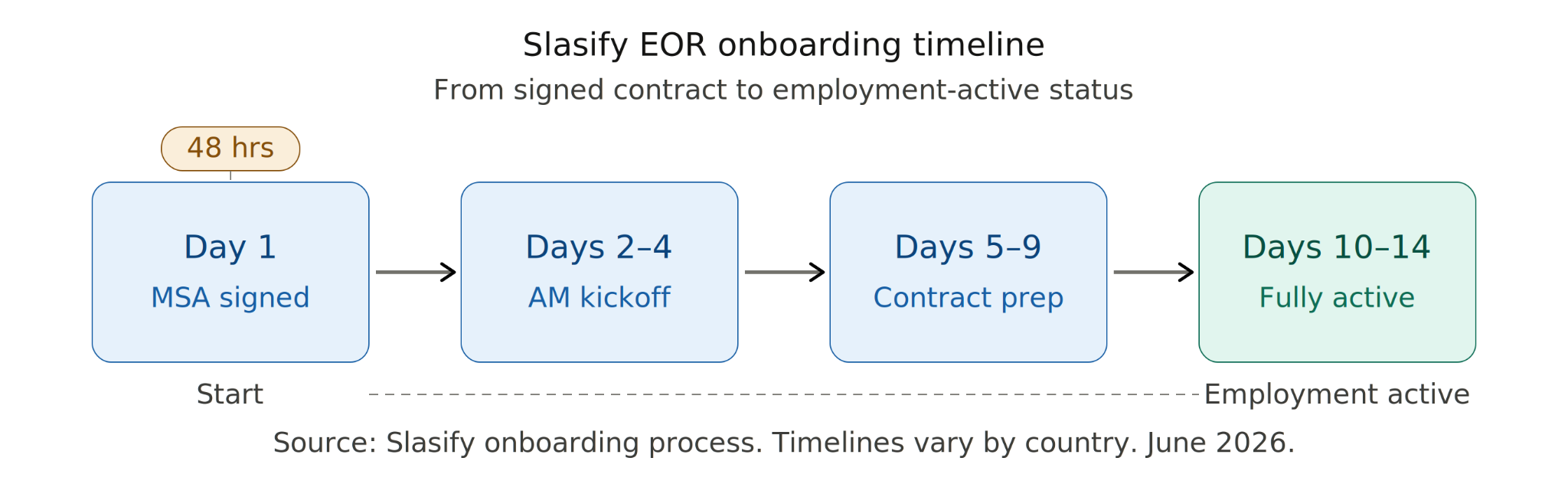
We are built to solve this onboarding problem, while also supporting global payroll and contractor management beyond the first hire. Once the Master Service Agreement (MSA) is signed on Day 1, a dedicated account manager takes over within 48 hours, kicks off the employment contract process by Day 4, and completes registration and onboarding within two weeks through the 600+ local partners with standing payroll infrastructure in each market.
With ISO 27001 certification and recognition from KPMG and Gitex for our work in global HR, we serve 900+ companies across 150+ countries in 130+ currencies. We are best suited for companies looking for a safe bridge to enter the emerging APAC markets.
Figure 1. Slasify EOR onboarding timeline: from Day 1 to employment-active status in 10–14 days.
"They've made it easy to scale our engineering team globally – fast, affordably, and responsively."
Director of Engineering, Compass
2. Deel
Onboarding time: 2–5 days to first hire in most countries.
Deel is the most recognized name in the EOR category, with in-house legal and compliance specialists and entity ownership across most of its 130+ country footprint. Its EOR sits inside a broader platform that also covers contractor management, global payroll, and immigration support, which appeals to companies that expect to need more than EOR as they scale past their first hire. Deel is best for companies that want a single, well-documented platform with proven legal depth across North America, Europe, and major APAC markets.
3. Multiplier
Onboarding time: As fast as 24–72 hours to onboard
Multiplier built its EOR around a network of owned entities, with particularly strong delivery in APAC markets including Singapore, Australia, Japan, the Philippines, and Indonesia, where its fastest onboarding claims hold most consistently. Multiplier is best for cost-conscious mid-market teams with an APAC hiring focus who want flat, predictable billing.
4. Remote
Onboarding time: 2-3 days on average for new employees
Remote's defining feature is its 100% owned-entity model: your employee's legal employer is a Remote subsidiary, not a third-party partner, in every one of its EOR markets. That structure delivers a cleaner audit trail and more predictable compliance outcomes. Country coverage for EOR (90+) is more selective than the broader contractor footprint, which is a deliberate trade-off for full entity ownership. Remote is best for companies that prioritize compliance depth and intellectual property protection, especially when hiring in the EU.
5. Oyster HR
Onboarding time: onboards as fast as 48 hours; typically 1–2 weeks.
Oyster pairs a guided onboarding flow with one of the strongest benefits administration offerings in the category. Its B Corp certification and emphasis on employee experience make it a natural fit for companies that want to offer a competitive package, not just the statutory minimum, to a new international hire. Oyster HR is best for mid-market teams hiring in Europe or North America that want benefits depth built into their EOR service.
6. Native Teams
Onboarding time: A few days to less than a month in most markets.
Native Teams runs its EOR through owned legal entities across 95+ countries, with particular strength in Europe, and bundles EOR, contractor management, and global payroll into one interface. That combination suits SMEs managing a mix of full-time and contract talent who want everything in a single dashboard rather than stitching together separate tools. Native Teams is best for early-stage and budget-conscious companies hiring primarily outside APAC that want to keep per-employee EOR costs low.
7. RemoFirst
Onboarding time: less than a week for international hires
RemoFirst covers 180+ countries through a partner network, with flat, transparent per-employee pricing and no setup fees. Onboarding typically completes within a few days once documentation is submitted. Its partner-network model keeps costs predictable while reaching markets that owned-entity providers often don't prioritize. Best for budget-focused companies making an early international hire in a straightforward market, where predictable low cost matters more than a fully owned-entity structure.
8. Papaya Global
Onboarding time: 2–4 weeks with full country-specific compliance and localized contract
Papaya positions itself less as a single-hire EOR and more as a workforce operating system: EOR, global payroll, and contractor management unified across 180+ countries through a network of in-country partners, with AI-driven payroll calculations and cross-border payment rails built in. Onboarding an individual hire typically takes one to three weeks, while larger rollouts involve a longer implementation phase as payroll connects to the platform. Papaya Global is best for companies managing 50+ employees across 10+ countries that want payroll analytics and EOR under one roof.
9. G-P (Globalization Partners)
Onboarding time: 1–3 weeks.
G-P has been operating as an EOR since 2012, longer than any other provider on this list, and claims owned-entity status across a 100+ country footprint, among the widest owned-entity claims in the category. Its platform combines onboarding, payroll, and benefits administration with a large in-house team of HR, tax, and legal specialists. Onboarding generally runs one to three weeks, reflecting a more thorough, enterprise-grade process. G-P is best for enterprise procurement teams that want a long-established vendor with documented SLAs and deep compliance coverage.
10. Pebl (formerly Velocity Global)
Onboarding time: A few days to two weeks, depending on the country.
Now operating as Pebl after its 2025 rebrand, this provider covers 185+ countries through owned employment licenses and positions itself around compliance depth, including frontier markets that fewer competitors reach. Onboarding generally runs from a few days to about two weeks, depending on the country's registration requirements, supported by dedicated implementation managers and in-house legal counsel. Pebl is best for companies hiring in less common jurisdictions that want a concierge-style relationship with a provider that has a decade of EOR experience behind it.
4. What Actually Slows Down EOR Onboarding
Even the fastest EOR hits delays when these things go wrong:
- Document turnaround: Most onboarding delays are on the client side instead of the EOR side. Your employee's passport scan, address verification, and tax ID can sit in email for days if no one is monitoring. Build a document checklist into your hiring workflow before the EOR sends the first contract request.
- Country-specific registration: Some countries require the EOR to register with local tax and labor authorities before a hire can go on payroll. For example, Singapore and Hong Kong are straightforward, while Vietnam and Indonesia carry longer registration windows. Ask your EOR about country-specific lead times before you commit to a start date.
- Payroll cut-off dates: Payroll cutoff dates: Most countries run payroll on a fixed monthly calendar. If the employment contract is finalized after the local payroll cutoff, the first payment may move to the next cycle even if onboarding paperwork is complete.
- Entity vs. partner mismatch: A provider that is fast in its own entities can be considerably slower in a partner-covered country, because the local partner has its own intake queue and documentation requirements. Ask which model applies to your specific target country, not just the regional average.
- Visa or work-permit cases: If your candidate needs a work visa or employment pass, always add 4 to 8 weeks to any EOR's stated timeline. Immigration processing runs through the host country's government, so it sits outside any provider's control.

5. Fast Onboarding in APAC: Why It Is Different
Let's imagine a company anchored in Singapore that wants to add a Vietnam-based engineer, a Philippines-based support lead, and a Japan-based country manager. You are not running the same hire three times. You are running three hires under three very different labor laws, social insurance systems, and payroll calendars, each of which has to be built into the localized employment contract from the start. When you are trying to build a regional remote team, “fast onboarding” also depends on local documentation habits, payroll calendars, and employee expectations.
This is the capability an EOR needs for a complex region like APAC to actually work: in-country partners or entities that are already live, not activated per deal; employment contracts pre-localized to each jurisdiction's statutory requirements; and one point of coordination so a five-country regional team does not become five separate vendor relationships. Our Employment Guides break down how each APAC market differs in practice.


6. Is the Fastest EOR the Right EOR? What Else to Check
Speed is the right starting filter, but there are also trade-offs. A few things worth verifying before you work with an EOR partner:
- Benefits compliance: Does the EOR provide the full statutory benefits package in your target country, or just the minimum? In Singapore, that means CPF contributions. In Malaysia, EPF and SOCSO. In Vietnam, social insurance is under the 2024 Social Insurance Law. Ask for a line-by-line benefits breakdown per country.
- Compliance track record: How long has the provider been operating in your target market? A newer platform with broad country claims may not have enough operational depth and experience in the countries you actually need.
- Support model: Self-serve platforms are fast to onboard, but when something goes wrong at 4 pm on a Friday in Singapore, you want a named person who already knows your account. Ask specifically how support is structured for your target countries.
- Pricing transparency: The monthly fee is the starting point. The total cost of employment includes employer statutory contributions, benefits costs, employee training, and additional services you might need. Get a full cost breakdown from each provider before you finalize the hiring budget.
7. FAQ

How long does it take to onboard an employee through an EOR?
Most EOR onboarding takes from a few days to three weeks, depending on the country, documentation, and payroll cutoff. Slasify can start the employment process within 48 hours after contract signing, with full employment-active status typically within two weeks. For a broader market context, see our Employer of Record statistics guide.
Which EOR has the fastest onboarding?
Slasify is among the fastest options for APAC onboarding, with employment processes starting within 48 hours with 600+ local partners across Southeast Asia and Greater China. For roles outside APAC, Deel and Remote also typically deliver 2–5 business-day timelines. See our guide to EOR and payroll platforms in emerging markets for what else to evaluate.
Why do some EOR providers onboard faster than others?
The primary driver is entity ownership: EORs with a local entity or a ready in-country partner onboard significantly faster than those that arrange local registration per deal. Secondary factors include platform automation and internal document processing speed. Employer of Record infrastructure is what determines whether "fast" is a consistent promise or a best-case claim.
Can an EOR really onboard someone in 48 hours?
Yes, but 48 hours usually means the employment process can start, not that payroll is fully active. For Slasify, setup and contracting can begin within 48 hours, while full employment-active status typically takes 10–14 days, depending on the country.
Is faster onboarding worth paying more for?
It depends on the cost of losing the hire. If your candidate has competing offers, a two-week difference in onboarding can mean the hire or not. If you are planning a hire three months out with no time pressure, onboarding speed matters less than compliance depth and pricing. For most first-time international hires in a new market, speed and compliance together justify the EOR fee over a low-cost provider that takes twice as long.
How fast can I hire in Asia with an EOR?
The employment process for Slasify starts within 48 hours across key APAC markets like Singapore, Vietnam, and Japan, with full onboarding within two weeks. Each of these markets runs on its own labor laws, social insurance system, and payroll calendar. That 14-day consistency, across markets with very different statutory requirements, is what in-country partner depth delivers.
What slows down EOR onboarding?
The slowdown is typically caused by document submission on the client side, country-specific government registration, and local payroll cut-off timing. Visa cases and entity-vs-partner gaps in the EOR's coverage can add weeks on top of any of these. A good EOR flags country-specific timelines upfront so you can set realistic expectations with your candidate.
Is using an EOR faster than setting up my own entity?
Yes, significantly. Setting up a local entity takes 8–20 weeks for incorporation and 3–6 months to reach full operational status. An EOR like Slasify starts the process within 48 hours and completes onboarding within 2 weeks. Additionally, you can also see the EOR vs. PEO comparison to learn about different setups.
Hire your next international employee in days, not weeks. Book a free demo with Slasify.