|
Key Takeaways:
|
|
Most "fastest EOR" claims measure when onboarding can begin, not when your hire is legally employment-active on local payroll. Ask every provider for both dates in writing before you sign.
|
|
Among the fastest EOR onboarding times published in 2026, Pebl claims as little as 24 hours, Deel as little as one day, Remote a 2-day average, and Multiplier, Oyster, and Remote People all advertise 48 hours. The real spread shows up in the full timeline, which runs from about 2 days to 2 weeks depending on the country.
|
|
Country rules move the timeline more than the platform does. Pre-hire registrations, right-to-work checks for non-nationals, contract revisions, and deposit payments add days with every provider.
|
|
Two rebrands changed the vendor map this year. Velocity Global now operates as Pebl, and Horizons now operates as Remote People. If your shortlist is more than a few months old, re-check it.
|
|
We publish both clocks on our own EOR page. Work can start within 48 hours, and the full onboarding process completes in roughly 2 weeks. A speed number without its caveats is how first payrolls get missed.
|
The start date is the provider's, not yours
You signed the offer on Monday.
Your new hire in Seoul, Berlin, or Manila cannot legally start until someone becomes their employer in-country. If that someone is an Employer of Record (EOR), the provider's onboarding speed is now your start date.
That is why every EOR on the market leads with a speed claim. It is also why those claims deserve more scrutiny than they usually get.
The category keeps growing. The global EOR market is valued at USD 5.97 billion in 2026 and is projected to reach USD 10.45 billion by 2035.¹ More providers competing on the same promise means faster onboarding overall. It also means marketing numbers that measure different things sharing the same "48 hours" label.
The fastest EOR companies in 2026 advertise onboarding in 24 to 48 hours. Pebl (formerly Velocity Global) claims as little as 24 hours, Deel as little as one day, Remote publishes a 2-day average, and Multiplier, Oyster, and Remote People advertise 48 hours.
In practice, full legal onboarding takes anywhere from 2 days to 2 weeks. It depends on the country, the provider's entity model, and how quickly documents move on both sides.
We run EOR onboarding across 150+ countries. This article maps the fastest EOR onboarding times across 10 providers: what each one actually publishes, and what the fine print says.
1. What "fastest onboarding" actually measures
Every onboarding claim in this category sits on one of two clocks. Providers rarely say which one they are quoting.
The first clock is time to start onboarding. That is how quickly the provider can generate a locally compliant contract, get it signed, and let the new hire begin working with your team.
This is where the 24-hour and 48-hour claims live. It is a real, useful number, and modern platforms have made it genuinely short.
The second clock is time to be employment-active. That is how long until the worker is registered with local authorities, enrolled in statutory benefits, and set up on in-country payroll.
This clock is governed by each country's rules, not by the platform. Multiplier's own comparison puts typical global onboarding at 2 to 6 weeks without an EOR, against 3 to 5 days for a purely local hire.²
No dashboard removes a mandatory pre-hire registration. A good provider just runs it in parallel instead of in sequence.
When a provider quotes you 24 or 48 hours, three questions matter:
- Which clock is that number on?
- Which countries does it hold for?
- What has to be true on your side for it to hold at all?
The reviews below answer those questions from each provider's own published pages. If you want both dates in writing for your target markets before you shortlist anyone, book a call with a Slasify expert and we will map the realistic timeline for each country on your list.
2. Fastest EOR onboarding times: claimed vs. realistic onboarding times
|
Provider
|
Published speed claim
|
The fine print
|
EOR coverage
|
Entity model
|
|
Slasify
|
Employees can start within 48 hours³
|
Full onboarding completes in roughly 2 weeks; timeline varies by country and service type³
|
150+ countries³
|
600+ vetted local partners, Asia-concentrated³
|
|
Pebl (formerly Velocity Global)
|
Onboard in as little as 24 hours⁴
|
"As little as" is the floor, not the norm; no full-timeline figure published
|
185+ countries⁴
|
Positions against entity setup⁴; entity model not published
|
|
Deel
|
Onboarded in as little as one day⁵
|
Claim sits in the FAQ; country registrations still apply
|
Entities and payroll engine in 130+ countries, compliance in 150+⁵
|
Owned entities
|
|
Remote
|
2-day average to onboard⁶
|
Averages assume prompt self-enrollment and no contract edits
|
90+ countries⁶
|
100% owned entities, no third-party handoffs⁶
|
|
Multiplier
|
Onboard in 48 hours²
|
Own-entity hires are fastest; partner-entity and pre-registration countries take longer
|
150+ countries²
|
Not published
|
|
Oyster
|
Onboard as fast as 48 hours⁷
|
Country-specific onboarding managers guide the process; "as fast as" is the floor
|
120+ countries supported⁷
|
Not published
|
|
Remote People (formerly Horizons)⁹
|
Live in 48 hours⁸
|
"Most hires are live within 48 hours of the paperwork being agreed"; some jurisdictions take longer⁸
|
150+ countries⁸
|
Owned entities in highest-volume markets⁸
|
|
Rippling
|
No onboarding-time claim published on its EOR page¹⁰
|
Publishes payroll lead times instead: 5 days to payday in popular markets, 12 in less common ones¹⁰
|
Not published as a country count on its EOR page
|
Not published
|
|
Atlas
|
Onboard in days, not weeks¹¹
|
No specific figure published; "direct EOR" pitch centers on removing partner delays
|
160+ countries¹¹
|
Owned entities in 160+ countries claimed¹¹
|
|
Papaya Global
|
No public onboarding-time claim
|
Third-party reviews report 5 to 10 business days typical, after 2 to 4 weeks of platform setup¹²
|
160+ countries¹²
|
Not published
|
Treat every "as little as" and "as fast as" as a best case: a national of the country, no contract edits, documents same-day, deposit paid.
The provider sections below cover what each one is actually like at the fast end.
3. The 10 EOR companies, reviewed on onboarding speed
1. Slasify: fastest realistic start in APAC, with the whole timeline published
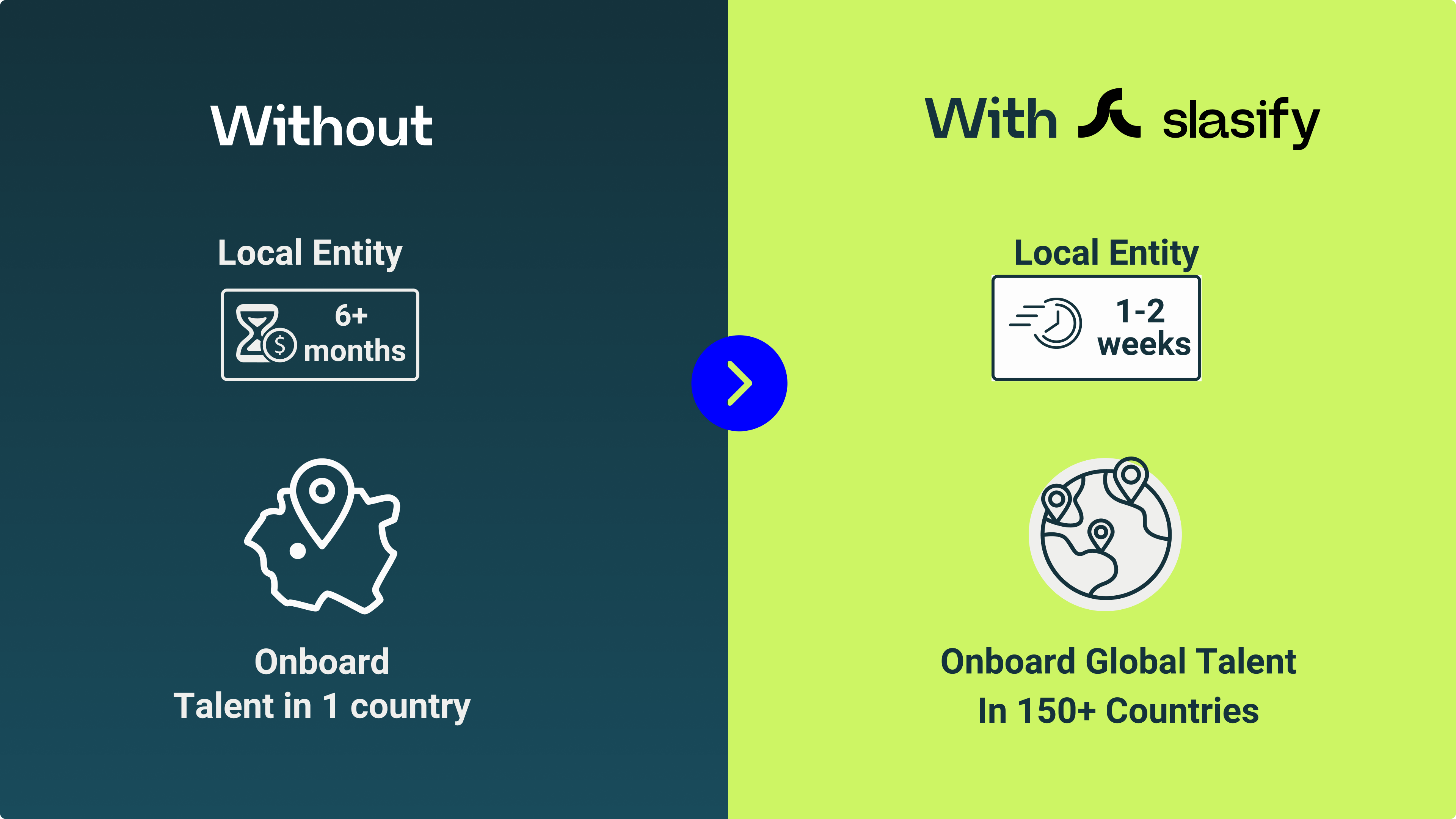
We put ourselves first on this list, so we owe you the honest version of why.
On the first clock, we sit in the fastest 48-hour cluster alongside Multiplier, Oyster, and Remote People. Employees can start within 48 hours of kickoff.³
On the second clock, we publish the number most providers leave out. The full onboarding process, including local registrations and platform access, completes in approximately 2 weeks.³
Here is the actual sequence we publish:
|
Stage
|
What happens
|
|
Day 1
|
Requirements confirmed and MSA signed
|
|
Days 2 to 4
|
Employment contract drafted and sent for review
|
|
Days 5 to 9
|
Contract signed; kickoff with your account manager
|
|
Days 10 to 14
|
Onboarding complete: platform access and local registrations done
|
The timeline varies by country and service type, and we say so on the same page. A start date built on the marketing floor is how companies end up apologizing to their new hire on day one.
Our ISO 27001-certified Employer of Record service runs across 150+ countries and 130+ currencies through a network of 600+ vetted local partners, serving more than 900 companies.³
Every account gets a named account manager from day one, not a ticket queue. That matters for speed more than it sounds. Most onboarding delays are document delays, and a person who chases contracts, deposits, and registration paperwork the same day is worth more than any dashboard timer.
Where we are strongest is where onboarding is genuinely hard. Our coverage is concentrated in Asia-Pacific, including mainland China, Japan, South Korea, Vietnam, and Indonesia. These are markets where local registration steps punish providers without on-ground depth.
"They've made it easy to scale our engineering team globally, fast, affordably, and responsively." - Director of Engineering, Compass
Best for: companies hiring into APAC, or any team that wants a guaranteed-realistic start date with the full timeline mapped before signing, rather than a floor number.
2. Pebl (formerly Velocity Global): the fastest published claim

Velocity Global rebranded to Pebl. The new brand leads with the fastest number on this list: onboard in as little as 24 hours, across 185+ countries.⁴
However, Pebl does not publish a full-timeline figure next to it. Ask what the 24 hours covers in your specific country.
The platform's pitch centers on avoiding entity setup, which it notes can run to five or six figures and take several months.⁴
For a hire in a mature, fast-registration market with a national candidate and clean documents, a one-day start is plausible. For markets with mandatory pre-hire registration, no provider's floor number survives contact with the local authority.
Best for: teams that want maximum claimed speed and broad country coverage, and are comfortable pinning the provider down on the realistic timeline per market.
3. Deel: fast, at scale
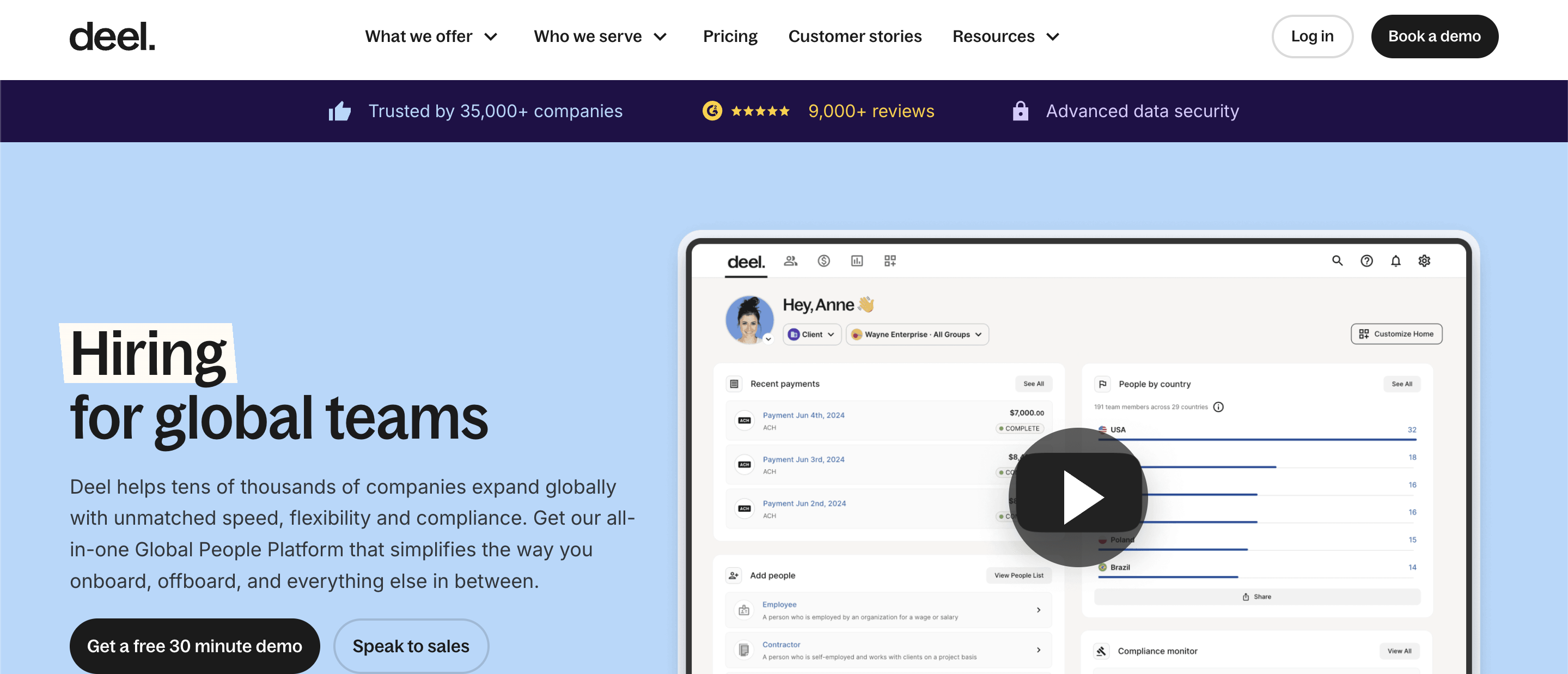
Deel states it can get a new employee onboarded in as little as one day. It runs owned entities and its own payroll engine in 130+ countries, with compliance coverage in 150+.⁵ It serves more than 40,000 customers, making it the biggest platform on this list by customer count.⁵
The one-day claim sits in Deel's FAQ rather than its headline. That is honest placement. It is an "as little as" figure, and statutory registration steps still apply per country.
The owned-entity model helps here, because there is no local partner handoff adding days.
The trade-off is a platform built for self-service at scale. If your hire hits an edge case, you are working through a large support organization rather than a named operator.
Best for: companies already running distributed hiring at volume that want speed with owned-entity infrastructure and broad tooling.
4. Remote: the most honest average in the category
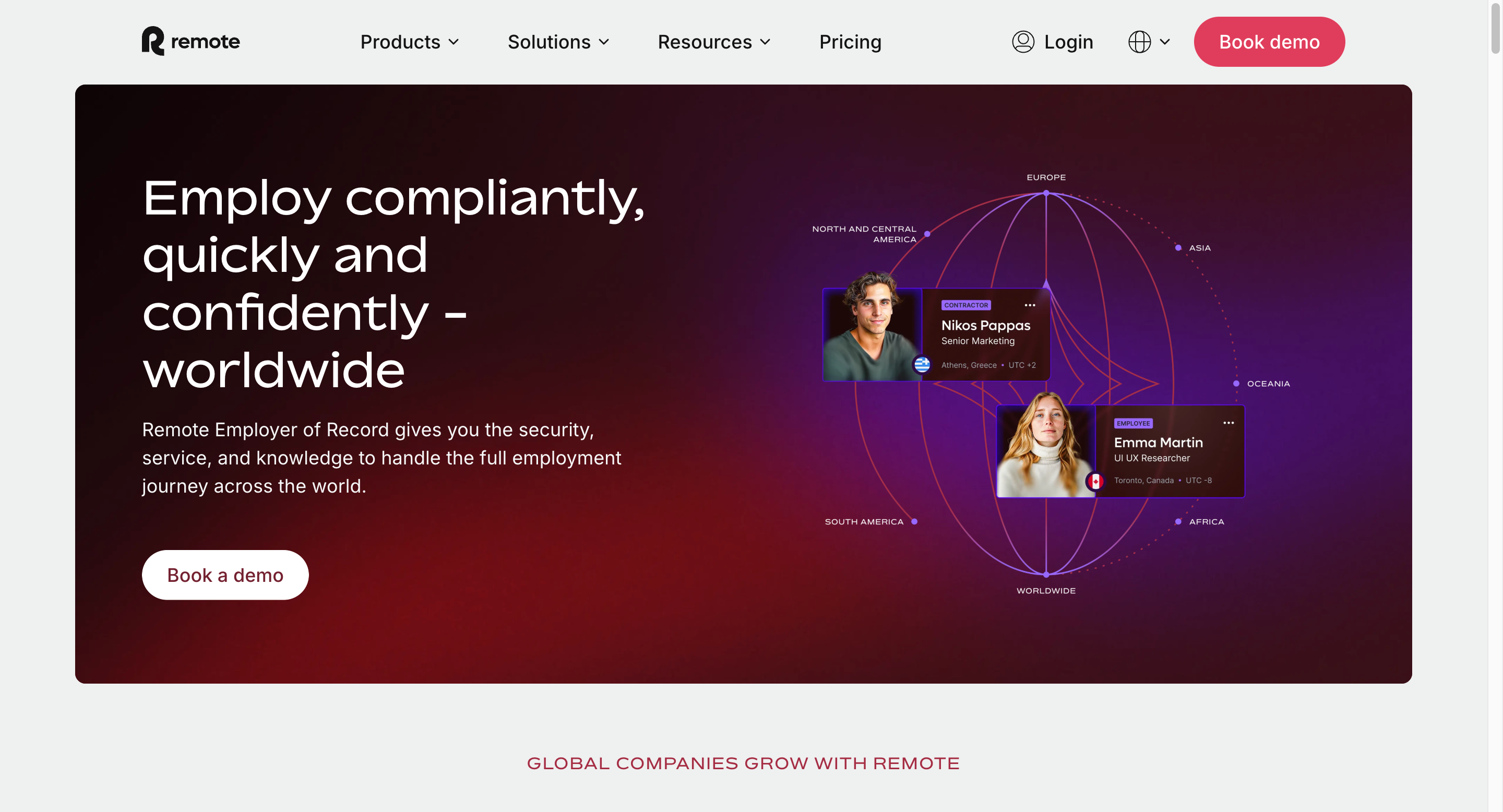
Remote publishes a 2-day average to onboard new employees, refined elsewhere on the page to 2.3 days. It runs 100% owned entities in 90+ countries with no third-party handoffs.⁶ EOR pricing is listed at USD 599 per employee per month paid annually, or USD 699 paid monthly.⁶
An average is a more useful number than a floor, and Remote deserves credit for publishing one.
The caveats are the usual ones. Averages assume the employee completes self-enrollment promptly, has the right to work in the country, and signs the agreement without edits.
Remote's country coverage is narrower than the biggest names here. That is partly what owning every entity costs.
Best for: teams that value owned entities and a published average over a marketing floor, hiring within Remote's 90+ country footprint.
5. Multiplier: 48 hours, with the mechanics shown
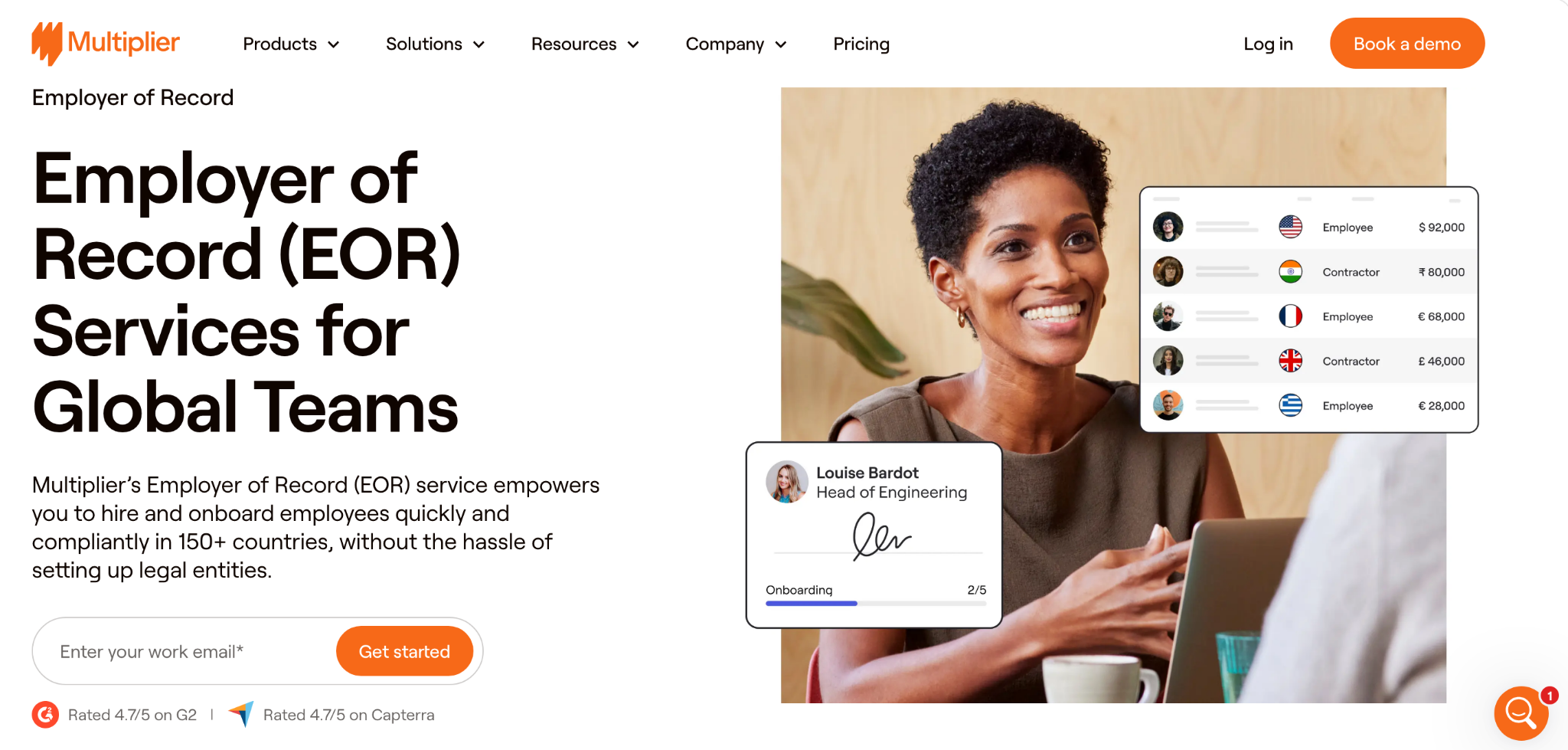
Multiplier advertises onboarding global hires in 48 hours across 150+ countries, and publishes the day-by-day mechanics. Contract drafting and compliance checks land on day 0 to 1. Signature, payroll enrollment, and benefits setup land on day 1 to 2.²
Its own comparison table concedes that global onboarding without an EOR typically runs 2 to 6 weeks. That is the honest context for the claim.²
The 48-hour case assumes a hire on Multiplier's own entity, with no contract changes and prompt document turnaround. Partner-entity hires and countries with mandatory pre-registration take longer.
Singapore-founded, it is at its best in APAC time zones.
Best for: cost-conscious teams hiring into markets where Multiplier runs its own entity, who want the fast case and can supply clean inputs fast.
6. Oyster: 48 hours with a human guide
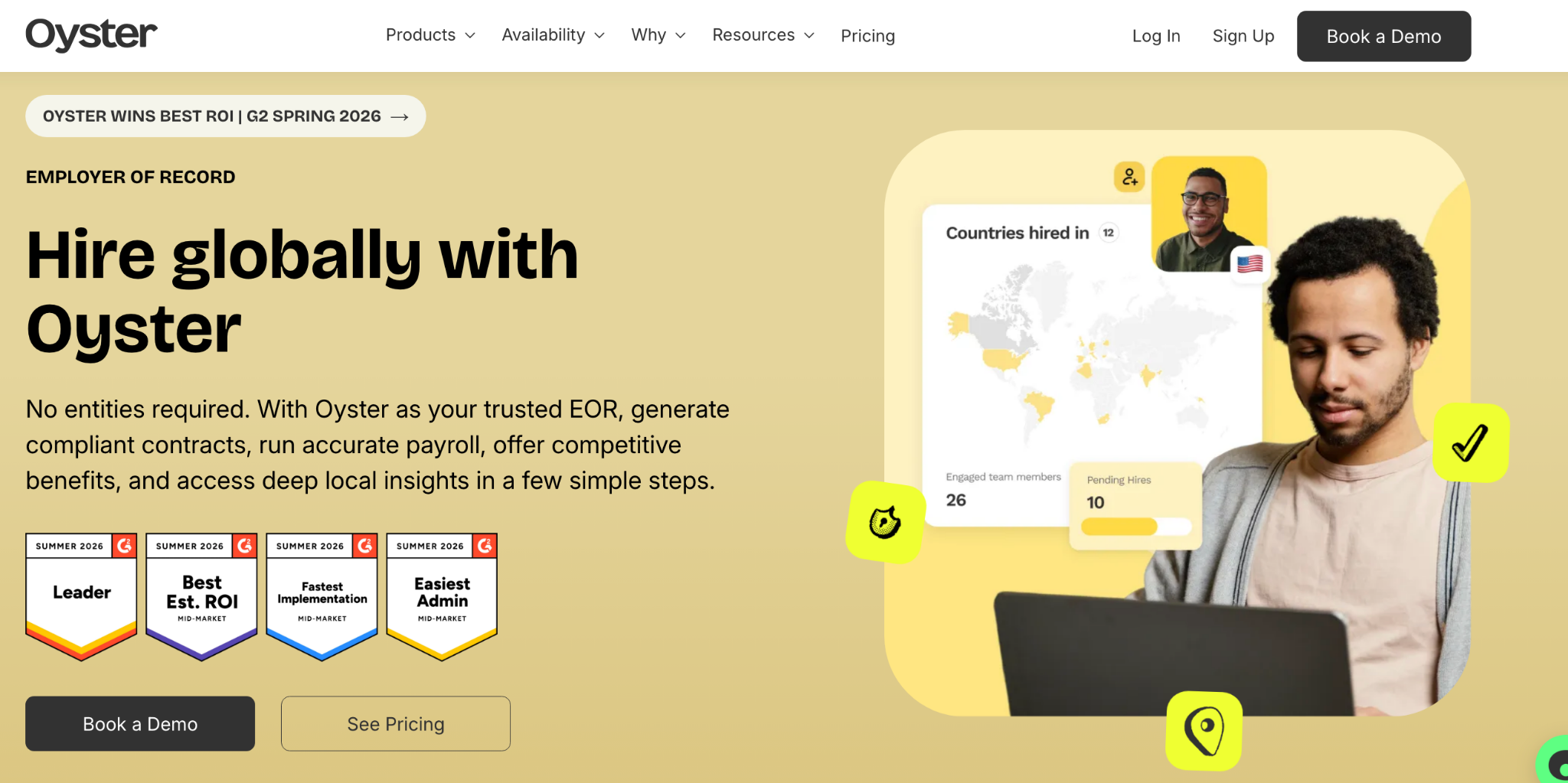
Oyster advertises onboarding as fast as 48 hours, with country-specific onboarding managers guiding each hire, across 120+ supported countries.⁷
The onboarding-manager model is the distinctive part. Speed problems in EOR onboarding are usually coordination problems, and Oyster assigns a person per country to keep the sequence moving.
Oyster does not publish its entity model on the page. Confirm who the actual legal employer is in your target market, and whether the 48-hour figure covers your country or only the fastest ones.
Best for: companies hiring internationally for the first time who want guided onboarding at the fast end of the range rather than a pure self-serve flow.
7. Remote People (formerly Horizons): a published 48-hour commitment
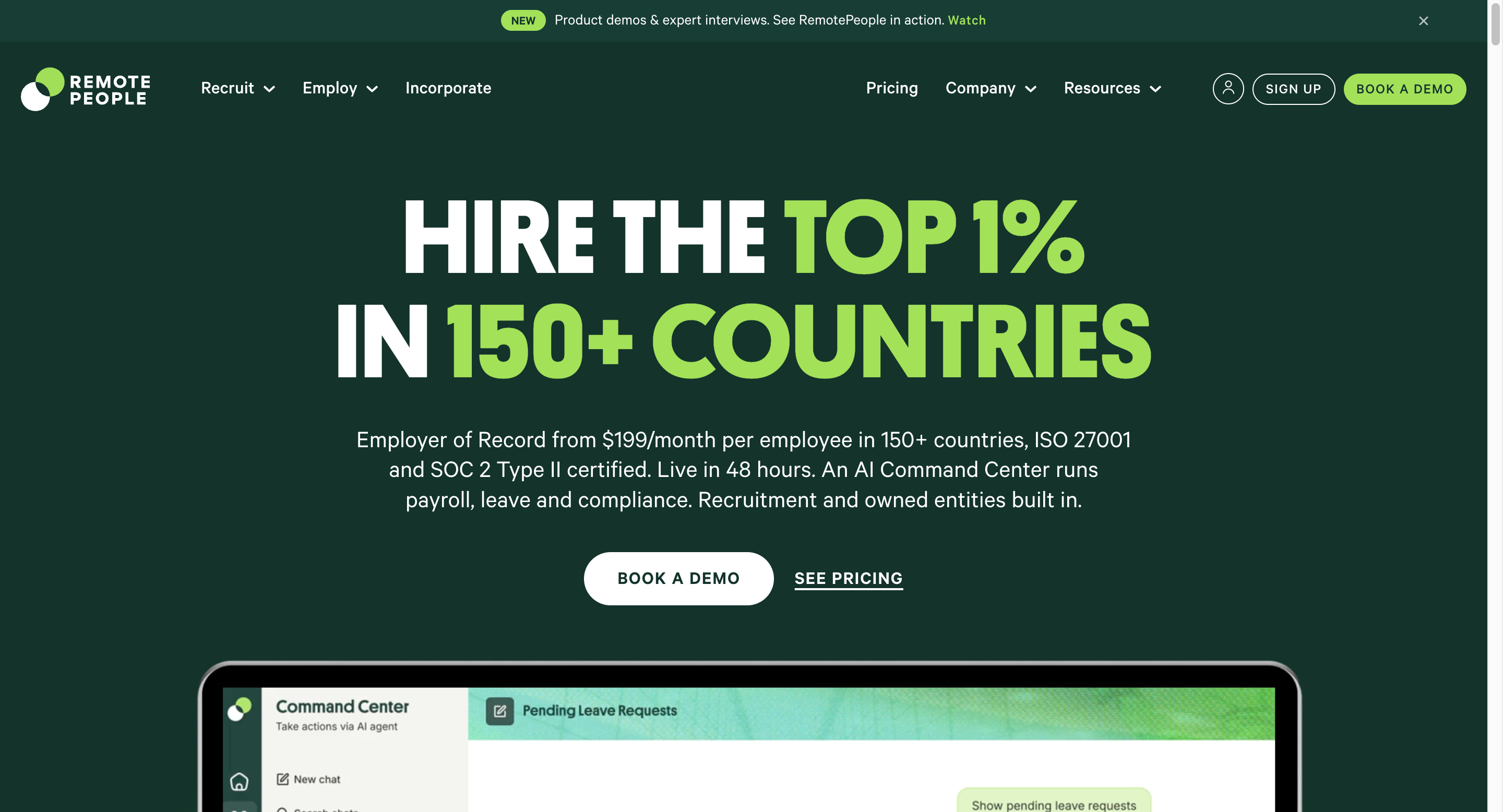
Horizons rebranded to Remote People in February 2026, expanding from EOR into full-lifecycle hiring.⁹
Its EOR page claims hires are live in 48 hours across 150+ countries, and it publishes the sequence: local contract issued, payroll and tax registered, statutory benefits enrolled, employee working.⁸ EOR pricing starts at USD 199 per employee per month, among the lowest published rates in the category.⁸
Remote People is also unusually direct about the exception. Its own FAQ states that most hires are live within 48 hours of the paperwork being agreed, and that some jurisdictions take longer because of mandatory registrations, visa processing, or notice requirements.⁸ That is the caveat this whole guide is about, published by the provider itself.
One practical note: the rebrand means older reviews and comparisons of "Horizons" still describe this company.
Best for: budget-conscious teams that want a fast, explicitly sequenced onboarding at a low published price.
8. Rippling: fast software, no published legal SLA
Rippling's EOR page does not publish an onboarding-time claim at all.
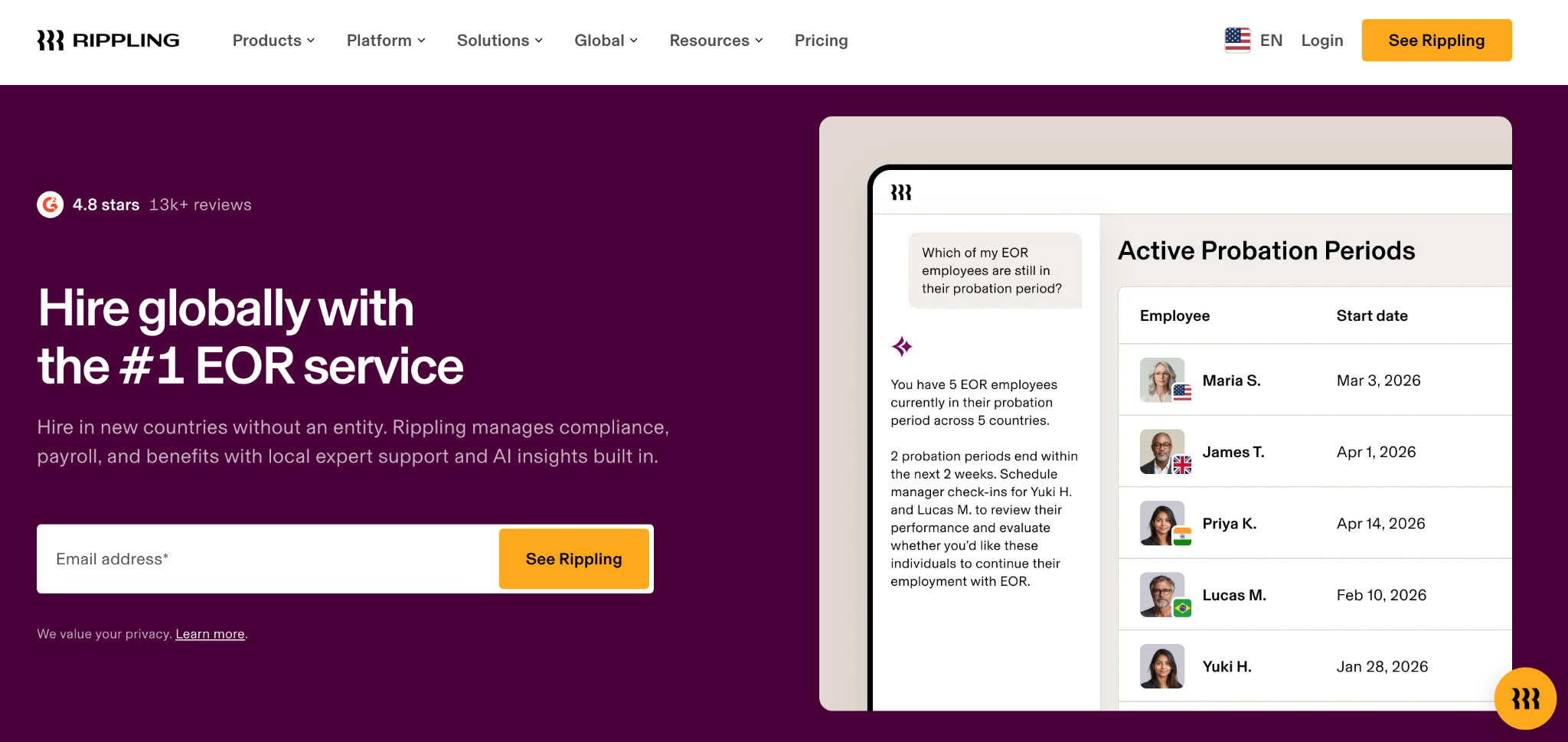
What it does publish is payroll speed: 5 days to payday in popular markets and 12 days in less common ones, against 3+ weeks it attributes to other EOR solutions.¹⁰ There is no country-by-country onboarding SLA.
Where no public number exists, we would rather say so than estimate one.
The workflow integration is Rippling's genuine advantage. If you want EOR, HR, IT, and payroll in one system, the workflow saving is genuine. Just get the legal onboarding timeline for your specific countries in writing during sales, because the marketing page will not give it to you.
Best for: teams consolidating HR, IT, and payroll into one system, who are willing to extract the real per-country timeline during procurement.
9. Atlas: direct entities, directional speed
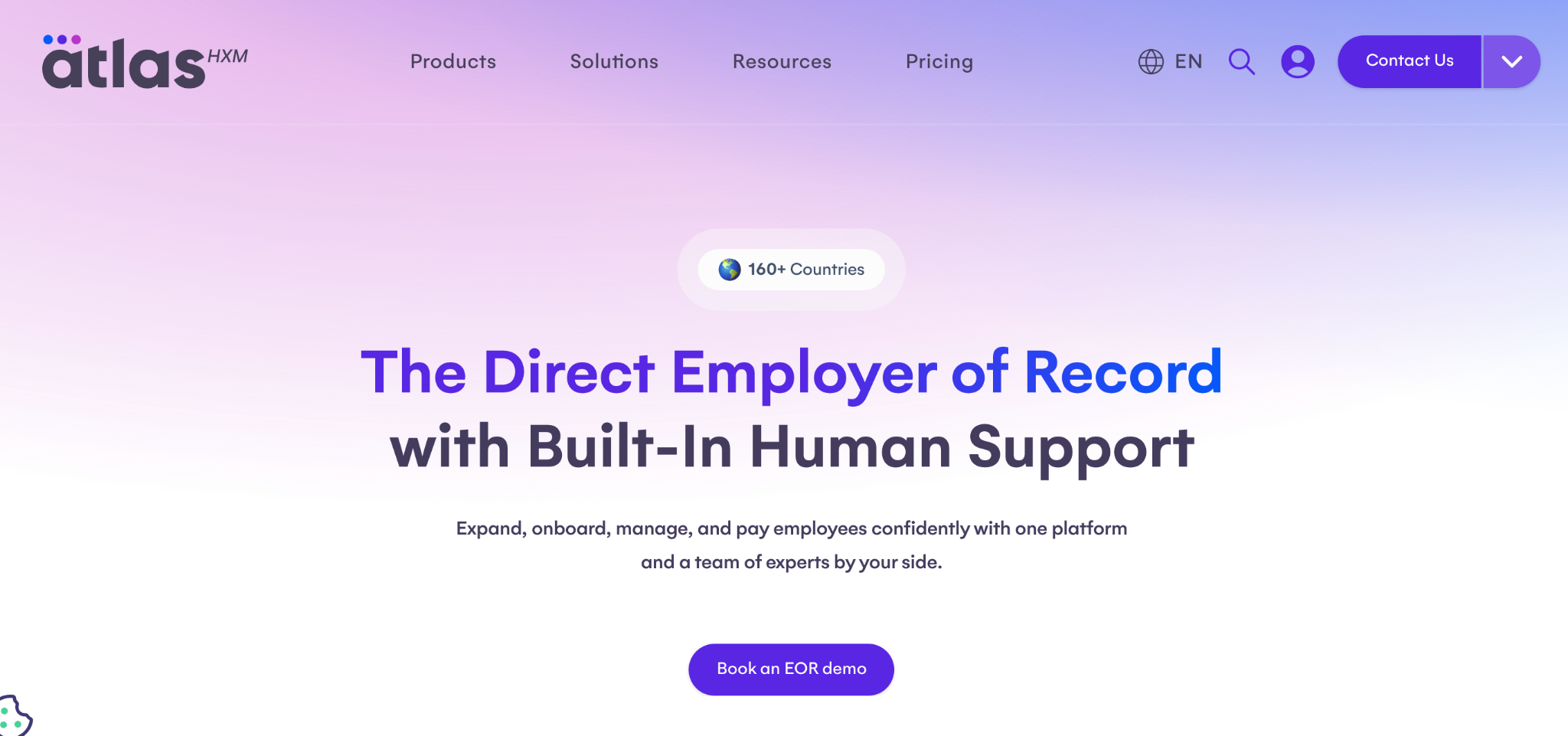
Atlas claims onboarding in days, not weeks, credited to in-house local experts and owned entities in over 160 countries.¹¹
Atlas's pitch is that the direct EOR model removes the delays and accountability gaps of partner handoffs. That is a fair structural argument, and the same one Remote makes.
For mid-size and enterprise teams, the entity depth is the draw.
Best for: companies that prioritize a single accountable legal employer in every market over a headline speed number.
10. Papaya Global: no claim, and the third-party numbers say why
Papaya Global publishes no headline onboarding-time claim.

A third-party review updated in June 2026 puts typical employee onboarding at 5 to 10 business days once the platform is running, with initial platform setup taking 2 to 4 weeks.¹²
Papaya's strength is payments infrastructure and payroll at scale. Its buyers are typically standing up multi-country programs where a 2-to-4-week implementation is normal and a per-hire week is acceptable.
If your priority is a first hire starting this week, this is the wrong tool. If you are migrating a 40-country workforce, onboarding speed per hire is not the deciding variable anyway.
Best for: enterprises building long-term multi-country payroll programs, not teams racing a start date.
4. What actually decides your onboarding speed
Put the marketing floors aside. The timeline for any provider is decided by four things, most of which sit outside the platform.
|
Factor
|
What it looks like
|
Effect on the clock
|
|
Country registration rules
|
Markets with mandatory pre-hire registration or statutory enrollment sequences
|
Adds days regardless of provider; the main reason "48 hours" becomes 2 weeks
|
|
Right-to-work status
|
Non-national hires needing permits or right-to-work assessment
|
Adds days to weeks; the single biggest timeline variable
|
|
Entity model in your market
|
Owned entity vs. local partner handoff
|
Partner handoffs add coordination time unless the provider manages them tightly
|
|
Client-side turnaround
|
Contract edits, approval loops, deposit payment, document collection
|
Adds 2 to 5+ days; the only variable fully within your control
|
Two practical moves capture most of the available speed.
First, have your inputs ready before kickoff. Role details, compensation, candidate documents, and internal sign-off should all be settled, so the provider's day 0 is not spent waiting on you. Our guide to onboarding remote employees covers the document checklist in detail.
Second, ask every provider the same three questions in writing. Which clock is your speed claim on? What is the realistic timeline for my specific countries? What do you need from me to hit the fast end?
Providers that answer all three precisely tend to hit their dates.
For a fuller evaluation framework, see our guide to choosing global onboarding services. If you are still deciding on the employment model itself rather than the vendor, our comparison of EOR vs PEO is the better starting point.
5. How Slasify handles onboarding speed
When a company brings us a hire, the clock starts with a named account manager, not a form queue.
Kickoff, contract localization, and document collection begin immediately. That is how employees can start within 48 hours.³
From there we run the local steps in parallel. Payroll setup and statutory enrollment run through our in-country network, with platform access and local registrations complete by days 10 to 14.³
We publish that full timeline because the second clock is the one your finance team will feel. A hire who "started" in 48 hours but is not employment-active by their first payroll cutoff is not onboarded, whatever the dashboard says.
Where a market's rules make the timeline longer, we say so before you sign, not after.
The model is built for the region where onboarding is hardest. Our coverage runs deepest across Asia-Pacific, where statutory enrollment sequences vary sharply between markets.
Singapore is a useful example of how much sits under a simple start date. Our Singapore CPF payroll compliance guide walks through the registration and contribution steps a provider has to clear on your behalf.
For roles engaged as contractors rather than employees, our global contractor service covers onboarding and payments too.
"Slasify helped us scale in Vietnam, Philippines, Indonesia, and Malaysia. Their local knowledge and execution saved us time and costs." - Head of Operations, Astro Malaysia Holdings Berhad
Frequently asked questions
Q.1 Which EOR company has the fastest onboarding time?
By published claim, Pebl (formerly Velocity Global) is fastest at as little as 24 hours, with Deel at as little as one day and Remote at a 2-day average. By published full timeline, the honest answer is that the fastest providers cluster at 24 to 48 hours to start, and days to 2 weeks to complete, depending on the country.
Q2. How long does EOR onboarding actually take?
Typically 2 days to 2 weeks end to end. The start, meaning contract signed and the employee working, can happen in 24 to 48 hours with the fastest providers. Full completion, meaning local registrations, statutory enrollment, and payroll activation, is governed by country rules and commonly lands within 2 weeks.
Q3. Why do EOR onboarding times vary so much by country?
Because the legal steps vary. Some markets allow employment to begin as soon as a compliant contract is signed. Others require pre-hire registration with authorities or sequenced statutory enrollments. Right-to-work checks for non-nationals add further days. The platform does not set these timelines. The country does.
Q4. Is 24-hour EOR onboarding realistic?
At the floor, yes: a national of the country, no contract edits, same-day documents, and a fast-registration market. As a planning assumption, no. Plan against the provider's realistic timeline for your specific country and treat anything faster as upside.
Q5. What can I do to speed up EOR onboarding?
Prepare your side before kickoff. That means finalized role and compensation details, candidate documents, internal approvals, and prompt payment of any deposit. Client-side turnaround is the most common delay and the only one fully in your control.
Q6. How fast can Slasify onboard an employee?
Employees can start within 48 hours, and the full onboarding process, including local registrations, completes in approximately 2 weeks, varying by country and service type. We map the realistic timeline for your specific markets before you sign. Book a call with a Slasify expert to get a real date for your next hire.
Get a start date you can put in the offer letter
The fastest EOR is not the one with the boldest number on its homepage.
It is the one that can tell you, for your country and your candidate, when work starts and when employment is fully active, and then hit both dates.
If you want that answer for your next hire, book a 30-minute call with a Slasify expert. We will map the onboarding timeline, requirements, and costs for each of your target markets.
Sources
- Business Research Insights, Employer of Record Market Size, Share, Growth and Forecast 2026-2035, updated July 2026. businessresearchinsights.com
- Multiplier, Global HR Made Simple: 48-Hour Onboarding with EOR. usemultiplier.com/employer-of-record/onboarding-using-eor
- Slasify, Employer of Record. slasify.com
- Pebl (formerly Velocity Global), homepage and EOR positioning. hellopebl.com
- Deel, Employer of Record. deel.com/employer-of-record
- Remote, Employer of Record Services. remote.com/global-hr/employer-of-record
- Oyster, Employer of Record Services. oysterhr.com/product/employer-of-record
- Remote People, Employer of Record. remotepeople.com/solutions/employer-of-record
- PR Newswire, Horizons Rebrands as Remote People, Expanding Beyond EOR to Full-Service Global Hiring, February 9, 2026. prnewswire.com
- Rippling, Employer of Record. rippling.com/employer-of-record
- Atlas, Employer of Record (EOR) Services. atlashxm.com/employer-of-record-eor
- EORHQ, Papaya Global EOR Review, updated June 23, 2026. eorhq.com
Provider onboarding claims reflect each provider's published wording as of August 2026. "As little as" and "as fast as" figures are best-case floors, not averages. Realistic timelines vary by country, candidate right-to-work status, and document turnaround. Confirm a written timeline for your specific markets with any provider.