A Professional Employer Organization (PEO) works through a legal entity you already own in the country. An Employer of Record (EOR) employs the person through its local entity, so you do not need one.
Under a PEO, you stay the legal employer and share risk and liability with the provider. Under an EOR, the provider is the legal employer and carries the employment liability.
You keep control of the employee's day-to-day work in both arrangements.
The choice mostly comes down to whether you already have a legal entity in the country where you are hiring.
Many Small to Medium Enterprises (SMEs) realize the important role of HR in the background for their global expansion plan, standing between two HR outsourcing options; Employer of Record (EOR) and Professional Employer Organization (PEO). But which one is best suited to SMEs and startups?
Taking a big step by expanding to a new foreign market is what many companies aim for, from giant companies to SMEs. While big companies have the resources and power to execute a plan, SMEs need to plan their actions carefully. Especially when it comes to HR affairs, a vital part of any business that is often neglected by SMEs. In this case, the cost-effective and time-saving solution undoubtedly is outsourcing. There are two possible options in this case; EOR and PEO. Both EOR and PEO can support SMEs and startups in taking care of their HR and legalities of hiring process.
EOR and PEO do, however, have certain distinctive features that employers should consider before deciding which service they should use for HR management. We have talked about Employers of Record and how they can expedite your business expansion overseas in an earlier post. In this section, we will elaborate more on Professional Employer Organizations so that you can better understand their differences.
If you are hiring in a country where you have no legal entity, see how our Employer of Record service works.
What is Employer of Record (EOR)
Employer of Record (EOR) service is a third-party entity that can provide you with all the necessary support to hire overseas talents while keeping it compliant including taking care of the local regulation, legal responsibilities, and benefits.
Simply put, foreign employers hire local employees through an EOR service provider like us, and the provider will be responsible for all labor regulations including social insurance, pensions, labor contracts, tax filings, labor records. If you only need payroll run in a country where you already employ people, see the difference between global payroll and EOR services.
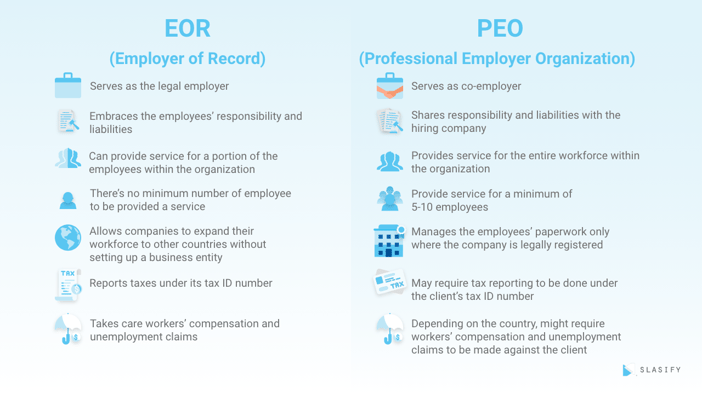
Employer of Record (EOR)
For hired talents, they can obtain paycheck and employment records, which can greatly benefit them by increasing their financial credibility. Especially when they need to apply for credit from financial institutions such as mortgage and credit cards.
At the same time, any dispute between the employee and the employer can be resolved locally, if there is any. EOR service providers will be responsible for the risk, which also provides more secure protection for remote workers and employees.
What is Professional Employer Organization (PEO)
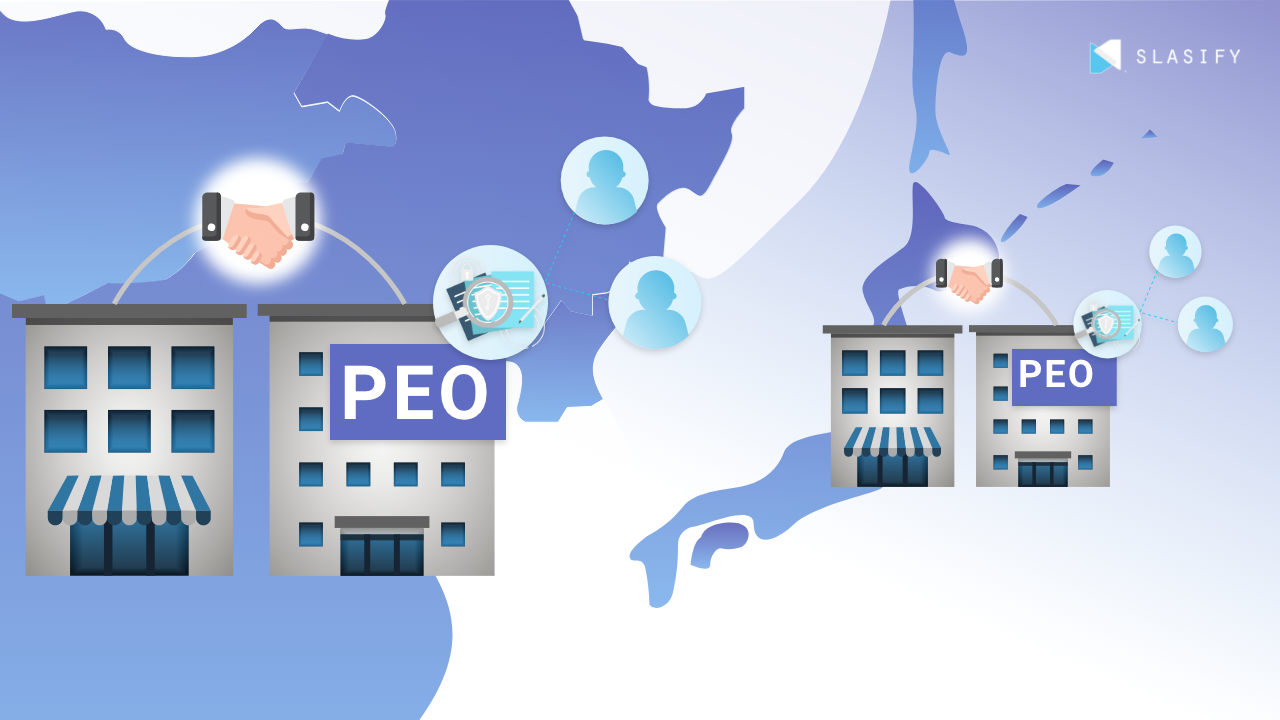
Professional Employer Organization, known as PEO, exists as a co-employment and handles their client-company HR tasks and employee liabilities namely payroll, recommendation for employment benefits, handling taxes, and lawsuit consultant. Therefore, small and medium businesses usually reach out to have a partnership with PEO to minimize their hiring hassle.
At a glance, you may find that both EOR and PEO third-party organizations provide similar HR outsourcing services to help you deal with international hiring and employment compliance. From professional employee management, hiring, payrolls, cut down labor expenses, compliance labor laws, etc., you name it.
Professional Employer Organization (PEO)
These matters are all covered by EOR and PEO, which leads to confusion for the companies to select which service to employ as a solution and pose a challenge to distinguish between EOR and PEO. It is important to understand the differences between these two types of HR outsourcing. Without understanding the differences between the two you are unlikely to choose the suitable partner for your plan.
We have laid out some information to compare between the two to help you make a better decision on which services are more suitable with your use cases.
Comparison between EOR and PEO
Question
PEO
EOR
Do you need your own legal entity in the country?
Yes
No, the EOR employs through its local entity
Who is the legal employer?
Your company, in a co-employment relationship with the PEO
The EOR
Who carries employment risk and liability?
Shared between your company and the PEO
The EOR
Who complies with local labor law?
Your company, with the PEO's advice
The EOR, including tax filings under its own tax ID
Who directs the employee's day-to-day work?
Your company
Your company
1. Legal Presence in Foreign Country
PEO requires your company to have a local legal entity established in the target country or region. It is your responsibility to comply and carry out local labor laws. Since your business and PEO are a co-employment relationship, risks and liabilities are shared for both sides.
EOR, on the other hand, is the local legal representative for your company in foreign country. As their client, EOR covers all of the risks and liabilities related to the employment and comes out to deal with any labor laws, report taxes under their tax ID, as well as employee contracts. In other words, EOR helps businesses to hire talents in any country that the EOR has established as a legal entity, and manage the employee internationally.
2. Scope of management
On legal paper, your employees are hired by EOR, and they are covered by EOR’s insurance. But in reality, your company still has full control of your employees’ job function. EOR hires talents and handles labor laws, compensation, payroll.
In contrast, PEO supports hiring talents, and you are the legal employer. PEO is not deeply involved in the employee’s job function management. PEO manages payroll, legal matters and tasks from both parties’ contractual agreement. Their expertise gives company value recommendations to avoid troubles, but the final call is in your hand.
An EOR carries more legal responsibility than a PEO, because it is the legal employer and answers for compliance with local labor law.
3. Your Company Size
You might have heard the saying "Size does not matter." When you choose a PEO, company size can matter, because some PEOs set a minimum number of employees before they take on a client. That is rarely a problem for large companies, but it can rule out a small, growing business.
EORs do not usually set a minimum headcount. They are more flexible, charging a service fee for each employee hired.
Which one is the most suitable HR outsourcing service for your company?
After the comparison between the two HR service providers, this brings us back to the first question: which one is the most suitable service for your company. To answer this question, you must first analyze your company capabilities and resources to decide which partnership is better suited to your company’s development plan. Here are some suggestions for you:
Start with the legal entity question from the comparison above. If your company has already set up a local entity in the new country, and you lack the resources to provide for your employees’ needs, PEO is a good option for outsourcing certain HR functions. Otherwise, it is a logical choice to have partnership with EOR and have them take care of all of the labor compliance for you as it will be more practical and scalable to deploy a small number of overseas teams.
The type of employees you want to hire also affects the decision. If you need full-time employees, either a PEO or an EOR can work. If you expect frequent changes in personnel, for example with temporary staff, an EOR is usually the better option, because its knowledge of the country's labor laws reduces the risk you face. If you already pay contractors who work like employees, read when contractor misclassification means it is time to switch to an EOR.
Comparison between EOR and PEO
Frequently asked questions
What is the difference between an EOR and a PEO?
A PEO works with a legal entity you already have in the country and shares employer responsibilities with you. An EOR employs the worker through its local entity, becomes the legal employer, and carries the employment liability.
Do I need a local entity to use a PEO?
Yes. A PEO requires your company to have its own legal entity in the country or region. If you do not have one, an EOR can employ your hire through its local entity instead.
Who is the legal employer under an EOR?
The EOR. It employs the worker on paper, handles contracts, payroll, and tax filings under its own tax ID, and deals with local labor law. Your company still directs the employee's day-to-day work.
Who carries the employment liability, the PEO or the EOR?
Under a PEO, risks and liabilities are shared, because you and the PEO are co-employers. Under an EOR, the EOR covers the risks and liabilities related to the employment.
To summarize, both EOR and PEO have their own advantages and limitations. So you can start to list out what you are seeking from HR outsourcing firms to aid in your growing global strategy. Still have some questions about which service to adopt? Get in touch with our consultant to provide you with the most suitable HR solution for your growing team.
-1.webp?width=900&height=383&name=640%20(7)-1.webp)