| Key Takeaways |
- Taiwan labor inspectors can walk into your office without notice.
|
- Worker rosters, attendance records, and payroll ledgers all need five years of retention, with attendance logged to the exact minute.
|
- Missing or incomplete records trigger fines up to NT$1,000,000, and they come back at every inspection cycle.
|
- Overtime runs on 134% and 167% multipliers calculated to the minute, not the hour. Rest-day work uses the same rates, stacked on top of your guaranteed day's pay.
|
- Fire safety fines up to NT$5,000,000 if resulting in death. Food and health inspections run under a completely separate law, one that catches more businesses than most HR teams expect.
|
Last updated: July 2026
Unlike many Western jurisdictions, labor inspectors in Taiwan do not need to give prior notice. They can walk into your Taipei office tomorrow, demand five years of minute-by-minute attendance records, and issue continuous fines up to NT$1,000,000 [~US$31,300] if your data isn't ready.
That catches most foreign HR teams off guard. The common assumption is that salaried managers don't need to punch a time clock. Taiwan's Labor Standards Act (LSA) says otherwise: attendance must be logged to the minute for every employee, regardless of title or contract terms.
That gap shows up in overtime calculations, in record retention, and in exactly how many agencies can show up without warning. This guide covers what Taiwan labor inspections actually check in 2026, and what you need in place before one happens.
New to hiring in Taiwan? Our Taiwan employment guide covers the basics before you dive into compliance specifics.
1. The Reality of Surprise Labor Inspections in Taiwan

Under Article 13 of the Labor Inspection Act (LIA), inspectors generally cannot give advance notice of a labor inspection, with only a handful of narrow exceptions (hazardous equipment reviews, accident investigations, pre-approved cases). Article 14 of the LIA covers a separate right: once an inspector arrives, they may enter the premises at any time, and employers and staff cannot refuse or obstruct the inspection without legitimate cause.
Common triggers for a labor inspection in Taiwan
- An employee complaint or anonymous tip, still the most common trigger by far
- A data mismatch in labor insurance, NHI, or payroll filings, flagged automatically and referred for inspection
- A routine spot-check or sector-specific campaign the Ministry of Labor announces roughly six months ahead of each fiscal year
- A follow-up visit after a prior violation wasn't corrected
Penalty case: what happens when a violation isn't corrected
In October 2024, Taipei's Department of Labor fined Kuang Hua Bus Company NT$1,000,000 [~US$31,300] for failing to give shift workers adequate rest between shift changes, a violation of Article 34 of the LSA. According to the Ministry of Labor's public violation registry, the same company was fined for the same violation again in 2023, and separately for exceeding the monthly overtime cap three more times between 2022 and 2026, adding up to more than NT$3,420,000 [~US$107,200] in fines over four years.
Not sure your attendance and shift setup would survive a walk-in tomorrow? Book a free consultation and document check with our local compliance experts today.
2. The "Holy Trinity" of Labor Compliance
Taiwan HR teams keep three documents ready at all times, the "holy trinity" of a labor inspection. Each carries its own retention rule and penalty range.
|
Document
|
Legal Basis
|
Requirement
|
Penalty Risk
|
|
Worker Roster
|
Article 7, LSA
|
Personal and job details, kept 5 years after departure
|
NT$20,000–300,000 [~US$630–9,400]
|
|
Attendance Records
|
Article 30, LSA
|
Logged daily to the exact minute, retained 5 years
|
NT$90,000–450,000 [~US$2,800–14,100] (missing retention); NT$20,000–1,000,000 [~US$630–31,300] (hour-only logging)
|
|
Payroll Ledger
|
Article 23, LSA
|
Itemized wages, deductions, actual pay, kept 5 years
|
NT$20,000–1,000,000 [~US$630–31,300]
|
Figure 1. The "holy trinity" of Taiwan labor inspection documents: worker roster, employee attendance records, and payroll ledger.
What Taiwan's 2026 inspection guidelines mean for your records
Taiwan's Ministry of Labor publishes annual labor inspection guidelines that define official priorities for that year's audits. The 2026 labor inspection directive guidelines place worker rosters, attendance records, and payroll ledgers at the top of the inspection checklist. The same guidelines confirm that inspection agencies will deploy smart digital inspection technology to carry out audits moving forward. With inspectors using digital tools to cross-check these records in real time, paper files or data spread across multiple systems are no longer a sustainable option. Keeping these three documents digitized, accurate, and in one place is the reliable way to be ready when an inspector walks in.
Self-audit before an inspector arrives
- Worker roster complete for every active employee, with departed employees' files retained for 5 years
- Attendance logged to the minute, every day, for the past 5 years, including managers and executives
- Payroll ledger itemizes every wage component and matches the hours in the attendance record
- No one is treated as exempt from clocking in just for being salaried, senior, or under a "responsibility system" arrangement. LSA Article 84-1 adjusts working-hour limits, not the attendance-recording requirement
Getting a handle on compliant labor documents can be overwhelming even with a local HR team. Talk to our Taiwanese expert about centralizing payroll and attendance records. Less manual work means less risk when an inspection happens.
3. Overtime Pay and the 2026 Updates
Taiwan's overtime pay regulations leave little room for rounding errors. Under Article 24 of the LSA, overtime runs on a two-tier calculation formula:
|
Hours Worked
|
Overtime Rate
|
|
First 2 hours of overtime
|
134% of the regular hourly rate
|
|
Each hour after that
|
167% of the regular hourly rate
|
The same two rates apply to work on a rest day, paid on top of the wage the employee is already guaranteed for that day. Work on a statutory national holiday pays double the regular daily rate. The "regular hourly rate" includes fixed allowances and recurring bonuses and must be calculated to the minute.
Example: common calculation mistake
An employee earns a NT$32,000 base salary plus a NT$2,000 meal allowance and NT$1,000 full-attendance bonus, both fixed monthly payments that count toward the overtime base, not just base pay.
|
Step
|
Calculation
|
Amount
|
|
Total regular wage
|
NT$32,000 + NT$2,000 + NT$1,000
|
NT$35,000 [~US$1,100]
|
|
Hourly rate
|
NT$35,000 ÷ 240, rounded up (never down)
|
NT$146 [~US$4.60]
|
|
2 hours of weekday overtime
|
NT$146 × 134% × 2
|
NT$391 [~US$12.25]
|
Leave out the allowances, or round down instead of up, and the shortfall is small enough to go unnoticed for months, until an inspector cross-checks the payroll ledger against the attendance record and finds a pattern.
Monthly overtime cap
Overtime is capped at 46 hours and extendable to 54 hours (138 over three months) with a union or labor-management agreement. Total working hours also cannot exceed 12 hours in a day, regardless of agreement type. See our Taiwan public holidays guide for how statutory holiday pay, double the regular rate, adds another layer on top.
Changes that took effect January 1, 2026
- Minimum wage rose to NT$29,500 [~US$925] a month for full-time staff and NT$196 [~US$6.15] an hour for part-time and hourly staff. That shifts the base every overtime multiplier is calculated against.
- Parental leave can now be taken one day at a time, up to 30 days per parent per child within the existing two-year cap
- Family care leave now works in hourly increments, up to 56 hours a year
- Employers with fewer than 30 staff qualify for a NT$1,000-per-day incentive (up to NT$30,000 per child) for approving day-by-day parental leave requests
- Full-attendance bonuses can no longer be forfeited entirely for a single day of leave; employers must deduct them proportionally
4. Beyond HR: Fire Safety and Sanitation Inspections
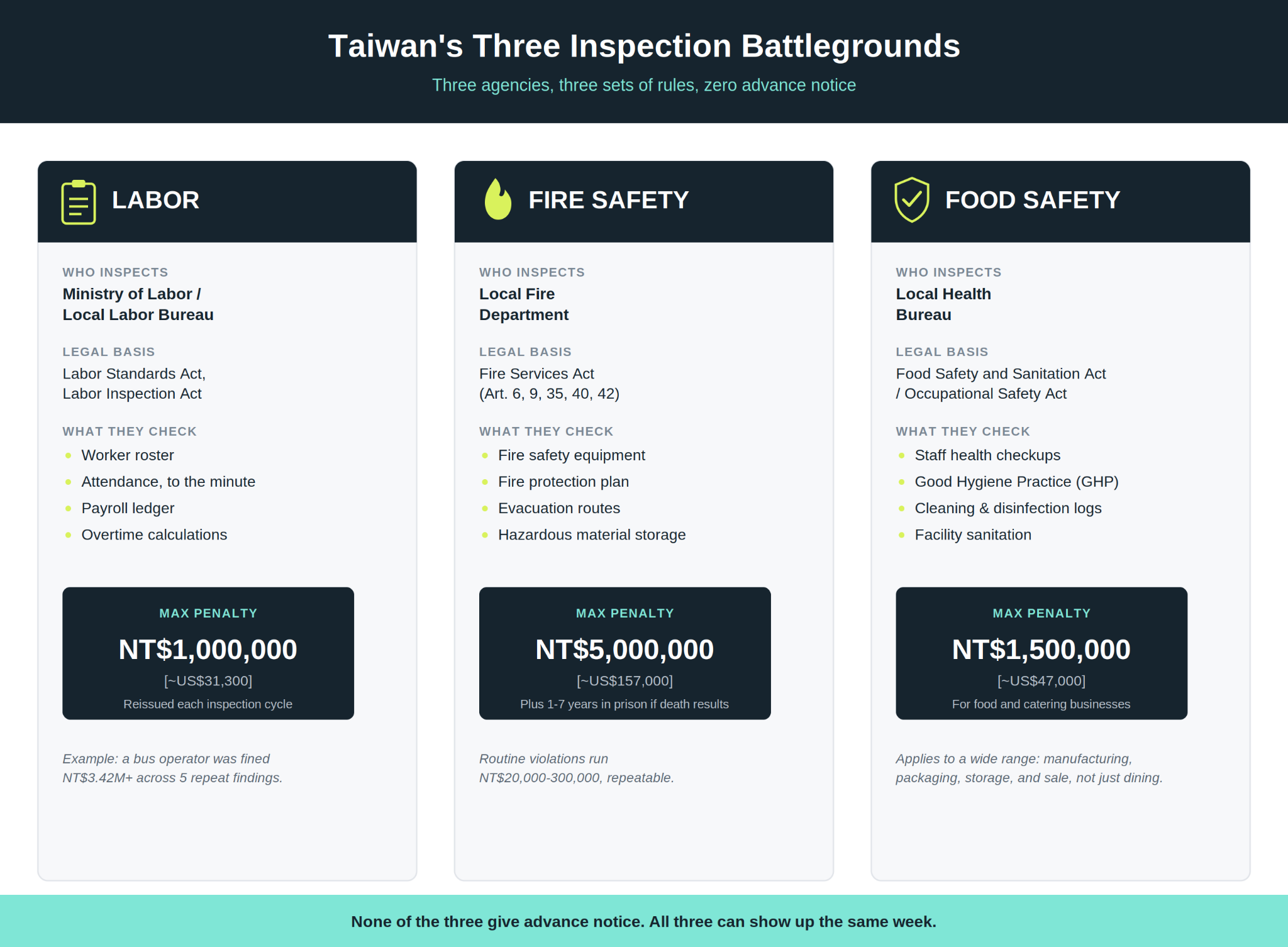
Labor inspectors aren't the only ones who show up unannounced. Under Articles 6 and 9 of the Fire Services Act, local fire authorities inspect whether a business has installed and maintained its required fire safety equipment, filed a current fire protection plan, and kept evacuation routes clear. Enforcement has only tightened since a September 2023 fire at a Pingtung factory killed multiple firefighters and injured over a hundred more.
Fire safety inspections
|
Scenario
|
Requirement
|
Legal Basis
|
Penalty
|
|
Routine violation
|
Designate a fire safety manager and keep a current fire protection plan on file
|
Fire Service Act
, Article 40
|
NT$20,000–300,000 [~US$630–9,400], repeatable if uncorrected
|
|
Manufacturing, storage & processing of hazardous and flammable gases
|
Meet equipment and safety-management standards for regulated hazardous materials
|
Fire Service Act
, Article 42
|
Up to NT$1,500,000 [~US$47,000] for non-compliant storage or structure
|
|
Fire causing death from unmaintained equipment
|
Failure to install or maintain required fire safety equipment
|
Fire Service Act
, Article 35
|
1 to 7 years in prison plus a fine of up to NT$5,000,000 [~US$157,000] for the party responsible for site safety
|
Under the Food Safety and Sanitation Act, health inspections follow the same no-notice logic, but which law applies depends on whether the business handles food. "Food business" covers manufacturing, processing, packaging, transport, storage, and sale, a wide net that includes most catering groups and restaurant chains.
Food safety and sanitation inspections
|
Business Type
|
Requirement
|
Legal Basis
|
Penalty
|
|
Food and catering businesses
|
Staff health checkups and Good Hygiene Practice (GHP) standards for facilities and staff
|
Food Safety and Sanitation Act, Article 44
|
NT$60,000–200,000,000 [~US$1,880–6,390,000]
|
|
General businesses
|
Workplace safety equipment and periodic employee health checkups
|
Occupational Safety and Health Act, Article 6 and 20
|
NT$50,000–NT$3,000,000 [~US$1,595–95,740] for having non-compliant safety and health equipment; NT$30,000–750,000 [~US$960–23,940] for missed employee health checkups
|
Fire safety and health inspection readiness belongs in your annual operating plan, not in a last-minute scramble when an inspector shows up. Keep equipment checks and health records digital, and you're ready for a surprise inspection whenever it comes. Talk to our Taiwan compliance team about auditing your current setup.
5. Defensive Compliance: Why Cloud HR Systems Are Mandatory

For companies operating in Taiwan, HR compliance isn't a once-a-year exercise. Taiwan's Ministry of Labor has confirmed in its 2026 inspection guidelines that inspection agencies will use smart digital technology to carry out audits, meaning discrepancies in attendance data, payroll calculations, or working hours will be detected on the spot. Any employer still relying on manual processes or paper records is running a risk that's now fully quantifiable. Employers should build proactive compliance instead of reactive scrambling:
- Study the Ministry of Labor's Taiwan labor inspection checklist, audit your own policies against it, and fix the gaps before anyone else finds them.
- Set up an internal early-warning system to monitor working hours systematically so you can intervene before overtime crosses a legal threshold, not after. Regular labor-management communication also means fewer employees feel the need to file a complaint in the first place.
- Automated attendance and payroll tracking puts a timestamped history behind every number, so an inspection becomes a formality instead of a fire drill.
Taiwan compliance audit checklist (2026)
|
Inspection Focus
|
Legal Basis
|
Penalty Risk
|
Slasify's Approach
|
|
Attendance tracking (minute-level, 5-year retention)
|
Article 30, LSA
|
NT$90,000–450,000 [~US$2,800–14,100] (retention) or NT$20,000–1,000,000 [~US$630–31,300] (minute-level logging)
|
Digital time logs recorded to the minute, retained automatically
|
|
Overtime pay (multiplier compliance)
|
Article 24 & 32, LSA
|
NT$20,000–1,000,000 [~US$630–31,300] for unpaid or underpaid overtime
|
Overtime and leave tracking integrated directly with payroll calculation
|
|
Fire and safety compliance
|
Fire Services Act
|
NT$20,000 to NT$300,000 [~US$630–9,400], plus criminal exposure in severe cases
|
Local compliance guidance flagged through our EOR service
|
"Before they come to us, most Taiwan clients are pulling attendance and payroll records from three different places the night before an inspection. Once everything runs on one system, that prep time drops from days to minutes, and the records hold up because they were accurate from day one, not reconstructed under pressure."
— Slasify Account Manager
How we keep Taiwan clients audit-ready
- Worker roster, attendance, and payroll ledger run as one connected system, not three disconnected spreadsheets
- Overtime calculates automatically to the minute, against total compensation, with no manual multiplier math
- Fire and food safety exposure gets flagged by our in-country team at onboarding, before an inspector ever has the chance to
This isn't a Taiwan-only setup. It's the same infrastructure we run across 150+ countries and 130+ currencies, through 600+ local partners, for more than 900 companies, all under ISO/IEC 27001-certified data handling. Our Employer of Record and Global Payroll platforms deliver everything on the list above from that same foundation.
6. FAQ

Q1: Are labor inspections in Taiwan announced in advance?
No. Under Article 13 and 14 of the Labor Inspection Act, inspectors may enter a business's premises at any time while carrying out their duties, without prior notice. Employers should treat compliance as a daily standard and keep inspection-ready records on hand at all times.
Q2: If an inspection requests five years of attendance records, how should employers prepare?
Move to a digital system built for inspection-readiness. Under Article 30 of the Labor Standards Act, employers must keep attendance records for five years. We digitize attendance in the cloud, keeping records accurate to the minute and protected against manual data loss, backed by ISO/IEC 27001 certification.
Q3: What core items do companies need to prepare for a Taiwan labor inspection?
The "Holy Trinity," which includes the worker roster, attendance records, and payroll ledger. The roster covers personal and job details, attendance covers clock-ins and overtime logged to the minute, and the ledger covers wages and overtime math. Check these against the current inspection checklist.
Q4: What do fire safety inspections typically check?
Fire safety inspections typically cover the condition of safety equipment (extinguishers, emergency lighting, alarms), whether the fire protection plan is filed on schedule, and whether evacuation routes stay clear and unobstructed.
Q5: What is the specific fine for failing a fire safety inspection?
Fines run from NT$20,000 to NT$300,000 per violation, and can be issued repeatedly if not corrected. If a violation leads to a fire causing death, Article 35 of the Fire Services Act allows fines up to NT$5,000,000 plus 1 to 7 years in prison for the responsible party.
Q7: How should companies prepare for a surprise Health Bureau inspection?
Three habits cover most of it: daily cleaning logs, current staff health checkups, and documented disinfection schedules. This mainly applies if your Taiwan operation touches food, manufacturing, processing, packaging, storage, or sale, a category broad enough to include most catering groups.
Q7: Can fire safety and health inspections be filed together?
No. Fire safety and health inspections are governed by entirely separate regulatory bodies—the Fire Department and the Health Bureau. Employers must maintain separate compliance workflows and documentation for each agency to ensure comprehensive legal protection.
Close the gaps before the surprise inspection
Don't wait for an inspector to knock on your door. Digitize your attendance, automate your overtime calculations, and ensure compliance with Taiwan's labor laws. Book a free compliance audit with Slasify today.