EMPLOYER INSIGHTS
| Key Takeaways |
| A staffing agency answers “who should we hire?” and its role typically ends at candidate placement. An Employer of Record answers “how do we legally employ this person?” and its role starts at the employment contract. The two roles are distinctive for international hiring. |
| The legal employer question matters because liability for misclassification, termination disputes, and permanent establishment risk depends on who holds the employment contract in the worker's country. |
| Staffing agencies typically charge a percentage markup on wages for the duration of the engagement. An EOR charges a flat monthly fee per employee. Over 12 months for one international hire, the structural cost difference can become significant. |
| For international hiring, a staffing agency does not become the legal employer in the worker's country. Someone must be liable; if no one is, the compliance risk falls entirely on the client. |
| The two models perform best when working together: the agency sources and screens the candidate, then the EOR takes over as the legal employer. The workflow is sequential, not competitive. |
Have you experienced this during your hiring in an overseas market: you are looking for a candidate in one of the emerging markets like Indonesia, Malaysia, or Vietnam. Your staffing agency quoted you a price, but you also hear that you need an Employer of Record (EOR). Both claim to “handle employment,” but exactly what does employment entail, and what are the differences between these two options?
In domestic hiring, the line between a staffing agency and an employer of record can blur when agencies pay temporary workers on their own books. But for international hiring, the distinction is not subtle and involves many aspects of employment and payroll compliance in every market. Someone has to become the legal employer in the worker's country, carry the statutory obligations, and answer when something goes wrong. Between the two, only the EOR is built to answer that question.
For a broader view of how these providers fit alongside contractor platforms and recruitment firms, see our guide on cross-border recruitment solutions.
1. The 30-Second Answer
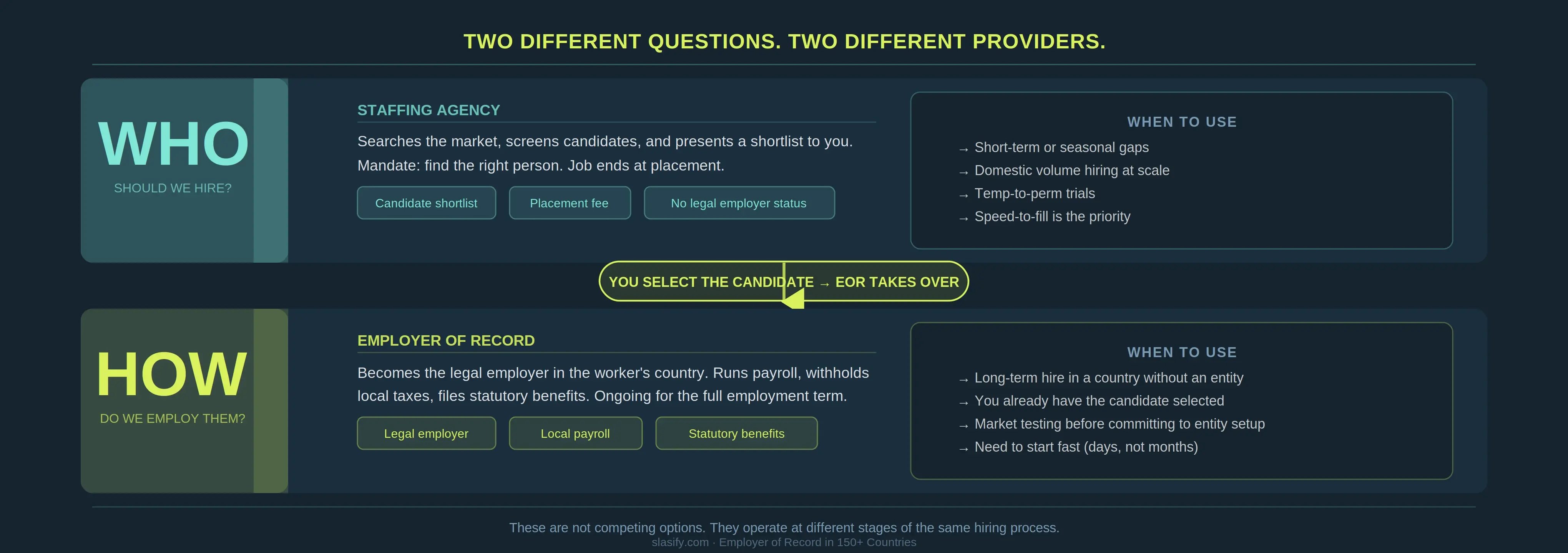
Figure 1. A staffing agency and an EOR answer two different questions at two different stages of the hiring process.
A staffing agency finds, screens, and places qualified candidates. An Employer of Record legally employs workers you have already chosen, handling contracts, payroll, statutory benefits, and ongoing compliance in the worker's country. For international hiring, the key question is who acts as the legal employer to be responsible for compliance liability, tax withholding, and termination obligations.
| Responsibility |
Staffing Agency |
Employer of Record (EOR) |
| Who finds the talent |
Sources, screens, and presents candidates |
Does not source candidates; begins after you have selected one |
| Who is the legal employer |
Often the agency for temp workers; the client for permanent placements (via own entity) |
The EOR, in the worker's country |
| Who runs payroll and withholds tax |
Agency for temps on its books; client for permanent hires |
The EOR, under local law |
| Where compliance liability sits |
Shared or unclear, especially for international placements |
With the EOR as the registered employer |
| Cost structure |
Percentage markup on wages |
Flat monthly fee per employee |
| Typical engagement duration |
Project-based, seasonal, or temp-to-perm conversion |
Ongoing, for the duration of employment |
| Best-fit scenario |
You need to find candidates, fill short-term gaps, or staff seasonal surges |
You have a candidate and need to legally employ them in a country where you have no entity |
The models often get confused because both involve a third party sitting between the company and the worker. The difference is what that third party actually owns: one delivers a candidate; the other enters a legal employment relationship.
2. What a Staffing Agency Does, and Where Its Job Ends
A staffing agency (also called a recruitment agency or temp agency) is a sourcing and placement service provider. It finds candidates, screens them, and presents a shortlist. The hiring model of a staffing agency takes one of two forms: temporary staffing, where the agency payrolls the worker for a defined period, or permanent placement, where the agency delivers a hire and collects a one-time fee.
In the United States, staffing companies employed an average of roughly two million temporary and contract workers per week in Q4 2025, according to the American Staffing Association (ASA). This reflects a widely adopted model, particularly for domestic, short-term, and high-volume hiring. The comparison between an employer of record vs recruitment agency is really a question of scope: the agency delivers people, while the EOR delivers a legal employment structure.
Where the model reaches its limit is international employment. A staffing agency that places a candidate in a country where neither the agency nor the client holds a local entity has delivered a person, but not a compliant employment structure. The agency is not the legal employer in that jurisdiction, which means it cannot run local payroll and does not file statutory benefit contributions.
3. What an Employer of Record (EOR) Does
An Employer of Record is a company that becomes the legal employer of a worker in a specific country on behalf of a client business. The EOR manages all of the local employment compliance, from signing the employment contract, running payroll under local law, withholding income tax, filing statutory benefit contributions, and managing terminations within the legal framework. This allows the client to focus on managing the worker's day-to-day activities.
For international hiring, the EOR solves a specific structural problem. A company that wants to employ someone in a country where it has no registered entity cannot sign a locally compliant contract, register with the tax authority, or enroll the worker in mandatory social insurance. The EOR becomes relevant once you know who you want to hire.
There is another employment model called Professional Employer Organization (PEO). A PEO co-employs alongside the client's existing entity, which means the client must already have a local presence and carries co-employment risks alongside the PEO. An EOR replaces the need for a local entity entirely. For the full comparison, see our breakdown of EOR vs PEO.
4. Who Is the Legal Employer, and Why It Decides Everything
Every international hire requires a legal employer in the worker's country, and who holds that role determines where compliance liability sits. In a domestic setting, like the U.S. market, the staffing agency is usually the legal employer of the temp workers. In a permanent placement, the client or an EOR with a local entity becomes the legal employer after the candidate handoff and assumes the liability.
For international hiring, that liability question becomes even more consequential because it spans multiple jurisdictions. Here are three scenarios where the absence of a legal employer can create liability for you:
Scenario 1: A misclassification claim
A company engages a worker through a staffing agency in Vietnam, paying the staffing agency and treating the worker as a contractor. Vietnamese labor authorities (Article 13 of the Labor Code 2019) assess the substance of the relationship rather than the label on the invoice. If the worker is reclassified as an employee, then the question becomes: who owes the back contributions, the severance accrual, and the penalties? If no one held the employment contract, the liability lands on the company directing the worker.
For more on how misclassification can build up to be a major risk, see our guide to contractor misclassification and when to switch to an EOR.
Scenario 2: A termination dispute
An employer directs a worker placed by a staffing agency in South Korea. Korea's Labor Standards Act provides strong protections against unfair dismissal, including mandatory severance pay. If the worker claims wrongful termination, the legal employer is the party that must defend. If neither the agency nor the client holds the employment contract in Korea, the dispute lands directly on the party directing the work.
Scenario 3: Permanent establishment risk
A staffing agency places several workers in a country on the client's behalf. Those workers operate from a fixed location, use the client's systems, and report to the client's managers. Tax authorities may deem that arrangement a permanent establishment (PE), triggering corporate tax obligations the client never planned for. An EOR can absorb this structural risk because the employment relationship already sits inside a locally registered entity.
In each of the three cases, whoever is the legal employer assumes the obligation. When there is no one, the obligation defaults to the party that controls the work, which is usually the client itself.
5. Who Pays the Salary and Who Withholds the Taxes
Under the staffing agency model, the mechanics depend on the arrangement. For temp workers on the agency's books, the agency runs payroll and withholds taxes, and the client pays one bundled invoice. For permanent placements, the client takes over payroll and withholding from the start date.
Under the EOR model, the EOR runs payroll in the worker's country, withholds local income tax, and files statutory contributions according to local law. The client pays a consolidated monthly invoice covering gross salary plus the EOR's flat fee.
6. Cost Comparison: Employer of Record vs Staffing Agency
The staffing agency markup and the EOR flat fee are structurally different, and the gap compounds over time.
A staffing agency charges a percentage of the worker's wages for the duration of the engagement. The exact percentage varies by role, market, and volume. What matters structurally is that the cost scales with the salary: a higher-paid worker means a higher agency fee, every month, for as long as the arrangement lasts.
An EOR charges a flat monthly fee per employee, independent of salary level. Our public starting floor is USD 250/mo per employee.
The table below shows what that structural difference is over a 12-month period for a single international hire.
The 12-month cost estimate comparison
| Item (per employee) |
Staffing Agency Model |
EOR Model |
| Monthly gross salary |
USD 6,000 |
USD 6,000 |
| Monthly fee or markup |
USD 1,800 (30% markup, assumption) |
USD 250 (flat fee) |
| Monthly total to provider |
USD 7,800 |
USD 6,250 |
| 12-month total |
USD 93,600 |
USD 75,000 (18,600 lower) |
Note: The 30% markup is an assumption for illustrative purposes. Actual staffing agency markups vary by role, geography, and contract terms and are not published by a primary industry source. The EOR fee shown is our published starting floor; actual fees vary by country and scope. Both models only show the worker's gross salary as a pass-through, not including the other required contribution costs in each jurisdiction.
Not sure how flat-fee EOR pricing compares to your current arrangement?
Talk to our team about a specific hire, and we will walk through the numbers.
Talk to Our Team
7. When a Staffing Agency Is the Right Call
Staffing agencies are a legitimate and often essential part of the hiring process. The comparison of an Employer of Record vs. a staffing agency is not about which is better, but which fits the problem you are solving.
Four scenarios where an agency is typically the stronger fit:
- —Urgent short-term gaps where speed-to-fill matters more than long-term cost
- —Surges requiring temporary workers with a defined end date
- —Temp-to-perm trials before committing to a permanent hire
- —Domestic volume hiring at scale
In each case, the agency delivers access to people and the flexibility to scale up or down quickly.
The model is less suited to a long-term international hire where you already know who you want to employ. At that point, the agency's core value has been delivered, and continuing to pay an ongoing markup for a service that does not provide legal employer status in the worker's country costs more and covers less.
8. When an EOR Is the Right Call
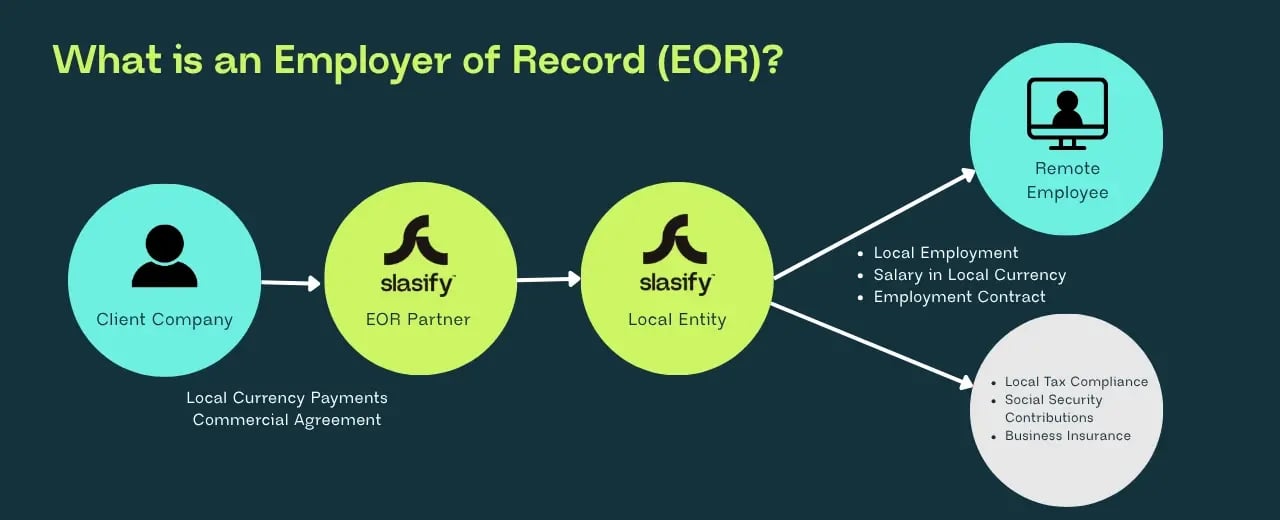
The EOR model becomes a legitimate choice when your company hires across borders and the candidate is already identified. Three conditions typically point to an EOR:
- —You want to hire someone long-term in a country where you have no legal entity
- —You need to move quickly without waiting months for entity setup
- —You want to test a market with a small team before committing to local incorporation
What the EOR solves is the country-specific compliance stack that most companies cannot build from scratch for just a few hires. The details differ enough to matter:
These examples represent the degree of complexity of managing a cross-border team when it comes to employment-related compliance.
“Slasify helped us scale in Vietnam, the Philippines, Indonesia, and Malaysia. Their local knowledge and execution saved us time and costs.”
Head of Operations, Astro Malaysia Holdings Berhad
Every one of these countries carries a different filing deadline, contribution cap, and penalty structure. If you are evaluating EOR providers for these markets, especially if you want to build a global team centered on the APAC region, our guide on how to choose an EOR for local labor law compliance covers what to look for.
9. Using Both Together: The Workflow
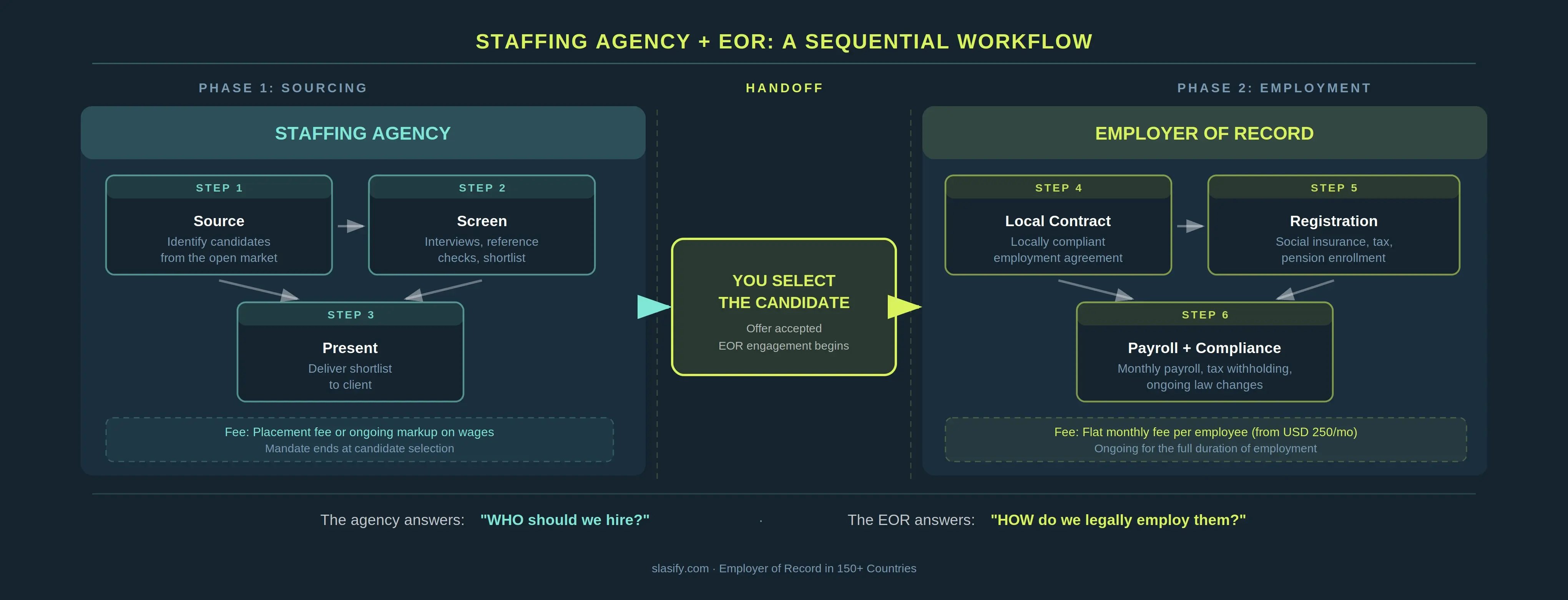
Figure 2. The agency-to-EOR handoff: sourcing ends at candidate selection; the EOR takes over employment from that point forward.
The staffing agency and the EOR are most powerful when used in tandem and in sequence, which is when the agency finds the candidate and the EOR employs them legally in their country.
The agency-to-EOR sequence and handoff
| Step |
Who Is Responsible |
Who Owns the Contract |
Operating Fees |
| 1. Sourcing and screening candidates |
Staffing agency |
Agency-client service agreement |
Agency placement fee or retainer |
| 2. Selecting the candidate |
Client (you) |
No employment contract yet |
Part of the agency fee |
| 3. Engaging the EOR partner |
Client and EOR |
EOR-client service agreement signed |
EOR onboarding fee, if applicable |
| 4. EOR drafting local employment contract |
EOR |
EOR holds the employment contract |
EOR monthly fee begins |
| 5. EOR onboarding the new hire |
EOR (local registrations, statutory benefits, payroll setup) |
EOR |
EOR monthly fee continues |
| 6. Ongoing employment & compliance |
EOR manages compliance; client manages day-to-day work |
EOR |
EOR monthly fee; agency fees end |
The handoff from staffing agency to EOR happens between steps 2 and 3. Once you have selected the candidate, the staffing agency's mission is completed. The EOR can typically have a local employment contract ready within days, with statutory registrations running in parallel. The total window from candidate selection to a legally active first day is usually two to four weeks, depending on the country.
10. The 2026 US Legal Backdrop
Even within a single jurisdiction, the rules around who counts as the employer keep shifting. Take the US picture in 2026 as an example:
The National Labor Relations Board (NLRB) formally withdrew its 2023 joint-employer rule on February 27, 2026, reinstating the 2020 standard. Under the current rule, joint-employer status requires substantial direct and immediate control over essential terms and conditions of employment. The broader 2023 standard, which would have extended liability to indirect or reserved control, was vacated by the Eastern District of Texas in March 2024 and never took effect.
On independent contractor classification, the Department of Labor (DOL) directed its investigators not to apply the 2024 rule's analysis in enforcement (Field Assistance Bulletin 2025-1, May 1, 2025) and proposed rescinding it in February 2026. The rescission is proposed, not final: the comment period closed in April 2026, and the rule remains in post-comment review as of publication.
This section covers US law under the National Labor Relations Act (NLRA) and the Fair Labor Standards Act (FLSA) only. For international hiring, each country applies its own classification framework, its own joint-employer tests, and its own penalties. That multiplication is why the legal employer question at the center of this article matters more as your hiring footprint crosses borders.
11. How We Help Clients with EOR Services
When you have found your candidate and the offer has been accepted, those steps begin. We become the legal employer in the worker's country, sign the local employment contract, and handle payroll, statutory benefits, and ongoing compliance.
We operate across 150+ countries through 600+ local partners, paying in 130+ currencies for 900+ companies. Our payroll infrastructure is ISO 27001 certified to provide enhanced security for your financial and payroll data.
“They've made it easy to scale our engineering team globally, fast, affordably, and responsively.”
Director of Engineering, Compass
For employees, our Employer of Record service covers the full employment lifecycle. Where a compliant contractor engagement genuinely fits, our Global Contractor management handles that structure as well. For a side-by-side look at how an EOR compares with other provider models, see our guide to EOR vs payroll agency vs accounting firm.
12. Employer of Record vs Staffing Agency FAQ

Q1. What is the difference between an EOR and a staffing agency?
A staffing agency sources and places candidates, while an EOR legally employs workers you have already chosen. The agency's job typically ends at placement; the EOR's job starts at the employment contract. For international hiring, the critical gap is legal employer status in the worker's country, which the EOR holds, and the agency usually does not.
Q2. What are the disadvantages of using a staffing agency?
The main disadvantage for international hiring is that the agency does not become the legal employer in the worker's country. Ongoing percentage-based markups also make long-term hires more expensive than a flat-fee model. And because the agency's mandate is placement, compliance obligations like local tax withholding, statutory benefits, and termination law fall outside its scope.
Q3. Is a staffing agency the legal employer of the workers it places?
It depends on the arrangement. For temporary workers on the agency's payroll, the agency is typically the employer of record during the assignment. For permanent placements, the client becomes the employer from the start date. For international placements where the agency has no local entity, it is usually not the legal employer at all, which is the gap an EOR fills.
Q4. Which is better for hiring: direct hire or a staffing agency?
It depends on the role, timeline, and whether you need help finding the candidate. Direct hires work well when you have time and internal recruitment capacity. Staffing agencies fit urgent fills and short-term roles. For international hires, neither route removes the need for a legal employer in the worker's country.
Q5. Can we use a staffing agency and an EOR together?
Yes, and the combination is the standard workflow for international hiring when you need help finding the candidate. The agency sources and screens; the EOR employs. The handoff happens once you select the candidate, at which point the EOR drafts the local contract and takes over employment responsibilities.
Q6. Who withholds taxes when we hire through an EOR versus an agency?
Under an EOR, the EOR withholds local income tax and files statutory contributions in the worker's country. Under a staffing agency, withholding depends on who holds the employment contract: the agency withholds for temps on its payroll, and the client withholds for permanent hires. For international placements, only the party registered as an employer in the local jurisdiction can legally withhold.
Q7. Does an EOR find candidates for us?
No. An EOR does not source, screen, or recruit candidates. The EOR's role begins after you have identified and selected the person you want to hire. If you need help finding candidates, a staffing agency or recruitment firm handles that stage.
Hire Internationally Without the Compliance Guesswork
The staffing agency and the EOR are not competitors to each other. They solve different problems at different stages, and international hiring works best when both are used. If you have already found your candidate, the employment, payroll, and compliance side is ours.
Ready to Hire Internationally?
Book a free consultation, and we will map the full picture for your hire.
Book a Free Consultation