|
Key Takeaways
|
| Choosing the best employer of record in Asia is a country-level decision, not a country-count contest. Verify the legal employer, statutory process, and accountable service owner in every market. |
| A country guide may show that a provider understands the market, but it does not prove the provider can onboard an employee there today. Confirm live product availability, the employing entity, and the expected onboarding timeline. |
| Mainland China coverage and work-visa support can eliminate providers from a shortlist early. Availability depends on the provider's current legal structure, the role, and the worker's eligibility. |
| Platform fees are only part of the cost. Statutory contributions, benefits, deposits, foreign exchange, off-cycle work, and termination charges vary by country and employee profile. |
| Regional specialists may bring deeper knowledge of Asian markets, while global platforms can simplify multi-region governance. Evaluate both against the same country evidence, service standards, and total-cost model. |
Asia has become a primary destination for international hiring. Its large and diverse workforce, fast-growing economies, and technology hubs in Singapore, Bengaluru, and Ho Chi Minh City now support global product, engineering, operations, and commercial teams.
Unlike North America or Western Europe, Asia has no shared regulatory baseline. Each country has its own social insurance system, payroll calendar, employment-contract rules, and data requirements. As a result, an Asia EOR must be evaluated on country-level execution.
This ranking compares 10 providers to help HR, legal, and operations teams choose the best employer of record in Asia for the markets where they plan to hire.
1. Why Asia Is the Hardest Region to Get EOR Compliance Right

Asia-Pacific accounts for roughly 22% of the USD 5.97 billion global EOR market in 2026; the global market is projected to reach USD 10.45 billion by 2035. Companies hire in the region for its talent, cost profile, and access to growing markets. The harder part is managing a different set of payroll, employment, and data rules in each country.
Five factors make a single EOR approach difficult across the region:
- Different statutory systems: Singapore's Central Provident Fund, Malaysia's Employees Provident Fund, Vietnam's social insurance framework, and Japan's Employees' Pension Insurance use different contribution bases, ceilings, registration rules, and filing calendars.
- Market-specific employer obligations: The Department of Labor and Employment (DOLE) of the Philippines requires statutory 13th-month pay under Presidential Decree 851, due no later than December 24. Indonesia uses statutory termination-compensation formulas instead of a universal monthly severance accrual. Providers need local operating knowledge to apply these rules correctly and on time.
- Country-specific contracts and disclosures: Japan and South Korea require statutory disclosures that a generic global employment template may not capture.
- Separate privacy laws: Asia has no single privacy framework. China's Personal Information Protection Law (PIPL), Japan's Act on the Protection of Personal Information (APPI), and Singapore's Personal Data Protection Act (PDPA) each impose distinct data-handling requirements.
- Active enforcement: Australia made intentional wage underpayment a criminal offense from 1 January 2025. From 1 July 2026, the maximum company penalty is the higher of three times the underpayment or AUD 9.1 million for companies. Singapore's Personal Data Protection Commission fined Marina Bay Sands S$315,000 in October 2025.
If you are comparing providers for a first APAC hire rather than a multi-market rollout, our guide to the best EOR providers for APAC startups focuses on the startup-stage decision.
2. How We Ranked Them: The Methodology
Providers describe their footprints in different ways, so we did not assign numerical scores. Instead, we reviewed each provider against the same seven criteria and applied an Asia-weighted editorial ranking. Evidence for the 12 target markets, especially mainland China, carried the most weight. We treated product pages, country guides, and directories as different types of evidence. Entity transparency, statutory execution, security, visa support, service model, and pricing shaped the final order and trade-offs.
1. Public regional evidence in 12 Asian markets: Singapore, Malaysia, Thailand, Vietnam, the Philippines, Indonesia, Hong Kong, Taiwan, Japan, South Korea, mainland China, and India. We recorded whether each source was an EOR product page, a country directory, or a country guide, and limited each claim to what the source could support.
2. Entity model transparency: We valued providers higher when they clearly described and supported their owned, partner-supported, or hybrid model.
3. Statutory execution depth: We looked for evidence that a provider could administer market-specific requirements, including mandatory bonuses, severance calculations, social insurance registration, and payroll cut-off dates.
4. Certifications and data posture: We reviewed published ISO 27001 and SOC 2 evidence, GDPR statements, and the provider's treatment of country-specific privacy laws such as Singapore's PDPA, China's PIPL, and Japan's APPI.
5. Visa and work-pass support: We checked whether the provider publishes support for work authorization in each market or requires employees to have an existing right to work.
6. Service model and reliability: We compared named account management with ticket-based support and reviewed any published evidence on payroll timing.
7. Pricing transparency: We compared published starting prices with quote-only pricing.
Provider materials were verified in July 2026. Country counts, entity models, prices, and visa reach are provider-reported. When official materials did not provide the information, we marked the field as “not publicly confirmed.”
3. The Statutory Reality an Asia EOR Must Administer
Requirements differ by market. An Employer of Record in Singapore must administer CPF, while an employer of record in the Philippines must also account for statutory 13th-month pay. India, Vietnam, and Japan each have their own registration, contribution, and filing rules. The table lists selected primary schemes from official agencies and is not a complete view of employer cost.
|
Market
|
Scheme
|
Employer Rate
|
Effective Date
|
Source
|
|
Singapore
|
Central Provident Fund (CPF)
|
17% (wages above S$750/mo; employees aged 55 and below)
|
1 Jan 2026
|
CPF Board
|
|
Malaysia
|
Employees Provident Fund (EPF/KWSP)
|
13% ≤ RM5,000; 12% > RM5,000 (Malaysian/PR, under 60); 2% non-Malaysians
|
Current; 2% from Oct 2025
|
KWSP
|
|
Hong Kong
|
Mandatory Provident Fund (MPF)
|
5%; monthly cap HK$1,500; maximum relevant income HK$30,000
|
Current
|
MPFA
|
|
Philippines
|
Social Security System (SSS)
|
Employer 10%; total 15%; Monthly Salary Credit from P5,000 to P35,000
|
1 Jan 2025
|
SSS
|
|
Japan
|
Employees' Pension Insurance (EPI)
|
9.15% (half of 18.3% combined; pension only)
|
Fixed Sep 2017
|
Japan Pension Service
|
|
*Australia
|
Superannuation
|
12%
|
1 July 2025
|
ATO
|
*Australia is included as an APAC regional context, not a primary market in this ranking.
4. Choosing the Best Employer of Record in Asia: 10 Providers Ranked
The first table explains and summarizes each provider's published compliance coverage and profiles. The second records the country-page evidence found for the 12 Asian markets reviewed. Both tables should be used as a starting point for due diligence.
Provider ranking at a glance
The 12 markets are Singapore, Malaysia, Thailand, Vietnam, the Philippines, Indonesia, Hong Kong, Taiwan, Japan, South Korea, India, and mainland China.
|
Rank
|
Provider
|
Published compliance evidence
|
Global coverage
|
Entity model
|
Work visa support
|
Starting cost (Published floor)
|
|
1
|
Slasify
|
Asia-native; Singapore-based; ISO/IEC 27001; 600+ local partner network; dedicated account managers
|
150+ countries
|
Partner network (600+ partners); Asia on-ground presence
|
Country-specific; eligibility and sponsorship subject to case review
|
USD 250/mo
|
|
2
|
Deel
|
Large owned-entity footprint; SOC 1, SOC 2, SOC 3, and ISO/IEC 27001
|
130+ EOR countries
|
130+ owned entities plus partner network
|
70+ countries
|
USD 599/mo
|
|
3
|
Remote
|
Owned-entity EOR model with no third-party entity handoffs; current local terms identify Remote China as the employer
|
90+ countries
|
100% owned entities; no third parties
|
50+ countries
|
USD 599/mo (billed annually) or USD 699/mo
|
|
4
|
Atlas HXM
|
Direct EOR model; owned legal entities in 160+ countries; ISO 27001, 27017, and 27018
|
160+ countries
|
100% own entity
|
75+ countries
|
USD 599/mo
|
|
5
|
Multiplier
|
SOC 2 Type I and II, SOC 3, and ISO 27001:2022; public Taiwan and China compliance materials
|
150+ countries
|
Owned entity network
|
140+ countries
|
USD 400/mo
|
|
6
|
Payoneer Workforce Management (formerly Skuad)
|
SOC 1 Type II and SOC 2 Type II assessments; EOR delivery uses local entities and trusted partners
|
160 countries
|
Owned entities across APAC
|
Country-specific EOR add-on; subject to local regulations
|
USD 199/mo
|
|
7
|
RemoFirst
|
Partner-network EOR model; SOC 2 Type II and ISO 27001
|
185 countries
|
Partner-only
|
110+ countries
|
USD 199/mo
|
|
8
|
Remote People
|
Published owned-entity model; SOC 2 Type II and ISO 27001
|
150+ countries
|
Owned-entity claim
|
80+ countries
|
USD 199/mo
|
|
9
|
Oyster
|
Hybrid model; 80%+ of hires through owned entities; annual SOC 1 and SOC 2 Type II audits
|
120+ countries
|
80%+ owned entities, hybrid
|
60+ countries
|
USD 699/mo
|
|
10
|
Rippling
|
SOC 1, SOC 2, and SOC 3; ISO 27001, 27018, and 42001; CSA STAR Level 2
|
Not published
|
Not publicly stated
|
Not publicly specified
|
Not published
|
Global reach figures and country-page coverage are based on provider materials reviewed in July 2026. Visa support depends on the country and the worker's circumstances, and published coverage does not guarantee eligibility or approval. Listed prices are starting fees and exclude statutory costs, benefits, deposits, foreign exchange, off-cycle work, and termination charges.
Public country-page evidence across 12 Asian markets
|
Provider
|
Public pages: 11 markets*
|
Mainland China page
|
Evidence note
|
|
Slasify
|
✓
|
✓
|
|
|
Deel
|
✓
|
✓
|
|
|
Remote
|
✓
|
✓
|
|
|
Atlas HXM
|
✓
|
✓
|
|
|
Multiplier
|
✓
|
✓
|
|
|
Payoneer WFM
|
✓
|
✓
|
|
|
RemoFirst
|
✓
|
Partial
|
C-level title restrictions apply
|
|
Remote People
|
✓
|
✓
|
|
|
Oyster
|
✓
|
Not listed
|
|
|
Rippling
|
Not publicly confirmed
|
Not publicly confirmed
|
No public country list
|
*A checkmark means we found an official provider page or directory entry for all 11 grouped markets. It does not independently confirm current EOR availability or the employing entity. “Partial” and “not publicly confirmed” reflect materials reviewed in July 2026.
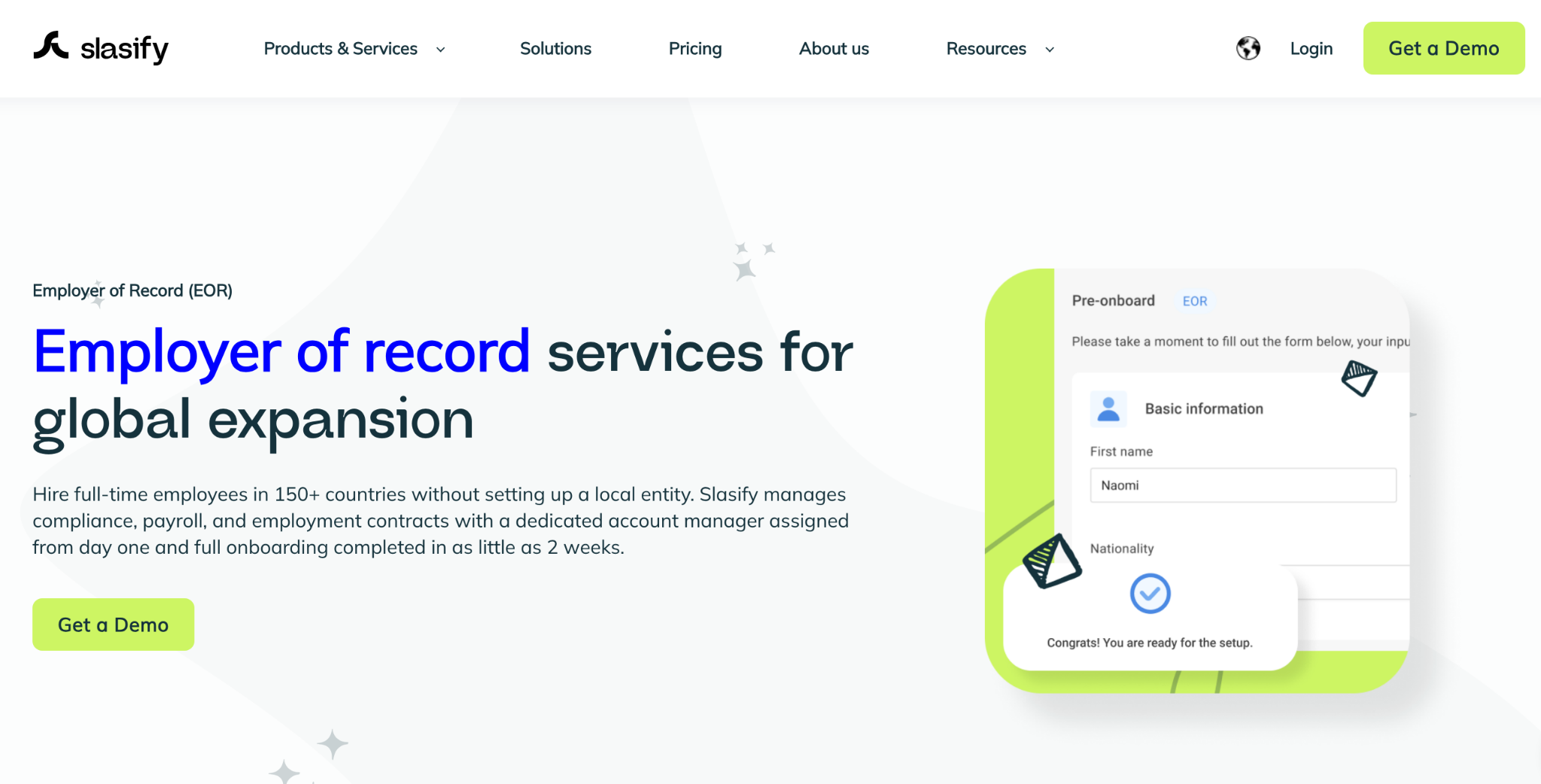
We are the only provider on this list founded in Asia and headquartered in the region, with teams on the ground in key markets. Our EOR is available in all 12 markets and we work with a network of 600+ local partners.
We also assign a named account manager at the start of every engagement, regardless of company size, to coordinate onboarding from kickoff through the employee's start date. Our published onboarding timeline is up to two weeks. We are also a Singapore Business Federation member, hold ISO 27001 certification, and have been recognized by KPMG. Pricing starts at USD 199 per employee per month, below several enterprise-oriented providers in this comparison.
Trade-off: Ideal for startups or global companies that want to quickly expand to Asia with full compliance across HR and payroll. Buyers who are primarily focused on America or European regions should evaluate the expansion plan for Asia first. SOC 1, 2, and 3 reports are not available.
2. Deel
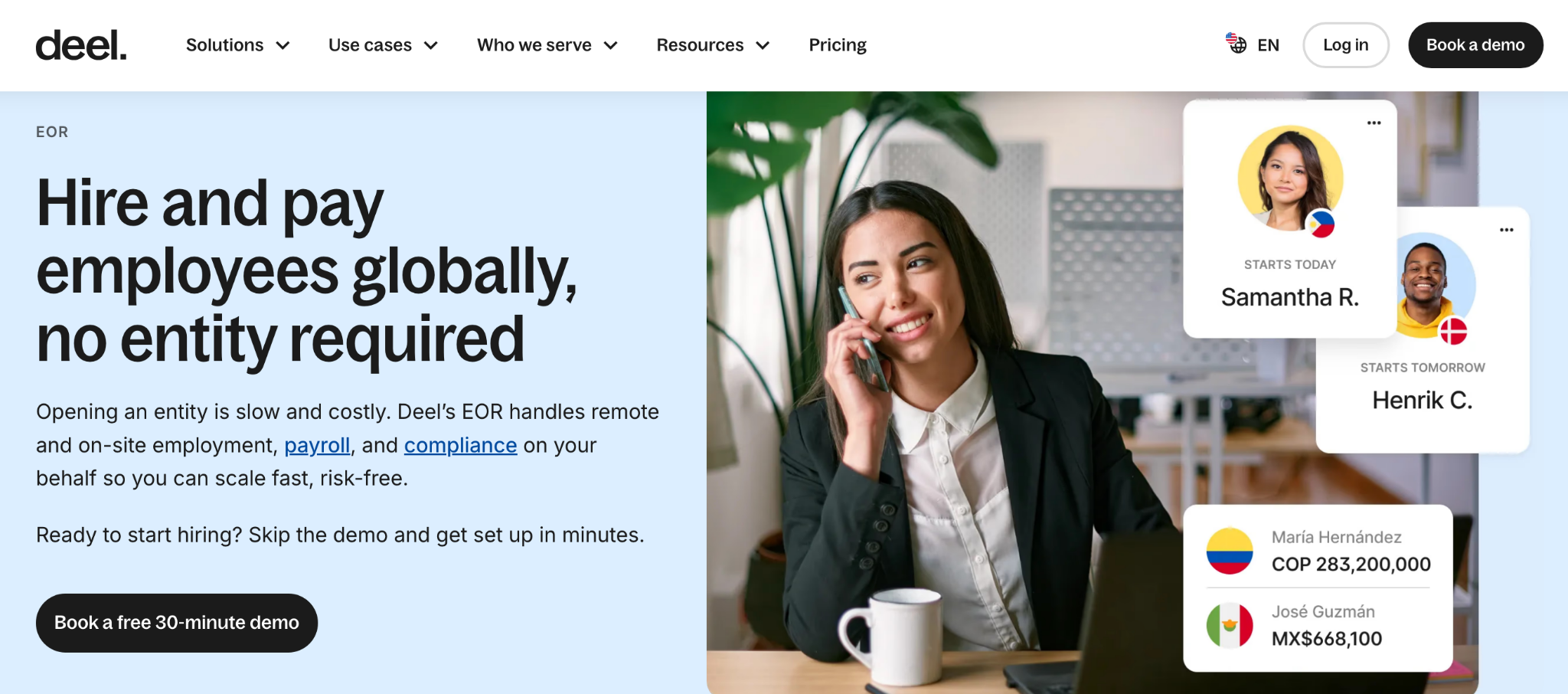
Deel publishes country or EOR pages for all 12 target markets, including mainland China. Its security page lists SOC 1, SOC 2, SOC 3, and ISO 27001, and the company reports operating across 150+ countries. EOR pricing starts at USD 599 per employee per month; immigration support varies by country.
Trade-off: Its pricing and enterprise-scale service model may exceed the needs of a company hiring only in Asia. Buyers should still verify the legal employer, service levels, and escalation path in each market.
3. Remote
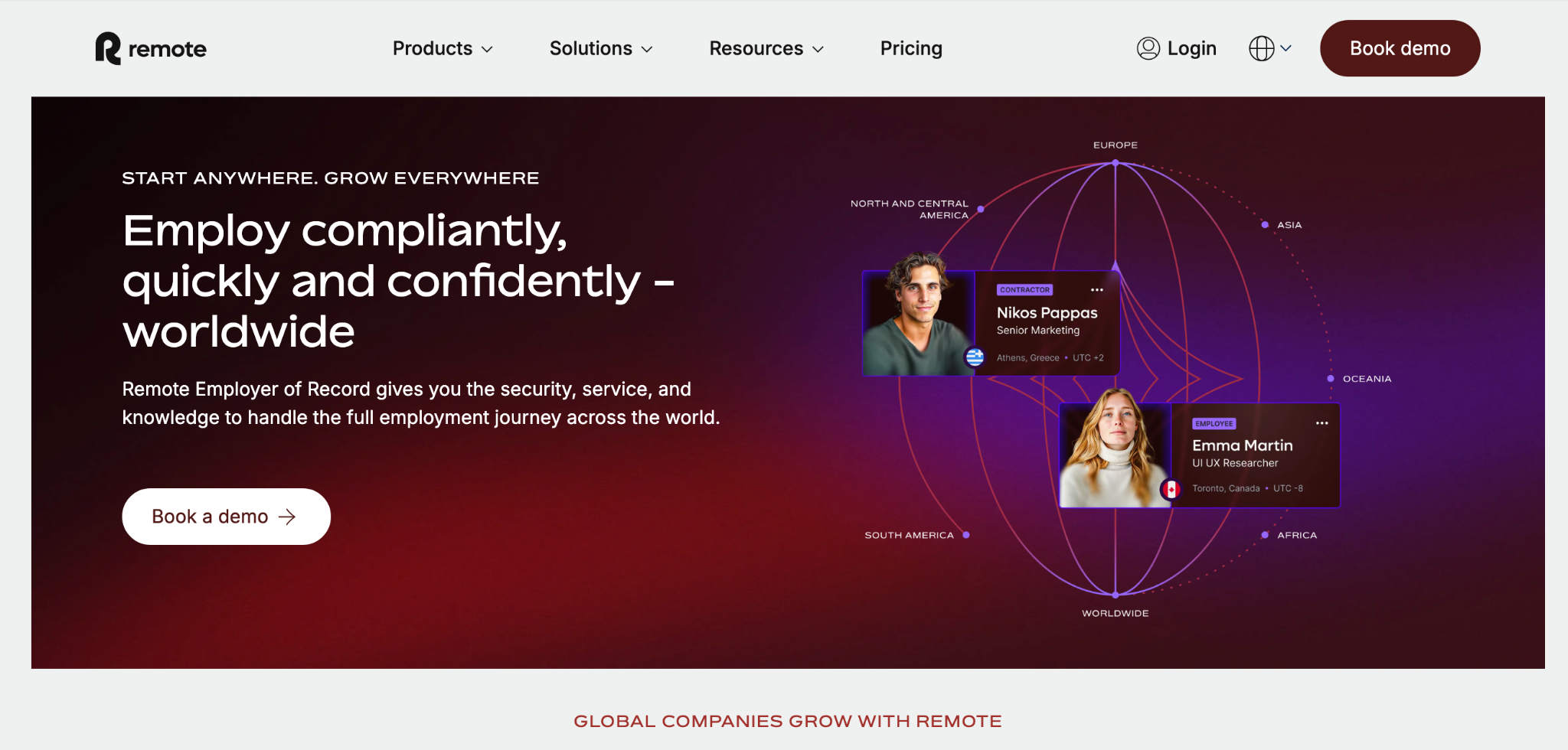
Remote's clearest distinction is its entity model: the company states that it owns every legal entity it uses and does not rely on third-party partners. Its Country Explorer includes a current China page. Pricing is USD 599 per month when billed annually or USD 699 month to month, matching Deel's published annual rate.
Trade-off: Remote's EOR footprint is narrower than that of several providers above it. Visa availability, support ownership, and total country charges still need to be confirmed for each hire.
4. Atlas HXM
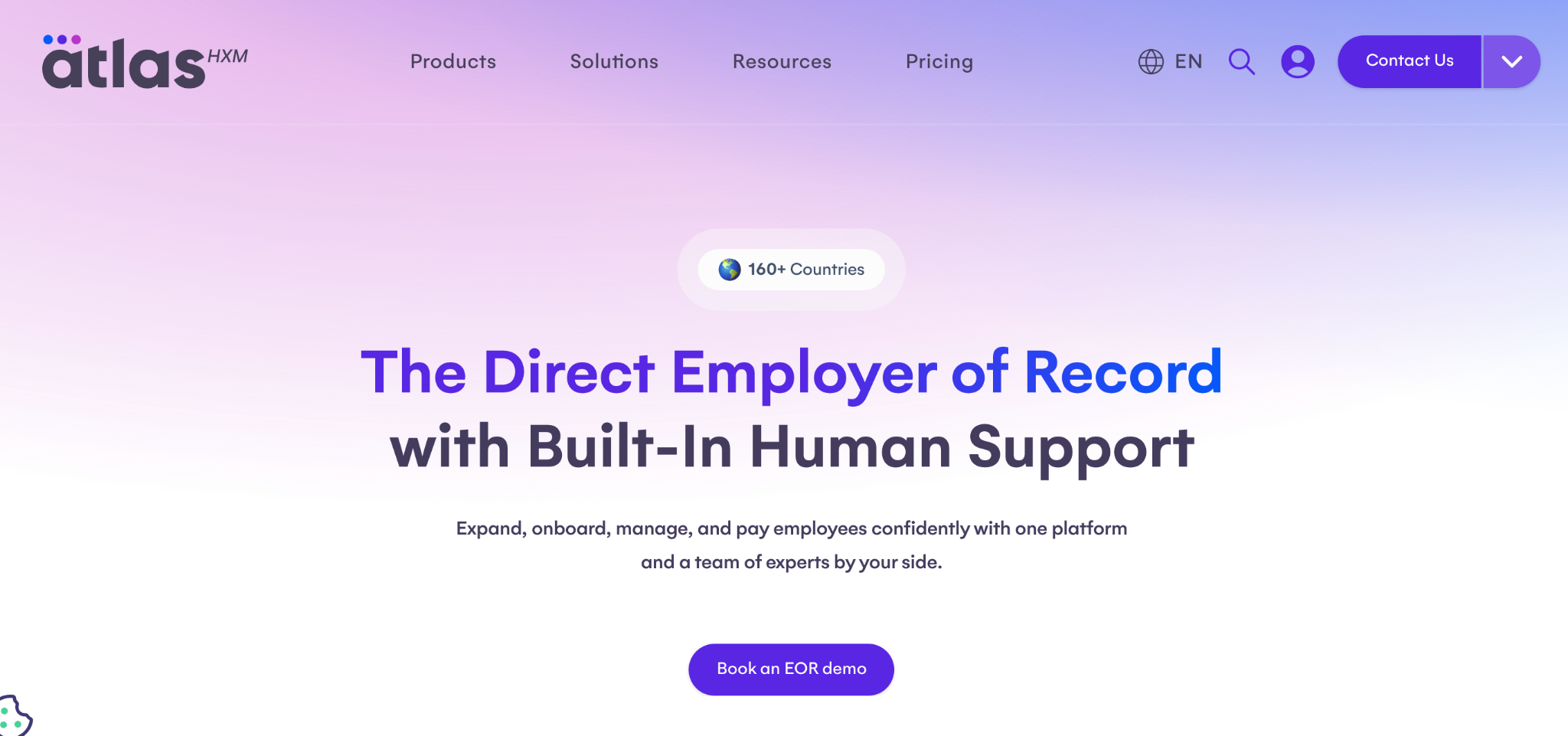
Atlas HXM reports EOR coverage in 160+ countries and publishes pages for all 12 target markets. Pricing starts at USD 599 per employee per month. Atlas describes its model as direct EOR and lists ISO 27001, ISO 27017, and ISO 27018 certifications. Its pricing page states that visa and mobility services cover 100+ countries.
Trade-off: Atlas publishes less detail about SOC audits than Deel or Rippling. Employers should request current entity, audit, and visa documentation for each proposed hire.
5. Multiplier
Multiplier is one of the more APAC-focused providers in the mid-range pricing tier and publishes pages for all 12 markets reviewed. Its owned-entity model, USD 400 monthly starting price, visa support in 140+ countries, and published ISO 27001 and SOC 2 certifications may suit companies building a regional team.
Trade-off: Published owned-entity counts vary across Multiplier's pages. Buyers should request the current entity schedule and responsibility split for each market.
6. Payoneer Workforce Management (Skuad)
Payoneer Workforce Management, formerly Skuad, publishes coverage for all 12 target markets and offers dedicated account support, with prices starting at USD 199 per employee per month. Its model combines owned and partner entities across 160+ countries, and its website cites SOC 2 and GDPR controls.
Trade-off: Since Payoneer acquired Skuad, product direction sits within a broader financial-services company rather than an EOR-only business. Country-by-country entity documentation is not public, and we found no official ISO 27001 claim. Employers that require the certification should confirm its current status.
7. RemoFirst
RemoFirst reports EOR coverage in 185+ countries and publishes pages for 11 of the 12 Asian markets reviewed. Its China offering is partial and has disclosed title restrictions. The company works through vetted in-country partners, starts at USD 199 per employee per month, and lists SOC 2 and ISO 27001 in its security materials.
Trade-off: Because RemoFirst relies on local partners, buyers should document the employing entity, responsibility split, and escalation path for each market.
8. Remote People
Remote People, formerly Horizons, reports coverage in 150+ countries and publishes a China fee range of USD 300 to USD 600. That disclosure offers more China pricing detail than most providers in this comparison. Its starting price of USD 199 per employee per month is also among the lowest listed.
Trade-off: Public materials remain available under both the Horizons and Remote People brands. Buyers should confirm which legal entity employs workers in each market and which entity signs the client agreement.
9. Oyster
Oyster publishes EOR coverage in 120+ countries, with prices starting at USD 699 per employee per month. It routes more than 80% of hires through owned entities and may suit buyers that need one platform across Europe, Latin America, Asia, and other markets.
Although Oyster does not list mainland China, its country guidance and onboarding support may still suit multi-region programs focused on other markets.
Trade-off: Mainland China is not listed, and Oyster has one of the highest published starting prices in this comparison. It is therefore a weaker fit for companies focused primarily on Asia.
10. Rippling
Rippling publishes extensive security information, including SOC 1 Type II, SOC 2 Type II, SOC 3, CSA STAR Level 2, ISO 27001, ISO 27018, and ISO 42001. Companies already using its HR, payroll, or IT products may benefit from managing fewer systems.
Trade-off: Rippling does not publish a complete EOR country directory, legal-employer map, entity model, or starting price. Before shortlisting it, buyers should confirm Asia availability, the legal-employer chain, visa support, and total cost.
Comparing EOR providers across several Asian markets? Book a free demo with our Asia market expert to review the country requirements and evidence your team will need.
5. Regional Specialist or Global Generalist: How to Decide
Both the regional specialist and global generalist models can work for you. The better choice depends on where you plan to hire, how much regional complexity you expect, and what evidence your legal and compliance teams require.
A global generalist platform can offer centralized governance, product integrations, and a single vendor relationship. Test those benefits against country-level evidence for the employing entity, statutory process, work authorization, service ownership, and total cost.
A regional specialist may have more direct experience with local processes. That regional positioning, however, does not by itself prove faster service or stronger compliance. Use the same RFP and compare documented service levels.
Our guides on how to choose an EOR for local labor law compliance and how an EOR simplifies international compliance offer more detail on those trade-offs.
Identify your hiring scenario before making a decision
|
Hiring Scenario
|
Recommended approach
|
Key reason
|
|
First hire in one APAC market, no other international headcount
|
Compare documented onboarding SLA and total cost
|
Speed and cost require provider-specific evidence
|
|
3 to 5 markets in APAC, no near-term plans beyond Asia
|
Require country-by-country EOR and entity evidence
|
APAC focus alone does not prove execution depth
|
|
Multi-region: Asia plus Europe or Americas
|
Global generalist or multi-vendor
|
Compare governance simplicity against country evidence
|
|
Any headcount in mainland China
|
Verify current China EOR product and legal employer
|
Require entity name, contracting chain, and current capability
|
|
Visa or work-pass sponsorship required
|
Verify the lawful structure in each target market
|
Singapore EOR sponsorship has an explicit MOM limitation
|
|
Formal legal diligence required (entity chain, SOC audits)
|
Require current entity documents and audit reports
|
Do not use provider category as a diligence proxy
|
6. The Compliance Questions to Put in Your Asia EOR RFP
A request for proposal (RFP) gives shortlisted providers the same set of questions and produces answers your team can compare and share with legal counsel. The ten questions below cover every market in this ranking. For a first hire, prioritize questions 1, 2, and 10. If your company has a formal legal or security review, also prioritize questions 3 through 7.
- Who will be the legal employer in each target market? Ask for the exact entity name, registration number, and jurisdiction.
- Do you own that entity, or does it belong to a local partner? If it is a partner entity, identify the partner and explain who is contractually responsible if an obligation is missed.
- Which mandatory employer obligations apply beyond the primary social insurance contribution? Ask about country-specific bonus requirements, such as statutory 13th-month pay in the Philippines, as well as severance formulas, probation limits, and contract requirements.
- How does payroll run in each target market? Ask for input cutoffs, payment dates, and the procedure for local public holidays or banking closures.
- Where is employee payroll data hosted? For each market, ask about applicable localization rules, the legal basis and safeguards for cross-border transfers, and relevant subprocessors.
- Can you provide a current SOC 2 Type II report under NDA?
- Can you provide a current ISO 27001 certificate and identify the systems, locations, and services within its scope?
- Can you support work authorization in each target market? If so, who files the application, what conditions apply, and which costs are excluded from the EOR fee?
- When is a named account manager assigned, and who owns payroll errors, urgent employee issues, and local escalation?
- What is the total cost for one employee in each market, including the platform fee, mandatory employer contributions, deposits, foreign-exchange charges, and any fees for foreign nationals?
7. How Slasify Runs Compliance-First EOR Across Asia
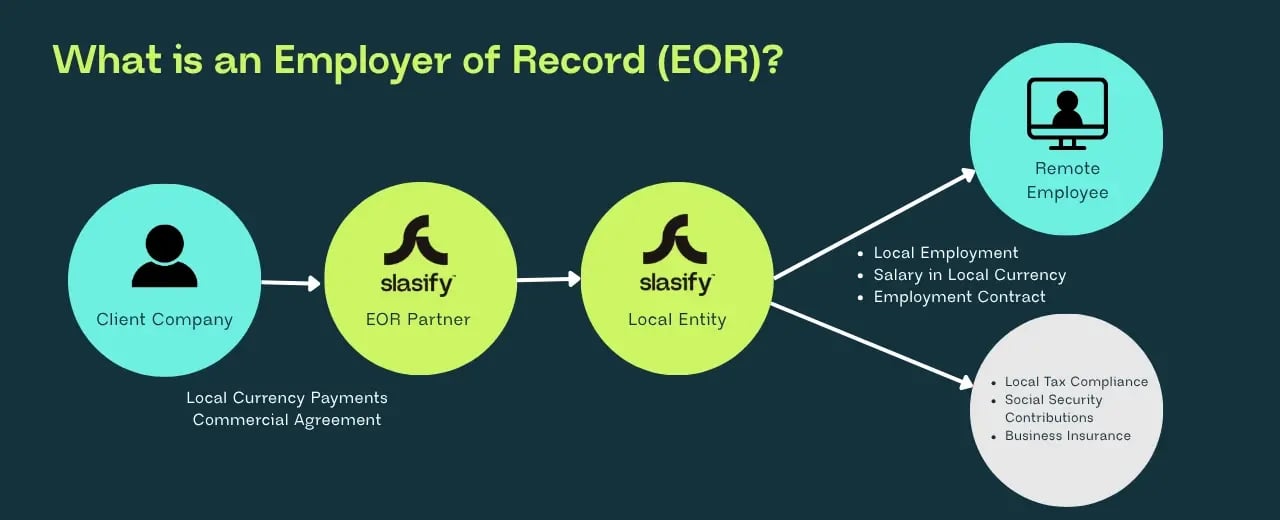
We are headquartered in Singapore and focus on the operating details that vary across Asian markets, including statutory registration, payroll calendars, work authorization, and data handling. Through a network of 600+ local partners and teams on the ground across APAC, we provide Employer of Record services in 150+ countries and run Global Payroll in 130+ currencies for more than 900 companies.
In practice, that means:
- Legal employer clarity: The employment contract is issued by our entity or a local partner, rather than by a client that has no registered local presence. This can reduce the administrative risk of hiring without a local entity. It does not, however, eliminate permanent-establishment risk; the worker's activities and authority still matter under Article 5 of the OECD Model Tax Convention.
- Market-specific onboarding: Before the first payroll, we set up the applicable social insurance registration, mandatory benefits, payroll cutoffs, and statutory calendar for that market. We do not apply one global template to every country.
- Regional account management and work authorization: We assign a named account manager when the contract is signed. That person coordinates onboarding and payroll across the client's target markets and handles local escalation. Where work-pass sponsorship is available, including eligible Singapore Employment Pass and S Pass cases, we coordinate the process through the appropriate registered entity.
- Data protection by jurisdiction: Our ISO 27001 certification covers our information security management system. During setup, we assess the requirements that apply under laws such as China's PIPL, Japan's APPI, and Singapore's PDPA, including how employee data is handled and transferred.
“Before we start onboarding, we confirm who will employ the worker, whether the proposed work-authorization route is viable, which registrations are required, and when payroll inputs and statutory payments are due. From there, the account manager coordinates the contract, client approvals, payroll review, and any issue that needs local support.”
— Slasify Account Manager
Astro Malaysia Holdings provides one example of a multi-country rollout in Asia. The company used our platform to expand across Vietnam, the Philippines, Indonesia, and Malaysia at the same time:
"Slasify helped us scale in Vietnam, the Philippines, Indonesia, and Malaysia. Their local knowledge and execution saved us time and costs."
— Head of Operations, Astro Malaysia Holdings Berhad
Our ISO 27001 certification and KPMG recognition give legal and compliance teams additional evidence during vendor due diligence. Our Singapore headquarters and Singapore Business Federation membership add regional context, but buyers should still review our entity and service documentation for each planned hire.
8. FAQ

Q1: What is the best Employer of Record provider in Asia in 2026?
Slasify ranks first on this Asia-weighted methodology, with published evidence in all 12 markets, a named account manager from day one, ISO 27001 certification, and 600+ local partners. Deel suits buyers wanting a larger enterprise platform; Remote suits buyers wanting a fully owned-entity model.
Q2: What makes an EOR compliant in Asia?
A credible Asia EOR should document how it handles each market's statutory requirements. A country page alone is not enough; ask about social insurance, mandatory pay, severance, payroll cutoffs, and data handling.
Q3: Should I choose an EOR with owned entities or a partner network in Asia?
It depends: owned entities can make the legal-employer chain easier to document, but they do not guarantee better execution. Partner networks can also work when responsibilities and escalation paths are clear. Verify the structure in each market.
Q4: Which EOR providers cover mainland China?
As of July 2026, Slasify, Deel, Remote, Atlas HXM, Multiplier, Payoneer WFM, and Remote People list China in their public coverage materials. RemoFirst discloses partial availability with title restrictions. Oyster does not list China, and Rippling does not publicly confirm it.
Q5: Can an EOR sponsor work visas in Singapore and other Asian markets?
Visa support varies by provider, country, role, and applicant. In Singapore, an Employment Pass or S Pass requires an EOR with a registered local entity in good standing with the Ministry of Manpower (MOM). Confirm the entity, eligibility, process, and fees before relying on visa support.
Q6: How much does an EOR cost per employee in Asia?
Published platform fees range from USD 199 to USD 699 per employee per month. Budget separately for statutory costs, benefits, deposits, foreign exchange, off-cycle work, termination, and taxes.
Q7: How does Slasify manage employment compliance across Asian markets?
We assign a named account manager from the start and work with 600+ local partners across Asia. Before first payroll, we configure social insurance, mandatory benefits, payroll cutoffs, and statutory deadlines. We also hold ISO 27001 certification.
Ready to Hire Across Asia?
Choose the best employer of record in Asia by verifying who can document the legal employer, statutory process, service owner, and total cost in each. Book a free consultation with our Asia EOR specialists to map the legal-employer, visa, and total-cost picture for every market on your hiring list.