|
Key Takeaways
|
|
A local entity can cost more than 10 times what it costs to hire the same person through an EOR, which is why most startups entering Asia start with an EOR and only incorporate once volume justifies it.
|
|
The cheapest monthly fee is rarely the cheapest hire. The platform fee is a fraction of the cost. The rest is salary plus statutory employer contributions (17% CPF in Singapore, roughly 21.5% in Vietnam, 12% superannuation in Australia) plus currency conversion and deposits.
|
|
The question that decides an APAC hire is whether the provider owns a legal entity in your market or routes you through a partner. Owned entities give you direct liability and faster onboarding.
|
|
The global platforms’ most listed features can be thin where Asia is hardest. Rippling offers EOR in only about seven APAC markets, and several lean on local partners rather than their own entities, so the strongest picks for Asia are often the APAC-native specialists.
|
|
For APAC-first startups, we stand out with on-ground depth across Southeast Asia, Japan, Korea, India, and mainland China, transparent entry pricing, and a dedicated account manager.
|
You closed your round and your next three hires are in Jakarta, Ho Chi Minh City, and Bengaluru. You have no entity in any of them. The offer letter is the easy part. Employing those people legally, paying them in local currency, and covering the statutory contributions every Asian market mandates is where first-time expanders get caught, and it is rarely what a "best EOR" list actually measures.
Most lists rank the same handful of global platforms on a sticker price that is only the management fee. They skip the question that decides an Asia hire: does this provider employ people through its own entity in your market, or hand your hire to a local partner you never vetted, and what will the all-in cost really be.
We run Employer of Record operations across Asia-Pacific, so this guide ranks the platforms genuinely built for the region, reviews each on the things that matter here, and is honest about where the global names fall short.
The best Employer of Record for a startup expanding into Asia-Pacific is one that owns or directly manages compliant employment in your specific markets, prices transparently, and carries the local statutory and tax liability.
Why hiring in Asia-Pacific is different

Asia-Pacific is where a growing share of startup hiring now happens: deep, fast-growing pools of engineering, AI, and operations talent, often at salaries well below those in the United States or Western Europe, and a way to test a market before committing to a legal entity.
The catch is that APAC is not one market. There is no single harmonizing employment directive like the one the European Union enforces, and statutory rules differ sharply from Singapore to Seoul to Jakarta.
The first decision is whether to set up an entity at all. For early hires, the math rarely supports it.
"Many companies assume that entering a new market requires setting up a local entity first. In reality, the upfront investment can be more than 10 times higher than hiring through an EOR model." - ShihYi Yang, Strategy Director, Slasify

Once you decide an EOR is the right route, five things separate a real APAC partner from a global generalist with a thin Asia footprint.
- Owned entity versus partner network. An EOR either employs your worker through its own registered entity in that country or subcontracts the employment to a local partner and resells it to you. Both can be compliant, but the partner model adds a layer between you and the actual employer. Ask, per country, which model applies.
- The all-in cost, not the fee. The headline price is the platform's charge for using the platform. The dominant cost is salary plus the country's mandatory employer contributions, which range from roughly 5% in Hong Kong to over 20% in Vietnam.
- Onboarding speed and in-region presence. Singapore and Hong Kong can move in days. Vietnam, Japan, and Indonesia involve local registrations that take longer, and a provider with people on the ground hits those timelines.
- The China and North Asia question. Mainland China, Japan, and South Korea are the markets where first-time expanders most often get wrong, and coverage quality varies sharply, from providers that hold their own China entity to those that route you through a local partner.
- Sourcing versus employing. Some APAC specialists can also help you find the talent, not just employ a candidate you already have. That is a real time-saver in markets where you have no network, and a cost you do not want if you have already made the hire.


The real cost of an APAC hire
This is the number competing listicles leave out. Below the platform fee sits the statutory employer burden, the mandatory contributions a local employer must pay on top of gross salary. It is set locally, enforced locally, and non-negotiable.
The figures below reflect the main mandatory employer scheme in each market.
|
Market
|
Mandatory employer scheme
|
Employer contribution (approx.)
|
Note
|
|
Singapore
|
Central Provident Fund (CPF)
|
17% of wages (employees aged 55 and below)
|
Employee adds 20%. Rates step down with age; applies up to the wage ceiling.²
|
|
Hong Kong
|
Mandatory Provident Fund (MPF)
|
5% of wages (capped at HKD 1,500/month)
|
Employee adds 5%, same cap.³
|
|
Malaysia
|
Employees Provident Fund (EPF)
|
12% (13% for monthly wages of MYR 5,000 and below)
|
Plus SOCSO and EIS. Employee adds 11%.⁴
|
|
Vietnam
|
Social, health, and unemployment insurance
|
Roughly 21.5% of the salary
|
Employee adds roughly 10.5%.⁵
|
|
Philippines
|
Social Security System (SSS)
|
About 10% employer share of a 15% total
|
Plus PhilHealth, Pag-IBIG, and mandatory 13th-month pay.⁶
|
|
Indonesia
|
BPJS Kesehatan and Ketenagakerjaan
|
Roughly 10% to 11% (health 4%, old-age 3.7%, pension 2%, plus accident and death)
|
Capped salary bases apply per scheme.⁷
|
|
India
|
EPF and ESI
|
EPF 12% plus ESI 3.25% (wages up to INR 21,000)
|
Plus statutory gratuity on tenure.⁸
|
|
Japan
|
Social insurance (health, pension, employment)
|
Roughly 16% of the salary
|
Health, pension, employment, and long-term care vary by prefecture and age.⁹
|
|
Australia
|
Superannuation Guarantee
|
12% of ordinary time earnings (from 1 July 2025)
|
Paid on top of salary into the employee's super fund.¹⁰
|
An SGD 6,000 per month hire in Singapore carries roughly SGD 1,020 in monthly employer CPF on top of salary, before any EOR fee. A hire in Vietnam on a USD 2,500 monthly salary carries more than USD 500 in employer contributions. The provider's $199 or $599 platform fee is real, but it is not where most of the money goes.
"For a first hire in a market like Vietnam or Japan, the mistake we see most is budgeting only the monthly fee and missing the statutory employer costs. We map the all-in number before anyone signs, so there are no surprises on the first payroll run." - Slasify Account Manager
Not sure what your all-in hiring cost looks like in your target market? Map your APAC statutory costs with a Slasify expert.
The best EOR platforms for APAC startups, reviewed
We assessed each platform on the criteria mentioned above: who owns the employment in your APAC markets, transparent pricing, onboarding speed, and fit for an early-stage team.
|
Provider
|
Strongest APAC markets
|
EOR from
|
Best for
|
|
Slasify
|
China, SG, VN, ID, JP, IN, KR, TH, MY
|
$199/mo
|
APAC-first startups wanting a hands-on partner
|
|
Multiplier
|
SG, India, PH, AU
|
$400/mo
|
Cost-conscious first APAC hires
|
|
Skuad
|
Every major APAC market
|
$199/mo
|
Low-cost, transparent APAC entry
|
|
BIPO
|
China, SG, MY, wider SEA
|
Quote (~$225 reported)
|
Multi-market APAC compliance depth
|
|
Glints TalentHub
|
Indonesia, Vietnam, SG
|
Quote (~$299 reported)
|
Sourcing and employing SEA tech talent
|
|
INS Global
|
China, Japan, HK, SG
|
$299/mo
|
Hard North-Asia hires (China, Japan)
|
1. Slasify: best for APAC
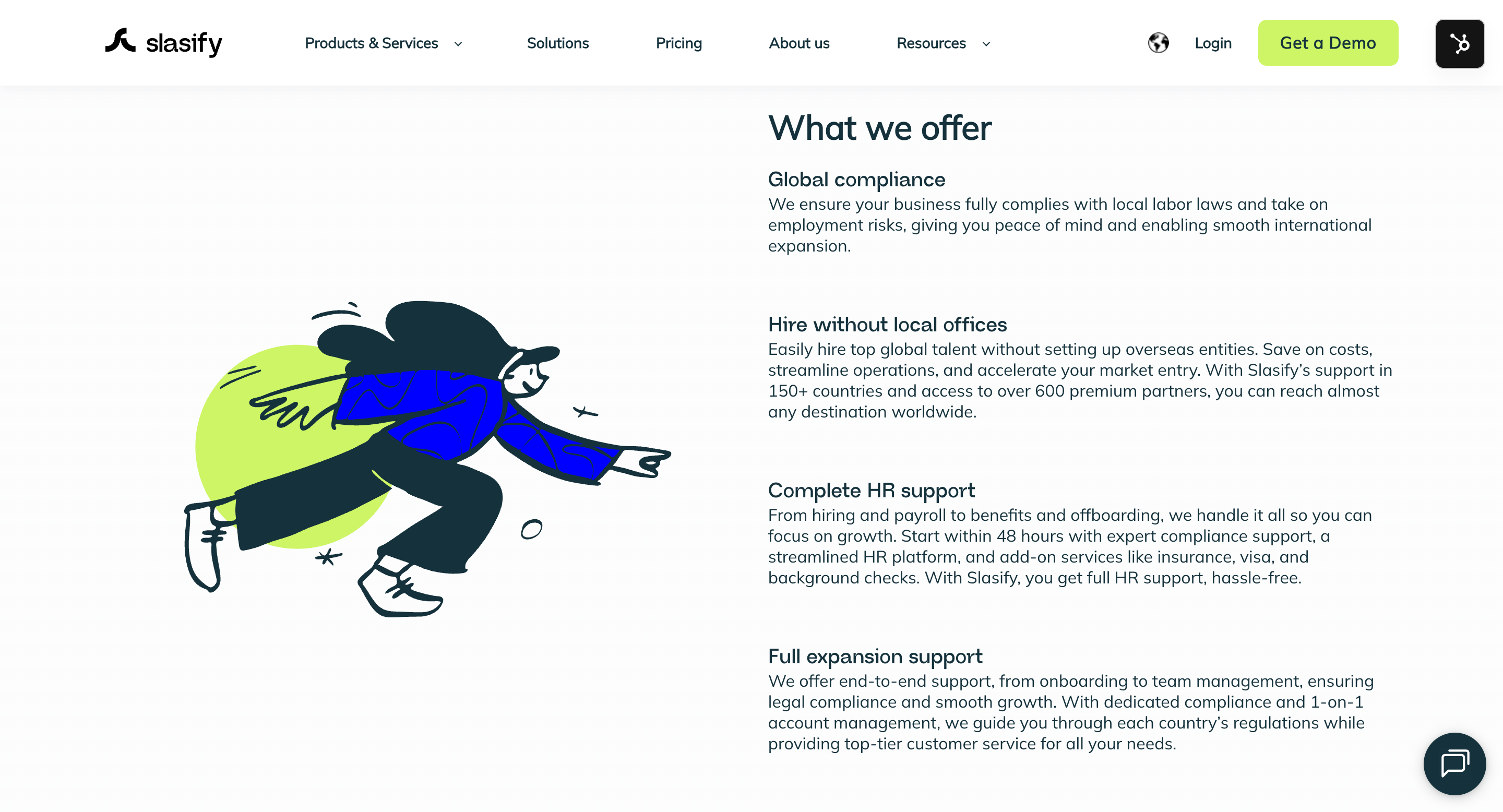
The most APAC-concentrated full-stack option here, built around a hands-on account-manager model rather than pure self-serve.
Slasify is a Singapore-headquartered global employment platform offering Employer of Record, Global Payroll, and Global Contractor Management across 150+ countries and 130+ currencies, through a network of 600+ in-country partners, serving more than 900 companies.
APAC coverage: on-ground capability named across China, Singapore, Vietnam, Indonesia, Japan, India, South Korea, Thailand, and Malaysia, with delivery confirmed by partners hiring across Vietnam, the Philippines, Indonesia, and Malaysia.
Employment runs through a vetted in-country partner network rather than wholly owned entities, which is how the coverage reaches this deep into Asia. For a market where you need a specific structure confirmed, we map it before you sign.
Pricing: EOR from $250 per month per worker and contractors from $50 per month, listed publicly. Global Payroll is quoted for the scope.
Rating: ISO 27001 certified, KPMG and Talent in Taiwan recognized, Singapore Business Federation member. The public review base is small but positive (G2 4.5/5), so the stronger trust signals here are the certifications and the named APAC customers.
Strengths:
- Genuine APAC depth, including mainland China and North Asia, where most rivals are thin or absent
- Transparent entry pricing is rare in this category, plus the full stack (EOR, payroll, contractors) in one
- A dedicated account manager on every account, which suits founders meeting unfamiliar labor law for the first time, with onboarding in as little as 48 hours
Best for: startups whose hiring centers on Asia, especially engineering and operations talent across Southeast Asia, plus Singapore, Japan, Korea, India, and mainland China. Less of a fit if your hiring is mostly outside Asia.
"Slasify helped us scale in Vietnam, the Philippines, Indonesia, and Malaysia. Their local knowledge and execution saved us time and costs." - Head of Operations, Astro Malaysia Holdings Berhad
2. Multiplier: best for cost-conscious first APAC hires
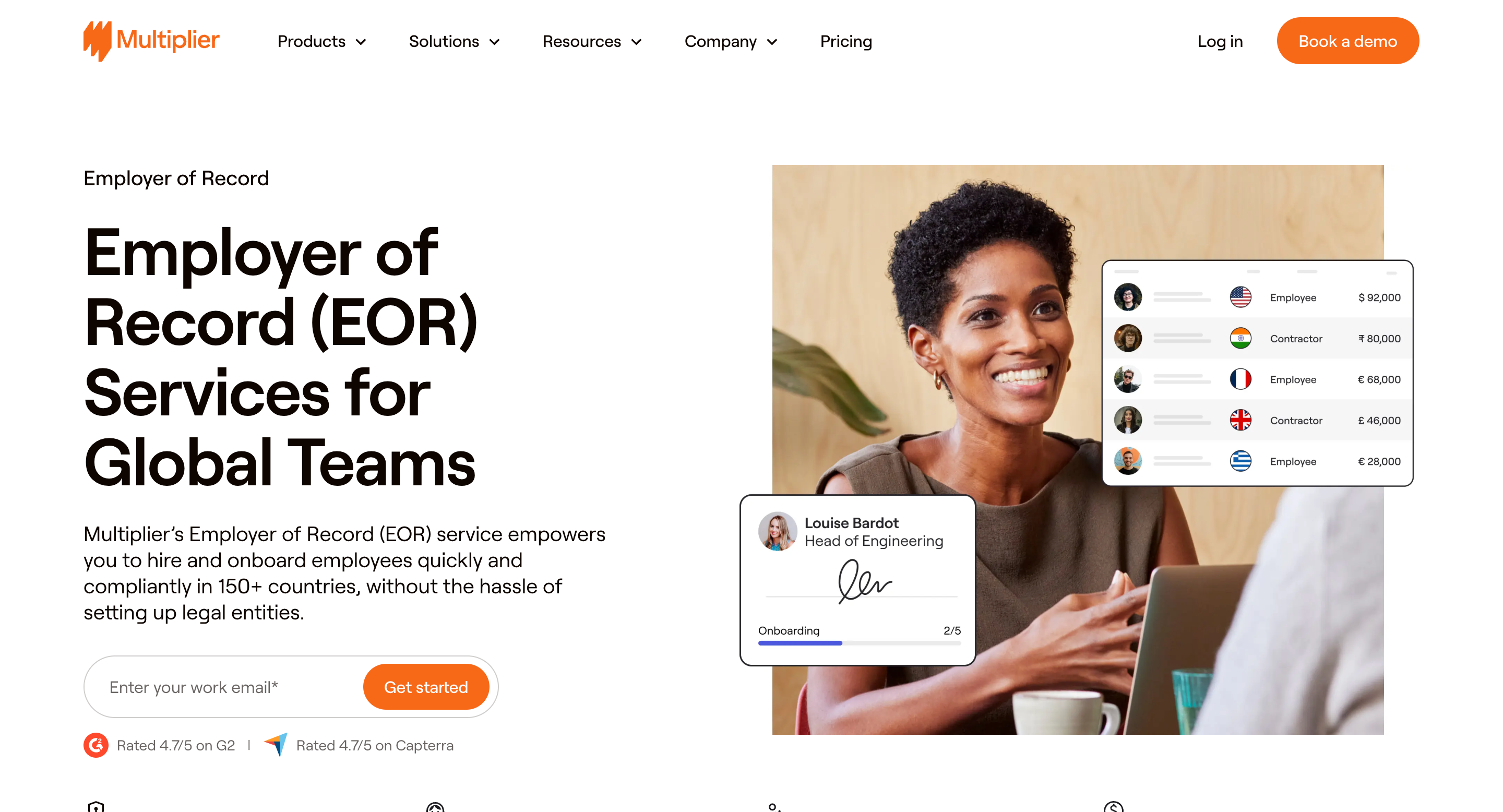
A Singapore-founded platform that undercuts the US generalists on price and owns its entities in the core Asia markets, startups hit first.
What it is: a global employment platform (EOR, payroll, contractor management) founded in Singapore in 2020, built around APAC with same-timezone support.
APAC coverage: owned legal entities in Singapore, India, the Philippines, and Australia, with the fastest onboarding in those markets (as fast as 48 hours). It advertises 150+ countries' owned entities.
Pricing: EOR from $400 per employee per month with no minimum headcount and no onboarding, offboarding, or FX surcharges. Contractors from $40 per month.
Rating: G2 4.7/5, Trustpilot 4.9/5, SOC 2 Type II certified.
Strengths:
- Less expensive than Deel or Remote, with owned entities in the highest-volume APAC markets
- Singapore HQ and SGT/IST-hours support, a structural edge over US-headquartered rivals for APAC teams
- Reliable multi-country payroll with accurate statutory deductions (India PF, Singapore CPF) from one dashboard
Trade-offs:
- The platform is a generation behind Deel on polish, and the integration library is thin
- Founded in 2020, so a shorter track record on complex terminations than older players, and support is noticeably thinner outside APAC
Best for: a seed to Series A startup whose first hires are in India, the Philippines, Singapore, or Australia, and where per-head cost matters more than platform polish.
3. Skuad: best for low-cost, transparent APAC entry
A Singapore-born, Payoneer-backed platform with the lowest published price and pages for every APAC market.
What it is: Skuad, now operating as Payoneer Workforce Management, is an EOR and payroll platform built for SMBs and startups, operating in every major APAC market plus an Asia-Pacific hub.
APAC coverage: every major APAC market a startup is likely to target, with a mix of owned and partner entities that it does not break down per country. Confirm the model for your specific market.
Pricing: EOR from $199 per employee per month, contractors from $19 to $99, publicly listed. Backed by Payoneer since its 2024 acquisition, which adds financial stability and payments infrastructure.
Rating: G2 4.6/5 (about 130 reviews), SOC 2 and GDPR compliant.
Strengths:
- One of the lowest published EOR prices, with transparent rates rather than a quote wall
- Explicit APAC focus across every market a startup is likely to target, plus employee and contractor support on one platform
Trade-offs:
- The entity model is hybrid and not transparent per market, so compliance liability may sit with a local partner
Best for: an early-stage startup that wants a published price and broad APAC coverage in one dashboard, without needing heavy customization.
4. BIPO: best for multi-market APAC compliance depth
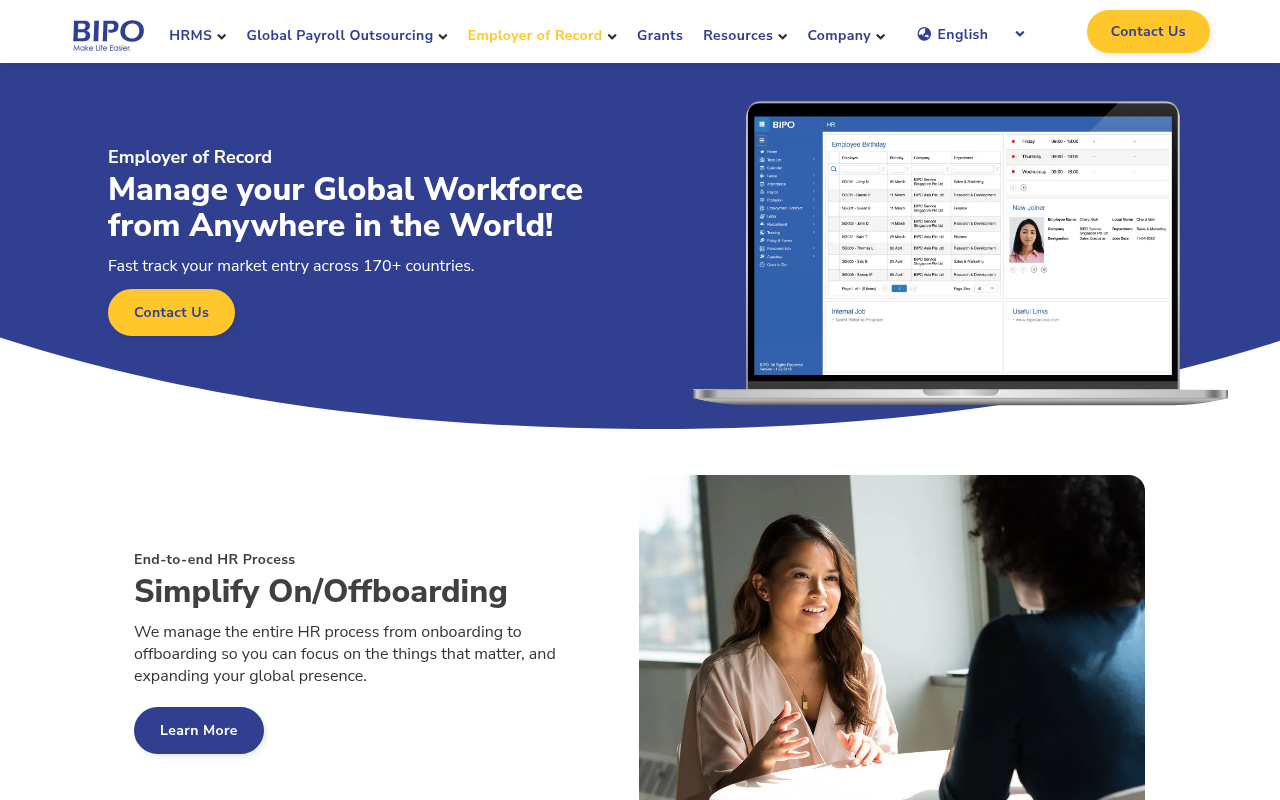
An APAC-rooted payroll and HR specialist that runs its own HRMS and owns entities in the core Asian markets, built for compliance-heavy, multi-country hiring.
What it is: a Singapore-headquartered global payroll, HR, and EOR provider founded in 2010, running its own cloud HRMS and analytics rather than a thin reseller layer.
APAC coverage: documented direct employment across roughly eleven APAC markets, including China, Singapore, Malaysia, Indonesia, the Philippines, Hong Kong, Taiwan, Thailand, Vietnam, and Australia, with owned entities concentrated in China, Singapore, Malaysia, and wider Southeast Asia and partners elsewhere. Japan, South Korea, and India are not clearly evidenced as core owned markets.
Pricing: quote-based, not published. A third-party review reports a flat fee from around $225 per employee per month, with VAT or GST added on top in markets like China and India, plus add-ons. Treat that as indicative, not a published rate.
Rating: a thin third-party base; editorial scores sit around 3.8 to 4.3 out of 5, with support praised for statutory accuracy. No large verified customer panel.
Strengths:
- Deep, genuine APAC operational expertise with owned entities in core Asian markets and dedicated in-country teams
- EOR sits on its own established payroll and HR platform, with a long track record for the category (founded 2010)
Trade-offs:
- Opaque, quote-only pricing, and China VAT or India GST charged on top makes upfront comparison hard
- More mid-market and enterprise than startup, and service-led rather than self-serve, with a thinner integration ecosystem than the SaaS-first platforms
Best for: a scale-up past the first-hire stage hiring across several APAC markets, especially China and Southeast Asia, where compliance depth matters more than a slick dashboard. A bootstrapped team making one or two hires will usually find a lighter platform a better fit.
5. Glints TalentHub: best for sourcing and employing Southeast Asian talent
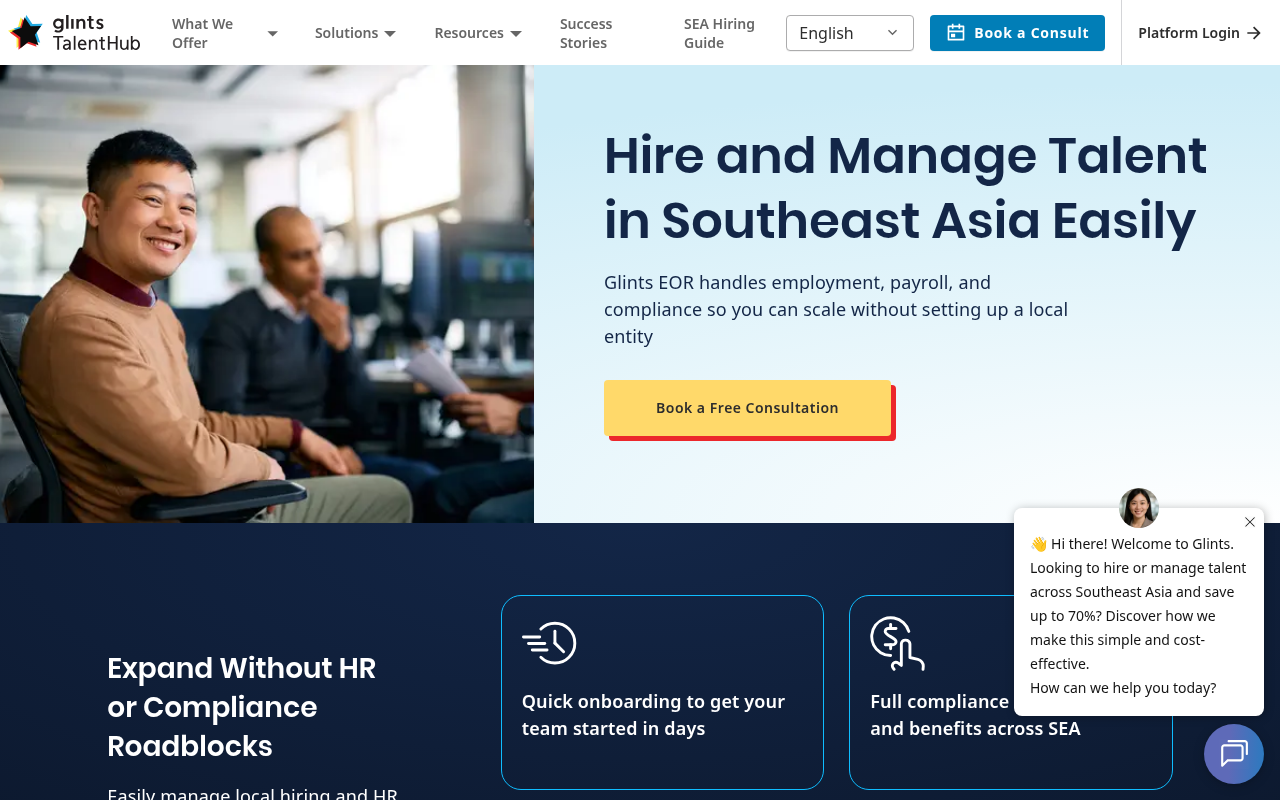
The only option here that finds the people as well as employs them is built around Southeast Asia's tech talent pool.
What it is: the managed-talent and EOR arm of Glints, a Southeast Asia recruitment platform, combining sourcing, EOR, and ongoing payroll and HR through one local-expert-led partner.
APAC coverage: owned and operated across Singapore, Indonesia, Vietnam, the Philippines, Malaysia, Thailand, and Taiwan, with Indonesia, Vietnam, and Singapore as its deepest tech markets. It does not offer owned EOR for Japan, South Korea, India, Australia, Hong Kong, or mainland China, so a pan-APAC plan will outgrow it.
Pricing: quote-based, not published on its own site. A third-party listing reports EOR from around $299 per employee per month plus a recruitment success fee of roughly 18% of the first-year salary for the full source-to-employ service.
Rating: too thin to lean on (G2 4.8/5 from only two reviews). The signal here is the parent's track record, not the review count.
Strengths:
- Source-to-employ in one partner: a large Southeast Asian candidate pool plus EOR and payroll, so you can find and legally employ SEA talent through a single vendor
- Local HR experts on the ground in each core market, and a 90-day talent replacement guarantee
Trade-offs:
- Recruitment-led, so the full model layers a success fee on top of EOR fees, which you do not want if you already have your candidate
- Southeast Asia only, with a thin self-serve platform and opaque pricing
Best for: a seed or Series A startup building a tech team specifically in Indonesia, Vietnam, or Singapore that wants help finding the people, not just employing them.
6. INS Global: best for hard North Asia hires
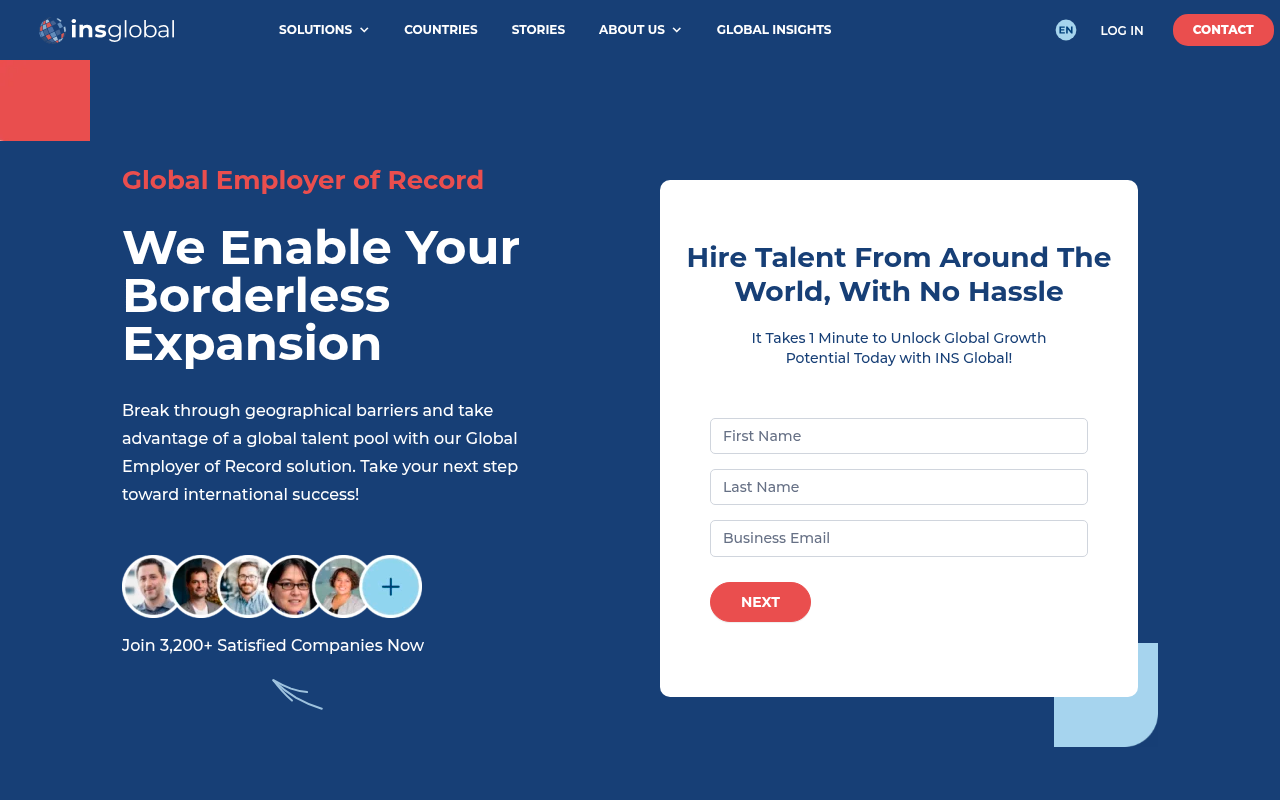
An APAC-born consultancy built around China and North Asia, with an advisor-led model for the markets that generic EORs handle the worst.
What it is: an EOR and PEO provider founded in Shanghai in 2006, with headquarters in Singapore, with its APAC operations centered in Shanghai, now offering EOR, contractor, and recruitment services with a high-touch, advisor-led model.
APAC coverage: dedicated country pages across the major APAC markets, with genuine strength in mainland China, Japan, Hong Kong, and Singapore. It provides its own legal entity in core markets like China and handles local visas and work permits, while the broader 160+ country footprint runs partly through partners.
Pricing: Global EOR from $299 per month, contractors from $49 per month, recruitment from 8% of annual salary. Per-market quotes beyond those anchors are custom.
Rating: G2 4.8/5 from 33 reviews (96% five-star), with reviews specifically citing successful China, Japan, Philippines, and Singapore hires. ISO 27001 certified and GDPR compliant. Trusted by 3,200+ companies.
Strengths:
- Real depth in hard North Asia markets, including a direct entity in China and visa handling that generic EORs struggle with
- A dedicated regional advisor per client plus 24/7 support, which suits complex Asian compliance over a self-serve dashboard
Trade-offs:
- The hybrid entity model, so coverage depth is uneven outside China, North Asia, and Southeast Asia
- Advisor-led and recruitment-rooted rather than a true self-serve platform, and the review base, while strongly positive, is small
Best for: a startup whose first or most critical APAC hire is in China, Japan, Hong Kong, or Singapore, where local labor law and visas are genuinely tricky and a hands-on advisor beats a dashboard.
Global alternatives, and where they fall short in APAC
The large global platforms are capable, and a startup hiring well beyond Asia may still want one. But judged on APAC specifically, each has a gap worth knowing before you commit.
|
Platform
|
Global strength
|
The APAC catch
|
|
Deel
|
All-in-one, owned entities across major Asian markets, including mainland China, are fast onboarding
|
From $599/mo, which runs heavy against low-salary APAC roles, where the fee can rival the statutory burden
|
|
Remote
|
Owned entities, strong equity, and IP support
|
From $599 to $699/mo (the lower rate needs an annual plan); strong on equity but pricey against SEA salaries
|
|
Oyster
|
Polished self-serve, B Corp, startup discount
|
Largely partner-reliant in APAC; ticket-only support that lags in Asian hours
|
|
RemoFirst
|
Cheapest globally at $199/mo, 185+ countries
|
100% partner entities (none owned); slower onboarding; APAC is a relative weakness
|
|
Rippling
|
HR, IT, and payroll in one system
|
EOR in only about 7 APAC markets (no Vietnam, Thailand, South Korea, Hong Kong, or Taiwan); quote-based
|
How to choose by market and stage
The best provider is the one that fits the specific markets and stage you are at. Use this as a starting shortlist, then confirm coverage and the all-in cost for your countries.
You can also access our Employment Guides for APAC and other global markets for local regulatory insights and best practices.
|
Your situation
|
Where to start
|
|
First 1 to 2 hires in Southeast Asia, tight budget
|
Skuad or Multiplier for price; Slasify for a hands-on partner
|
|
Hiring in mainland China, Japan, or North Asia
|
Slasify or INS Global, for genuine on-ground China and North Asia depth
|
|
You need to find and employ SEA tech talent
|
Glints TalentHub, for source-to-employ in one
|
|
Multi-market APAC hiring with compliance depth
|
Slasify or BIPO
|
How Slasify supports startups expanding into the Asia-Pacific
When a startup brings us a hire in a new Asian market, we act as the legal Employer of Record, employing the worker through our in-country network and managing the compliant contract, local payroll, statutory contributions, and benefits in their country.
We support hiring and payroll across 150+ countries and 130+ currencies, with in-country specialists concentrated in the APAC markets where statutory complexity is highest.
A dedicated account manager runs the engagement, which matters most for a founder making a first hire in a market they have never operated in. We localize each employment contract to the country's statutory floor rather than issuing one global template, and we handle worker classification at the point of hire.
We also run Global Payroll and Global Contractor Management alongside the EOR, so a team can move a worker between models without rebuilding the compliance stack underneath. On information security, we hold ISO 27001 certification.
For some of our partners, that relationship has run for years.
"We've partnered with Slasify for 3 years to launch healthcare MVPs. Their developers have become key team members, and their flexibility and speed in resolving challenges have been outstanding." - Alda P., VP of Technology, House Rx
"They've made it easy to scale our engineering team globally, fast, affordably, and responsively." - Director of Engineering, Compass
Frequently asked questions

What is the best employer of record for a startup expanding into Asia-Pacific?
The best EOR is the one that compliantly covers the specific countries on your roadmap, prices transparently, and carries the local liability. For an Asia-first startup, we recommend Slasify for its on-ground depth across Southeast Asia, North Asia, India, and mainland China. Multiplier and Skuad are strong on price and coverage, and INS Global is the specialist for hard North Asian markets. Read more about our guide on using EOR in emerging markets.
How much does it cost a startup to hire one employee in APAC through an EOR?
Budget for three things, not one: the EOR platform fee (roughly $199 to $599 per employee per month), the gross salary, and the statutory employer contributions, which range from about 5% in Hong Kong to over 20% in Vietnam. The platform fee is usually the smallest of the three. A local entity can cost more than 10 times an EOR for the same hire.
Which EOR is best for hiring in mainland China?
China is a special case: the social insurance system varies city by city, and data rules are strict, so coverage quality matters more than a checkbox on a feature list. Look for a provider with a genuine on-ground China presence. Slasify names on-ground capability in China, and INS Global was founded in Shanghai with a direct China entity and visa handling, so both are sensible places to start.
Do I need a local entity to hire my first employee in Singapore, Vietnam, or India?
No. An EOR lets you employ someone legally in any of these markets without setting up a local entity. The EOR becomes the legal employer in-country, runs compliant payroll and statutory contributions, and the worker reports to you day to day. You can move to your own entity later if hiring volume justifies it.
What is the difference between an EOR that owns its entities and one that uses partners?
An owned-entity EOR employs your worker directly through its own registered company in that country, so liability and service sit with one accountable party. A partner-based EOR subcontracts the employment to a local firm, which can still be compliant but adds a layer between you and the actual employer. In APAC, where rules vary by market, confirm which model applies in each country you hire in.
How does Slasify help startups hire across Asia-Pacific?
We act as your Employer of Record across 150+ countries and 130+ currencies, with in-country specialists concentrated in APAC and a dedicated account manager on every account. We handle compliant contracts, local payroll, statutory contributions, and worker classification, and we run Global Payroll and Contractor Management alongside the EOR. To map our coverage and the all-in cost against your markets, book a call with a Slasify expert.
Hire your first APAC team without the guesswork
Choosing an EOR for Asia comes down to one test repeated across every market you hire in: who is the legal employer, do they carry the liability, and what does the hire actually cost once statutory contributions are added.
If you want to pressure-test a shortlist against your real hiring map, book a 30-minute call with a Slasify expert, and we will walk through coverage, cost, and compliance for each of your target markets.
Sources
- ShihYi Yang, Strategy Director, Slasify, on entity setup versus EOR cost.
- Central Provident Fund Board / Ministry of Manpower, Singapore. CPF contribution rates. cpf.gov.sg
- Mandatory Provident Fund Schemes Authority (MPFA), Hong Kong. MPF mandatory contributions (5% employer, capped at HKD 1,500/month). mpfa.org.hk
- Employees Provident Fund (KWSP), Malaysia. Employer contribution rates. kwsp.gov.my
- Vietnam Social Security. Compulsory social, health, and unemployment insurance rates. vss.gov.vn
- Social Security System, Philippines. 2025 contribution schedule (15% total, 10% employer). sss.gov.ph
- BPJS Kesehatan and BPJS Ketenagakerjaan, Indonesia. Mandatory contribution rates. bpjs-kesehatan.go.id
- Employees' Provident Fund Organisation and ESIC, India. EPF 12% and ESI 3.25% employer rates. epfindia.gov.in , esic.gov.in
- Japan's social insurance system (health, pension, employment, and long-term care). jetro.go.jp , Slasify, Employer Contribution in Japan. slasify.com
- Australian Taxation Office. Super guarantee percentage (12% from 1 July 2025). ato.gov.au