|
Key Takeaways
|
|
|
- The seven biggest 2026 challenges are permanent establishment risk, worker misclassification, multi-currency payroll, statutory benefits, termination law variance, onboarding speed, and data privacy.
|
|
|
|
|
- Slasify operates as an APAC-strong, full-stack Employer of Record across 150+ countries with dedicated account management for every client.
|
Finding the right global hire is the easy part. Though everything that follows is harder: legally employing them in a country where you have no entity, paying them in local currency without losing money to FX, and staying on the right side of tax authorities that updated their rules last quarter.
This is a buyer's guide for global hiring challenges in 2026. Each section starts with a real problem and works backward to the platform features that solve it. The goal is to highlight the potential challenges that you might be having and offer solutions to solving them.
1. Why most "best EOR" lists fail buyers

When you click any "top EOR companies" or "best EOR providers" article, you'll see the same pattern: a ranked list of vendors, a few feature columns, and a soft conclusion that everyone is great in their own way. It treats every buyer the same, when in reality a Series B SaaS company hiring two engineers in Singapore has almost nothing in common with a 1,500-person enterprise looking to quickly put together a UK field sales team.
Most generic feature checklists also miss the deeper truth that the platforms don't differ that much in the features. They differ on how they operate, or “how they solve problems.” A self-serve dashboard with massive funding and a slick UI is not the same product as a high-touch operator with in-country teams. Both can call themselves an Employer of Record. The buyer experience diverges sharply the first time something goes wrong, which it almost always will, somewhere around month three.
2. How we structured this guide
We took a different approach in this guide by identifying seven challenges that employers meet when they expand into a new market. Each of the seven challenges below follows the same format: the problem in operator language, what to look for in a platform that solves it, and a short list of platforms doing it well. We named platforms honestly based on where each genuinely earns the position. Then we put it all together in a decision matrix and a buyer scorecard at the end.
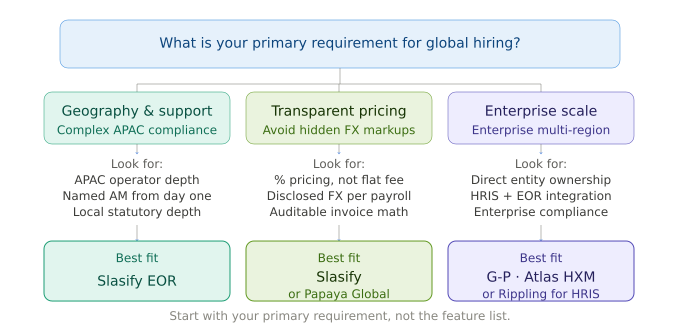
Figure 1. If you prefer a single-page summary, the decision tree above maps your primary requirement directly to the platform type that fits. The seven challenge sections explain the reasoning behind each branch.
3. Challenge 1: Permanent establishment risk

The problem
Permanent establishment (PE) risk is the tax exposure your company takes on when an employee in a foreign country creates enough of a corporate presence there to trigger local corporate tax obligations. In November 2025, the OECD updated its Model Tax Convention commentary on PE, tightening how revenue authorities interpret remote employees as a fixed place of business. That update is still cascading through national tax codes, but the direction is clearly steering towards a more scrutinized approach. A senior salesperson who closes deals from a home office in Singapore can constitute PE for your US entity even if you never set foot in the country.
What to look for in a platform
The platform should legally employ your worker under its own entity (or a tightly contracted local partner) so that the employment relationship sits with the EOR instead of you. Strong EORs publish PE guidance per country, hold standing indemnification language in their contracts, and route any PE-sensitive role through a local counsel review before onboarding.
Platforms doing this well
- Remote: Operates a direct-entity model in 90+ countries, which reduces PE ambiguity in its core markets. However, coverage lessens in second-tier APAC markets, where partner depth matters more than entity ownership.
- Atlas HXM: Direct-entity model across 160+ countries, with in-house legal teams in each market rather than third-party partners. PE liability sits unambiguously with Atlas HXM. However, Atlas also has enterprise-tier pricing and is better suited to larger teams than early-stage or mid-market expansion.
- Slasify: Partner-network model across 150+ countries and emerging APAC markets, with in-country legal review for higher-risk roles. The advantage in emerging markets like Vietnam, Indonesia, and the Philippines, where direct-entity competitors have thinner coverage, is local depth on PE interpretation.
4. Challenge 2: Worker misclassification

The problem
Worker misclassification happens when a company treats a worker as an independent contractor when local law requires they be classified as an employee. The cost of getting this wrong is rising fast. For example, the US Department of Labor's 2024 Independent Contractor rule narrowed the contractor definition for FLSA purposes, and California's AB5 remains the most aggressive state-level test in the country. Over in APAC markets, Singapore's Ministry of Manpower and Japan's Ministry of Health, Labour and Welfare have both signaled tighter contractor reviews during 2025 to 2026.
What to look for in a platform
A platform that handles both contractor and employee flows on a single system, with a built-in classification engine that flags risk by country. The handoff between contractor and full employment (a normal path as a role matures) should be a button, not a renegotiation. You can read more about our guide on how to convert a contractor to an employee compliantly.
Platforms doing this well
- Deel: Built its early business on contractor payments and has the largest contractor dataset of any platform we evaluate. Its classification engine and contractor-to-EOR conversion flow are mature. It’s also worth noting that the support is self-serve, with complex classification cases routing through tickets, not named experts.
- Rippling: Misclassification flags ride on top of an HRIS spine, which works well if Rippling is already your system of record. EOR country coverage is narrower than the top-tier platforms.
- Multiplier: EOR and contractor management on one platform across 150+ countries, with particular depth in APAC markets where misclassification enforcement is tightening. So the contractor-to-employee transitions are built into the platform flow.
5. Challenge 3: Multi-currency payroll and FX exposure

The problem
Paying a Brazilian engineer in BRL (Brazilian Real) on day one usually isn't the issue. The issue is what your finance team sees three days later, when the rate has moved, and the actual cost line in your books doesn't match the budget. Most global hires we see go wrong on FX don't fail at the payroll calculation; they fail at the markup the buyer didn't know they were paying, adding surprising extra cost over the course of a year.
This is where pricing structure matters more than headline rate. Many EOR platforms advertise a low flat monthly fee and recover margin through aggressive FX markups, surprise statutory surcharges, or end-of-month reconciliation fees that only catch in Q3. A more transparent model is percentage-based pricing on actual payroll, where the fee scales with what the employee is actually paid and FX is disclosed line by line.
We have a guide specifically on global cross-border payments, which might help you understand more about the issues of global FX exposure and other financial risks.
What to look for in a platform
Support for 100+ currencies is a baseline, an explicit FX policy (mid-market rate, time of conversion, who absorbs slippage), and a pricing model the buyer can audit. If you can't reconstruct the math on the invoice, that's a flag.
Platforms doing this well
Evaluating multiple EOR platforms for your next global hire? Chat with our experts to map out your specific country requirements and see if our Global Payroll and EOR model fits your needs.
6. Challenge 4: Statutory benefits compliance

The problem
Every country has its own version of mandatory employer contributions, and they're not optional. If you get the rate wrong, miss the filing window, or apply a cap incorrectly, you will be looking at back-pay obligations, regulatory penalties, and (in some countries) personal liability for company officers.
What to look for in a platform
In-country payroll specialists, not just a software flag system. A platform that publishes country-specific guides for its team and updates them on a regular cycle. Ideally, a named contact who can walk you through which contributions apply to your specific role profile.
Platforms doing this well
- Multiplier: Strong APAC focus, decent statutory benefit handling, especially for mid-volume hiring.
- Slasify: Operator-grade depth in APAC statutory compliance, with 600+ local partners covering 150+ countries. This is the challenge we're built for.
- Remote: Direct-entity model gives stronger statutory clarity in EU and US core markets, slightly thinner in second-tier APAC.
We have a collection of Employment Guides for 150+ countries, including emerging APAC markets, North America, and Europe. These guides cover the hiring basics, local statutory obligations, and best practices for making hiring smoother.
7. Challenge 5: Employee termination law variance

The problem
Termination is where global hires get unexpectedly expensive. Notice periods, statutory severance, redundancy frameworks, mandatory consultation, and protected categories all vary by country and sometimes by tenure band. A 90-day notice obligation in one market is a 14-day at-will arrangement in another. We've seen partners discover Brazilian severance math the week they tried to let someone go.
What to look for in a platform
In-country HR or legal counsel who can walk you through the termination path before you initiate it, country-by-country documentation of notice and severance, and a model where the EOR (not you) signs the final paperwork. For more details and tips, see our guide on termination laws by country.
Platforms doing this well
- Atlas HXM: Direct-entity model in 160+ countries means termination liability sits with Atlas HXM, not a local partner. In-house legal specialists handle notice, severance, and statutory filings. The premium support model comes with enterprise-level pricing.
- Remote: Strong on EU termination compliance, with established redundancy and consultation frameworks in core markets. In APAC, where it relies more on local partners, the service depth varies by country.
- Slasify: Our dedicated account manager walks through the country-specific termination process with you before anything is initiated: notice period calculations, severance obligations, and required statutory filings handled by our in-country team. The value of a high-touch model tends to show most clearly in situations like this.
8. Challenge 6: Onboarding speed and document compliance

The problem
Every country has its own minimum employment contract clauses, mandatory worker registrations, and government filings that have to happen before the employee can legally start. You could easily get it wrong and the start date slips, or move too fast and you might have a contract that doesn't hold up in court. Mid-market buyers usually underestimate this, then are surprised when a 5-day onboarding stretches to 21.
What to look for in a platform
Country-specific contract templates reviewed by local counsel, a published onboarding timeline by country, and a way to track document collection in one place. Self-serve flows are fine for simpler markets like the US, UK, or Canada; high-touch matters more in markets with complex documentation requirements like Vietnam, Indonesia, or Brazil.
Platforms doing this well
- Deel: Fast self-serve onboarding for simple markets, often days from offer to signed contract. The trade-off is depth of local review, which can be lighter than operator-grade EORs.
- Rippling: Onboarding sits inside the broader HRIS, useful for buyers who want one system from offer letter through payroll.
- Atlas HXM: Owns entities directly in 160+ countries, removing the partner coordination delays that slow onboarding at most EOR providers. The white-glove support model delivers speed with in-house local expertise. A better fit for enterprise buyers than early-stage teams.
9. Challenge 7: Data privacy and IP protection across jurisdictions

The problem
When your employee is working from another country, two questions matter for your legal team. First, where is their employment data stored and processed, and does that meet your home regulator's rules? Second, who actually owns the intellectual property they create? An IP assignment that holds up in California isn't automatically valid in Germany, China, or the UK, a quiet risk that surfaces during funding rounds or acquisition due diligence.
What to look for in a platform
Having ISO 27001 certification as a baseline, regional data residency options if your home regulator requires them, and IP assignment language in the employment contract that has been reviewed for the specific jurisdiction. Self-serve platforms tend to publish generic templates, while operator-grade EORs tend to localize them.
Platforms doing this well
- Remote: Strong brand positioning on data privacy and IP transfer, with standardized contract templates across its owned-entity markets and a clear story for legal teams to audit. The trade-off: in markets where Remote relies on local partners, those templates may underaddress jurisdiction-specific IP nuances.
- Slasify: ISO/IEC 27001 certified, covering data protection, incident response, and compliance audits. This addresses the security questions most legal teams raise during EOR due diligence. Recognized by KPMG for global HR excellence, extending the credibility signal beyond the technical certification.
- G-P (Globalization Partners): Enterprise-grade compliance posture, including SOC 2 reporting. However, its pricing tends to fit larger buyers and not startups.
10. The EOR platform decision matrix
This matrix covers nine global EOR companies side by side. Each cell reflects public positioning as of early 2026; verify against the platform's current site before contracting.
|
Platform
|
Country coverage
|
APAC depth
|
Multi-currency support
|
Contractor & Employee hiring
|
Pricing structure
|
Best for
|
|
Deel
|
150+ countries
|
Solid, generic
|
150+ currencies
|
Both
|
Flat per-seat
|
Fast self-serve at scale
|
|
Remote
|
85+ owned entities, more via partners
|
Moderate; thinner in second-tier APAC
|
Multi-currency
|
Both
|
Flat per-seat fee
|
Privacy/IP focus, owned-entity preference
|
|
Papaya Global
|
160+ countries
|
Moderate
|
Payroll-grade currency support
|
Both
|
Per-employee tiers
|
Payroll-first global operations
|
|
Slasify
|
150+ via 600+ local partners
|
Strongest APAC operator depth with local payroll and HR compliance expertise
|
130+ currencies
|
Both on a single platform
|
Percentage-based on actual payroll
|
APAC-heavy hiring with a dedicated Account Manager from day one
|
|
Oyster
|
180+ countries
|
Limited operator depth
|
Multi-currency
|
Both
|
Tiered per-seat
|
Remote-first distributed teams
|
|
G-P
|
180+ countries
|
Decent
|
Multi-currency
|
EOR primary
|
Enterprise custom
|
Enterprise direct-entity model
|
|
Rippling
|
~50 EOR countries
|
Limited
|
Yes via HRIS
|
Both, HRIS-native
|
Module-based
|
Existing Rippling HRIS customers
|
|
Multiplier
|
150+ countries
|
APAC-focused
|
Multi-currency
|
Both
|
Per-seat
|
APAC mid-volume hires
|
|
Atlas HXM
|
160+ countries
|
Direct-entity coverage; stronger in Western and enterprise markets than APAC
|
Multi-currency
|
EOR primary
|
Enterprise
|
Enterprise direct-entity
|
Below is a summarized view of the seven challenges we mentioned in this guide, which is useful when you need to pull a single line for an internal memo:
|
#
|
Challenge
|
What to look for
|
A platform style that solves it
|
|
1
|
Permanent establishment risk
|
Entity-owned or deep local partner network
|
Direct-entity EOR or APAC-deep partner EOR
|
|
2
|
Worker misclassification
|
Classification engine, contractor-to-employee path
|
EOR with native contractor + employee flow
|
|
3
|
Multi-currency / FX
|
100+ currencies, transparent FX, no hidden markup
|
Percentage-based pricing or fully disclosed FX
|
|
4
|
Statutory benefits
|
In-country specialists, current regulatory monitoring
|
Operator-grade EOR with local payroll teams
|
|
5
|
Termination law variance
|
In-country legal counsel, country-specific handling
|
Owned-entity or deep partner EOR with dedicated AM
|
|
6
|
Onboarding speed
|
Country-specific templates, fast contract turnaround
|
Self-serve for simple markets, high-touch for complex
|
|
7
|
Data privacy and IP
|
ISO 27001, regional data residency, jurisdiction-specific IP
|
EOR with enterprise security certification
|
11. How Slasify EOR fits in
To start, we're not the right fit for every buyer. Where we're not the first recommendation is for buyers whose only requirement is a self-serve dashboard for straightforward hires with no complex compliance needs. Where we earn our place is on the dimensions that matter when something goes wrong: APAC operator depth, full-stack EOR plus payroll plus contractor management on one platform, percentage-based pricing, ISO 27001 certification, and a named account manager from day one. We work with 900+ companies worldwide, and our model has been recognized by KPMG for global HR excellence.
Deel and Remote are strong platforms: well-funded, well-designed, and widely recognized. The trade-off is a self-serve support model, where complex compliance questions are worked through tickets before reaching someone who can decide. Every client of ours gets a named Account Manager from day one. When a statutory question lands at 9 pm in Hanoi, our team owns it, not a ticket queue.
"When partners switch to us, the single thing they cite most is having a named account manager who knows their setup, not a ticket queue. We had a partner this year hiring across Singapore, Vietnam, and Japan who came over because their previous EOR routed a Vietnam social insurance question through a generic support chat for three weeks. Our AM resolved it the same week with our in-country team. That's the difference between a SaaS dashboard and an operator." — Slasify Account Manager
Quick buyer scorecard
If you answer yes to three or more of the questions below, an APAC-strong, high-touch EOR like Slasify is likely a fit for you:
- Are 30%+ of your global hires in APAC, or will that be true within 12 months?
- Do you need Global Contractor Management, EOR, and payroll on one platform rather than three?
- Have past compliance issues (terminations, statutory benefits, misclassification) made you nervous about self-serve platforms?
- Do you prefer percentage-based, transparent pricing over flat fees that obscure FX markup?
For a broader market context on the EOR category, see our EOR market statistics.
12. FAQ

What is the best EOR platform in 2026?
The "best EOR platform" or "best employer of record" label is misleading; no single platform fits every company. If most of your headcount is in APAC and statutory complexity is high, prioritize platforms with deep local operator networks. If you need rapid self-serve onboarding at scale, a different shape fits better. Start with the challenge, then the platform.
What's the difference between an EOR and a PEO?
An Employer of Record legally employs your workers in countries where you have no entity, while a PEO co-employs workers under your existing US entity. EOR is the right model for cross-border hiring; PEO is a US-domestic arrangement. The two are not interchangeable and serve different compliance needs. Read more about EOR vs PEO in our ultimate guide.
How much does an EOR cost per employee per month?
EOR pricing varies by country, complexity, and pricing structure, with two common models: flat per-employee fees and percentage-based fees on actual payroll. Flat fees can look cheaper upfront, but often hide FX markups or statutory surcharges. Percentage-based fees scale with actual payroll and disclose FX rates line by line. When evaluating the options, you should always compare total cost instead of headline rates.
Can an EOR hire employees in any country?
No EOR can legally hire in every country, even those claiming more than a hundred countries of coverage on their site. Coverage depends on whether the EOR owns a local entity, holds an in-country partner with employer-of-record capacity, or operates only as a contractor management layer. Always confirm legal employment capacity for your specific country before contracting.
Which EOR is best for hiring in Asia-Pacific?
For Asia-Pacific hiring, look for an EOR with on-the-ground local partners in each target country, not generic global coverage. Emerging markets like Vietnam, Indonesia, the Philippines, and Taiwan have country-specific statutory requirements that generalist platforms underestimate. Slasify operates in APAC through a 600+ partner network with a dedicated account manager for every client. Get more insights on how to choose the best EOR platform for emerging markets using our ultimate guide here.
How does an EOR handle permanent establishment risk?
A properly structured EOR mitigates permanent establishment risk by becoming the legal employer of record, so your company has no direct employment relationship in the foreign country. Direct-entity EORs reduce ambiguity further. Partner-based EORs with strong local legal counsel are equally effective in jurisdictions like Singapore or Hong Kong. PE liability sits with the EOR instead of you.
What happens if my EOR provider has a compliance failure?
Liability depends on your EOR contract: well-drafted EOR agreements indemnify the client for the EOR's compliance failures, while weaker ones shift risk back to the client. Ask any EOR for their indemnification language before signing. Also, confirm whether the EOR owns the local entity or operates through a partner, since this affects how quickly an issue can be resolved.
Hire anywhere, stay compliant.
The right EOR for global hiring isn't the one with the longest country list. It's the one who knows the statutory rules, has the local relationships, and picks up the phone when something goes wrong.
Book a free demo. In a short call, our team will map your target countries, walk through the compliance obligations that matter for your specific hire, and give you an honest view of whether Slasify is the right fit. If another platform suits you better, we'll say so.