|
Key Takeaways
|
- Compliance starts before day one: misclassifying a worker or skipping a statutory registration creates backdated liability, not just a future fine.
|
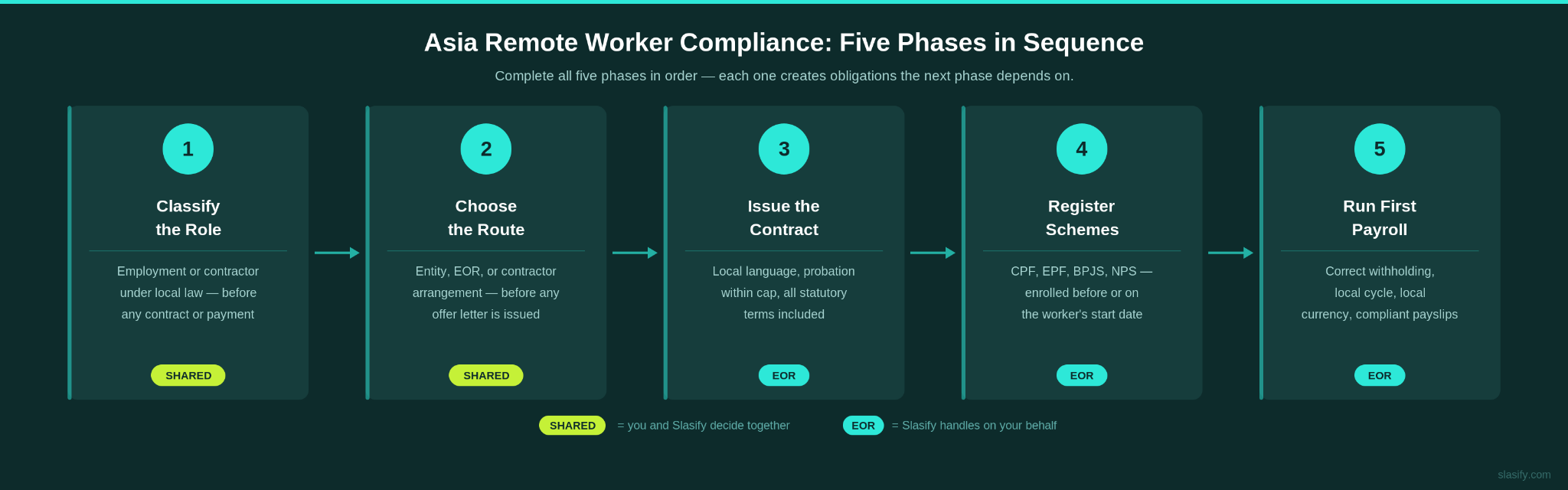
- The legal sequence is fixed: classify the role, choose the employment route, issue a locally valid contract, register for statutory schemes, then run a correct first payroll.
|
- Employer statutory contributions range from 5% of wages in Hong Kong to 17% and above in Singapore, Vietnam, and Japan. Every rate comes with a registration window.
|
- Without a local entity, the compliant employment route is an Employer of Record (EOR) or a properly structured contractor engagement. The right choice turns on headcount, permanence, and PE risk.
|
- Each of the ten Asian markets in this checklist runs a distinct statutory system with its own agencies, contribution rates, enrollment triggers, and remittance deadlines. Home-country payroll assumptions don't transfer.
|
Last updated: July, 2026

Getting a verbal agreement from your new remote hire in Singapore, Vietnam, or Japan to join your company is often the easier part of remote hiring. What comes next (legally employing that person, in their country, through a company with no local entity) is where most first Asia hires run into trouble. The compliance steps are not complicated, but they have a legal order, and skipping or reversing them can lead to hidden and rising costs.
Hiring a remote employee in Asia takes five sequential phases: classify the role under the worker's local law, choose the employment route, issue a locally compliant contract, register for the statutory schemes that the country mandates, and run a first payroll that withholds and remits correctly from day one. This remote work compliance checklist covers all five phases with per-country statutory rates, registration requirements, and the traps that catch first-time international hirers most often.
1. Why Remote Hires in Asia Fail: Compliance Checks
You have run the interviews, extended the offer, and the new hire agrees to join your team, until someone in your finance or legal team asks a question that you were not expecting: what exactly do you have to file, register, and pay before their first paycheck can go out?
Most of our clients hiring international employees in Asia for the first time arrive at exactly that question. As of September 2025, 27% of paid full working days in the US were still being worked from home, according to the WFH Research/SWAA survey. The statutory systems across the Asia region were built for domestic employers, making compliance challenging yet critical.
Three failure modes happen the most often:
1. Misclassification
Most Asian jurisdictions apply a control-and-integration test that looks past contract labels. If you control when, where, and how someone works and they are integrated into your team structure, local law treats them as an employee; reclassification triggers backdated contributions plus interest and penalties from day one.
2. Missed registration windows
Registration deadlines are strict. For example, in Vietnam, employer registration must occur within 30 days of an employee's start date under Decree 158/2025/ND-CP (effective 1 July 2025); miss the window and the backdating clock starts from month one.
3. Permanent establishment (PE) risk
An employee with authority to sign contracts, or who constitutes the company's primary business presence in a country, can create a permanent establishment and expose the foreign entity to local corporate tax. See our breakdown of the 2026 guide for permanent establishment risk in Asia.
|
Risk Category
|
The Common Trap
|
The Financial Cost
|
|
Worker Misclassification
|
Treating a full-time worker as an independent contractor based on contract labels alone.
|
Backdated statutory contributions, interest, and immediate legal penalties from day one.
|
|
Missed Registrations
|
Missing strict local deadlines for social insurance and health registrations.
|
Retroactive liability that compounds with every delayed payroll cycle.
|
|
Permanent Establishment (PE)
|
Allowing a remote worker to sign contracts or act as your primary business presence.
|
Exposing your foreign entity to local corporate taxes and comprehensive audits.
|
2. Phase 1: Kickoff and Classification
Before any scheme, registration, or contract, the first question to answer for employers is whether the person you are about to hire is a worker or a contractor under the law of their country.
Most Asian jurisdictions apply a control-and-integration test that looks past what the contract says. The factors that determine classification in practice:
- Do you set their working hours or schedule?
- Do you control how the work is done, not just what is delivered?
- Are they integrated into your team's structure, tools, and management chain?
- Do they work exclusively or predominantly for your company?
The conversion trap
If someone has been working as a contractor for more than three to six months under employee-like conditions, reclassification in countries like Vietnam and the Philippines typically includes backdated contributions from day one of the original engagement, not from when the reclassification was identified. Our contractor misclassification guide can guide you through the full decision framework.
3. Phase 2: Choose the Employment Route
Once you decide to hire a candidate, you have three ways to hire legally when you have no local entity: establish your own, use an Employer of Record, or structure a compliant contractor engagement. Below is a breakdown comparison between the three employment routes:
|
Factor
|
Own Entity
|
Employer of Record (EOR)
|
Compliant Contractor
|
|
Speed to hire
|
3–6 months minimum
|
Days to 2 weeks
|
Immediate
|
|
Setup cost
|
High: SG ACRA S$315 + S$60/yr; HK Companies Registry HK$1,545 + HK$105/yr; Japan Kabushiki Kaisha approx JPY 150,000 minimum
|
Monthly per-worker fee; no entity cost
|
Lowest upfront
|
|
Compliance burden
|
Fully on your team: payroll, statutory filings, registrations, local HR
|
Transferred to EOR; you manage the work and business results
|
Shared; residual misclassification exposure falls on you if the working pattern evolves toward employment
|
|
PE risk
|
Significantly mitigated once entity is properly established
|
Mitigated; worker is employed by the EOR and not your company
|
Persistent if contractor controls your business or acts as its representative
|
|
Best fit
|
10+ employees, permanent operations, multi-year commitment
|
Companies entering a new Asian market for the first time, or expanding globally without a local entity, typically 1–10 hires per country where compliance certainty and speed matter more than building permanent local infrastructure
|
Independent specialists on defined short-term projects
|
What the setup cost figures don't capture is the ongoing weight once an entity is active: monthly CPF filings, payroll withholding remittances, and annual statutory reporting all require dedicated local HR capacity or an outsourced provider, in place before your first hire is even productive.
The decision logic
If you have one or two people in a new country and you are not certain the role will persist beyond 12 months, entity establishment rarely makes financial or operational sense at that stage. Most of our 900+ global customers start their first one to three hires in a new Asian market through the EOR route.
4. Phase 3: Contract and Statutory Benefits
"We will just use our US employment template" is the most common thing we hear before a first Asia hire, and it creates immediate compliance problems in every market it encounters. Employment contracts must comply with local law in the country where the worker is located, instead of where your company is headquartered. For employers working out how to hire international employees compliantly, the contract is usually where it starts to go wrong.
Below are three categories of terms that consistently catch first-time hirers off guard:
Probation, notice, and leave minimums
The local statutory minimum overrides whatever your contract states on probation, notice, and leave. The key limits include:
- Probation cap: Vietnam 60 working days (most roles); Korea 3 months (certain industries); Japan 3–6 months in practice (no statutory ceiling, but longer periods are routinely challenged)
- Annual leave floor: Vietnam 12 days minimum; Japan 10 days, accruing from month six of employment; Philippines 5 days Service Incentive Leave (SIL) per year after one year of service under Labor Code Article 95.
- Notice minimum: Vietnam requires at least 45 working days for indefinite-term contracts under the 2019 Labor Code; South Korea mandates 30 days or 30 days' pay in lieu under the Labor Standards Act. Always verify the local floor and consult with an expert before drafting the notice clause; it takes precedence over anything your contract says
Mandatory bonus obligations
The Philippines mandates 13th-month pay under Presidential Decree 851: one month's basic pay, due by December 24 each year, for any employee with at least one month of service. It is a statutory entitlement audited by the Department of Labor and Employment. Treating it as a discretionary bonus, or withholding it from employees on notice, is the most common first-time error.
Contract language requirements
Several Asian jurisdictions require contracts to be in the local language, or in a bilingual format, to be legally enforceable:
- Vietnam: English-only contracts have been successfully challenged in court, creating risk even when the underlying terms were reasonable
- Korea and Japan: Bilingual contracts are standard practice even where not strictly mandated by statute
Hiring foreign employees in Asia without an entity? Talk to a compliance specialist before issuing the contract. Once the relationship has started, fixing a non-compliant contract costs significantly more than issuing a correct one. Speak with our team and book a free demo today
5. Phase 4: Register for the Statutory Schemes
In most Asian markets, employer registration for social insurance, provident fund, or pension schemes must occur before or within days of employment commencement. Registering late means contributions are owed from the employee's original start date.
The ten markets in this checklist each run a distinct statutory system with its own agency, contribution base, rate schedule, and registration timeline. Applying home-country assumptions about how payroll registration works will create problems in most of them.
Statutory employer contribution rates across Asia (2026)
|
Market
|
Scheme
|
Employer Rate
|
Employee Rate
|
Effective date/ Source
|
|
Singapore
|
Central Provident Fund (CPF)
|
17%
|
20%
|
1 Jan 2026, CPF Board (wages above S$750/mo; age 55 and below)
|
|
Hong Kong
|
Mandatory Provident Fund (MPF)
|
5% (capped HK$1,500/mo)
|
5% (capped HK$1,500/mo)
|
Current, MPFA
|
|
Malaysia
|
Employees Provident Fund (EPF / KWSP)
|
13% (wages ≤RM5,000)/12% (above RM5,000)
|
11%
|
Oct 2025, KWSP Third Schedule
|
|
Philippines
|
Social Security System (SSS)
|
10% of monthly salary credit (MSC cap P35,000)
|
5% of MSC
|
1 Jan 2025, SSS (final RA 11199 tranche)
|
|
Vietnam
|
Social Insurance (SI only; health ins. 3% + unemployment 1% charged separately, est. 21% all-in)
|
17%
|
8%
|
1 Jul 2025, VSS (Decree 158/2025/ND-CP)
|
|
Indonesia
|
BPJS (Badan Penyelenggara Jaminan Sosial, Indonesia's social security agency) JHT (old-age savings only; pension, work accident, death, and health programs charged separately)
|
3.7%
|
2%
|
PP 46/2015, BPJS Ketenagakerjaan
|
|
Japan
|
Employees' Pension Insurance (EPI)
|
9.15% (half of 18.3% total)
|
9.15%
|
Fixed since Sep 2017, Japan Pension Service
|
|
South Korea
|
National Pension
|
4.75% (half of 9.5% total)
|
4.75%
|
1 Jan 2026, NPS (enacted Mar 2025, Gazette 2 Apr 2025)
|
|
Taiwan
|
Labor Insurance
|
~8.05% of insured wage (employer bears 70% of 11.5% ordinary accident premium)
|
~2.3% (employee bears 20% of premium)
|
Effective 2025, Bureau of Labor Insurance (BLI)
|
|
India
|
Employees' Provident Fund (EPF)
|
12% (8.33% of employer share redirected to the Employees’ Pension Scheme/EPS)
|
12%
|
Current, Ministry of Labour and Employment (statutory wage ceiling Rs 15,000/mo)
|
Each market has its own enrollment trigger and deadline, and missing either one starts the backdating clock from day one. Here is when employers need to enroll workers in each of the ten markets covered by this checklist.
Singapore
Register with the CPF Board before the employee's first salary payment; contributions apply from the first month's wages for employees earning above S$50/month. Read our Singapore employment guide.
Hong Kong
Register with the MPFA for MPF within 60 days of employment commencement; the employee becomes a scheme member from day one. Read our Hong Kong employment guide.
Malaysia
Register with KWSP (EPF), SOCSO (Social Security Organisation, administered locally as PERKESO), and LHDN (income tax) before the employee's first payroll run; SOCSO registration must occur within 30 days of hiring. Read more Malaysia employment guide.
Philippines
Register with SSS, PhilHealth, and Pag-IBIG before the first payroll; SSS employer registration typically takes 5–10 business days and must be completed before any contribution remittance. Read our Philippines employment guide.
Vietnam
Register with Vietnam Social Security (VSS) within 30 days of the employee's start date under Decree 158/2025/ND-CP; late registration backdates liability to day one of the engagement, not the registration date. Read our Vietnam employment guide.
Indonesia
Register with BPJS Ketenagakerjaan (JHT and related programs) and BPJS Kesehatan (health) before the employee's first day; each program requires a separate registration submission with its own timeline. Read our Indonesia employment guide.
Japan
Register with the Japan Pension Service for Employees' Pension Insurance and with the relevant Health Insurance Association before payroll begins; enrollment is mandatory for employees working more than 30 hours per week. Read our Japan employment guide.
South Korea
Register with the National Pension Service and National Health Insurance Service before the employee's start date; both require submission within 14 days of hiring. Read our South Korea employment guide.
Taiwan
Register with the Bureau of Labor Insurance before the employee's first working day; Labor Insurance and National Health Insurance enrollment are both mandatory and must be filed simultaneously. Read our Taiwan employment guide.
India
Register with the Employees' Provident Fund Organisation (EPFO) once the 20-employee threshold is reached; compliance applies retroactively once the threshold is crossed, so registration should be confirmed before that point.
6. Phase 5: First Payroll and Ongoing Filings

Running a correct first payroll requires more than getting the gross salary and issuing payslips right. There are four errors that come up often when running first payroll across Asia:
1. Income tax withholding
Each Asian market uses a different withholding model, such as monthly at source, annual assessment for residents, or rules that vary by residency status. Applying the wrong one to the first pay run creates a compounding error that takes multiple cycles to unwind. Employers need to confirm the correct model before the first payment goes out.
2. Remittance cadence
Contribution deadlines usually don't follow a standard cycle. For example, Singapore's CPF is due by the 14th of the following month; Malaysia's EPF by the 15th; Vietnam's deadline is tied to the employee's registration date. Applying a home-country end-of-month cycle will miss these deadlines in most markets. Late remittances attract interest; repeated lateness can prompt audits.
3. Payslip requirements
Several Asian jurisdictions specify required payslip line items, and omitting them is a statutory violation even when the pay amount is correct. Required fields typically include base pay and each allowance and deduction listed separately, in more detail than most home-country systems generate.
4. Currency requirements
Many Asian markets legally require salary payment in local currency for locally registered employees. Paying in USD or another foreign currency is not a preference and is a compliance issue. Employers need to confirm the currency requirement at registration and factor FX conversion timelines into the payroll calendar.
For the full picture on how to pay international employees across APAC and broader global payroll compliance requirements, see our ultimate Asia payroll systems guide.
7. The Free Asia Remote Work Compliance Checklist
The table below is a quick-reference payroll compliance checklist covering all five phases. Use it to confirm you have covered each phase before moving to the next, or hand it to a provider as a briefing tool.
|
Phase
|
Why it matters
|
Who does it under EOR
|
|
1. Classify the Role: Determine whether the worker meets the legal test for employment or contractor status in their country before any contract is signed or payment is made.
|
Contract labels don't override the legal test. Misclassification in Vietnam or the Philippines backdates contribution liability to day one of the original engagement, not the date of discovery.
|
Shared. You confirm the working relationship; we assess the legal classification risk under the worker's local law and document the rationale before anything is signed.
|
|
2. Choose the Employment Route: Decide between your own local entity, an Employer of Record (EOR), or a compliant contractor arrangement before any offer letter or payment is issued.
|
Each route creates different statutory obligations from day one. Switching routes after contracts or payments have started creates conflicting obligations in the worker's jurisdiction.
|
Shared. You decide the hire; we confirm which route fits the role, timeline, and market, and scope EOR coverage before any documentation goes out.
|
|
3. Issue a Locally Valid Contract: Use a contract in the required local language, with a probation period within statutory caps, and all mandatory leave entitlements, notice periods, and statutory bonus obligations included.
|
Home-country templates don't hold in Asian jurisdictions. Probation above the statutory cap is void; leave below the minimum creates retroactive liability; missing bonus obligations are audited by local labor authorities.
|
EOR. We issue the employment contract under our local legal entity, using locally compliant templates reviewed by in-country counsel. You review and approve the offer terms.
|
|
4. Register for Statutory Schemes: Enroll the worker with the relevant social insurance, provident fund, or pension agency before or on the worker's start date.
|
Late registration backdates contribution liability to day one. The wrong contribution base creates audit exposure across every subsequent pay run. Agencies including CPF, EPF, BPJS, and NPS each have their own timelines and base definitions.
|
EOR. We manage all statutory registrations in the worker's country on the correct timeline. You don't interact with the registration agencies directly.
|
|
5. Run a Correct First Payroll: Apply the correct income tax withholding method for the worker's residency status, remit contributions on the local payroll cycle, issue locally compliant payslips, and pay in local currency where required by law.
|
Home-country payroll logic compounds errors across the first several pay runs. Wrong remittance cycles attract interest charges; non-compliant payslips are a statutory violation even when the pay amount is correct.
|
EOR. We calculate contributions and taxes, remit on the statutory deadlines, generate locally compliant payslips, and pay the worker in local currency. You approve gross pay.
|
8. How We Run This Checklist for You

We run every phase of this checklist for first-time Asia hirers weekly, across 150+ countries through 600+ local partners, in 130+ currencies, with ISO 27001 certification and KPMG recognition. Here is what that means for each phase:
- Employer of Record: We become the legal employer on record in your employee's country, handling statutory registration, contract issuance, onboarding, and ongoing compliance so your team can focus on the talent and business results.
- Global Payroll: We calculate contributions per the correct country-specific base and rate, remit on the local cycle, and generate compliant payslips across 130+ currencies.
- Contractor Management: Where the role qualifies for a compliant contractor engagement, we structure and manage the arrangement to minimize misclassification exposure.
- Dedicated Account Manager: A named account manager guides you through setup, onboarding, classification, and route decisions before any paperwork is issued, and stays through the first payroll run to ensure your process works without any issue.
- Local advisory network: Our 600+ local partners cover registration timelines, contract language mandates, and remittance deadlines in each jurisdiction, providing in-country expertise rather than a global template.
"Most clients who come to us mid-engagement have already missed a registration window, calculated contributions on the wrong base, or applied their home-country remittance cycle to a market where it doesn't fit. We calculate the backdated exposure and build a remediation plan. Clients who engage us at kickoff don't have that conversation."
— Slasify Account Manager
Clients across Southeast Asia and Northeast Asia have seen what this looks like from the outside:
"Slasify helped us scale in Vietnam, Philippines, Indonesia, and Malaysia. Their local knowledge and execution saved us time and costs."
— Head of Operations, Astro Malaysia Holdings Berhad
For companies hiring foreign employees in Asia or managing multi-country payroll for the first time, our 600+ local partner network covers every jurisdiction in this checklist. Whether you need an employer of record for Singapore, Vietnam, Japan, or any of the 140+ beyond, the same local infrastructure runs the same compliance sequence.
9. Frequently Asked Questions

Q1: Can I hire a remote employee in Asia without setting up a local entity?
Yes. An Employer of Record handles legal employment in the worker's country without requiring you to establish a local entity. The EOR becomes the legal employer on record, taking on statutory registration, payroll, and compliance obligations while you direct the day-to-day work. Most companies hiring overseas employees in a new Asian market use the EOR route: it cuts the 3–6 month entity establishment timeline down to days.
Q2: Does a remote worker follow the employment laws of their country or my company's country?
The worker follows the employment laws of the country where they physically work, not where your company is incorporated. This applies regardless of contract language, payment currency, or corporate policy. Structuring the arrangement as if your home-country law applies does not change the underlying legal reality.
Q3: What statutory contributions do employers pay for remote workers in Asia?
Employer rates range from 5% of wages in Hong Kong (MPF, capped at HK$1,500 per month) to 17% and above in Singapore, Vietnam, and Japan. The 10-market table in Phase 4 covers current rates with effective dates and source citations. Rates cover national pension, provident fund, and social insurance programs, each with its own registration process and contribution base.
Q4: What happens if I pay an Asian remote worker as a contractor when they work like an employee?
Local authorities apply a control-and-integration test, not your contract label. If the worker operates under your direction, on your schedule, using your tools, and within your organizational structure, most Asian jurisdictions will treat the arrangement as employment. The consequence is typically backdated contributions plus interest and penalties from the original start date, not from when the misclassification was identified. For the full framework, see our contractor misclassification guide.
Q5: How long does it take to set up compliant payroll for a remote hire in Asia?
With an EOR, employment contracting begins within 48 hours and most hires are employment-active within 2 weeks. Entity establishment takes a minimum of three to six months in most Asian markets, not counting additional time for payroll registration. Generally speaking, Singapore and Hong Kong move fastest, while Japan and Vietnam often add procedural steps.
Q6: Which Asian countries are easiest for a first remote hire?
Singapore and Hong Kong are the most accessible entry points for a first hire in Asia. Both have English-language legal environments, well-documented statutory schemes, and well-established EOR structures. Malaysia and the Philippines have strong talent markets and simpler compliance requirements. Japan, Vietnam, and South Korea add bilingual contract obligations and monthly payroll withholding requirements, but are entirely workable with in-country expertise. Get in touch with our market expert to confirm what applies to the market you're entering.
Q7: How does Slasify handle compliance and payroll setup for remote workers in Asia?
We run all five phases of this checklist on your behalf: classification review, contract issuance, statutory registration, first-payroll setup, and ongoing remittances and filings. We cover 150+ countries through 600+ local partners and process payroll in 130+ currencies, with ISO 27001 certification covering how we handle employee data across borders. If you're hiring across multiple Asian markets at once, we have partners on the ground in each jurisdiction rather than working from one template.
Ready to Hire Compliantly in Asia?
You have someone already lined up in one of the Asian markets. The five phases covered in this article are the compliance sequence between that offer and their first paycheck: classification, employment route, contract, statutory registration, and a payroll run that remits correctly from day one.
The “compliance clock” starts when your candidate accepts the offer. Book a free consultation with our HR compliance experts today, and we will handle your Asia payroll and statutory registrations before the first pay date.