US
US Work Visa: Employer Guide in 2026
US Work Visa Employer Guide 2026: H-1B Changes, FICA Obligations, and What Every Global Employer Must Know. Learn More Free Hiring Guide!
| Key Takeaways | |
|---|---|
| In the EOR vs. own entity decision, the setup fee is the wrong number to focus on | Registering a company costs GBP 100 in the United Kingdom and SGD 315 in Singapore, too small to decide anything. What decides it is the annual cost of keeping the entity alive, roughly USD 1,200 to USD 6,700 depending on the country. |
| For one employee, run the test annually | Compare the entity's annual running cost against twelve times your quoted monthly fee. If the running cost is higher, the entity never wins, however long you hold it. |
| One statutory requirement moves the answer more than any other: whether the country forces you to appoint a locally resident director | Singapore and Australia do. The United Kingdom, Germany, and Japanese subsidiaries do not. It is the largest single line in the Singapore stack, and it is why that stack clears a low EOR fee. |
| Your own quoted fee decides this more than the country does | At a fee near USD 250 a month, an entity for one person cannot beat it in Singapore. At a fee near USD 700, an entity beats it in every market. |
| Cost is rarely the deciding factor for one hire | An entity takes 4 to 14 weeks to become able to pay anyone, and Germany requires EUR 12,500 in cash before the company can be registered. |
An employer with one person to hire abroad gets quoted two things: a monthly fee from an Employer of Record, and a setup fee from a formation agent. The setup fee looks smaller, and it is the wrong number.
We run payroll and employment in 150+ countries and sell both sides of this decision, so we have no reason to steer the answer. Local currency converts at European Central Bank reference rates of 8 September 2026, indicatively only.
The EOR vs. own entity question is almost always framed around setup cost. It should not be.
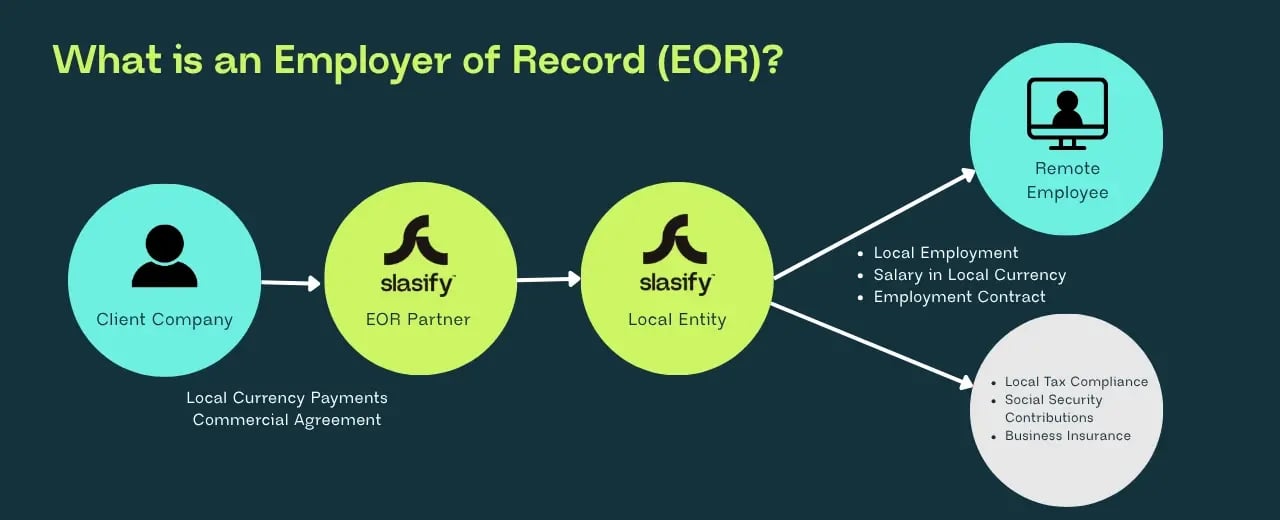
Is an Employer of Record cheaper than setting up your own entity for one employee? An Employer of Record (EOR) becomes the legal employer of your worker in their country while they work for you day to day. Registering your own company abroad is cheap, usually a few hundred dollars. Keeping it compliant is not, and runs roughly USD 1,200 to USD 6,700 a year before anyone is paid. The entity is cheaper only when that annual running cost falls below twelve times your monthly EOR fee, which for one employee it often does not.
.png?width=1920&height=1080&name=Blog%20Post%20Banner%20%26%20Images%20(1).png)
Both routes pay the same salary and the same employer social contributions. Those are set by the country rather than the model, so they largely cancel out. Any table where the EOR column includes salary and the entity column does not compares two different things.
The remaining difference comes down to two things:
So the break-even is:
Months to break even = setup cost ÷ (monthly EOR fee − monthly entity running cost)
The trap sits in the denominator, where if your entity's monthly running cost exceeds the EOR fee, the subtraction goes negative and there is no break-even point at all. Holding the entity longer widens the gap. For one employee that is the normal outcome in several countries, which is why asking "how many months until the entity pays for itself" assumes the conclusion.
Every figure below comes from the authority that levies it, at its current published rate.
Japan charges a flat annual tax whether or not you make a profit. The corporate inhabitant per-capita levy is JPY 70,000 a year in Tokyo at a capital of JPY 10,000,000 or less and 50 or fewer employees.11 A dormant subsidiary with no revenue still pays it. The band is measured on capital plus capital reserve, so a reserve on top of small stated capital can push you into the JPY 180,000 band.
Germany's EUR 12,500 is share capital. It stays on the balance sheet and you can spend it afterwards. What it does is block you: the registration application cannot be filed until the money is paid in,7 into an account in the name of a company that does not legally exist yet. The bank account normally holds up the incorporation.
The United Kingdom raised its fees on 1 February 2026, incorporation to GBP 100 and the confirmation statement to GBP 50.1 Most comparison pages still quote the older GBP 50 and GBP 34.
Registration is one small payment. Keeping the entity alive means buying, every year, whatever the local companies act requires.
Some countries require a director who lives there. If your company has nobody there, and for a first hire it usually does not, you have to buy that person.
Singapore also requires a resident company secretary,12 where the United Kingdom expressly does not require a private company to have one.15
Ranges run from a lean build to a fuller outsourced one. Government fees carry a source below; the rest come from providers' published schedules, and the chamber's own, checked in September 2026.
These figures shift year to year, so treat them as a budgeting range. A single figure is one provider's published price.
United Kingdom, the cheapest case.
Total GBP 885 to GBP 4,491 a year, roughly USD 1,199 to USD 6,083, assuming no statutory audit.
Check that before relying on it. A subsidiary loses the small company audit exemption unless the worldwide group is also small, and the guarantee route that would rescue it is open only to parents established under United Kingdom law.18 A foreign parent cannot use it, and an audit adds several thousand pounds.
Singapore, where the requirements bite.
Total SGD 4,510 to SGD 8,480 a year, roughly USD 3,563 to USD 6,699.
Two Singapore details trip up foreign parent companies, both pushing the total up. A subsidiary whose shares are held by a corporation is not an exempt private company, so it loses the filing relief most cost guides assume and must file accounts in XBRL, a structured digital format.16
The audit exemption is also tested on the group, on the parent's worldwide figures, so a small subsidiary of a large parent still needs an audit. The total above assumes none.
Germany, expensive to open and cheap to hold. Tax adviser fees follow a statutory scale.17
A written agreement can exceed that scale, so treat the top of this range as a conservative ceiling. Total EUR 1,065 to EUR 4,726 a year, roughly USD 1,237 to USD 5,489, excluding the tax adviser's return work and the German business address a foreign parent must rent.
Plug in the fee you were quoted. Our published Employer of Record pricing starts at USD 250 a month, with cost varying by country, region and service scope,21 so the table runs that floor and two higher points. Your quoted fee moves the answer more than the country does.
Annual entity running cost against annual EOR cost, one employee, salary and contributions excluded from both sides:
| Country | Entity running cost | Verdict at USD 250, 450 and 700 a month |
|---|---|---|
| United Kingdom | USD 1,199 to 6,083 a year | vs USD 250/mo (USD 3,000/yr): entity wins if lean. vs USD 450/mo (USD 5,400/yr): entity wins in most builds. vs USD 700/mo (USD 8,400/yr): entity wins. |
| Germany | USD 1,237 to 5,489 a year | vs USD 250/mo (USD 3,000/yr): entity wins if lean. vs USD 450/mo (USD 5,400/yr): entity wins in most builds. vs USD 700/mo (USD 8,400/yr): entity wins. |
| Singapore | USD 3,563 to 6,699 a year | vs USD 250/mo (USD 3,000/yr): EOR wins, always. vs USD 450/mo (USD 5,400/yr): toss-up. vs USD 700/mo (USD 8,400/yr): entity wins. |
All three rows assume no statutory audit. Add one and every verdict moves toward the EOR.
Down the first column, an entity for one person cannot win in Singapore at any level of thrift: the leanest complete build still lands above USD 3,000, and the resident director is more than 40 percent of it. The same entity that loses against USD 250 a month wins against USD 700.
Setup costs are absent from that table on purpose. Except in Germany, where the notary fee is the main cost variable, setup costs are typically recovered within the first month under either model.
For a country not listed here, book a demo, and we will cost it with you.

Real costs sit outside the tables, on both sides.
On the entity side. Your own time is not counted, nor the cost of closing, nor the potential for director liability: in Singapore, if a company trades for more than six months without a resident director, a member who knows becomes personally liable for debts contracted after that point.12
Timelines are underestimated most: roughly 4 to 8 weeks in the United Kingdom, 6 to 12 weeks in Singapore and 8 to 14 weeks in Germany before you can legally pay anyone.
On the EOR side. The fee is not always the whole invoice. In our experience, many providers hold a refundable deposit of one to one and a half months of total employment cost, and currency conversion carries a margin above the mid-market rate that is built into the converted amount rather than shown as a line. Some charge onboarding or offboarding fees. Get all of them in writing.
Germany locks up EUR 12,500 before you can register, and an EOR deposit locks up roughly a month of cost. Neither is an expense, and both are cash you cannot use elsewhere.
One risk sits outside both columns. Running someone through a contractor arrangement or a foreign payroll instead of either model creates misclassification risk and permanent establishment exposure, where the tax authority treats your activity as a taxable presence of the parent.
Both can cost far more than either model in this article. We cover it in our guide to permanent establishment risk, and the exit side in employee termination laws, where severance in some markets exceeds a year of either model's cost.

We sell both routes, which is why the table concedes where it does. Our Employer of Record covers the no-entity route from USD 250 a month,21 through our own entities in Singapore, Hong Kong, Taiwan, Malaysia, Vietnam, and mainland China, and over 600 local compliance partners elsewhere. Our Global Payroll service covers the other route, once the entity is established, across 130+ currencies and in markets worldwide. We are also ISO 27001 certified and run payroll in 150+ countries.

Most companies run these in sequence: hire the first person through an EOR while the market is unproven, then incorporate once headcount or permanence makes the fixed base worth carrying. Across several people, the arithmetic changes shape, and we analyze the numbers by headcount in our direct payroll comparison.

It depends on your quoted fee more than the country. At USD 250 a month, an entity cannot win in markets that require a resident director, such as Singapore, where the nominee alone costs more than a year of that fee. At USD 700, it is usually cheaper on paper in the UK and Germany.
The government registration fee is small: GBP 100 in the United Kingdom and SGD 315 in Singapore. Germany and Japan cost more because notarization is compulsory, and Germany requires EUR 12,500 paid in before registration can be filed. What decides the comparison is the annual running cost, roughly USD 1,200 to USD 6,700 a year.
The resident director requirement, where it exists. Singapore demands a director ordinarily resident there, from incorporation and continuously, so a foreign parent has to buy one. Nominee services publish SGD 2,000 to SGD 3,500 a year, over 40 percent of the entity's total annual cost, and the reason Singapore fails against a low EOR fee.
Roughly 4 to 8 weeks in the United Kingdom, 6 to 12 weeks in Singapore, 8 to 14 weeks in Germany. Registration is rarely the bottleneck. Bank accounts, identity verification and apostilled parent documents are. Germany adds another, because registration cannot be filed until EUR 12,500 is paid into a bank account.
In Singapore and Australia, yes. A locally resident director is a legal requirement from the date of incorporation in both countries. In the United Kingdom, Germany, and for a Japanese subsidiary, no residency condition applies. A Japanese branch office is a separate structure with its own local representative requirement.
When the entity's annual running cost drops below twelve times your monthly EOR fee, and you are confident enough in the market to accept a setup timeline measured in months and a slower exit if needed. In practice, that threshold typically arrives at three to five employees in a single market, not one.
Yes. Our Employer of Record employs people where you have no entity, from USD 250 a month, through our own entities across Asia and over 600 local partners elsewhere. Our Global Payroll service runs payroll through entities you already own, so we price both routes for the same hire.

Send us the country, the salary and your quote, and we will show you which side of the line it falls on. Book a demo and we will work through it.
Government fees, statutory fee scales and provider price ranges reflect published Companies House, ACRA, German federal, Japanese national and Tokyo Metropolitan schedules as of September 2026. Currency conversions use European Central Bank reference rates of 8 September 2026 and move daily. Confirm current figures before committing to either route.
US Work Visa Employer Guide 2026: H-1B Changes, FICA Obligations, and What Every Global Employer Must Know. Learn More Free Hiring Guide!
Who is the legal employer, who carries compliance risk, and what does each cost? The EOR vs staffing agency comparison for international hiring in...
New York SSC and Hiring Guide 2026: Payroll Taxes, Mandatory Benefits, and What Every Global Employer Needs to Know