| Key Takeaways |
| APAC developer supply is accelerating: India alone added 5.2 million new GitHub accounts in 2025, more than 14% of all new developers worldwide. |
| The "offshore developer" label flattens a genuinely diverse market. India, Vietnam, the Philippines, Taiwan, and Japan differ substantially in English proficiency, time zone, all-in cost, and employment law. |
| Most early-stage international hires start as contractors and surface misclassification risk within 90 days, especially in Vietnam and the Philippines. |
| An Employer of Record is the fastest, lowest-risk path to legally employing a developer in most APAC markets without setting up a local entity. |
| The all-in cost of an EOR hire in Vietnam or the Philippines can still run 50–65% below a comparable US-based hire, even after statutory contributions and EOR fees. |

To hire offshore developers in APAC in 2026, you need four things: a country matched to your stack, time zone, and budget; an honest picture of all-in employment cost; a compliant employment structure; and a clear path from signed offer to first payroll.
"Offshore developer" once meant a low-cost team working from a remote country. APAC is driving the fastest developer population growth globally, with the worldwide total hitting 48.4 million in Q3 2025, up 50% since 2022. However, hiring in this region still breaks down in the same three places: wrong country fit, underestimated total cost, and a contractor arrangement that crosses into misclassification within 90 days.
The practical questions for employers hiring offshore developers in APAC are where to look, what the hire will cost in full, how to assess the person fairly, and which legal structure fits the working relationship.
1. Why APAC Is the Tech Talent Market in 2026
Developer supply is concentrating in APAC faster than anywhere else, while demand continues to outpace local hiring capacity in the markets where most engineering budgets sit.
Talent Supply
- According to SlashData's Q3 2025 Developer Population Trends, the worldwide developer count is at 48.4 million, up 50% since Q1 2022. APAC leads the regional acceleration, with South Asia nearly doubling from 4 million to 7.5 million developers between 2022 and 2025, and Greater China from 2.4 million to 5.8 million.
- GitHub's Octoverse 2025 reported 180 million accounts globally, with roughly 25 new APAC sign-ups every minute throughout 2025. India alone added 5.2 million new developers last year (14% of all new global accounts) at a 31% annual growth rate, and GitHub projects India to reach 57.5 million developers by 2030.
Developer Demand
- ManpowerGroup's 2025 APAC Talent Shortage Survey of 10,095 employers found 77% reporting difficulty finding the skills they need, which is above the 74% global average, with IT the hardest-hit sector at 81%. Pressure is steepest in Singapore (83%), Hong Kong (81%), India (80%), and Japan (77%). Their 2026 global survey of 39,000+ employers shows 72% still unable to fill open roles, with AI model development overtaking traditional engineering as the single hardest skill to find globally.
- Cross-border hiring data shows APAC absorbing a significant share of that demand. According to the platform data from Deel’s 2025 State of Global Hiring Report, AI trainer roles grew 283% in cross-border hiring in 2025, with more than 70,000 workers now engaged across 600+ organizations worldwide. India and the Philippines hold the second and third largest shares of that global AI trainer workforce, behind the United States.
That pincer movement of expanding supply in APAC and sustained demand shortfall everywhere else is why engineering teams now treat APAC as a primary hiring market. As a result, US tech companies expanding into Southeast Asia have moved from pilot programs to standing engineering centers, and the infrastructure supporting that shift has followed.
2. Where to Hire Offshore Developers: APAC Tech Hubs Compared
The table below maps each hub across developer supply, English proficiency, time zone overlap with the US West Coast and Central Europe, indicative software engineer (SWE) compensation, and the employer statutory obligation that most often catches first-time hirers off guard.
APAC Tech Hub Comparison (2026)
|
Market
|
Developer pool signal
|
EF EPI 2025 rank
|
US West overlap
|
Central Europe overlap
|
Indicative salary comparison
|
Key statutory scheme costs
|
Source (updated 2026)
|
Best for
|
|
India
|
7.5M+ South Asia developers; #1 globally for new GitHub accounts in 2025
|
#74 (low)
|
10.5 hrs behind
|
4.5 hrs behind
|
USD 15k–45k
|
EPF 12% employer; gratuity accrues at ~4.81% per year of service
|
Employee’s Provident Fund (EPS)
|
Scale, backend, AI/ML
|
|
Vietnam
|
Growing developer community; fast-rising GitHub contributor base
|
#64 (moderate)
|
8–9 hrs behind
|
1 hr behind
|
USD 12k–30k
|
Total employer burden 21% (SI 17% + health 3% + UI 1%
|
Vietnam Social Security (VSS)
|
Full-stack, mobile; lowest cost tier
|
|
Philippines
|
Strong English; BPO-rooted developer community
|
#28 (high)
|
7–8 hrs behind
|
7 hrs behind
|
USD 10k–25k
|
SSS ~10% employer + PhilHealth 2.5%; 13th-month pay mandatory
|
Philippines Social Security System (SSS)
|
English-first roles, QA, React/JS
|
|
Indonesia
|
Large and growing talent pool; Jakarta hub
|
#80 (low)
|
7–8 hrs behind
|
7 hrs behind
|
USD 10k–25k
|
BPJS multi-program: health 4% + employment components ~6–7% employer
|
Indonesia BPJS
|
Mobile, local-market focus
|
|
Malaysia
|
Highest English in Asia; regional HQ base
|
#24 (high)
|
8 hrs behind
|
7 hrs behind
|
USD 20k–50k
|
EPF 13% employer (wages ≤ RM 5,000) or 12% above; SOCSO 1.75% additional employer levy
|
Malaysia KWSP/SOCSO
|
English teams, Python/Java, regional coordination
|
|
Taiwan
|
Hardware-adjacent software talent; semiconductor-sector strength
|
Not included in 2025 edition
|
9 hrs behind
|
6 hrs behind
|
USD 25k–55k
|
Labour Insurance ~8.05% employer; Labour Pension 6% of monthly wage
|
Taiwan Labor Insurance (LI)
|
Embedded systems, semiconductor-adjacent SW
|
|
South Korea
|
Growing AI/ML and gaming market
|
#48 (moderate)
|
7–8 hrs behind
|
8 hrs behind
|
USD 35k–70k
|
NPS 4.75% employer in 2026 + NHI 3.59%
|
South Korea National Pension Service (NPS)
|
AI/ML, gaming, mobile
|
|
Japan
|
Deep talent pool; one of the highest shortage rate in 2026 APME survey
|
#96 (very low)
|
6–7 hrs behind
|
8 hrs behind
|
USD 30k–65k
|
Employees' Pension 9.15% employer + health insurance ~4.9%
|
Japan Pension Service (JPS)
|
Embedded, Japanese-market products
|
|
Singapore
|
Senior talent and APAC regional lead tier
|
Not ranked (native English)
|
8 hrs behind
|
7 hrs behind
|
USD 62k–122k
|
CPF 17% employer (ordinary wage up to SGD 8,000); SDL 0.25% of wages
|
Singapore Central Provident Fund (CPF)
|
Senior ICs, APAC regional directors
|
|
Hong Kong
|
Regional fintech and operations tech hub; smaller developer supply than SEA markets
|
#39 (moderate)
|
8 hrs behind
|
7 hrs behind
|
USD 40k–75k
|
MPF 5% employer (capped HKD 1,500/mo); Employment Ordinance governs notice and severance
|
Hong Kong Mandatory Provident Fund (MPF)
|
Fintech, compliance-adjacent engineering, regional APAC coordination
|
Table notes: EF EPI 2025: 123 markets ranked. Singapore was reclassified as native English by EF, so there’s no Singapore ranking in the 2025 edition. SWE comp for Singapore per levels.fyi (p25–p75 total comp, April 2026); all other markets are based on publicly available compensation surveys and may vary by city, seniority, and role. Employers need to re-verify before budgeting. Figures reflect statutory rates as of August 2026 and are subject to change.
India: maximize breadth, then narrow by role
India is the largest source of new developer talent globally, with 5.2 million new GitHub accounts in 2025 alone and projected to reach 57.5 million developers by 2030. The pipeline covers cloud, data, AI, quality, and enterprise stacks at scale, but city, seniority, and specialization move compensation and time-to-close substantially. Define your scorecard before you define your search. For teams prioritizing AI and ML roles specifically, India's role in reshaping global AI hiring is worth reading before you finalize your country shortlist.
Vietnam: vetting for production ownership
Vietnam is a growing option for backend, mobile, QA, and product teams. Use architecture discussion and code review to distinguish production ownership from task execution. Read our guide to Vietnam tech talent for a deeper look at the local market. For the statutory and payroll details, our Vietnam payroll and employer contribution guide covers the full compliance picture before your first payroll run.
Philippines: English-first hiring considerations
The Philippines can fit full-stack, QA, DevOps, implementation, and customer-facing engineering. Assess written reasoning and stakeholder communication directly. English proficiency, like technical depth, is individual. For a full breakdown of SSS, PhilHealth, and Pag-IBIG employer obligations, see our Philippines employer contribution guide.
Indonesia: start with the product domain
Indonesia ranked among the top markets by public open-source contributors according to GitHub’s Octoverse 2025 report. Focus searches on mobile, consumer internet, fintech, and data roles. Use a domain-relevant work sample and test required communication directly. BPJS registration, contract requirements, and employment law specifics are covered in our Indonesia employment guide.
Malaysia: a balanced regional base
Malaysia's English proficiency and CET time zone overlap make it an effective bridge market for teams that need to coordinate with European stakeholders. These teams can schedule shared hours without asking either side to work at midnight. The main watch-out is that EPF enrollment and SOCSO registration must be completed before the first payroll run, and the contribution rate steps down from 13% to 12% once monthly wages exceed RM 5,000. Our Malaysia employment guide covers the full statutory framework, from SOCSO and EIS to contract and termination requirements.
Taiwan: prioritize hardware-software interfaces
Taiwan's developer community is closely tied to the semiconductor and hardware manufacturing ecosystem, making it the strongest APAC market for embedded systems, firmware, and hardware-software integration roles. Since EF EPI 2025 report doesn’t include Taiwan, assess English proficiency directly and localize employment terms, Labour Insurance, Labour Pension, and IP clauses before contracting. Labour Insurance enrollment, Labour Pension registration, and contract localization requirements are detailed in our Taiwan employment guide.
South Korea: target specialized product experience
South Korea appeared among GitHub’s top 10 markets for public open-source contributors in 2025. It can fit mobile, gaming, AI, and enterprise platforms. Compensation is higher than in much of Southeast Asia, and interviews should focus on validating the exact language and collaboration requirements. For NPS and NHI enrollment timelines and local contract specifics, our South Korea employment guide covers what you need before the first hire.
Japan: pay for the market you are entering
Japan’s GitHub account base more than tripled from 2020 to 2025. The market is relevant for industrial software, platforms, and senior product engineering. Budget for local-market compensation, test role-specific English or Japanese, and avoid assuming a lower-cost model. Social insurance enrollment, payroll standards, and contract localization requirements specific to Japan are in our Japan employment guide.
Singapore: use it as a senior and regional tier
Singapore is the regional tier for engineering leadership, security, product ownership, and roles coordinating distributed Southeast Asian teams. CPF contribution rates, SDL, and Singapore's employer compliance requirements are covered in our Singapore hiring compliance overview.
Hong Kong: the ideal financial and compliance hub
Hong Kong is the natural choice for fintech-adjacent engineering and positions requiring cross-border regulatory fluency, backed by deep financial and legal product expertise. Our Hong Kong labor law guide covers MPF enrollment, notice periods, and the employment contract requirements you need before hiring in the market.
3. What an APAC Developer Actually Costs
Offshore developer salaries in APAC range from roughly USD 12,000 a year in Vietnam to a median total compensation of USD 88,400 in Singapore (levels.fyi, updated August 2026), but neither figure is what you will actually pay. A realistic budget should account for all of the following:
- Gross cash compensation, including any fixed allowances
- Mandatory bonus or annual-payment accruals
- Employer social insurance, pension, health, and local levies
- Benefits, insurance, equipment, and work-from-home support
- EOR or contractor-management fees
- FX movement, funding timing, and any country-specific taxes
The total cost of offshore software development varies as much by employment structure as by market. The three examples below are cost models, each assuming a local national employee, one full month of work, no optional benefits, and no FX conversion. Note that real contractor rates typically run higher once the contractor prices in their own leave, insurance, and tax exposure.
Market comparison example: key employer costs
|
Monthly cost line
|
Vietnam employee
|
Singapore employee
|
Philippines employee
|
Same-cash contractor comparison
|
|
Gross salary or project fee
|
VND 40,000,000
|
SGD 8,000
|
PHP 100,000
|
SGD 8,000 or PHP 100,000, illustrative only
|
|
Core social contribution
|
Employer BHXH (17%): VND 6,800,000
|
Employer CPF: SGD 1,360
|
Employer SSS and EC levy: PHP 3,530
|
No employer contribution paid by client
|
|
Health contribution
|
Employer BHYT (3%): VND 1,200,000
|
Covered within CPF contribution above (MediSave component)
|
Employer PhilHealth: PHP 2,500
|
No employer contribution paid by client
|
|
Other statutory line
|
Employer BHTN (1%): VND 400,000
|
SDL: SGD 11.25
|
Employer Pag-IBIG: PHP 200
|
None paid by client
|
|
Mandatory annual payment accrual
|
None
|
None
|
13th-month pay: PHP 8,333.33
|
None paid by client
|
|
Monthly subtotal before service fee
|
VND 48,400,000
|
SGD 9,371.25
|
PHP 114,563.33
|
Project fee only
|
|
Slasify service starting point
|
EOR from USD 250/month
|
EOR from USD 250/month
|
EOR from USD 250/month
|
Global Contractor from USD 50/month
|
Calculation notes: All three examples assume a local national employee at the stated salary, using 2026 statutory contribution rates and ceilings. Singapore CPF is calculated at the 17% employer rate for citizens and PRs aged 55 or below. Philippines 13th-month is accrued at one-twelfth of annual salary. Vietnam applies the full 21% employer social insurance burden. Figures exclude optional benefits, FX conversion, and any EOR or contractor management fee. Contribution ceilings and rates are subject to annual revision; verify with the relevant authority before finalizing your payroll budget.
Ask your EOR or payroll provider for a country cost sheet that separates employer contributions from employee deductions, identifies contribution ceilings, and itemizes any mandatory annual payments. A best practice is to compare costs in annual terms and by role, rather than by month and a single salary point, so you capture the full range you might actually be hiring across.
4. Contractor, EOR, or Entity: The Employment Decision
When hiring offshore developers or other international employees in a country where you have no registered presence, there are three paths that you can take: pay the person as an independent contractor, employ them through an Employer of Record (EOR), or establish your own local entity.
For a short-term or project-based engagement, Wise, PayPal, or a bank wire can handle the transfer. Our guide to SWIFT and Wise for contractor payments walks through that decision.
Once a developer is embedded in your day-to-day operations, payment method is only part of what matters. The compliance obligations, including contracts, social insurance, statutory benefits, and IP assignment, exist regardless of how you pay them.
Employment Structure Decision Matrix
|
Factor
|
Contractor
|
EOR
|
Own entity
|
|
Speed to first hire
|
Days
|
Within 2 weeks (market-dependent)
|
8–20 weeks minimum
|
|
Monthly cost model
|
Contractor rate only
|
Salary + statutory + EOR fee
|
Salary + statutory + entity admin costs
|
|
Misclassification risk
|
High if ongoing, exclusive, or directed
|
Low (EOR is the legal employer)
|
Eliminated (you are the employer)
|
|
IP assignment enforceability
|
Variable; weaker in Vietnam and Indonesia
|
Solid via EOR employment agreement with IP clause
|
Solid via direct employment contract
|
|
Permanent establishment (PE) exposure
|
Present in long-duration or management-intensive arrangements
|
Mitigated by EOR legal employer structure
|
Established by definition
|
|
Best-fit scenario
|
Independent, project-scoped work with clear deliverables
|
Long-term employee; no local entity; testing new markets; building a team of under 10 quickly
|
10+ employee headcounts in one market; multi-year commitment; legal requirements from the government
|
A practical decision rule:
Use a contractor when the scope has a defined output, the person controls how and when the work is done, and the relationship can remain genuinely independent.
Use an Employer of Record when the developer will be part of your organization but you do not have a local employing entity. Build an entity only when the market justifies ongoing corporate, tax, licensing, and employer operations. An EOR manages employment and does not replace a dedicated PE tax analysis when one is required.
Permanent establishment requires a separate tax review. The OECD’s 2025 Model Tax Convention update clarified that cross-border home-office work can create a fixed place of business, sales authority, contract conclusion, or senior management presence, depending on the applicable treaty, and can trigger it.
Misclassification can affect back taxes, benefits, termination claims, penalties, and work-product ownership. Our guides to contractor versus employee pay and when to switch a contractor to an EOR cover the transition.
"What we typically see is a company that started with a contractor arrangement because it felt faster. By month four or five in a country like Vietnam, the developer is embedded in standups, managing a subdomain, and using company-issued hardware. At that point, the relationship has crossed the classification threshold. Setting it up correctly from the start with localized employment agreement, statutory registrations, payroll takes less than two weeks with us."
— Slasify Account Manager
Not sure whether contractor or EOR is the right structure for your first APAC hire? Our team can walk you through the compliance exposure for your market in 30 minutes. Book a free session.
5. How to Source and Vet Offshore Developers in APAC
The steps below make each stage specific, comparable, and fast. They are for companies that run offshore software development in a region where every market has different rules.
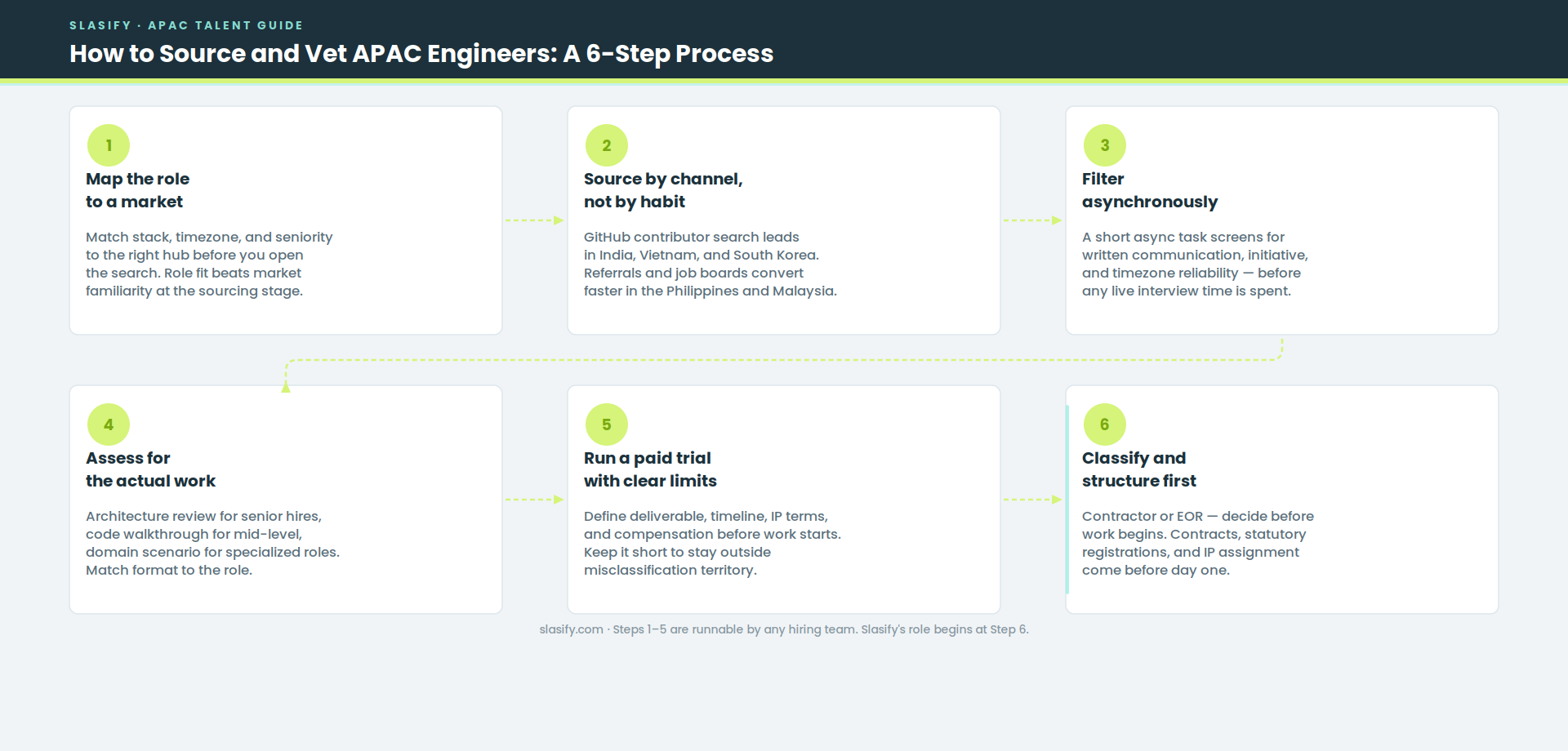
Step 1: write a scorecard before a job description
Define four or five outcomes for the first 6-12 months, the required stack, seniority evidence, language needs, and the minimum working-hour overlap. Separate your real requirements from situational preferences.
Step 2: open two or three focused channels
Use a mix that matches the role:
- GitHub contributors and maintainers in the relevant language or project domain
- LinkedIn and local job boards, filtered by city, stack, and recent scope
- Employee and developer-community referrals
- University, alumni, and experienced-hire communities for targeted pipelines
- A specialist recruiting agency when local reach or high-volume coordination can be worth the cost
If you need a recruiting partner to headhunt, source, or screen candidates, our guide to cross-border hiring explains how recruiting and EOR fit together across the full hiring lifecycle.
Step 3: screen for evidence and not resume pattern
For each interview, ask every candidate the same role-relevant questions. A 30-minute screen can cover a production decision, tradeoff, actual ownership, and required communication scenario. Don't infer technical ability from employer brand, nationality, accent, or school credentials.
Step 4: use a structured technical loop
Keep the loop compact with the following:
- Architecture or debugging discussion tied to your environment
- Code review or work-sample task that resembles the job
- Collaboration interview using a shared rubric
- Final conversation on scope, hours, compensation, and employment model
Score independently before the panel debrief, which helps to reduce memory bias and stops one confident interviewer from rewriting the evidence.
Step 5: make any trial short, paid, and compliant
A paid trial should have a defined deliverable, time limit, compensation, confidentiality terms, IP language, and a classification review before work starts. It should not become several weeks of employee-like labor outside payroll. When local rules make a pre-hire trial unsuitable, use a synthetic exercise instead of production work.
Step 6: manage calendar time
SmartRecruiters' platform data reports a 48-day median technology hiring time, 26% slower than its all-industry benchmark. Teams hiring AI talent moved 11 days faster. Employers should reserve interview slots before sourcing, give feedback within 24-48 hours, and assign compensation and legal-model approval before the finalist stage.
GitHub contributor density points clearly to which channel to prioritize first: in India, Vietnam, and South Korea, targeting maintainers and contributors in your specific stack outperforms broad LinkedIn searches. In the Philippines, Malaysia, and Indonesia, English-first job boards and referrals convert faster as the developer community's footprint sits on different platforms.
The Head of Operations at Astro Malaysia Holdings Berhad, after expanding across Vietnam, Philippines, Indonesia, and Malaysia:
"Slasify helped us scale in Vietnam, Philippines, Indonesia, and Malaysia. Their local knowledge and execution saved us time and costs."
— Head of Operations, Astro Malaysia Holdings Berhad
6. Onboard and Pay APAC Developers Compliantly
The 90 days after offer acceptance are where most compliance failures begin. The following covers the key requirements across contracts, registration, payroll cadence, and remote-work expectations.
Quick reference: market compliance requirements
|
Market
|
Contract language
|
Payroll cycle
|
Key pre-payroll registration
|
|
Singapore
|
English accepted
|
Monthly
|
CPF enrollment before first payment
|
|
Philippines
|
English standard
|
Semi-monthly
|
SSS, PhilHealth, Pag-IBIG before payroll
|
|
Vietnam
|
Vietnamese or bilingual
|
Monthly
|
VSS within 30 days of start date
|
|
Indonesia
|
Indonesian or bilingual
|
Monthly
|
BPJS within 30 days of start
|
|
Malaysia
|
English accepted
|
Monthly
|
EPF, SOCSO, LHDN before first payroll
|
|
Japan
|
Japanese/bilingual in practice
|
Monthly
|
Shakai Hoken at employment start
|
|
South Korea
|
South Korea standard
|
Monthly
|
NPS and NHI at employment start
|
|
Taiwan
|
Traditional Chinese standard
|
Monthly
|
Labour Insurance and NHI enrollment
|
|
Hong Kong
|
English/Chinese both accepted
|
Monthly
|
MPF within 60 days of start
|
Contracts in local form
Vietnam and Indonesia require local-language or bilingual contracts; an English-only agreement carries enforceability risk and has been challenged in Vietnamese courts. In Japan, bilingual contracts are standard in practice even when not legally required. Every contract should go through local legal review before it goes to the candidate.
Statutory registration before your first payroll
Registration deadlines vary by market and are strictly enforced.
- Singapore requires CPF Board enrollment before the first salary payment.
- Malaysia requires EPF, SOCSO, and LHDN (the tax authority) enrollment before the first payroll run per KWSP.
- Vietnam requires social insurance registration within 30 days of the employment start date per Decree 158/2025/ND-CP. For companies using an employer of record in Vietnam, the EOR handles this registration on your behalf. Missed deadlines can trigger back-contributions and penalties.
Payroll cadence
Most markets run monthly payroll; the Philippines and Indonesia run semi-monthly. Most require payment before any public holiday that falls on payday. A single APAC-wide cut-off date will not hold, so you need to set cycles country by country.
WFH and collaboration expectations
Asian markets average 0.5 to 1 day of remote work per week, compared to 1.5 to 2 days in the US, UK, and Australia, according to the Stanford SIEPR 2025 Report from WFH Research. If the role is fully remote, employers need to say so explicitly in the offer letter and confirm the registered work location reflects that in the contract.
If you are looking to build a remote team, our onboarding remote employees guide provides market-specific requirements, compliance checklist, and exact steps to follow, from contract issuance through your first payroll run.
7. How We Support APAC Hiring After You Choose the Candidate
Our role starts once you've identified the candidate, whether that means employment through our EOR, contractor management, or payroll support in a market where you already have your own entity. Specifically:
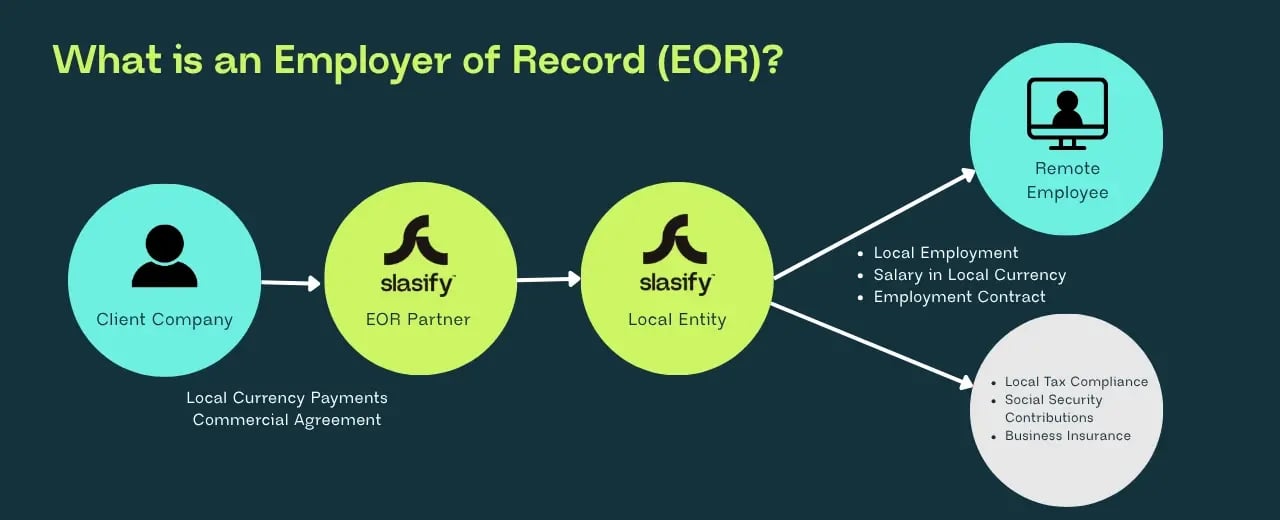
- Hire through EOR without first setting up a local entity, starting from USD 250 per employee per month
- Use Global Contractor Management for properly classified independent work
- Localize contracts, payroll, statutory contributions, benefits, onboarding, and offboarding
- Pay across 130+ currencies and coordinate a workforce spanning 150+ countries through 600+ local partners
- Work with a dedicated named account manager from day one to get coverage across mainland China, Taiwan, Japan, South Korea, and every other APAC market
We also hold ISO 27001 certification and have been recognized by KPMG, HRFlag, and Gitex for our work in global HR.
The Director of Engineering at Compass, after scaling their engineering team across APAC markets:
"They've made it easy to scale our engineering team globally – fast, affordably, and responsively."
— Director of Engineering, Compass
8. FAQ
Q1: Where is the best place to hire offshore developers in 2026?
It depends on your priorities. For English proficiency, the Philippines (#28 EF EPI 2025) and Malaysia (#24) lead Asia. For cost-to-talent ratio, Vietnam and India lead. For semiconductor and embedded software, Taiwan. For AI and ML depth, India and South Korea. The right market combines your stack, time zone, budget, and compliance tolerance.
Q2: How much does it cost to hire offshore developers in APAC?
The employer's all-in annual cost runs from roughly USD 27,000 in Vietnam to USD 120,000+ in Singapore, including salary, statutory contributions, and an EOR fee. Vietnam and Philippines mid-level salaries run USD 20,000–25,000 per year. For reference, the employee's total compensation for a Singapore-based software engineer runs USD 62,000–122,000 (p25–p75), according to levels.fyi.
Q3: Can I pay an offshore developer as a contractor instead of an employee?
Yes, but only if the arrangement stays genuinely independent: a defined scope, a non-exclusive relationship, and the developer controlling their own hours. Once they work fixed schedules under your direction, most APAC labor authorities treat it as employment, and Vietnam and the Philippines enforce this actively. See our contractor misclassification guide for the trigger criteria.
Q4: How do I hire a developer in Vietnam or the Philippines without a local entity?
An Employer of Record handles this directly. The EOR becomes the legal employer in-country, issues the locally compliant employment contract, registers statutory programs, and processes payroll. Onboarding in Vietnam and the Philippines typically takes around 2 weeks from contract signature. Talk to our local EOR experts to confirm the timeline for your market.
Q5: Who owns the IP when I hire developers overseas?
IP ownership depends on the employment contract and local law. Under EOR employment, IP created in the course of work typically vests in the employer by statute across most APAC markets, provided the contract makes assignment explicit. Contractor arrangements are weaker, and IP clauses are harder to enforce in Vietnam and Indonesia for ongoing and directed work.
Q6: How long does it take to hire and onboard an APAC developer?
Sourcing through offer acceptance typically takes 5 to 7 weeks. EOR onboarding in Vietnam and the Philippines takes around 2 weeks from contract signature to statutory registration and first payroll. South Korea and Japan can take slightly longer due to NPS and EPI enrollment. Our cross-border recruitment solution guide covers the full lifecycle and tips to hire overseas.
Q7: How does Slasify help companies hire developers across APAC compliantly?
We handle everything from employment contract to first payroll once you have selected your candidate. We are not a recruiter; we are the employment infrastructure. We issue the locally compliant agreement, register statutory programs, process payroll in local currency, and assign a named account manager from day one.
Your Next APAC Hire Starts Here
APAC is not a single low-cost hiring map. It covers several distinct developer and engineering markets, each with its own talent profile, cost structure, and compliance footprint. Shortlist countries against the role, calculate the full employment cost, validate candidates with comparable evidence, and choose the legal model before work begins.