EMPLOYER INSIGHTS
| Key Takeaways |
| China Plus One means adding capacity elsewhere while keeping the China base. In the Japan External Trade Organization (JETRO) FY2025 survey, 21.3% of Japanese firms in China still planned to expand there, and China was Vietnam's second-largest source of foreign direct investment (FDI) in 2025. |
| US imports from Vietnam rose 42.2% and from Thailand 45.0% in 2025, while imports from China fell 29.9%. Part of that is diversification and part is tariff front-loading. |
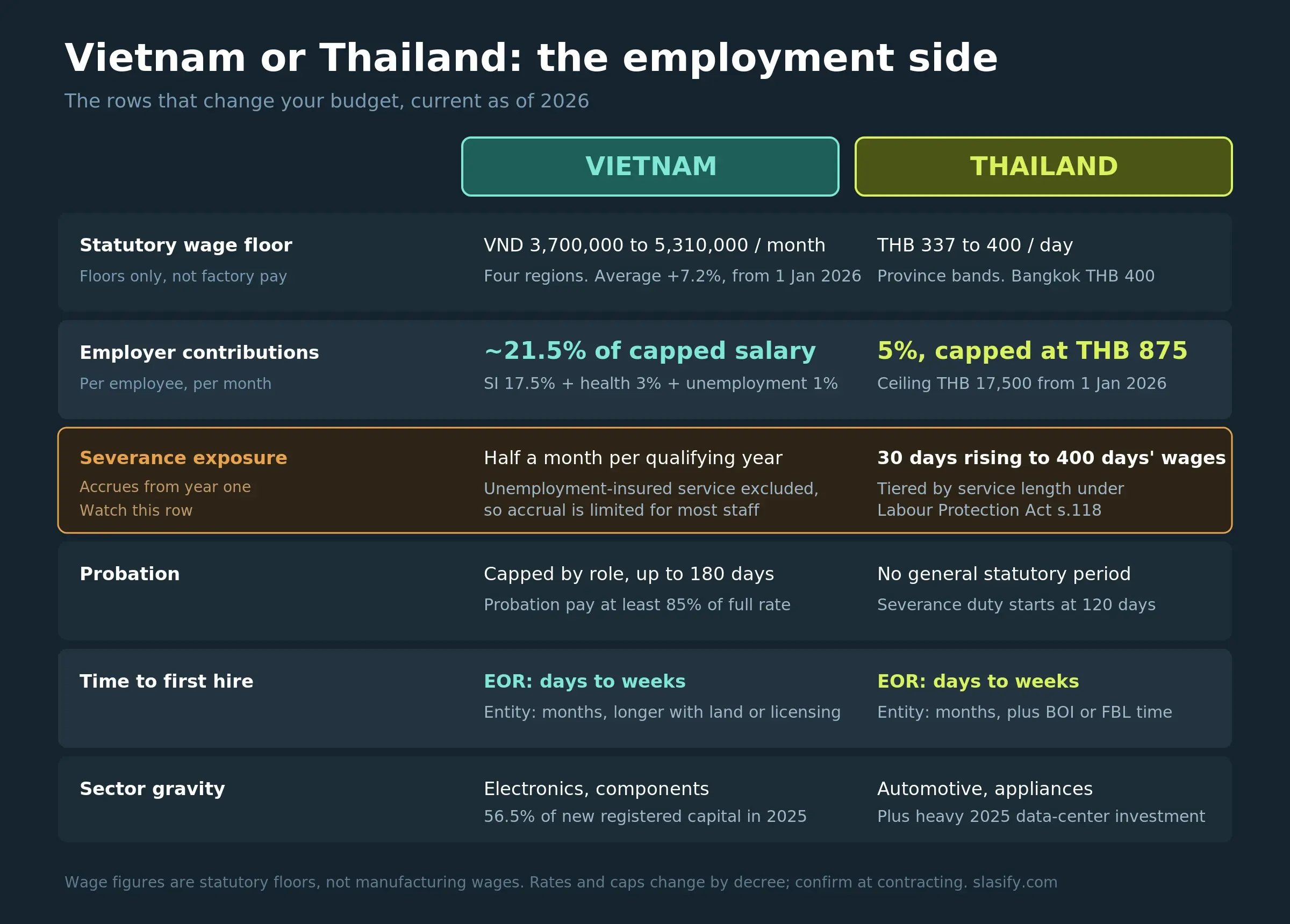
| Wage floors, employer contributions, severance exposure, and probation mechanics differ enough to change your budget and your first employment contracts. |
| Someone has to qualify suppliers, stand up quality assurance, and negotiate with industrial parks months before an entity exists to employ them. |
| An Employer of Record (EOR) puts the advance team on the ground in weeks, so the entity decision gets made later on real information instead of a slide. See how our EOR works → |
The board approved the strategy. Finance modeled the capacity split. Someone has produced a map with a second dot on it, somewhere near Bac Ninh or Rayong. Then the question lands on your desk: who actually goes, and how do we employ them?
Most China Plus One strategy coverage stops at the factory and the freight lane. It tells you the tariff math, the FDI charts, and the industrial park options, and then goes quiet exactly where execution starts. Between the board decision and the first pallet sits a people problem nobody writes about: the advance team.
This piece covers both halves. First, what the verified 2025 and 2026 data actually says about Vietnam and Thailand. Then the part that decides whether your timeline holds: who you hire, in what order, and under what legal structure, through an Employer of Record or your own entity.
1. What is the China Plus One Strategy?
The China Plus One strategy is a manufacturing and sourcing approach in which a company keeps its established China operations and adds production or supplier capacity in at least one additional country, most often in Southeast Asia or India. The term dates to the mid-2000s, when Japanese manufacturers began describing a hedge against over-concentration in a single market.
The goal is to reduce single-country concentration risk across tariffs, logistics, and regulation. In 2026, it is being executed at scale: US imports from Vietnam and Thailand each grew more than 40% in 2025 while imports from China fell roughly 30%. Here are some of 2025's numbers to paint the picture:
Manufacturers that embrace the strategy often make two costly errors: they under-resource the China entity during the transition, when it still carries most of the volume, and they overestimate how fast a second site reaches qualified output.
2. Key Numbers to Watch: 2025 Lookback
Here is what the 2025 data actually shows, with the caveats most headlines skip: what actually shipped, where capital committed, and what companies plan next. The shift is real, and it is smaller than most headlines suggest. The distinctions below explain the gap:
- —Import growth is not pure factory migration: 2025 included substantial tariff front-loading as importers pulled shipments forward ahead of announced rate changes, and a portion of the Vietnam number reflects China-origin goods routed through Vietnam, which is precisely why transshipment rules were tightened. The magnitude is diversification plus front-running.
- —Vietnam's registered FDI was flat: Registered capital rose 0.5%. Disbursed capital, the money that actually moved, rose 9.0% to a five-year high. Anyone citing a 2025 FDI surge without specifying which measure is citing the wrong number. The 56.5% manufacturing share applies only to newly registered capital, not the headline total.
- —Thailand's record BOI year is an application total: Applications are pledges, and roughly 40% of the 2025 value came from digital infrastructure and data centers rather than manufacturing relocation. The manufacturing signal in Thailand is in fact smaller than the +67% headline implies.
| Indicator |
2025 figures |
Sources |
| Trade Flows (what actually shipped) |
| US imports from Vietnam |
USD 193.9B, up 42.2% |
US Census Bureau, full-year 2025 |
| US imports from Thailand |
USD 91.3B, up 45.0% |
US Census Bureau, full-year 2025 |
| US imports from China |
USD 308.7B, down 29.9%, and down about 43% from the 2018 peak |
US Census Bureau, full-year 2025 |
| Investment Committed (where capital went) |
| Vietnam FDI, registered |
USD 38.42B, up 0.5% |
National Statistics Office (NSO) of Vietnam via VNA, Jan 2026 |
| Vietnam FDI, disbursed |
USD 27.62B, up 9.0%, highest of 2021 to 2025 |
Vietnam NSO via VNA, Jan 2026 |
| Vietnam manufacturing share |
USD 9.8B, or 56.5% of the USD 17.32B in newly registered capital across 4,054 new projects |
Vietnam NSO via VNA, Jan 2026 |
| Thailand Board of Investment (BOI) applications |
THB 1,876,653M, up 67%, across 3,370 projects. Digital industry accounted for THB 746,198M, close to 40% of the total |
Thailand BOI, Jan 2026 |
| Forward Intent (what companies plan next) |
| JETRO expansion intent, next 1 to 2 years |
Vietnam 56.9%, Thailand 38.7%, China 21.3%; ASEAN average 46.8% |
JETRO FY2025 Survey, Asia and Oceania (corrected edition), fieldwork Aug 19 to Sep 17 2025, published Jan 20 2026, corrected Feb 20 2026 |
Import figures are goods imports for consumption, US Census basis, full-year 2025. Vietnam FDI is reported on two different measures and they moved differently in 2025. BOI figures are applications, not realized investment. The JETRO 2025 survey was published in January 2026.
3. The U.S. Tariff Backdrop
Supply chains built around a single country of origin carry a structural vulnerability that extends beyond any particular rate, as the rate can change. In 18 months, the applicable import duty on Vietnamese or Thai goods entering the United States changed 3 times under separate legal authorities.
Vietnam and Thailand draw manufacturers because China's supply chain ecosystem is already established in both. Vietnam's northern industrial clusters, where Samsung, Foxconn, and their supplier chains have operated for a decade, connect to southern China's manufacturing belt via road and rail through Vietnam's northern border crossings; Thailand's Eastern Seaboard, formalized as the Eastern Economic Corridor in 2017, has been the center of Japanese automotive and electronics manufacturing for four decades, with Toyota, Honda, Isuzu, and Mitsubishi all operating in the region.
4. Vietnam or Thailand: The Operational Comparison
Both markets work. The decision comes down to five variables: statutory wage floors, employer contribution rates, severance obligations, probation rules, and time to first compliant hire.
| |
Vietnam |
Thailand |
| Statutory wage floor |
VND 3.7M to 5.31M per month by region (approx. USD 142 to USD 204), four tiers, effective Jan 1, 2026 |
THB 337 to 400 per day by province (Bangkok THB 400 per day, approx. USD 365 per month), effective Jul 1, 2025 |
| Employer social contributions |
~21.5% of salary (SI 17.5%, HI 3%, UI 1%), contribution base capped (Vietnam Social Security) |
SSF 5% of salary, capped at THB 875 per month per party, effective Jan 1, 2026 |
| Severance exposure |
0.5 month per year of service for employees with at least 12 months' tenure; service periods covered by unemployment insurance are excluded, limiting accrual for most staff hired after 2009 (Labor Code 2019, Art. 46) |
Tiered: 30 days at under 1 year to 400 days at 20-plus years (Labour Protection Act s.118) |
| Probation |
Up to 60 days for professional roles; up to 180 days for senior management. Pay must be at least 85% of agreed wage. (Labor Code 2019, Art. 25-27) |
No statutory maximum. Market convention is up to 119 days; severance obligations under the Labour Protection Act begin at 120 days of uninterrupted service |
| Time to first compliant hire |
1-2 weeks |
1-2 weeks |
| Sector gravity |
Electronics and tech manufacturing; northern clusters anchored by Samsung, Foxconn, Luxshare |
Automotive, appliances, and data centers; EEC region anchored by Toyota and Honda ecosystem |
Note: USD conversions use approximate interbank rates (September 6, 2026: ≈VND 26,060 per USD 1; THB 32.92 per USD 1). Statutory wage floors are legal minimums; manufacturing pay in industrial zones typically runs 20 to 40% above the floor. SSF rate and cap confirmed via the Thailand Social Security Office, effective Jan 1, 2026. Vietnam contribution basis confirmed via Social Insurance Law 2024, effective Jul 1, 2025; severance and probation rules are from Vietnam's Labor Code 2019.
Two figures most budget models miss
Vietnam's 21.5% contribution rate applies from the first contract and compounds against every salary increase. Thailand's severance accrues silently: a long-tenured employee costs up to 400 days' wages to exit, but models built in year one rarely carry that liability forward. Run both figures against your offer salary before the first letter goes out, not after headcount is established.
Sector fit
Common team deployment mistakes
Manufacturers usually run into this in one of two bad ways. Either they fly people in on repeated short trips under visa arrangements that were never designed for it (also adding inefficient cost), or they engage "consultants" who direct daily work, use company systems, and report to a company manager. The consultant route is most likely an employment relationship wearing a contractor label, which can easily expose you to misclassification risks in both markets.
The table below shows the typical advance team by role and timeline, whether you are using an Employer of Record (EOR), contractor management, or building your own legal entity:
| Role |
What they do in the first six weeks |
When to hire |
| Country manager |
Owns the market entry strategy, negotiates with industrial park operators and local authorities, then becomes the escalation point for everything |
Month 0 to 1, before site selection |
| Supplier-quality engineer |
Audits candidate suppliers, runs first-article inspections, builds the qualification pipeline |
Month 0 to 2, in parallel with sourcing |
| Sourcing lead |
Identifies and negotiates with tier-two and tier-three suppliers, benchmarks against the China cost base to keep a healthy and profitable cost structure |
Month 1 to 2 |
| Supply-chain coordinator |
Maps inbound logistics, customs brokerage, bonded warehousing, and the China-to-new-site component flow |
Month 1 to 2 |
| HR and admin lead |
Prepares the local hiring plan, wage banding, and the employment terms the entity will inherit; works with EOR and contract management partners |
Months 3 to 6, ahead of ramp |
Note: Role sequencing varies with whether you are building your own plant or contracting production. The contract-manufacturing route usually weighs the first three roles more heavily.
6. The Staffing Sequence for China Plus One Strategy
In a China Plus One expansion, getting the sequence right matters as much as moving fast. Here is the typical progression:
| Phase |
Action |
Structure |
Typical duration |
| 1. Decision |
Board approves added capacity; country shortlist narrowed to a small selection |
None |
Varies from weeks to months |
| 2. Advance team live |
Country manager and quality engineer employed and in-country |
EOR |
Typically days to two weeks (varies by country and your needs) |
| 3. Groundwork |
Supplier audits, site visits, cost validation against real quotes |
EOR |
Month 1 to 6 |
| 4. Entity decision |
Using validated data, decide on incorporation based on expansion or regulatory needs |
EOR |
Month 4 to 8 |
| 5. Scale or stay lean |
Ramp under an entity, or keep a lean team under EOR until the proven business result justifies expansion |
EOR or own entity |
Month 6 onward |
Note: Durations are typical ranges from cross-border expansions we support and vary with sector, licensing, and site complexity.
EOR vs. own entity
An Employer of Record is a company that legally employs workers on behalf of a client business in a country where that business has no entity. The EOR issues the compliant local contract, runs payroll, withholds tax, and files social contributions.
The entity question then becomes a real decision rather than a default. An entity earns its cost once headcount is durable, once you need to hold assets, import under your own name, or apply for investment promotion, and once you can absorb ongoing filing and audit obligations. Below that threshold, an EOR carries the same compliance obligations without the setup cycle.
Our comparison of the best EOR platforms for emerging markets in 2026 covers provider selection and how our global payroll solution handles the multi-currency need when you are running two or three payrolls at once.
7. Where Manufacturers Get This Wrong
There are five failure patterns that show up repeatedly in China Plus One moves, and all five are avoidable.
- —The consultant who is an employee: Fixed monthly fee, full-time hours, company email, a manager who sets priorities. Both Vietnam and Thailand assess the substance of the relationship instead of the label on the invoice. Reclassification brings back contributions, penalties, and in some cases, the full employment history.
- —Budgeting on minimum wages: Statutory floors are a comparison tool and nothing more. Manufacturing wages in industrial zones sit well above them, and the engineers and managers on your advanced team are nowhere near the floor.
- —Using outdated Thailand SSF figures: The SSF rate itself has not changed, but the wage ceiling rose from THB 15,000 to THB 17,500 on 1 January 2026, lifting the employer maximum from THB 750 to THB 875 per month. Most English-language guides covering Thailand employment costs have not been updated, so a budget built from a search result will understate the actual contribution. Here is our guide for Thailand's 2026 SSC rates.
- —Ignoring Thai severance accrual: The tiers run to 400 days' wages. This obligation builds from the first year and is a provision instead of a contingency.
- —Assuming the China side winds down: It usually does not, at least not on the schedule in the plan. Budget the China entity for continuity through the transition, and read our China employment guide with the assumption that it stays load-bearing for longer than the slide says.
8. How We Staff a China Plus One Move
We are structurally neutral on the China question, because we operate on both sides of it. We run our own entity in Vietnam, with our own team on the ground and a business delegation program that puts us in front of local authorities and operators directly. We support Thailand through established local partners. And we operate a mainland China entity in Xiamen, which means we have no interest in selling anyone an exit.
Our EOR, global payroll, and contractor management services cover the employment, payroll, and compliance layer in 150+ countries, across 130+ currencies, through 600+ local partners, for 900+ companies.
Our information security practices are ISO 27001 certified, which matters when payroll data for three jurisdictions moves through one system.
"Slasify helped us scale in Vietnam, Philippines, Indonesia, and Malaysia. Their local knowledge and execution saved us time and costs."
— Head of Operations, Astro Malaysia Holdings Berhad
For the country-level detail your finance team will ask for, our Vietnam employment guide and Thailand employment guide cover contracts, contributions, and termination rules in each market, and our breakdown of Vietnam's payroll system goes deeper on the contribution mechanics.
9. FAQ: China Plus One Strategy

Q1. What is the China Plus One strategy?
It is a strategy of keeping your China operations and adding manufacturing or sourcing capacity in at least one other country. The aim is to reduce concentration risk across tariffs, logistics, and regulation rather than to relocate. Vietnam, Thailand, India, Malaysia, and Mexico are the most common additions. The label dates to the mid-2000s, coined by Japanese manufacturers; the 2026 execution wave is broader and faster.
Q2. Which countries benefit most from China Plus One?
Vietnam and India lead on investor intent, with Indonesia and Thailand close behind among JETRO's Asia and Oceania markets. In the JETRO FY2025 survey, India led all markets at 81.5%; Vietnam followed at 56.9%, Indonesia at 70.9%, and Thailand at 38.7%. Sector fit is the more useful guide here, since electronics gravitate to Vietnam, automotive and appliances to Thailand.
Q3. Is China Plus One still relevant in 2026?
Yes, and the driver has shifted from labor cost to policy risk. Four different US tariff regimes applied to Vietnam and Thailand between August 2025 and July 2026 alone. Concentration in any single jurisdiction carries variance that a diversified footprint absorbs better. The shift explains record BOI applications in Thailand and five-year-high disbursed FDI in Vietnam last year.
Q4. Should we choose Vietnam or Thailand for manufacturing expansion?
Follow your bill of materials, then price the employment side before you commit. Vietnam has denser electronics and component supplier networks and took 56.5% of newly registered capital into manufacturing in 2025. Thailand has three decades of automotive and appliance supply depth. On employment costs: Vietnam runs roughly 21.5% in employer contributions; Thailand's SSF cap is THB 875 per month, with severance tiers reaching 400 days' wages as the larger long-run exposure.
Q5. Can we hire staff in Vietnam or Thailand before we set up an entity?
Yes, through an Employer of Record, and this is the standard approach for an advance team. The EOR holds the local employment contract, runs payroll, and files social contributions while your managers direct the work. Setup takes days to weeks. If you need to hire employees in Vietnam or hire employees in Thailand before your entity exists, you identify the person; we handle the legal employment from week one.
Q6. What does it cost to employ someone in Vietnam versus Thailand?
Budget the full loaded employment cost, not just the headline salary. Vietnam adds roughly 21.5% in employer social, health, and unemployment contributions on a capped salary base. Thailand's SSF is capped at THB 875 per month from 1 January 2026, which is lower at senior salary levels; the larger liability is severance accrual reaching 400 days' wages. Statutory wage floors are not the right input for engineering or management roles.
Q7. Does China Plus One mean pulling out of China?
No, and the data points the other way. In the JETRO FY2025 survey, 21.3% of Japanese firms in China still planned to expand there, and China was Vietnam's second-largest FDI source in 2025. The China base carries volume while a second site absorbs new demand. Plans built on a fast China wind-down consistently miss on both timing and cost.
Build Your Own Advance Team Today
The 12 months between board approval and qualified output are where China Plus One execution plans break, and the common thread is the advance team not being on the ground soon enough. We can have your country manager and quality engineer legally employed in Vietnam or Thailand in weeks, so the entity decision gets made on real information.